
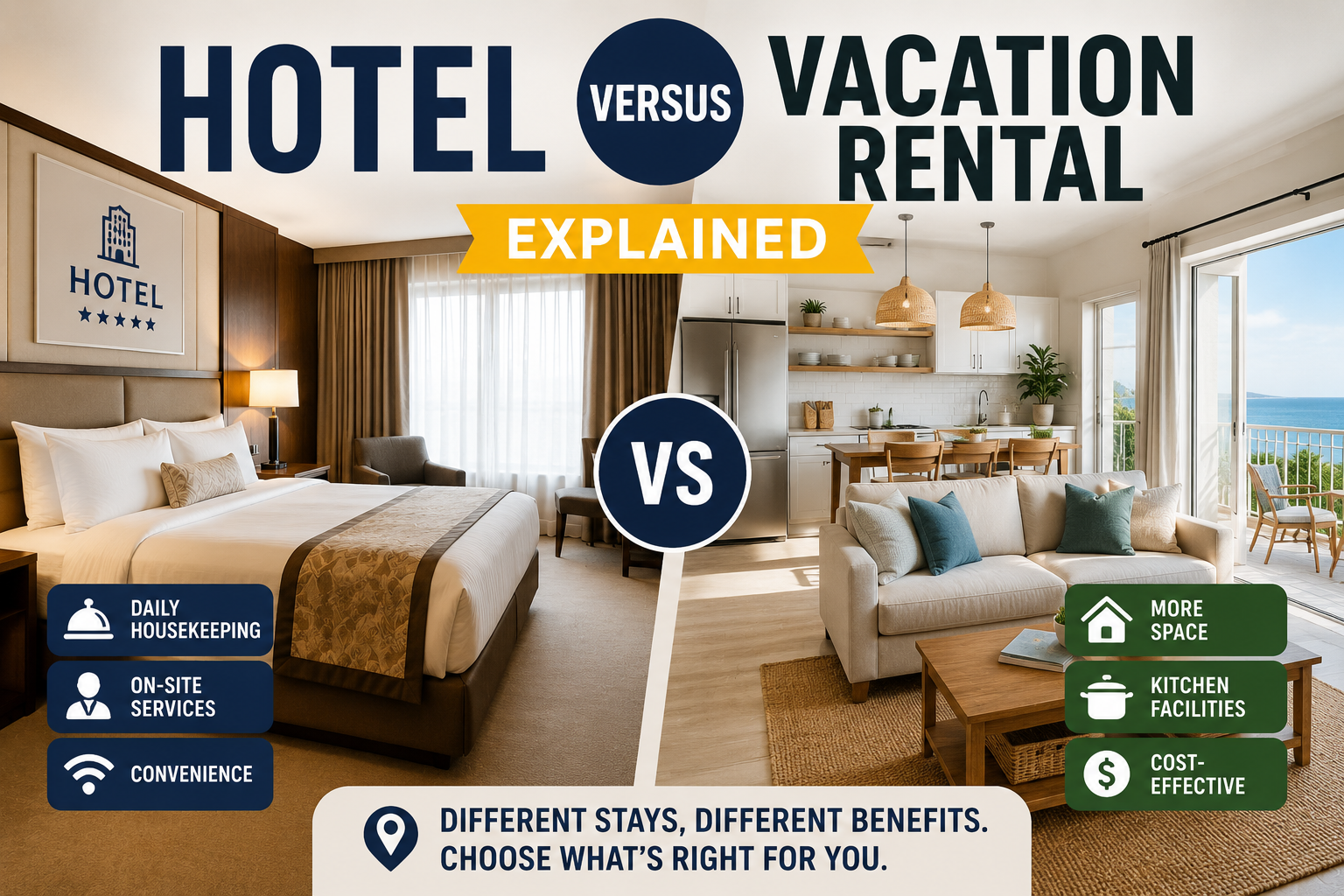
Hotel Versus Vacation Rental Explained
Choosing where to stay can have a major impact on a trip. Hotels and vacation rentals offer very different experiences, and the better choice depends on factors such as trip length, budget, privacy, location, and how much space or flexibility you need.
A hotel may be ideal for a short city break when convenience matters most. A vacation rental can make more sense for families or groups who want a kitchen, separate bedrooms, and a more residential experience.
Understanding the differences can make it easier to choose accommodation that fits both your travel plans and your budget.
What Is a Hotel?
A hotel is a professionally operated accommodation property that typically offers individual rooms or suites along with shared facilities and services.
Depending on the property, guests may have access to amenities such as:
- Daily or scheduled housekeeping
- Front-desk assistance
- Restaurants and room service
- Swimming pools
- Fitness centers
- Business facilities
- Laundry services
- Parking
- Concierge services
Hotels range from basic budget properties to luxury resorts, so the level of service and amenities can vary significantly.
One of the biggest advantages of staying in a hotel is convenience. Guests generally do not have to manage the property themselves, making hotels particularly attractive for short trips.
What Is a Vacation Rental?
A vacation rental is a privately owned or professionally managed property rented to travelers for a temporary stay.
Vacation rentals can include:
- Apartments
- Condos
- Houses
- Villas
- Cottages
- Cabins
- Townhouses
Unlike a conventional hotel room, a rental often provides a larger living area and facilities designed for everyday use.
Many properties include kitchens, laundry machines, living rooms, dining areas, and multiple bedrooms.
This can make vacation rentals particularly appealing for families and groups traveling together.
Hotel Versus Vacation Rental: The Biggest Differences
The most important differences usually involve space, service, privacy, flexibility, location, and total cost.
| Factor | Hotel | Vacation Rental |
|---|---|---|
| Space | Usually smaller | Often larger |
| Housekeeping | Commonly available | Often limited or self-managed |
| Kitchen | Usually unavailable or limited | Often included |
| Privacy | Shared property | More private |
| Front desk | Common | Usually unavailable |
| Long stays | Can become expensive | Often more practical |
| Families | Depends on room size | Often convenient |
| Groups | Multiple rooms may be needed | One property may accommodate everyone |
| Amenities | Often extensive | Varies by property |
| Daily flexibility | High | Often high, but property rules apply |
Neither option is automatically better. The right choice depends on what matters most during the trip.
When a Hotel Makes More Sense
Hotels tend to work particularly well for travelers who value convenience and service.
Short Trips
For a one- or two-night stay, a hotel can be easier than arranging an entire rental property.
There may be no need to shop for groceries, clean the accommodation, or manage check-in instructions beyond what the hotel requires.
Business Travel
Hotels can be especially useful for business travelers who need reliable services and convenient locations.
A hotel near a conference center, airport, business district, or major transportation hub can save valuable travel time.
Travelers Who Want Daily Service
Some travelers simply prefer having housekeeping, reception staff, and other services available.
With a hotel, problems such as a missing towel, room issue, or maintenance request can generally be directed to staff.
Central Locations
Hotels are often concentrated in popular tourist districts, downtown areas, and near transportation hubs.
This can make them convenient for travelers who want to spend most of their time exploring a city rather than staying inside the accommodation.
When a Vacation Rental Makes More Sense
Vacation rentals can be particularly attractive when travelers need more space or independence.
Families With Children
A rental with multiple bedrooms can provide parents and children with separate sleeping areas.
Having a kitchen can also make it easier to prepare meals, store snacks, and maintain familiar routines.
Larger Groups
A group traveling together may find it more convenient to rent one larger property rather than reserve several hotel rooms.
A shared living room and kitchen can also create a more social environment.
Longer Stays
For stays lasting a week or longer, the additional space and household facilities of a rental can become increasingly valuable.
Being able to cook meals and do laundry at the property may reduce some everyday travel expenses.
Travelers Seeking Privacy
A standalone house or apartment can provide a level of privacy that is difficult to achieve in a traditional hotel.
There may be no shared hallway immediately outside the bedroom and no need to use common hotel facilities.
Comparing the Total Cost
Price is one of the most important factors, but the advertised nightly rate does not always tell the whole story.
Hotels may include taxes, resort fees, parking charges, breakfast costs, or other expenses depending on the property.
Vacation rentals can have additional charges such as cleaning fees, service fees, deposits, taxes, or other property-specific costs.
For this reason, travelers should compare the total price for the entire stay, rather than simply comparing nightly rates.
A rental that appears cheaper initially may not remain cheaper after additional fees are included.
At the same time, a larger rental can provide better value for a family or group because several travelers can share the cost of one property.
Which Option Offers More Space?
Vacation rentals generally have the advantage when it comes to living space.
A typical hotel room may provide a bedroom and bathroom, while a rental property could include several bedrooms, a kitchen, a living room, and outdoor space.
For couples traveling alone, the additional space may not justify the extra cost.
For families or groups, however, having multiple rooms can significantly improve comfort.
Which Option Is More Convenient?
Hotels generally have the edge in convenience.
A hotel may offer reception services, housekeeping, luggage storage, room service, on-site dining, and assistance with transportation or local recommendations.
Vacation rentals can provide more independence, but guests may have to handle certain tasks themselves.
Check-in may involve a key box or digital lock, while communication with the property manager may take place remotely.
For travelers who want a straightforward experience with minimal responsibilities, a hotel may be the better fit.
Which Option Is Better for Cooking?
Vacation rentals usually win when cooking facilities matter.
A fully equipped kitchen can allow travelers to prepare breakfast, pack lunches, or cook dinner instead of eating at restaurants for every meal.
This can be particularly useful for families, people with specific dietary requirements, and travelers staying for extended periods.
Hotels may offer refrigerators, microwaves, or small kitchenettes in some rooms, but these facilities vary widely.
Which Option Offers More Privacy?
Vacation rentals can provide greater privacy, particularly when the property is an entire house or apartment.
Hotels, by contrast, are shared buildings with common hallways, elevators, lobbies, and other facilities.
That does not mean hotels cannot be private or comfortable. However, travelers seeking a residential setting or private outdoor space may prefer a rental.
What About Housekeeping?
Hotels generally provide more predictable housekeeping services.
The frequency varies by property and booking, so travelers should check what is included rather than assuming daily service.
Vacation rentals may include cleaning before and after a stay but may not provide daily housekeeping.
Guests may therefore be expected to keep the property reasonably tidy during their stay and follow checkout instructions.
Which Is Better for Families?
There is no universal answer, but vacation rentals often have practical advantages for families.
A larger property can provide:
- Separate bedrooms
- Kitchen facilities
- Laundry
- More living space
- Dining areas
- Outdoor areas
- Greater flexibility
Hotels can still be excellent for families, particularly when they offer suites, connecting rooms, children’s facilities, pools, restaurants, or other family-oriented amenities.
The decision often comes down to whether the family values services and amenities or additional private living space.
Which Is Better for Couples?
For couples taking a short getaway, a hotel can offer an easy and comfortable experience.
A well-located hotel may put restaurants, attractions, entertainment, and transportation within easy reach.
For longer romantic stays, however, a private rental may offer more space and a quieter atmosphere.
The ideal choice depends largely on the destination and the type of trip.
What Should You Check Before Booking a Vacation Rental?
Vacation rentals can vary considerably from one property to another.
Before booking, check:
- Exact location
- Total price
- Cancellation policy
- Check-in process
- Number of bedrooms
- Number of bathrooms
- Kitchen equipment
- Parking arrangements
- Internet availability
- Cleaning requirements
- House rules
- Guest capacity
- Reviews from previous guests
Photos can also be useful, but they should not be the only source of information. Read the property description carefully and pay attention to recent guest feedback.
What Should You Check Before Booking a Hotel?
Hotel travelers should also look beyond the headline price.
Important considerations include:
- Room size
- Location
- Parking costs
- Breakfast options
- Wi-Fi
- Housekeeping policies
- Check-in and checkout times
- Resort or facility fees
- Cancellation rules
- Available amenities
- Accessibility
- Guest reviews
Location deserves particular attention. A slightly more expensive hotel may ultimately save money if it reduces transportation costs and travel time.
Hotel or Vacation Rental: Which Is Cheaper?
There is no universal winner.
A hotel may be cheaper for a solo traveler or couple staying for one or two nights. A vacation rental may provide better value for a larger group sharing a property over several days.
The calculation should account for all costs, including:
Accommodation + taxes + fees + transportation + food + parking + other required expenses
For example, a rental with a kitchen could potentially reduce restaurant spending, while a hotel located close to major attractions could reduce transportation costs.
The cheapest accommodation on paper is not necessarily the cheapest option for the entire trip.
Safety and Reliability Matter
Whatever type of accommodation you choose, safety and reliability should be part of the decision.
Look for established properties, clear booking information, transparent pricing, and credible reviews.
Travelers should also understand the cancellation and refund policies before paying.
For vacation rentals, it is particularly important to understand who manages the property and how guests can get help if a problem occurs.
Hotels generally have on-site staff, which can be an advantage when immediate assistance is important.
The Best Choice Depends on the Trip
Rather than asking whether hotels are better than vacation rentals, travelers should ask which accommodation matches the specific trip.
Choose a hotel when you prioritize:
- Convenience
- Housekeeping
- Front-desk assistance
- Short stays
- Central locations
- On-site amenities
- Business travel
Consider a vacation rental when you prioritize:
- Space
- Privacy
- Kitchens
- Multiple bedrooms
- Longer stays
- Family travel
- Group travel
- A residential experience
The best accommodation is ultimately the one that provides the right combination of comfort, convenience, location, and overall value.
Choosing Accommodation That Fits Your Travel Style
Hotels and vacation rentals serve different needs, and neither should be treated as a one-size-fits-all solution.
A hotel can simplify a short trip by putting services and amenities at your fingertips. A vacation rental can make a longer or group trip feel more like living in the destination, with additional space and everyday facilities.
Before booking, compare the complete cost, location, available amenities, property rules, and your actual needs for the trip. A few extra minutes spent evaluating those factors can help prevent accommodation from becoming an unexpected source of stress—or expense—once the journey begins.





2 Comments
Micle harison
June 7, 2019Lorem ipsum dolor sit amet, usu ut perfecto postulant deterruisset, libris causae volutpat at est, ius id modus laoreet urbanitas. Mel ei delenit dolores.
John Doe
June 7, 2019Some consultants are employed indirectly by the client via a consultancy staffing company.