
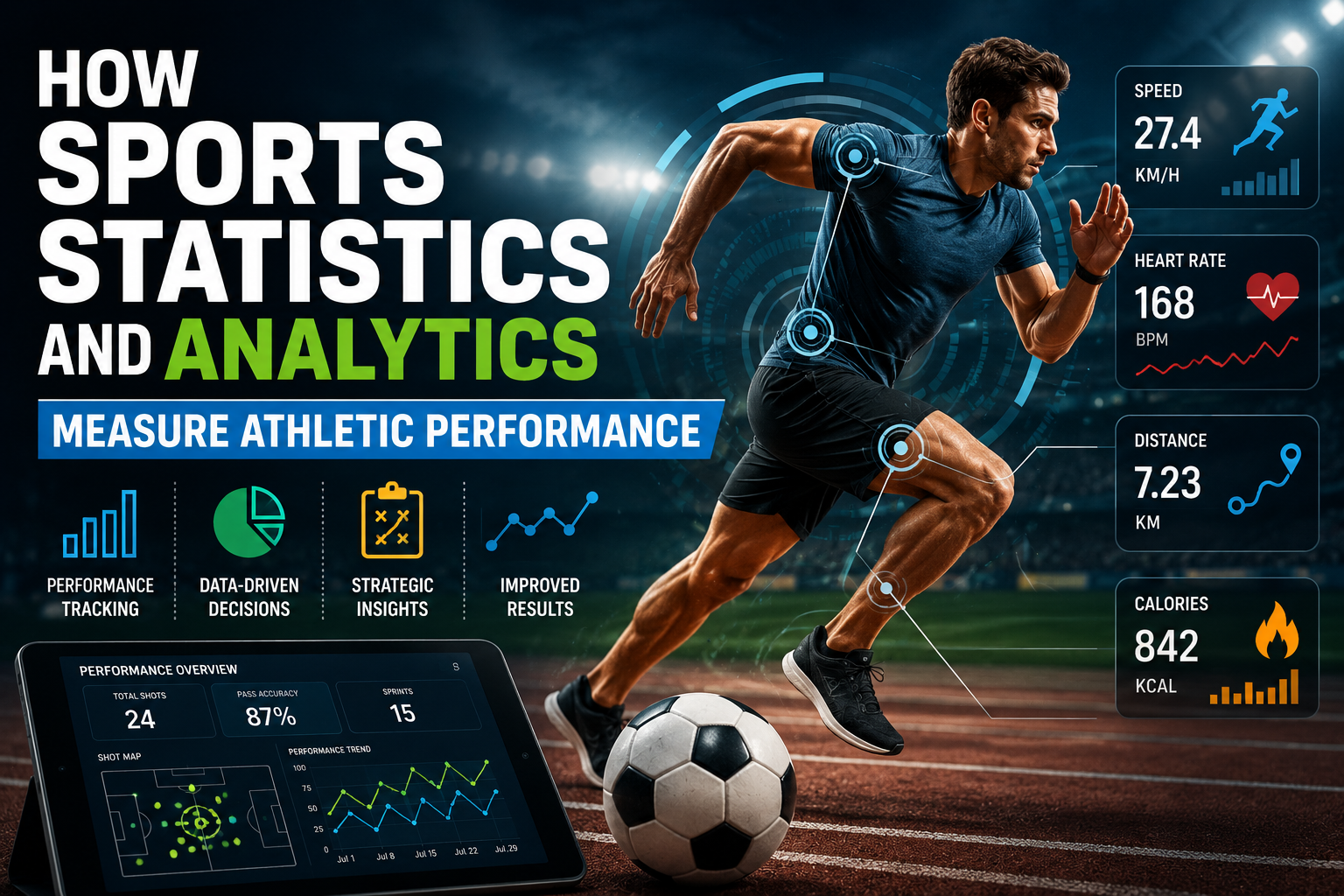
How Sports Statistics and Analytics Measure Athletic Performance
Sports have always produced numbers.
Goals, points, assists, rebounds, runs, wins and losses have traditionally provided simple ways to measure what happens during a game. But modern sports analytics has transformed those basic statistics into a much more detailed picture of athletic performance.
Today, coaches, athletes, scouts and teams can analyze everything from sprint speed and shot selection to workload, positioning, decision-making and efficiency. Advanced technology has made it possible to collect enormous amounts of information during training and competition, helping sports organizations understand not just what happened, but also why it happened.
The result is a more sophisticated approach to measuring performance—one that combines traditional statistics, advanced metrics, video analysis and physical tracking.
Why Sports Statistics Matter
At their simplest, statistics turn individual events into measurable information.
A basketball player’s points, rebounds and assists provide an immediate snapshot of production. A baseball player’s batting average, home runs and strikeouts describe aspects of offensive performance. A soccer player’s goals, assists and passes provide information about their contribution to a match.
These numbers make comparisons possible.
Coaches can evaluate players over time, teams can identify strengths and weaknesses, and fans can compare performances across games and seasons.
But traditional statistics have limitations.
A player can score many points while taking inefficient shots. A soccer player can complete a high percentage of passes without creating meaningful opportunities. A baseball hitter can have a strong batting average while rarely producing extra-base hits.
This is where analytics becomes more valuable.
From Basic Numbers to Advanced Metrics
Sports analytics attempts to provide more context around traditional statistics.
Instead of simply counting events, advanced metrics can consider factors such as efficiency, opportunity, difficulty, game situation and the quality of an opponent.
In basketball, analysts might examine effective field-goal percentage, true shooting percentage, usage rate or player efficiency metrics.
In baseball, statistics such as on-base percentage, slugging percentage, weighted runs created and expected statistics can provide additional insight into offensive performance.
In soccer and football, analysts can evaluate expected goals, progressive passes, possession value, pressure actions and other measures that attempt to quantify contributions that may not appear in the traditional scoreline.
These metrics do not necessarily replace basic statistics. Instead, they add another layer of information.
Efficiency Is Often More Important Than Raw Production
One of the biggest changes in modern sports analysis is the growing emphasis on efficiency.
Consider two basketball players who each score 20 points.
At first glance, their performances appear identical.
But suppose one player takes 12 shots to reach 20 points while the other needs 22 attempts. Their offensive efficiency is clearly different.
The same principle applies across sports.
A baseball player who reaches base frequently may provide more offensive value than a player with a similar batting average but fewer walks. A soccer striker who scores from difficult chances may have a different underlying performance profile from someone who scores primarily from high-quality opportunities.
Efficiency helps analysts determine how much production an athlete generates relative to the opportunities they receive.
Context Can Change the Meaning of a Statistic
Numbers rarely tell the complete story without context.
A player might have fewer points because they faced an elite defender. A pitcher might allow several runs after entering a game with runners already on base. A soccer midfielder might have relatively few assists because teammates failed to convert the chances they created.
Analytics attempts to account for some of these circumstances.
Game state is particularly important.
A performance in a close game can have a different strategic meaning from the same performance during a comfortable lead. A team may deliberately slow down late in a game, for example, changing the statistical profile of its offense.
Understanding context helps prevent analysts from drawing simplistic conclusions from individual numbers.
Tracking Technology Has Changed Performance Measurement
Modern athletes can be monitored using sophisticated tracking systems.
Wearable devices and location-tracking technologies can collect information about movement, acceleration, deceleration, distance covered and changes in speed.
In team sports, tracking systems can also record player positioning throughout a game.
That creates an enormous amount of data.
Instead of knowing only that a soccer player completed 90 minutes and covered a certain distance, analysts can examine where those movements occurred, how frequently the player accelerated and how their positioning changed during different phases of play.
Basketball teams can analyze spacing, defensive positioning and player movement without the ball.
In American football, tracking data can reveal how quickly players move, how routes develop and how defensive formations change.
The athlete becomes measurable not only through what they do with the ball, but also through what happens around them.
GPS and Wearable Sensors Help Measure Physical Workload
Training performance can also be analyzed using wearable technology.
GPS-based systems can track the distance athletes travel and the intensity of their movements. Accelerometers can provide information about changes in speed and physical impacts.
This information can help coaches monitor workload.
An athlete who suddenly experiences a large increase in training intensity may face greater fatigue or injury risk. By comparing workloads over time, teams can adjust training programs and recovery periods.
The objective is not simply to make athletes work harder.
It is to find an appropriate balance between training stimulus, recovery and performance.
Heart Rate Provides Another Window Into Performance
Heart-rate monitoring can help athletes and coaches understand cardiovascular demands.
During training, heart-rate data can indicate how intensely an athlete is working and how quickly they recover after exertion.
Over time, these measurements can help establish individual training zones and evaluate changes in fitness.
Heart rate is not a complete measure of athletic performance, however.
Two athletes can have the same heart rate while performing very different tasks. Environmental conditions, stress, hydration and other factors can also influence readings.
For that reason, heart-rate information is generally most useful when combined with other measurements.
Video Analytics Adds Tactical Context
Numbers can tell analysts what happened, but video can help explain why.
Modern sports teams use video analysis to examine individual movements, tactical decisions and patterns of play.
A basketball coach can review how a defender reacts to screens. A soccer analyst can examine a midfielder’s positioning when the team loses possession. A football coach can evaluate how defensive players respond to different formations.
Video can also be synchronized with statistical and tracking information.
This creates a more complete picture of performance.
An analyst might discover that a player consistently creates space even when they do not receive the ball. Traditional statistics might miss that contribution, while video and tracking data can reveal it.
Expected Statistics Try to Measure Opportunity
One of the most influential ideas in modern sports analytics is the concept of expected performance.
Expected goals in soccer are a well-known example.
Rather than treating every shot as equal, an expected-goals model estimates the probability that a particular chance will result in a goal based on factors such as location, angle and type of opportunity.
A striker who scores two goals from chances worth 0.2 expected goals each may have produced a very different performance from a striker who scores twice from several opportunities worth 1.0 expected goals.
Expected statistics therefore help analysts distinguish between opportunity and outcome.
This can be useful when evaluating whether a performance is likely to continue or whether it may have been influenced by unusual finishing or bad luck.
Baseball Has Become a Laboratory for Analytics
Baseball has long been one of the most statistically driven sports.
Because the game consists of many discrete events, researchers can analyze enormous amounts of data.
Traditional statistics such as batting average, runs and earned-run average remain widely recognized, but modern baseball analysis includes metrics measuring exit velocity, launch angle, pitch movement, spin rate and expected outcomes.
A hitter’s performance can be evaluated based not only on whether a ball became a hit, but also on how hard and at what angle it was struck.
Pitchers can be analyzed through velocity, spin, movement, location and pitch selection.
These measurements help teams identify skills that traditional box-score statistics might overlook.
Basketball Analytics Measures More Than Scoring
Basketball is another sport where advanced analytics has significantly changed evaluation.
Traditional statistics provide information about points, rebounds and assists, but modern analysis can go much deeper.
Teams can measure shooting efficiency, lineup performance, possession outcomes, defensive activity and spacing.
Three-point shooting is a clear example.
Analytics helped demonstrate that the value of a shot depends not only on its probability of going in but also on the number of points it produces when successful.
As teams increasingly recognized the value of efficient three-point shooting, offensive strategies changed across the sport.
This is an example of statistics influencing how the game itself is played.
Soccer Analytics Looks Beyond Goals and Assists
Goals and assists remain the most visible measures of attacking production in soccer, but they represent only a fraction of what happens during a match.
A midfielder can influence a game through ball progression, defensive positioning, pressure, chance creation and possession recovery without scoring or assisting.
Modern tracking and event data allow analysts to quantify some of these contributions.
Metrics can examine progressive passes, carries into dangerous areas, defensive actions and the quality of chances created.
Some analytical models attempt to assign value to individual actions based on how they change the team’s probability of scoring or conceding.
That makes player evaluation increasingly multidimensional.
Defensive Performance Is Particularly Difficult to Measure
Offensive statistics are often easier to understand because successful outcomes are visible.
Defensive performance is more complicated.
A defender’s value may come from preventing an opponent from receiving the ball, forcing a poor shot, closing passing lanes or positioning correctly before an attacking move develops.
The absence of an event can itself be evidence of good defense.
Analytics therefore uses combinations of tracking data, event data and video to estimate defensive impact.
This remains one of the most challenging areas of sports analytics because defensive responsibilities vary significantly by position and tactical system.
Analytics Can Help Identify Talent
Teams increasingly use data when scouting potential players.
Rather than relying exclusively on reputation or traditional statistics, scouts can examine performance across multiple dimensions.
A young athlete might not dominate in one headline statistic but could demonstrate strong underlying indicators of future development.
Teams can compare players from different leagues, age groups or competitive environments using standardized metrics.
However, statistical models cannot eliminate uncertainty.
A player’s performance can change after moving to a stronger league, joining a different tactical system or facing a new level of competition.
Data can improve the decision-making process, but it cannot guarantee that every prediction will be correct.
Analytics Can Improve Training
Performance data is also useful away from competition.
Coaches can identify weaknesses and design training sessions around specific needs.
A runner might discover that their pace deteriorates significantly during the final part of a race. A basketball player might identify inefficiencies in shooting from particular areas. A soccer team might discover that it loses possession too frequently under pressure.
Instead of relying entirely on observation, coaches can use data to identify patterns that deserve attention.
Training can then become more individualized.
The same approach can help athletes understand their own performance and track progress over time.
Injury Prevention Is Another Major Application
One of the most promising uses of sports analytics is monitoring injury risk.
Teams can combine workload data, movement patterns and recovery information to identify unusual changes.
For example, a sudden increase in high-intensity running could signal that an athlete’s training load has changed substantially.
The data does not necessarily predict that an injury will occur. Human bodies are too complex for simple formulas to provide certainty.
But monitoring trends can help medical and performance staff make better-informed decisions about training intensity and recovery.
Statistics Have Limits
Despite the power of modern analytics, statistics should not be treated as perfect representations of athletic ability.
Every metric is based on assumptions.
Different models can produce different results depending on the data included and the methods used.
Sample size also matters. A player can have an extraordinary performance over a handful of games that does not continue over an entire season.
Data quality presents another challenge.
If tracking systems miss movements or event data contains errors, analytical conclusions can become unreliable.
The best sports organizations therefore combine statistical analysis with coaching expertise, scouting, medical information and direct observation.
The Future of Sports Analytics
The next generation of sports analytics is likely to become even more detailed.
Artificial intelligence and machine learning can process enormous datasets and identify relationships that would be difficult for humans to detect manually.
Computer vision can analyze video without requiring every event to be manually recorded. Tracking systems can increasingly capture movement in real time.
Teams could eventually use these technologies to build increasingly sophisticated models of decision-making, fatigue, tactical positioning and performance.
The challenge will be determining which information is genuinely useful.
More data does not automatically produce better decisions.
The most successful teams will likely be those that can transform large quantities of information into a small number of meaningful insights that coaches and athletes can actually use.
Turning Numbers Into Better Decisions
Sports statistics have evolved from simple scorekeeping into a sophisticated science of performance measurement.
Traditional statistics still provide the foundation, but modern analytics adds efficiency metrics, expected outcomes, tracking data, physical measurements, video analysis and increasingly powerful computational models.
Together, these tools can reveal aspects of athletic performance that might otherwise remain hidden.
Yet numbers work best when they complement human judgment rather than replace it. A statistic can identify a pattern, but understanding the reason behind that pattern often requires coaching knowledge, video analysis and an understanding of the athlete’s circumstances.
The future of sports analytics will therefore not simply be about collecting more numbers. It will be about finding better ways to turn those numbers into meaningful information—and using that information to help athletes train smarter, compete more effectively and understand performance with greater precision.





2 Comments
Micle harison
June 7, 2019Lorem ipsum dolor sit amet, usu ut perfecto postulant deterruisset, libris causae volutpat at est, ius id modus laoreet urbanitas. Mel ei delenit dolores.
John Doe
June 7, 2019Some consultants are employed indirectly by the client via a consultancy staffing company.