
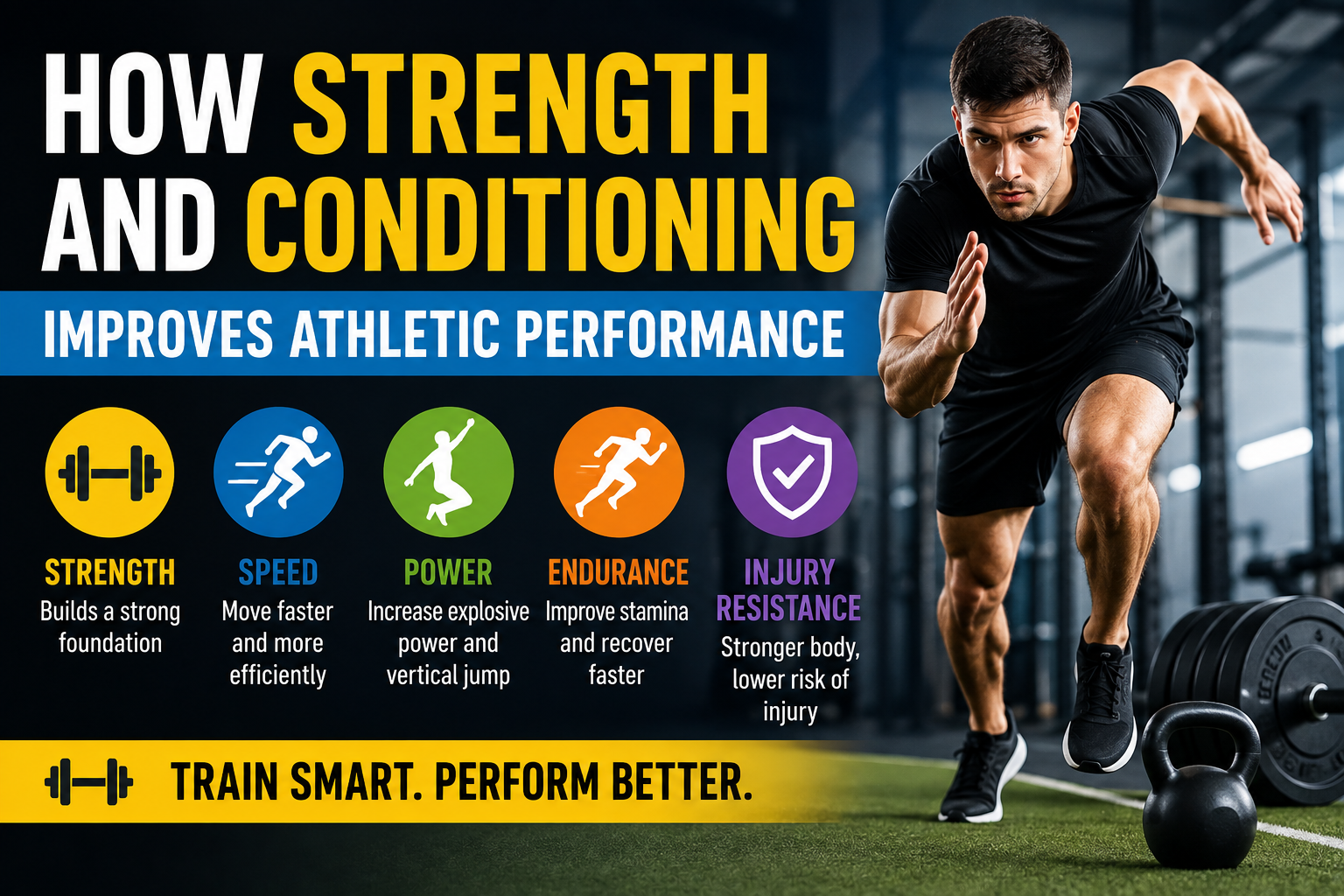
How Strength and Conditioning Improves Athletic Performance
Athletic performance is rarely determined by skill alone. The ability to run faster, jump higher, change direction quickly, maintain balance and recover between efforts depends heavily on the physical qualities that support sport-specific skills.
That is where strength and conditioning comes in.
Strength and conditioning combines structured resistance training, speed and agility work, power development, mobility, conditioning and recovery strategies to help athletes perform at a higher level. The goal is not simply to build bigger muscles. A well-designed program develops the physical qualities an athlete needs while helping them handle the demands of training and competition.
From professional athletes to recreational competitors, appropriate strength and conditioning can improve performance in ways that extend well beyond the weight room.
What Is Strength and Conditioning?
Strength and conditioning is a broad approach to physical preparation.
Strength training focuses primarily on improving an athlete’s ability to produce force. Exercises such as squats, deadlifts, presses, rows and Olympic lifting variations may be incorporated depending on the athlete’s sport and experience.
Conditioning develops the body’s ability to produce and sustain effort, recover between efforts and tolerate the physical demands of competition.
A complete program can also include:
- Speed training
- Agility and change-of-direction drills
- Explosive power exercises
- Mobility work
- Core training
- Balance and coordination
- Aerobic conditioning
- Sprint training
- Recovery strategies
The exact combination depends on the athlete.
A marathon runner, football player, swimmer and basketball player require different physical qualities, so their programs should not look identical.
Strength Gives Athletes a Stronger Physical Foundation
Strength is one of the fundamental qualities behind athletic movement.
When an athlete becomes stronger, they can potentially produce greater force against the ground, an opponent, equipment or other resistance.
For a sprinter, stronger muscles can contribute to forceful acceleration. For a basketball player, strength can help support jumping, landing and changing direction. For a rugby player, it can help with contact situations and maintaining body position.
Strength also provides a foundation for developing other qualities.
An athlete who can produce more force can often learn to express that force rapidly through appropriate power and speed training.
However, becoming stronger does not automatically make someone a better athlete. Strength has to be developed in a way that complements the demands of the sport.
Power Helps Turn Strength Into Explosive Movement
Strength describes the ability to produce force, while power involves producing force quickly.
This distinction is critical in many sports.
A basketball player may need to explode upward for a rebound. A volleyball player may need to jump rapidly for a block. A sprinter must apply substantial force against the ground in very short periods.
Exercises such as jumps, medicine-ball throws, Olympic lifting variations and appropriately prescribed plyometrics can help athletes develop explosive power.
The objective is not simply to lift heavier weights. It is to improve the athlete’s ability to produce useful force rapidly.
Speed Is More Than Just Running Fast
Speed training can improve several components of athletic movement.
An athlete may need to accelerate quickly from a stationary position, reach maximum running speed or rapidly change direction.
Strength and conditioning can support these abilities through exercises that develop force production, coordination and technique.
Acceleration training might involve short sprints, resisted movements or carefully designed starts. Maximum-speed training can involve longer sprint efforts with sufficient recovery.
The amount and type of speed work should depend on the athlete’s sport, training age and physical condition.
Quality is generally more important than simply accumulating large numbers of sprints.
Agility Helps Athletes React to the Game
Many sports require athletes to respond to unpredictable situations.
A soccer player reacts to an opponent’s movement. A basketball defender adjusts to a ball handler. A tennis player responds to the direction and speed of an incoming shot.
This is different from simply running through a predetermined cone drill.
Agility involves physical qualities such as acceleration, deceleration and change-of-direction ability, but it also involves perception and decision-making.
Strength training can help athletes produce and absorb the forces involved in rapid changes of direction. Conditioning can help them repeat those efforts without excessive performance decline.
Conditioning Improves the Ability to Repeat Efforts
An athlete may be exceptionally fast or powerful but struggle to maintain those qualities throughout a competition.
Conditioning helps address that problem.
Different sports place different demands on the cardiovascular and muscular systems. A distance runner needs the ability to sustain prolonged effort, while a field-sport athlete may repeatedly sprint, slow down, change direction and recover before another high-intensity effort.
A well-designed conditioning program reflects those demands.
It can include continuous aerobic work, intervals, repeated-sprint training or sport-specific conditioning.
The objective is not simply to make an athlete tired. Effective conditioning should improve the athlete’s ability to perform the required work and recover appropriately.
Stronger Muscles Can Support Movement Quality
Strength training can also improve an athlete’s ability to control movement.
Exercises performed through appropriate ranges of motion require athletes to coordinate multiple muscles and stabilize joints while producing force.
Better control can be particularly useful during movements such as landing, decelerating, changing direction and maintaining body position under pressure.
However, technique matters. Strength exercises performed with poor mechanics or inappropriate loads can undermine the purpose of training.
Coaching and progression are therefore important parts of a successful program.
Mobility Supports Efficient Movement
Mobility is another important component of athletic preparation.
Athletes need sufficient movement at the relevant joints to perform their sport effectively. Restricted movement can sometimes interfere with technique or make certain positions more difficult to control.
Strength and conditioning programs can incorporate mobility exercises alongside strength training.
This does not necessarily mean spending long periods stretching before every workout. Mobility work should be selected according to the athlete’s needs and integrated into an overall training plan.
Dynamic warm-ups, controlled mobility exercises and strength exercises performed through appropriate ranges of motion can all contribute to movement quality.
Core Strength Helps Transfer Force
The core is more than the abdominal muscles.
It includes the muscles and structures that help stabilize the trunk and transfer force between the upper and lower body.
A strong and well-controlled trunk can be useful when an athlete needs to produce force while maintaining body position.
A baseball player rotating to hit a ball, a swimmer maintaining body alignment and a football player resisting contact all rely on effective trunk control.
Core training can include movements such as carries, anti-rotation exercises, loaded movements and appropriately selected trunk exercises.
The goal is to build useful stability and force transfer rather than simply maximizing the number of abdominal exercises.
Strength and Conditioning Can Improve Work Capacity
As athletes become better conditioned and physically stronger, they may be able to tolerate greater training demands.
This is sometimes described as work capacity.
An athlete with greater work capacity can potentially complete high-quality training sessions while recovering appropriately between them.
That matters because athletic development depends on consistent training over time.
A single excellent workout will not transform performance. Improvements generally come from repeatedly applying an appropriate training stimulus, recovering from it and gradually progressing.
Recovery Is Part of Performance
Training creates stress. Recovery allows the body to adapt to that stress.
A strength and conditioning program that ignores recovery can become counterproductive.
Important recovery factors include:
- Adequate sleep
- Sufficient nutrition
- Hydration
- Appropriate rest periods
- Training-load management
- Mobility and low-intensity recovery activities
- Scheduled lighter training periods when appropriate
More training is not automatically better.
An athlete who continually trains while excessively fatigued may experience declining performance and struggle to maintain training quality.
Good programming balances stress and recovery.
Strength Training Can Help Athletes Become More Resilient
Athletes repeatedly expose their bodies to forces during training and competition.
Running, jumping, landing, throwing, tackling and changing direction all place physical demands on muscles, tendons, bones and joints.
Progressive strength training can help athletes develop the physical capacity to handle these demands.
This does not mean strength training can eliminate injuries. No training program can guarantee that an athlete will remain injury-free.
However, appropriately designed physical preparation can be an important part of reducing certain injury risks and improving an athlete’s ability to tolerate sport-specific loads.
Training Should Be Specific to the Sport
One of the most important principles of strength and conditioning is specificity.
An athlete should train physical qualities that have meaningful relevance to their sport.
A heavyweight strength program might be appropriate for a powerlifter but poorly suited to an endurance athlete who needs to prioritize running economy and aerobic capacity.
Similarly, a professional soccer player needs a different combination of strength, speed, conditioning and recovery than a competitive swimmer.
The best program therefore starts with the demands of the sport and works backward.
Progressive Overload Drives Adaptation
The body adapts when it is exposed to training demands that challenge it appropriately.
This principle is known as progressive overload.
Progression can involve increasing resistance, volume, training intensity, movement complexity or the quality of performance, depending on the objective.
Progression does not mean adding weight every workout.
An athlete might improve by performing the same exercise with better technique, moving a load faster, completing more repetitions at the same quality or reducing unnecessary fatigue.
The appropriate progression depends on the athlete and the training phase.
Periodization Helps Manage Training Over Time
Athletes rarely need to maximize every physical quality simultaneously.
A training program may therefore change throughout the year.
During an off-season, an athlete might spend more time developing general strength and addressing physical weaknesses. As competition approaches, training may become more specific to speed, power and sport performance.
During the competitive season, maintaining physical qualities while managing fatigue may become the priority.
This structured approach is often referred to as periodization.
The precise model can vary, but the underlying idea is simple: training should evolve according to the athlete’s goals and competitive schedule.
Individualization Matters
Two athletes on the same team may have very different physical needs.
One player may need more strength development. Another may need improved acceleration. A third may require additional mobility or better conditioning.
Age, training experience, injury history, position, competition schedule and individual response to training can all influence program design.
That is why effective strength and conditioning is not simply a collection of exercises.
It is a process of assessing an athlete, identifying priorities, selecting appropriate training methods and adjusting the program based on progress and recovery.
Nutrition Supports the Training Process
Training cannot be separated completely from nutrition.
Muscles need energy and nutrients to perform and recover. Athletes who consistently underfuel their training may struggle to maintain performance and recover between sessions.
A balanced diet that provides sufficient energy, protein, carbohydrates, fats, vitamins and minerals can support the demands of training.
The appropriate nutritional strategy depends on the sport and the athlete’s goals.
For competitive athletes with demanding training schedules, working with a qualified sports nutrition professional can help ensure that nutrition supports rather than undermines physical preparation.
Consistency Matters More Than Short-Term Intensity
Athletic development takes time.
An athlete may notice improvements in strength relatively quickly when beginning a structured program, but developing advanced speed, power, conditioning and movement skills can require months or years of consistent work.
Trying to accelerate the process by dramatically increasing training volume can create unnecessary fatigue and interfere with recovery.
A sustainable program allows athletes to train consistently while gradually progressing.
That consistency is one of the most important advantages a well-designed strength and conditioning program can provide.
Technology Is Changing Athletic Training
Modern strength and conditioning programs increasingly use technology to measure performance.
Athletes and coaches can track variables such as sprint times, jump performance, training loads, heart rate and movement data.
Wearable devices and force-measurement technologies can provide additional information about how athletes are responding to training.
Technology can be useful, but it does not replace coaching judgment.
Numbers are most valuable when they help answer practical questions: Is the athlete improving? Are they recovering? Is the training producing the intended adaptation? Does the program need to change?
The Goal Is Better Performance, Not Just Better Fitness
The ultimate purpose of strength and conditioning is to help athletes express their abilities when competition matters.
A stronger athlete is not automatically a better athlete. A faster athlete is not necessarily better conditioned. More training does not automatically produce better results.
The real objective is to combine physical qualities in a way that supports sport-specific performance.
Strength provides a foundation for force production. Power helps athletes express that force quickly. Speed and agility improve movement. Conditioning supports repeated efforts. Mobility and movement control help athletes execute skills effectively. Recovery allows the body to adapt.
When these elements are carefully combined, strength and conditioning becomes much more than weightlifting or cardio.
It becomes a structured system for helping athletes build the physical capacity to perform, recover and improve consistently.
For athletes at almost any level, that physical foundation can make the difference between simply participating in a sport and being prepared to perform at their best.





2 Comments
Micle harison
June 7, 2019Lorem ipsum dolor sit amet, usu ut perfecto postulant deterruisset, libris causae volutpat at est, ius id modus laoreet urbanitas. Mel ei delenit dolores.
John Doe
June 7, 2019Some consultants are employed indirectly by the client via a consultancy staffing company.