
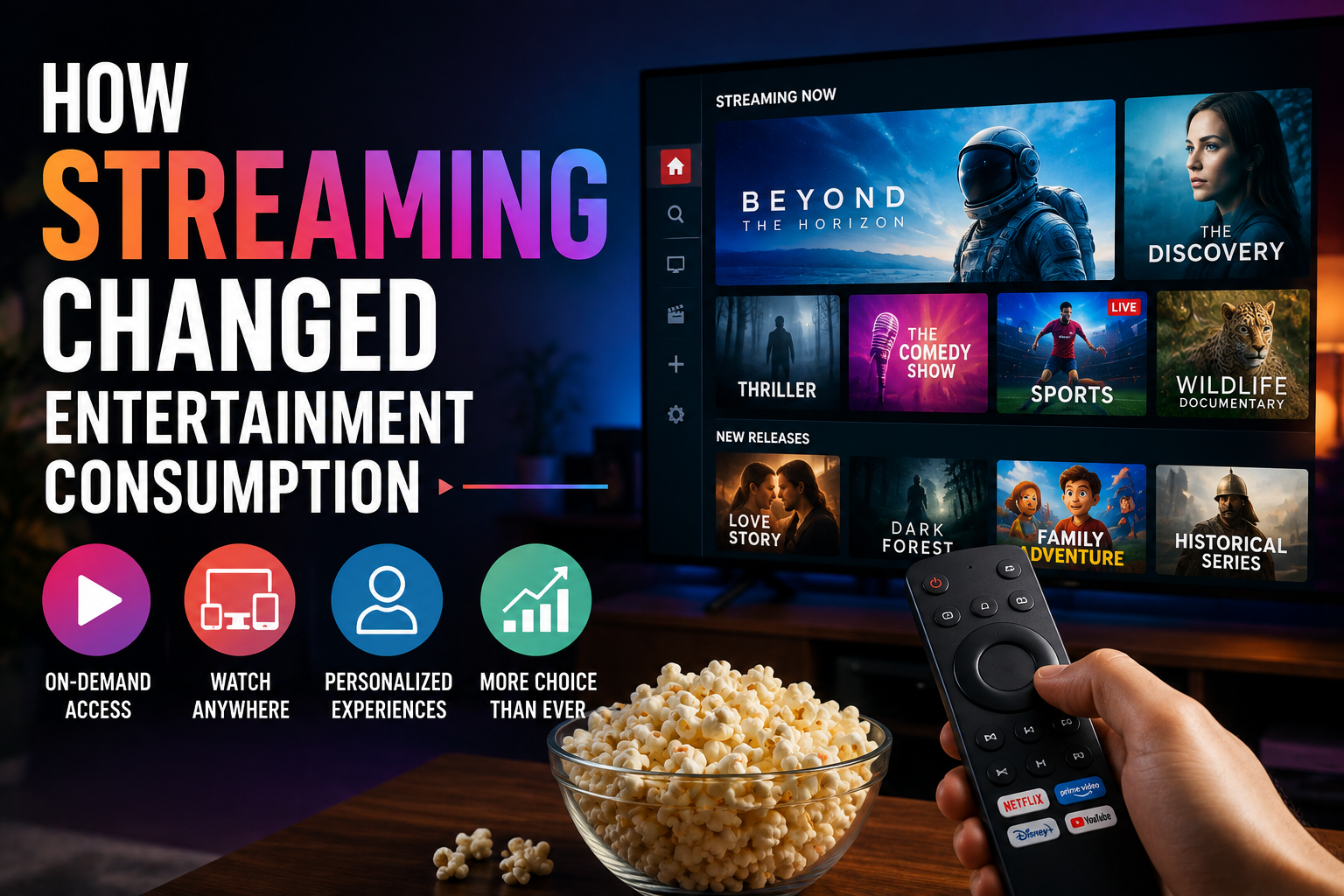
How Streaming Changed Entertainment Consumption
Streaming has fundamentally changed the way people watch movies, television shows, listen to music and discover new forms of entertainment. What once required a trip to a cinema, a television schedule, a physical store or a record collection can now happen from a smartphone, television, computer or gaming console within seconds.
The shift has affected much more than convenience. Streaming has changed how entertainment is produced, distributed, marketed and consumed. It has altered audience expectations around availability, pricing, personalization and even the meaning of a successful movie or television series.
Instead of waiting for entertainment to arrive at a particular time, consumers increasingly expect it to be available whenever they want it.
From Scheduled Entertainment to On-Demand Viewing
Traditional television was built around schedules.
Viewers had to tune in at a specific time to watch a program. Missing an episode could mean waiting for a repeat broadcast or finding another way to watch it later.
Streaming removed much of that limitation.
On-demand platforms allow viewers to choose what they want to watch and when they want to watch it. This flexibility has become one of the defining characteristics of modern entertainment consumption.
A viewer can watch one episode during breakfast, another during a commute and several more in the evening. Movies no longer need to be watched according to a broadcaster’s schedule.
This shift has given audiences considerably more control over their entertainment routines.
The Rise of Binge-Watching
One of the biggest behavioral changes created by streaming is binge-watching.
Traditional television generally released episodes according to a weekly schedule. Streaming services helped popularize the practice of making multiple episodes available simultaneously, allowing viewers to continue watching without waiting days or weeks for the next installment.
Binge-watching changed how audiences experience serialized stories.
Instead of spending months following a season, viewers can sometimes complete an entire season within a weekend. This can create a more immersive experience because the details, characters and storylines remain fresh.
It has also influenced how television shows are written. Writers and producers can create longer narrative arcs knowing that viewers may watch episodes close together.
At the same time, binge-watching can make entertainment feel less like a shared weekly experience. When everyone watches at different speeds, conversations around a series can become fragmented by spoilers and different viewing schedules.
Entertainment Became More Personalized
Streaming platforms collect information about what users watch, skip, search for and complete.
That data can be used to recommend additional entertainment.
Instead of browsing a television guide or walking through a video store, viewers increasingly encounter personalized recommendations based on their previous behavior.
A person who watches several crime dramas may be presented with more crime-related content. Someone who frequently watches documentaries may see documentary recommendations prominently displayed.
Personalization reduces the amount of effort required to discover something new.
However, it also creates a potential downside: people can become trapped in narrow recommendation patterns. If algorithms repeatedly show users content similar to what they already enjoy, they may encounter fewer unexpected genres, creators or perspectives.
The Meaning of a “Hit” Has Changed
Streaming has complicated the traditional definition of entertainment success.
For decades, movie success could be measured through box-office revenue, while television success was closely associated with ratings.
Streaming platforms have access to different types of data.
They can analyze viewing duration, completion rates, repeat viewing, subscriber behavior and audience demographics. Some platforms may release selected performance figures, while others keep much of their data private.
As a result, it can be harder for audiences and competitors to determine exactly how successful a streaming title is.
A film that receives a theatrical release has a relatively visible box-office performance. A streaming movie may attract millions of viewers without generating a publicly comparable revenue figure.
This has changed the business conversation surrounding entertainment.
Movies No Longer Depend Entirely on Theaters
Streaming has also disrupted the traditional movie distribution model.
Historically, major films typically moved through a sequence that began with theatrical release and was followed later by home entertainment and television distribution.
Streaming has introduced alternative models.
Some movies receive an exclusive theatrical run before moving to a streaming service. Others become available digitally much sooner than they would have in the past. Some productions are created primarily for streaming audiences.
This has expanded consumer choice but also created debate about the role of movie theaters.
The theatrical experience offers a large screen, powerful sound and a social environment that home viewing cannot completely replicate. Streaming, meanwhile, offers convenience and eliminates the need to travel or purchase individual tickets.
Both models can coexist, but their relationship continues to evolve.
Television Became More Like an Online Library
Traditional television offered a constantly changing schedule.
Streaming platforms operate more like enormous digital libraries. Viewers can search for specific titles, browse genres or explore recommendations without waiting for a program to appear.
This has made older entertainment more accessible.
A television series that originally aired years ago can find a new audience when it becomes available on a streaming platform. Older movies can also experience renewed interest after being added to a popular service.
This phenomenon has helped blur the distinction between new and old entertainment.
A title does not necessarily disappear from public attention simply because its original release occurred years earlier.
Global Audiences Became Easier to Reach
Streaming has dramatically expanded the international reach of entertainment.
A television series produced in one country can attract viewers thousands of miles away when it becomes available on a global platform.
Subtitles and dubbing have further reduced language barriers.
This has allowed audiences to discover entertainment from countries and cultures they might previously have encountered only rarely.
International hits have demonstrated that audiences are often willing to embrace stories outside their own markets when those stories are accessible and effectively promoted.
For creators, this means the potential audience is no longer limited as strongly by geography.
Music Consumption Changed Too
The streaming revolution extends far beyond television and movies.
Music consumption has undergone a similar transformation.
Physical albums and downloads once played a major role in how listeners obtained music. Streaming services shifted the model toward access to enormous catalogs through subscriptions or advertising-supported services.
Listeners can now explore artists without purchasing entire albums.
Playlists have also become an important part of music discovery. Instead of relying entirely on radio stations, music stores or personal collections, listeners can receive recommendations based on their listening habits.
This has changed the relationship between artists, songs and audiences.
A listener might discover a new artist through a playlist, hear one song repeatedly without ever purchasing an album and then explore the artist’s broader catalog.
Short-Form Entertainment Has Changed Attention Habits
Streaming should not be understood only as long movies and television series.
The broader digital entertainment ecosystem has normalized short-form video as well.
Platforms built around short clips have introduced another model of consumption: entertainment that can be watched in seconds or minutes and consumed almost continuously.
This has created a much wider range of entertainment formats.
People can move from a two-hour movie to a 20-minute documentary, a five-minute comedy video or a 30-second clip without leaving the broader digital entertainment environment.
For creators, this means competition for attention exists across increasingly different formats.
Consumers Expect More Choice
Streaming has helped create an expectation that there should always be something else to watch or listen to.
Traditional entertainment offered limited choices at particular times. Streaming libraries can contain thousands of movies, shows, songs and other pieces of content.
That abundance is convenient, but it can also create a new problem: choice overload.
When consumers have too many options, deciding what to watch can become surprisingly difficult.
A viewer might spend more time scrolling through recommendations than actually watching something.
Streaming companies therefore compete not only to provide content but also to design interfaces and recommendation systems that help users choose it.
Subscription Fatigue Became a New Problem
Streaming initially appealed to consumers partly because several services could seem cheaper than traditional entertainment packages.
Over time, however, the number of subscription services increased.
Consumers may now encounter separate platforms for movies, television, sports, music, children’s programming and specialized content.
If a particular show is exclusive to one service and another popular series is exclusive to a different platform, consumers may feel pressured to maintain multiple subscriptions.
This has produced what is commonly described as subscription fatigue.
People increasingly have to decide which services provide enough value to justify their monthly costs.
Some consumers respond by subscribing temporarily, watching the content they want and then canceling. Others rotate between services depending on what is available.
Advertising Returned in a New Form
Streaming did not eliminate advertising.
Instead, advertising has increasingly become part of streaming’s business model.
Many platforms offer lower-priced plans that include advertising, while some free services rely heavily on advertisements.
This has created a hybrid entertainment market in which consumers can choose between paying more for fewer advertisements or paying less while accepting commercial interruptions.
Digital platforms can also use audience data to make advertising more targeted than traditional broadcast advertising.
That creates opportunities for marketers but also raises questions about privacy, data collection and how much information entertainment platforms should use to personalize commercial experiences.
Creators Have More Ways to Reach Audiences
Streaming has also lowered some traditional barriers between creators and audiences.
A production no longer necessarily needs to fit the programming schedule of a major broadcaster to find viewers. Digital distribution provides additional paths for independent filmmakers, musicians, comedians and other creators.
This has contributed to a larger and more diverse entertainment ecosystem.
However, greater accessibility also means greater competition.
Millions of pieces of content can compete for the same limited amount of audience attention. Being able to publish something is easier than ensuring that people discover it.
As a result, creators increasingly have to think about storytelling, audience development, social media, discoverability and personal branding alongside the creative work itself.
Algorithms Influence What People Discover
One of streaming’s most significant effects is that algorithms increasingly participate in entertainment discovery.
In the past, recommendations came primarily from friends, critics, radio presenters, television networks, newspapers and entertainment magazines.
Today, software can determine which titles appear prominently on a user’s home screen.
This can be extremely useful. A viewer may discover a small production that would otherwise have remained unnoticed.
But recommendation systems also have significant influence over what becomes visible.
The entertainment industry is therefore increasingly shaped by both human creativity and algorithmic discovery.
The Social Experience of Entertainment Has Evolved
Streaming has changed how people share entertainment with one another.
Watching a movie at home has always been possible, but streaming has made individualized viewing much more common. Family members may watch different programs on separate devices, while friends in different cities can follow the same series at their own pace.
At the same time, online communities have created new forms of shared entertainment.
People discuss shows on social platforms, share reactions, create fan communities and produce their own commentary and memes.
The experience has therefore become less geographically dependent. People do not necessarily have to sit in the same room to participate in the same entertainment conversation.
Entertainment Became More Portable
Perhaps the simplest transformation is portability.
A smartphone can carry access to an enormous entertainment library.
People can watch shows while traveling, listen to music while exercising or catch up on films from almost anywhere with a suitable internet connection.
This has made entertainment less tied to a particular physical location.
It has also changed expectations. When people become accustomed to having entertainment available whenever they want it, waiting can feel increasingly unusual.
What Streaming Means for the Future of Entertainment
Streaming has not simply replaced older forms of entertainment. It has created a more complicated ecosystem in which theaters, broadcast television, physical media, cable services, social platforms and digital subscriptions can coexist.
The biggest change may be the shift in power toward the consumer.
Audiences have more control over what they consume, when they consume it and increasingly how they discover it. At the same time, platforms have gained unprecedented insight into audience behavior and have become powerful gatekeepers of entertainment discovery.
That creates both opportunities and challenges.
For consumers, streaming offers extraordinary convenience and variety, but it can also bring subscription costs, endless choices and algorithm-driven recommendations. For creators, it opens access to global audiences while intensifying competition for attention.
The entertainment industry is unlikely to return to the limited schedules and physical distribution models that once defined it. Streaming has permanently changed audience expectations.
The next stage will be about determining how platforms, creators and consumers balance convenience, creativity, affordability and discovery in an entertainment world where the question is no longer what is on tonight, but what do you want to experience right now?


2 Comments
Micle harison
June 7, 2019Lorem ipsum dolor sit amet, usu ut perfecto postulant deterruisset, libris causae volutpat at est, ius id modus laoreet urbanitas. Mel ei delenit dolores.
John Doe
June 7, 2019Some consultants are employed indirectly by the client via a consultancy staffing company.