
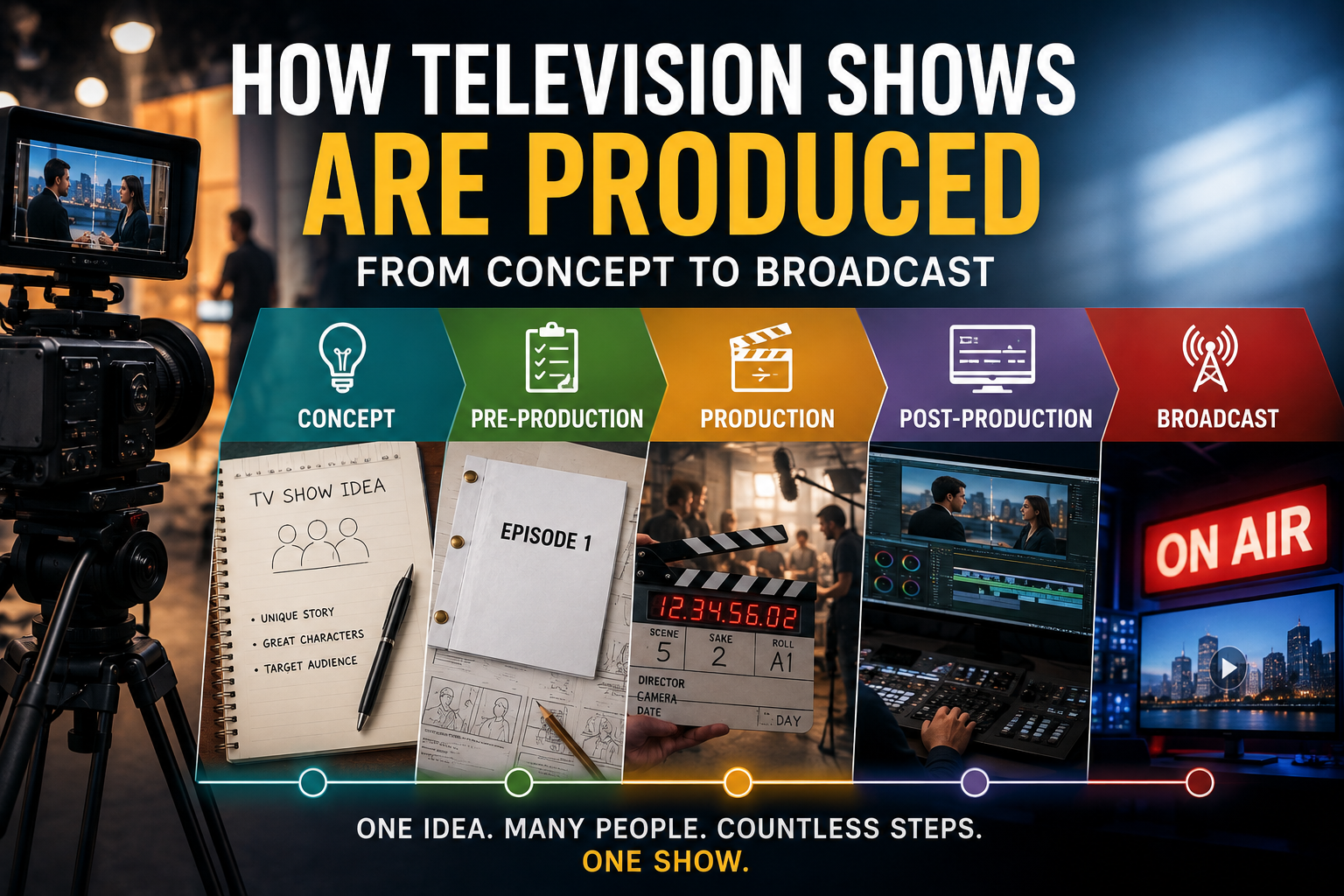
How Television Shows Are Produced From Concept to Broadcast
When viewers sit down to watch a television show, the finished episode can feel effortless. Characters appear on screen, scenes unfold, music rises at the right moment and the story moves seamlessly from one sequence to the next.
Behind that polished experience, however, is a complicated production process involving writers, producers, directors, actors, camera crews, editors, designers, technicians and many other specialists.
A television show can take months or even years to move from an initial idea to a finished production. The journey varies depending on whether it is a scripted drama, sitcom, reality program, documentary, talk show or competition series, but most productions follow a similar path from development through distribution.
It All Starts With an Idea
Every television production begins with a concept.
The idea might come from a screenwriter, producer, director, production company or another creator. Sometimes it is based on an existing book, film, podcast, real-life story or intellectual property. Other times, it begins with an entirely original premise.
At this early stage, creators consider what the show is about, who the main characters are, what makes the concept distinctive and why audiences might want to watch it.
A basic idea might be as simple as a workplace comedy or a crime drama. Turning that idea into a viable television series requires considerably more detail.
Creators may develop character descriptions, story arcs, episode ideas and an explanation of how the show could sustain multiple episodes or seasons.
Developing the Pitch
Once the core concept has been established, creators usually develop a pitch designed to communicate the show’s potential to decision-makers.
A pitch may include:
- The central premise
- Main characters
- Tone and visual style
- Target audience
- Potential storylines
- Episode structure
- Season-long story arcs
- Comparable programs
- Production considerations
For scripted programs, creators may also prepare a pilot script or other sample material.
The pitch needs to answer an important question: Why should this show exist, and why would audiences keep watching it?
Finding a Network or Streaming Home
A television concept needs financial backing and a distribution platform before it can become a full production.
Depending on the project, creators may present it to a television network, streaming service, studio or production company.
Executives evaluate numerous factors, including audience appeal, production costs, scheduling, existing programming and the potential commercial value of the project.
Streaming platforms may evaluate concepts differently from traditional broadcasters because they are not necessarily working within the same weekly programming schedule or advertising model.
Competition is intense. Many ideas are pitched, but only a fraction eventually receive approval for production.
The Pilot and Greenlight
For some scripted shows, the next major step is producing a pilot episode.
A pilot serves as a demonstration of what the series could look and feel like. It introduces the characters, establishes the tone and gives executives an opportunity to assess the creative and commercial potential of the project.
Not every show requires a traditional pilot. Some productions receive a series order based on scripts, existing development work or other materials.
When a project receives approval to move forward, the industry often describes it as being greenlit.
That decision transforms the project from an idea under consideration into an actual production.
Building the Production Team
Once a show is approved, producers begin assembling the team responsible for bringing it to life.
A large television production can involve hundreds of people, depending on its scale.
Key positions may include:
- Executive producers
- Showrunners
- Producers
- Writers
- Directors
- Casting directors
- Cinematographers
- Production designers
- Costume designers
- Editors
- Sound professionals
- Visual-effects artists
- Camera operators
- Lighting technicians
- Production assistants
The exact structure varies significantly between productions.
One of the most important figures on a scripted television series is often the showrunner. The showrunner typically has significant creative and managerial responsibility, overseeing the writers’ room and working with production departments to maintain the show’s overall direction.
Writing the Episodes
For scripted television, writing is one of the most important stages of production.
Writers develop individual episodes while also considering the larger story of the season.
A writers’ room may break down story ideas, develop character arcs and determine how individual episodes connect.
Once an episode’s story is established, writers create a script containing dialogue, action, scene descriptions and other information required by the production team.
Scripts may go through numerous revisions.
Changes can occur because of creative decisions, production limitations, network or platform feedback, actor availability, budget considerations or the need to improve the story.
Television writing is therefore not simply about producing dialogue. It is an ongoing process of shaping a story that can actually be filmed within the available resources.
Casting the Actors
Casting determines who will portray the characters audiences eventually see on screen.
Casting directors work with producers and directors to identify performers who fit the roles.
Actors may audition individually or participate in chemistry readings with other performers, particularly when relationships between characters are central to the story.
For established productions, casting can also involve well-known actors whose involvement may influence audience interest and financing.
Once the principal cast is selected, contracts and schedules must be coordinated with the production timetable.
Preparing Before Cameras Roll
Pre-production is where the plans become increasingly detailed.
The production team determines where scenes will be filmed, what sets need to be constructed, which costumes and props are required and how individual scenes will be scheduled.
Location scouts search for suitable filming environments. Production designers create sets and establish the visual identity of the show.
The cinematography team plans lighting and camera approaches, while costume and makeup departments develop the appearance of the characters.
At the same time, production managers create detailed schedules designed to use time and resources efficiently.
This stage is crucial because filming is expensive. Poor planning can lead to delays, budget overruns and other problems once production begins.
Filming the Show
Production begins when the cameras start rolling.
Scenes are rarely filmed in the same order audiences eventually see them.
A production may shoot several scenes in the same location at once, even if those scenes appear in completely different episodes or parts of the story.
This approach saves time and money.
Actors rehearse scenes before filming, while the director works with the cast and crew to determine performances, camera movements and staging.
Multiple takes may be recorded because of acting choices, technical problems, continuity issues or creative preferences.
A single scene that lasts only a few minutes on screen can require hours of work to capture.
The Work Behind Every Shot
Filming involves much more than pointing a camera at actors.
The camera department determines framing and movement. Lighting teams create the visual atmosphere. Sound crews record dialogue and other audio. Production designers ensure that sets and locations match the intended world of the story.
Continuity teams monitor details between shots.
A character’s clothing, the position of objects on a table or the amount of liquid in a glass may need to remain consistent across multiple takes.
Meanwhile, producers and production managers monitor schedules and budgets.
The goal is to capture enough usable material to construct the final episode during post-production.
Post-Production Turns Footage Into an Episode
Once filming is complete, the production enters post-production.
Editors review the footage and assemble scenes into a coherent sequence.
This process can dramatically change how a story feels.
Editors decide which takes work best, how long shots should remain on screen and where scenes should begin and end. They also work with directors and producers to shape pacing and storytelling.
An episode may go through multiple versions before the final cut is approved.
Sound, Music and Visual Effects
Post-production involves far more than editing pictures.
Dialogue may need to be cleaned up or replaced through additional recording. Sound designers create effects ranging from footsteps and doors closing to explosions and environmental atmosphere.
Music can also have a major influence on the emotional impact of a scene.
Composers may create original scores, while productions can license existing songs.
Visual-effects teams handle everything from subtle corrections to major computer-generated environments and characters.
On large productions, visual effects can require months of work after filming has ended.
Color and Picture Finishing
Once the edit is largely complete, specialists refine the visual appearance of the program.
Color correction and grading help ensure that shots have a consistent appearance and that the intended mood is maintained.
A production may use warmer tones for one environment and cooler tones for another, depending on the creative direction.
Technical checks are also performed to ensure that the finished program meets the requirements of its intended platform.
Testing and Final Approval
Before an episode reaches viewers, it may go through several rounds of review.
Producers, studios, networks or streaming platforms may evaluate the finished program for creative, technical and regulatory reasons.
Some shows undergo audience testing or preview screenings, particularly when producers want feedback before a wider release.
Scenes can occasionally be shortened, reordered or removed at this stage.
The final version must also meet technical specifications for broadcasting or streaming.
From Finished Episode to Audience
Once an episode has been approved, it is prepared for distribution.
For traditional television, broadcasters schedule programs at specific times and transmit them through their television networks.
Streaming services operate differently. Episodes can be released individually, weekly, or as part of a larger batch, depending on the platform and the show’s strategy.
Distribution may also involve international licensing.
A program produced in one country can eventually be sold to broadcasters and streaming services around the world, sometimes with dubbing, subtitles or other adaptations.
Marketing Begins Before the Premiere
Producing the show is only part of the challenge. Audiences also need to know that it exists.
Marketing campaigns can include trailers, posters, interviews, social media promotions, press events and advertising.
For major productions, promotional campaigns can begin months before the first episode becomes available.
Marketing teams study the show’s intended audience and determine how to position it in a crowded entertainment market.
The promotional strategy can be particularly important for streaming services, where audiences have an enormous number of programs competing for their attention.
Ratings and Viewer Data Shape What Happens Next
After a show reaches audiences, its performance can influence its future.
Traditional broadcasters may examine television ratings and audience demographics. Streaming platforms have access to different types of viewing data, which can include completion rates, viewing patterns and audience retention.
Other factors may also matter, including production costs, critical reception, social-media attention and international performance.
A popular program may receive additional seasons, while a poorly performing series may be canceled.
However, decisions are rarely based on a single number.
Why Some Shows Take Years to Reach the Screen
The television production process can be surprisingly long.
A concept may spend months or years in development before receiving approval. Once greenlit, production can face scheduling difficulties, casting changes, location challenges, technical problems and post-production delays.
Large-scale productions are particularly complicated because hundreds of people may need to coordinate their work.
Even after an episode has been filmed, editing, sound design, visual effects and approvals can take considerable time.
This helps explain why audiences sometimes wait years between seasons of major television productions.
Television Production Is a Team Effort
The finished program that viewers see represents the combined work of many different departments.
Writers create the story. Actors bring characters to life. Directors shape performances and scenes. Cinematographers create the visual language. Designers construct the world. Editors determine the rhythm. Sound and music teams establish atmosphere. Visual-effects artists expand what can appear on screen.
Producers coordinate these efforts while keeping an eye on time, money and creative objectives.
No single department can produce a television series alone.
How Streaming Has Changed the Production Process
The growth of streaming has changed how television is developed, released and consumed.
Traditional television often revolves around fixed schedules, advertising breaks and weekly episodes. Streaming has introduced greater flexibility in episode length, release strategies and storytelling structures.
Some streaming dramas resemble traditional television series, while others adopt structures that would have been unusual on conventional broadcast networks.
The shift has also created greater demand for original programming, increasing opportunities for creators while intensifying competition for audiences.
The Journey Behind the Screen
The next time a television show appears on a screen, it is worth remembering how much work is hidden behind those few minutes of entertainment.
What begins as an idea can pass through development meetings, script revisions, casting sessions, location scouting, rehearsals, filming, editing, sound design, visual effects, technical reviews and marketing before finally reaching an audience.
That complex chain of creative and logistical decisions is what transforms a simple concept into a finished television program.
From the first sentence written in a script to the final frame delivered to a television or streaming platform, producing a show is a collaborative process built on creativity, planning and thousands of individual decisions. For viewers, it may be an hour of entertainment. For the people who make it, it can represent months—or even years—of work.





2 Comments
Micle harison
June 7, 2019Lorem ipsum dolor sit amet, usu ut perfecto postulant deterruisset, libris causae volutpat at est, ius id modus laoreet urbanitas. Mel ei delenit dolores.
John Doe
June 7, 2019Some consultants are employed indirectly by the client via a consultancy staffing company.