
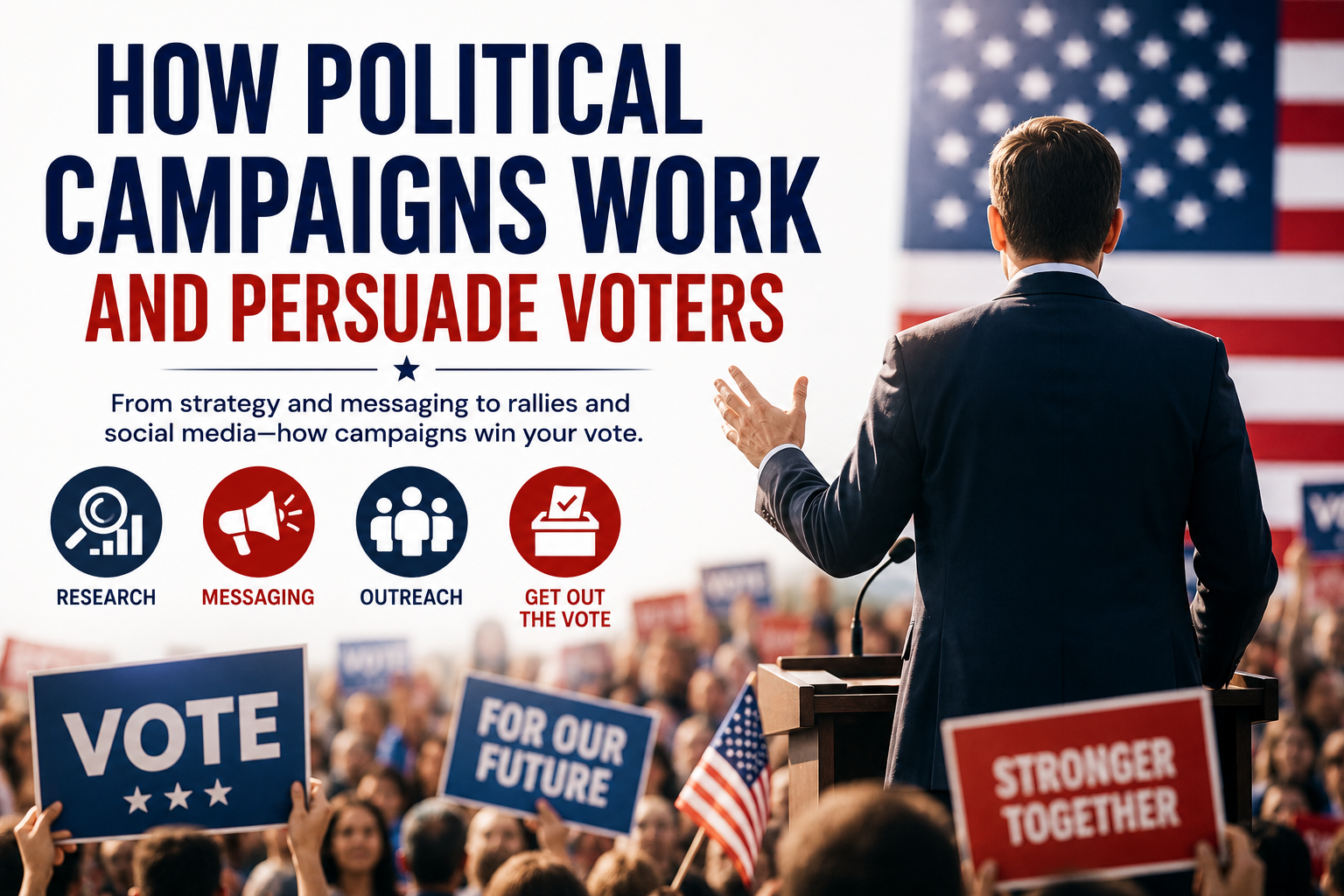
How Political Campaigns Work and Persuade Voters
Political campaigns are a defining feature of democratic elections. In the months or years leading up to an election, candidates and political parties work to convince voters that they deserve their support.
Behind the speeches, rallies, advertisements and social media posts is a carefully organized operation. Campaigns research voters, develop messages, raise money, recruit volunteers, communicate through multiple channels and encourage supporters to turn out on election day.
Persuasion is at the center of nearly all of these activities. Campaigns are trying not only to introduce candidates and explain their policies, but also to shape how voters understand the election, the major issues and the choices available to them.
Understanding how political campaigns work provides useful insight into why certain messages become prominent, how candidates target different audiences and why some campaign strategies are more effective than others.
What Is a Political Campaign?
A political campaign is an organized effort to help a candidate or political party win an election.
Campaigns vary significantly depending on the country, type of election and political system. A national presidential campaign may involve thousands of employees and volunteers, while a local election campaign might be run by a much smaller team.
Despite those differences, most campaigns have several basic objectives:
- Introduce the candidate to voters
- Explain the candidate’s priorities
- Persuade undecided voters
- Encourage supporters to participate
- Raise money
- Build a recognizable political identity
- Respond to opponents
- Increase voter turnout
A campaign therefore has two related challenges: winning support and getting that support converted into actual votes.
A candidate can be popular among potential voters but still struggle if supporters do not participate in the election.
Campaigns Start With Research
Before deciding what to say publicly, campaigns typically try to understand the political environment.
They may study previous election results, polling data, demographic information, public opinion and local concerns.
Campaign strategists want to answer questions such as:
- Which issues matter most to voters?
- Which groups are likely to support the candidate?
- Where are the strongest areas of support?
- Which voters are undecided?
- Which voters are unlikely to participate?
- What concerns could damage the candidate?
- What arguments are opponents likely to make?
Research helps campaigns decide where to spend their limited time and resources.
A campaign cannot communicate equally with every voter, so it has to determine which audiences are most important to its strategy.
Building a Campaign Message
Once campaigns understand their political environment, they develop a central message.
This message is usually a simple explanation of why voters should support the candidate.
It might focus on economic opportunity, public services, national security, political change, government reform, social issues or another subject that resonates with the intended audience.
The message needs to be understandable because campaigns repeat it across many different forms of communication.
A candidate might express the same basic idea during a speech, in a television advertisement, on social media and in a conversation with voters.
Consistency helps voters associate the candidate with particular priorities.
Why Emotional Appeals Matter
Political decisions are not based entirely on statistics or policy documents.
People also respond to emotions, values, personal experiences and perceptions of identity.
Campaigns therefore often use emotional appeals involving ideas such as:
- Hope
- Fear
- Pride
- Anger
- Security
- Fairness
- Belonging
- Change
- Stability
A campaign emphasizing economic hardship may try to create a sense of urgency around its proposed solutions. Another campaign may emphasize stability and warn voters about the risks of dramatic change.
Emotional communication can make political messages memorable, but it can also oversimplify complicated issues.
For voters, recognizing the emotional element of political messaging can make it easier to separate an emotional reaction from an assessment of a candidate’s actual policies and record.
Storytelling Helps Candidates Become Familiar
Candidates are not simply presenting policy proposals. They are also presenting themselves.
Campaigns frequently tell stories about a candidate’s childhood, career, family, community, challenges or accomplishments.
The purpose is often to make the candidate seem relatable and to establish a personal connection with voters.
A politician who is presented as having grown up in an ordinary household may be positioned as someone who understands everyday financial pressures. Another candidate may emphasize professional experience to demonstrate competence.
These stories can influence how voters interpret everything else the candidate says.
Campaigns Target Different Voters
Not every voter responds to the same issues.
A young voter may prioritize education or employment opportunities. A retiree may place greater emphasis on pensions, healthcare or the cost of living. A business owner might focus on taxes and regulation.
Campaigns therefore divide their audiences into groups and tailor communication accordingly.
This practice is known as targeting.
Campaigns may use geographic information, polling, voter history and other legally available data to determine where different groups of voters are located and what issues are likely to matter to them.
Targeting allows campaigns to concentrate resources where they believe those resources can have the greatest impact.
Digital Campaigning Has Changed Politics
The internet has transformed political communication.
Instead of relying entirely on television, newspapers, radio and physical events, campaigns can communicate directly with voters through websites, email, social media and online advertising.
Digital platforms offer several advantages.
Campaigns can publish information quickly, respond to breaking developments and reach specific audiences without necessarily purchasing traditional mass-media advertising.
Social media also allows candidates to communicate in a more personal and immediate style.
However, digital campaigning has introduced new challenges. False information can spread quickly, political messages can become highly polarized and voters may encounter content designed primarily to generate emotional reactions.
Political Advertising Is Designed to Influence Perception
Political advertisements are among the most visible campaign tools.
An advertisement may introduce a candidate, highlight a policy proposal, celebrate an achievement or criticize an opponent.
Positive advertisements typically try to associate a candidate with desirable qualities such as competence, honesty, leadership or optimism.
Negative advertisements take a different approach. They attempt to make voters view an opponent unfavorably.
Negative campaigning can be effective because voters often pay close attention to information that threatens their interests or challenges their existing beliefs.
But political advertising should be evaluated carefully. Campaign advertisements are created to persuade, not to provide a neutral overview of the candidates.
Why Candidates Talk About Their Opponents
Campaigns rarely focus exclusively on their own candidate.
Opponents are an important part of the political narrative because elections are fundamentally comparisons.
A candidate may argue that their opponent’s policies would produce higher costs, weaker services, greater instability or other undesirable outcomes.
Campaigns can also attempt to define opponents before the opponents define themselves.
Once voters develop a strong negative impression of a candidate, changing that perception can become difficult.
This is why campaigns often respond quickly to controversies or attacks.
Rallies and Public Events Serve Several Purposes
Political rallies are not only about attracting large crowds.
They can generate media coverage, energize supporters, create compelling images and demonstrate enthusiasm around a candidate.
Public events also give candidates opportunities to deliver speeches without journalists or opponents controlling the setting.
For supporters, attending a rally can create a sense of community and shared purpose.
That emotional connection can be valuable later when campaigns ask supporters to volunteer, donate or encourage other people to vote.
Volunteers Are an Important Part of Campaigns
Large political campaigns depend on more than paid staff.
Volunteers can help with activities such as:
- Making phone calls
- Distributing campaign materials
- Organizing events
- Speaking with voters
- Supporting voter-registration efforts
- Managing local campaign offices
- Sharing campaign information
- Helping with election-day operations
Volunteers also extend a campaign’s reach.
A message delivered by a friend, family member or trusted community figure can sometimes carry more credibility than a paid advertisement.
This makes grassroots organizing an important part of many campaigns.
Fundraising Determines What Campaigns Can Do
Running a political campaign requires money.
Campaigns may need to pay for staff, offices, transportation, advertising, technology, research, events and communication.
Fundraising can come from various sources depending on the country’s election laws. These may include individual donations, party resources, membership contributions, public funding or other permitted sources.
Money does not automatically guarantee electoral success, but it can provide a campaign with greater ability to communicate and organize.
Campaign finance rules exist in many political systems to regulate how campaigns raise and spend money.
Polling Helps Campaigns Make Decisions
Polling can provide campaigns with information about how voters currently view candidates and issues.
Campaigns may use polls to determine whether a message is working, which issues deserve greater attention and where the race appears competitive.
However, polls are snapshots rather than guarantees.
Voter opinions can change, polling methods can differ and turnout assumptions can affect results.
A campaign that becomes overly dependent on favorable polling can also make strategic mistakes.
Good campaign teams therefore tend to use polling as one source of information rather than treating it as a prediction of the final result.
The Ground Game Turns Support Into Votes
One of the most important parts of campaigning happens away from television screens and social media.
The ground game refers broadly to the organizational effort to reach voters directly and encourage them to participate.
This can include door-to-door canvassing, telephone outreach, local events and voter-contact operations.
The goal is often not simply to persuade voters but to identify supporters and make sure they actually vote.
This distinction is crucial.
An election is ultimately decided by votes that are cast, not by people who merely say they support a candidate.
Campaigns Try to Mobilize Their Base
Political campaigns usually have a core group of supporters who already strongly favor their candidate or party.
Instead of persuading these voters to change their minds, campaigns often focus on mobilization.
Supporters may be encouraged to:
- Register to vote
- Vote early where available
- Participate on election day
- Volunteer
- Encourage friends and relatives to participate
- Donate money
- Attend campaign events
Mobilization can be especially important in elections where the contest is close.
Why Campaigns Repeat the Same Messages
Political campaigns can seem repetitive because repetition is intentional.
A candidate may return to the same slogan, policy or criticism dozens of times.
The objective is to make the central message familiar and easy to remember.
Voters encounter enormous amounts of information during an election. Most will not read lengthy policy documents or watch every speech.
Repeated messages allow campaigns to compete for attention in a crowded information environment.
Social Identity Can Influence Political Choices
Political persuasion is not always about specific policies.
People can also identify with political parties, regions, communities, professions, generations or broader social groups.
Campaigns often try to connect their candidate with identities that matter to particular audiences.
This can make political messages more powerful because voters may interpret an election as a question of who represents people like them.
Identity-based campaigning can strengthen political participation, but it can also deepen divisions between groups.
Campaigns Adapt When the Political Environment Changes
No campaign strategy remains completely fixed.
Candidates may change their messaging after new economic data, a major event, a public controversy, an opponent’s attack or a shift in public opinion.
A campaign might discover that voters care more about the cost of living than an issue it originally emphasized.
It can then adjust speeches, advertisements and outreach accordingly.
This ability to adapt is one reason campaigns constantly monitor news coverage, polling and voter reactions.
How Voters Can Evaluate Campaign Persuasion
Understanding campaign strategy can help voters make more independent decisions.
When watching a political advertisement or speech, it can be useful to ask:
What is this message trying to make me feel?
Emotional reactions are a normal part of political communication, but recognizing them can provide useful distance.
It is also worth asking:
What evidence supports the claim?
Campaigns naturally highlight information that benefits their candidates. Checking claims against independent and reliable sources can provide a fuller picture.
Another useful question is:
What information has been left out?
A campaign may present a policy’s benefits without discussing its costs or present an opponent’s record without providing broader context.
Looking beyond the campaign’s preferred narrative can reveal important details.
Persuasion Does Not Always Mean Changing Someone’s Mind
One of the biggest misconceptions about political campaigns is that their primary objective is to convert opponents.
In reality, campaigns may spend considerable effort reinforcing existing supporters and persuading undecided voters.
Someone who already strongly supports a candidate may not need to be convinced. Instead, the campaign wants that person to remain engaged and vote.
Likewise, a voter who strongly opposes the candidate may be considered unlikely to change.
The most valuable audience may therefore be the people who are uncertain, disengaged or open to competing arguments.
The Election-Day Test
Ultimately, every campaign strategy faces the same test: can it translate communication and organization into votes?
Successful campaigns generally combine several elements rather than relying on one tactic.
They need a recognizable candidate, a persuasive message, an effective organization, sufficient resources and a strategy for reaching the voters who matter most.
They also need to respond to unexpected events without losing sight of their central argument.
For voters, the same complexity provides a reason to look beyond campaign slogans and advertisements. Elections involve competing promises, records, personalities and interpretations of the issues.
Understanding the Strategy Behind the Message
Political campaigns are carefully designed efforts to compete for attention, shape perceptions, build support and ultimately influence electoral behavior.
They use research to identify audiences, messaging to communicate priorities, storytelling to build candidate identities, advertising to shape perceptions, digital platforms to reach voters and grassroots organizations to turn support into participation.
Persuasion works partly because campaigns understand that voters are not simply collections of policy preferences. People respond to facts, values, emotions, personal experiences, identities and concerns about the future.
That does not mean voters are powerless against political persuasion. In fact, understanding how campaigns operate can make it easier to evaluate their messages critically.
The most informed voters are not necessarily those who avoid political persuasion altogether. They are the ones who recognize how the persuasion is being attempted, examine the evidence behind the claims and make their decisions based on more than the campaign’s most memorable slogan.


2 Comments
Micle harison
June 7, 2019Lorem ipsum dolor sit amet, usu ut perfecto postulant deterruisset, libris causae volutpat at est, ius id modus laoreet urbanitas. Mel ei delenit dolores.
John Doe
June 7, 2019Some consultants are employed indirectly by the client via a consultancy staffing company.