
How Federal and Decentralized Governments Divide Political Power
Political power can be organized in very different ways. In some countries, most important decisions are made by a national government. In others, substantial authority is shared with states, provinces, regions or local governments.
This division of responsibility is one of the defining features of modern government.
A federal system formally divides constitutional authority between a national government and regional governments. A decentralized system, by contrast, gives lower levels of government significant responsibilities, but the national government generally retains the legal authority to determine how those powers are organized.
The distinction can sometimes be difficult to see in practice because countries use different combinations of federal, regional and local institutions. Understanding how these systems distribute power helps explain why governments make decisions differently—and why political conflicts often emerge between national and local leaders.
What Is a Federal Government?
Federalism is a system in which political authority is divided between at least two levels of government, typically a national government and regional governments such as states or provinces.
The division is usually established by a constitution or another fundamental legal framework.
Each level has areas in which it can exercise authority independently.
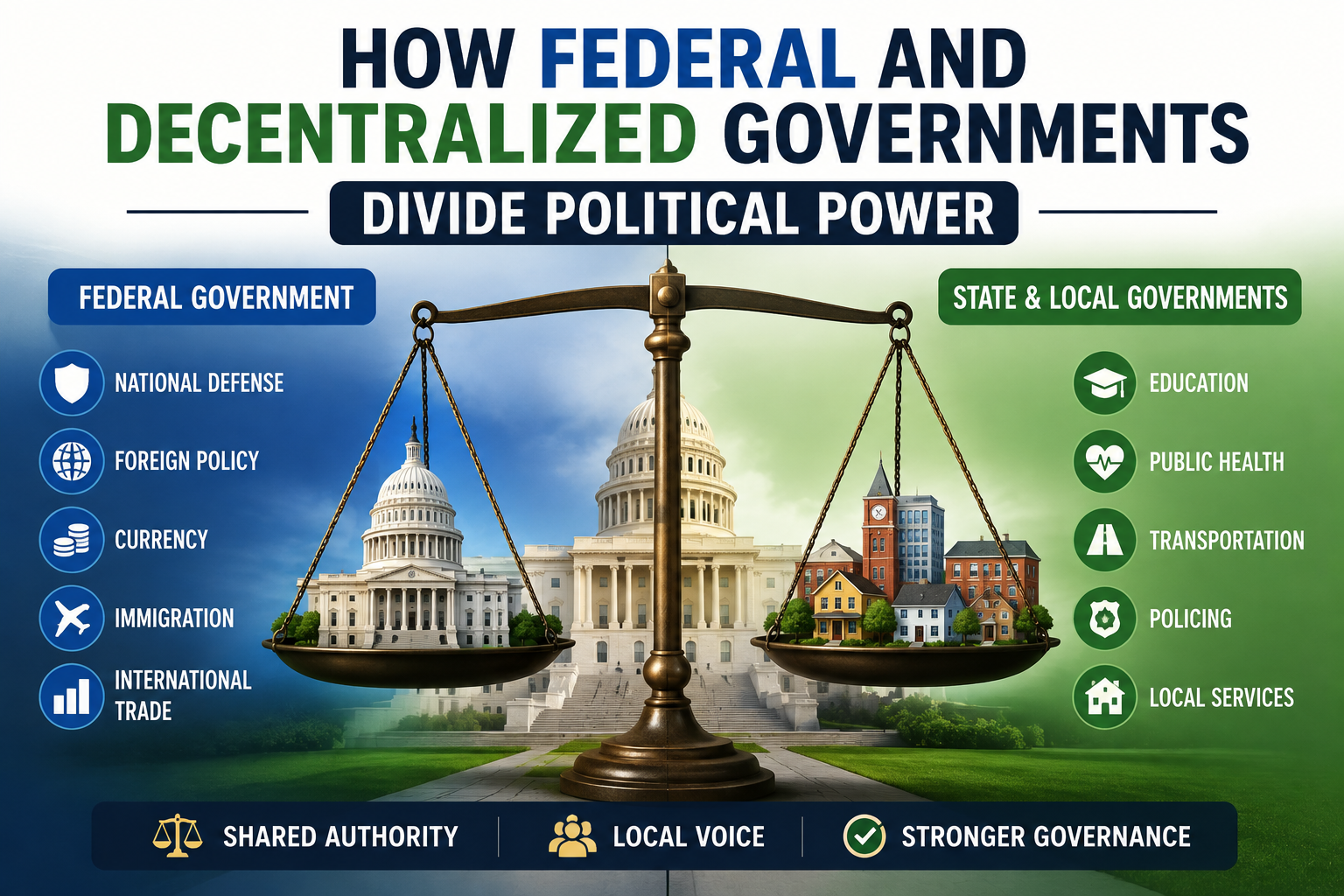
For example, a national government might be responsible for:
- National defense
- Foreign policy
- Currency and monetary affairs
- Immigration
- International trade
- National taxation
Regional governments may control areas such as:
- Education
- Public health
- Local transportation
- Policing
- Land-use regulation
- Regional taxation
The exact division differs from one country to another.
The central principle is that regional governments are not simply administrative branches of the national government. They possess constitutionally recognized authority of their own.
How Federalism Divides Political Power
Federal systems divide power in two major ways.
The first is vertical division, which separates authority between national and regional governments.
The second is horizontal division, which separates government responsibilities among institutions such as legislatures, executives and courts.
This creates multiple layers of political authority.
A national government may establish broad policies while regional governments determine how those policies are implemented locally. In other cases, regional governments can establish their own policies within areas reserved for them by the constitution.
The result is a system in which political power is distributed rather than concentrated in a single government.
Why Countries Adopt Federal Systems
Federalism can be useful for countries with large populations, significant geographic differences or strong regional identities.
Different regions may have different economic conditions, cultural traditions and policy priorities.
A single national policy may not work equally well everywhere.
Giving regional governments meaningful authority allows them to respond to local circumstances.
Federalism can also help prevent excessive concentration of political power. Because authority is divided among multiple governments, national leaders may face institutional limits on what they can decide on their own.
At the same time, federalism can make government more complicated because different levels of government must coordinate their responsibilities.
What Is a Decentralized Government?
Decentralization refers more broadly to the transfer of political, administrative or financial responsibilities from a central government to lower levels of government.
A decentralized country does not necessarily have a federal constitution.
The national government may retain ultimate legal authority over local institutions while allowing them considerable freedom to manage particular areas.
Decentralization can take several forms.
Political decentralization gives local governments greater authority to make decisions.
Administrative decentralization transfers responsibility for implementing public programs.
Fiscal decentralization gives local governments control over revenue collection, spending or budgeting.
These forms can exist independently or together.
Federalism and Decentralization Are Not the Same
The terms are sometimes used interchangeably, but they describe different concepts.
Federalism is primarily a constitutional arrangement.
Decentralization describes how authority is distributed in practice.
A federal constitution can guarantee regional governments certain powers that cannot easily be removed by the national government.
In a decentralized unitary system, however, the national government generally remains constitutionally supreme and can often alter the powers of local authorities through legislation.
This distinction matters during political disputes.
If a regional government in a federation claims that the national government has exceeded its constitutional authority, courts may have to determine which level of government has jurisdiction.
In a decentralized unitary system, the legal relationship between central and local government is usually different.
Local Governments Bring Politics Closer to Citizens
Decentralization can make government more responsive to local needs.
A national government may struggle to understand the specific problems facing individual communities. Local governments are often closer to residents and may have better information about local infrastructure, housing, transportation, sanitation or community services.
For example, a national government might establish broad environmental standards while local authorities determine how waste collection operates in individual communities.
This can make public policy more adaptable.
However, local decision-making can also produce differences between communities.
One region may prioritize public transportation while another invests more heavily in roads. One local government may impose stricter development rules than another.
Decentralization therefore allows variation—but that variation can sometimes become politically controversial.
The Role of Constitutions
Constitutions are especially important in federal systems because they establish the legal boundaries between different levels of government.
They may specify which powers belong to the national government, which belong to regional governments and which are shared.
Constitutional courts can then become important referees in disputes over jurisdiction.
Suppose a national government introduces legislation affecting an area traditionally controlled by regional governments. A regional government may challenge the law, arguing that the national government has exceeded its constitutional powers.
The resulting legal dispute can have major political consequences.
In this way, constitutional rules do more than describe government structures. They establish the boundaries within which political competition occurs.
Shared Powers Can Create Conflict
Not every responsibility fits neatly into one category.
Healthcare, environmental protection, transportation, taxation and economic development often involve multiple levels of government.
A national government might provide funding while regional governments administer programs. Local governments might then deliver services directly to residents.
This creates overlapping responsibilities.
When a policy succeeds, different governments may claim credit. When it fails, those same governments may blame one another.
Political disagreements can therefore emerge over:
- Who should pay for a program
- Who should set standards
- Who should enforce regulations
- Who controls public employees
- Who receives tax revenue
- Who is responsible when services fail
The more responsibilities governments share, the more important coordination becomes.
Money Is One of the Biggest Sources of Political Power
Political authority depends heavily on financial resources.
A government can have legal responsibility for a service but lack sufficient revenue to provide it effectively.
This is why fiscal federalism and fiscal decentralization are so important.
National governments often have access to larger tax bases, while regional and local governments may be responsible for delivering expensive public services.
Transfers, grants and revenue-sharing arrangements can help close that gap.
But financial transfers can also create political tension.
Local leaders may argue that the national government is not providing enough money. National leaders may demand greater accountability for how funds are spent.
The question of who controls public money is therefore often inseparable from the question of who holds political power.
Central Governments Can Still Have Enormous Influence
Decentralization does not necessarily mean that local governments are politically independent.
National governments can influence lower levels of government through funding, national legislation, administrative standards and regulatory requirements.
A central government might give local authorities responsibility for education but determine national curriculum requirements or establish minimum standards.
Similarly, local governments might control infrastructure projects while relying heavily on national grants to finance them.
This creates a relationship in which formal responsibility and practical power may not always be identical.
Federal Systems Can Encourage Policy Experimentation
One advantage of divided political authority is that different regions can try different approaches.
A state or province can introduce a policy on a smaller scale before other governments decide whether to adopt it.
This can create what political scientists sometimes describe as policy experimentation.
If one region develops an effective approach to transportation, education or environmental management, others can study the results.
But experimentation also carries risks.
Different policies can produce unequal outcomes, particularly when residents have very different levels of access to public resources depending on where they live.
Federalism Can Protect Regional Interests
Federal systems can give geographically concentrated political communities a stronger voice.
A region with a distinct economic structure or cultural identity may have greater influence when it controls certain policy areas directly.
Regional governments can also serve as political counterweights to national leaders.
If the national government adopts a controversial policy, regional authorities may challenge it through courts, legislation or administrative decisions, depending on the country’s constitutional framework.
This can strengthen checks and balances.
At the same time, strong regional governments can make national policymaking more difficult when political parties or leaders disagree across levels of government.
Decentralization Can Improve Accountability—or Complicate It
Bringing government closer to citizens can make elected officials easier to monitor.
Residents may find it easier to contact a local representative than a national minister.
Local elections can also give communities a direct way to reward or punish officials for their performance.
But decentralization can create confusion when responsibilities overlap.
If a road deteriorates, for example, residents may not know whether responsibility belongs to a national agency, regional government or municipality.
Effective decentralization therefore requires clear responsibilities and transparent financial arrangements.
Citizens need to know not only who has power but also who is accountable for using it.
Political Parties Operate Across Multiple Levels
Federal and decentralized systems also influence political parties.
A political party may control the national government while losing power in several regional governments.
This creates a complex political environment in which national and regional leaders from the same party may still disagree.
Regional politicians have their own electoral constituencies and may prioritize local concerns over national party strategies.
Opposition parties can also gain influence at the regional level even when they have limited representation nationally.
As a result, elections at different levels can produce very different political landscapes.
Courts Can Become Important Political Actors
When governments disagree about their respective powers, courts often become involved.
Judicial institutions may be asked to determine whether a law or government action falls within the authority of a particular level of government.
These cases can involve major questions about taxation, elections, environmental regulation, education, healthcare and civil rights.
The courts therefore play an important role in maintaining the boundaries of a federal system.
Their decisions can sometimes reshape the balance of power between national and regional governments for years.
The Balance of Power Can Change Over Time
The distribution of political authority is rarely completely static.
Economic crises, wars, technological changes, national emergencies and major political movements can alter the relationship between central and regional governments.
A crisis may lead national governments to take a larger role in areas normally managed locally.
After the crisis passes, political pressure may emerge to return some responsibilities to regional authorities.
Similarly, governments may gradually decentralize responsibilities as local institutions become stronger.
Political systems therefore evolve as societies change.
Technology Is Creating New Questions About Government Power
Digital technology is adding another dimension to debates over centralization and decentralization.
Issues such as data privacy, artificial intelligence, cybersecurity, digital taxation and online platforms can cross regional boundaries almost instantly.
A local government may want to establish its own rules, while national leaders may argue that consistent standards are necessary.
The same tension applies to environmental issues, public health and infrastructure.
Modern problems increasingly cross administrative boundaries, making coordination between levels of government more important.
Finding the Right Balance
Neither federalism nor decentralization automatically produces better government.
The effectiveness of either system depends on institutional design, financial resources, administrative capacity, political culture and the willingness of different levels of government to cooperate.
Too much centralization can make government distant and insensitive to local conditions.
Too much fragmentation can produce inconsistent policies, duplicated services and disputes over responsibility.
The challenge is finding a balance in which national governments can address problems that require national coordination while regional and local governments retain enough authority to respond to the needs of their communities.
Why the Division of Power Matters
The way political power is divided affects almost every aspect of government.
It determines who makes laws, who collects taxes, who provides public services and who is held accountable when policies succeed or fail.
Federal systems formally protect certain powers for regional governments, while decentralized systems can transfer substantial responsibilities to lower levels without necessarily giving those governments constitutional independence.
Both approaches attempt to solve the same fundamental problem: how to govern large and diverse populations without concentrating every political decision in one place.
As countries confront increasingly complex challenges—from economic inequality and climate change to digital technology and public health—the relationship between national, regional and local governments will remain central to political debates.
The most effective systems are likely to be those that make the division of authority clear, give each level enough resources to fulfill its responsibilities and preserve meaningful accountability to the citizens they serve.




2 Comments
Micle harison
June 7, 2019Lorem ipsum dolor sit amet, usu ut perfecto postulant deterruisset, libris causae volutpat at est, ius id modus laoreet urbanitas. Mel ei delenit dolores.
John Doe
June 7, 2019Some consultants are employed indirectly by the client via a consultancy staffing company.