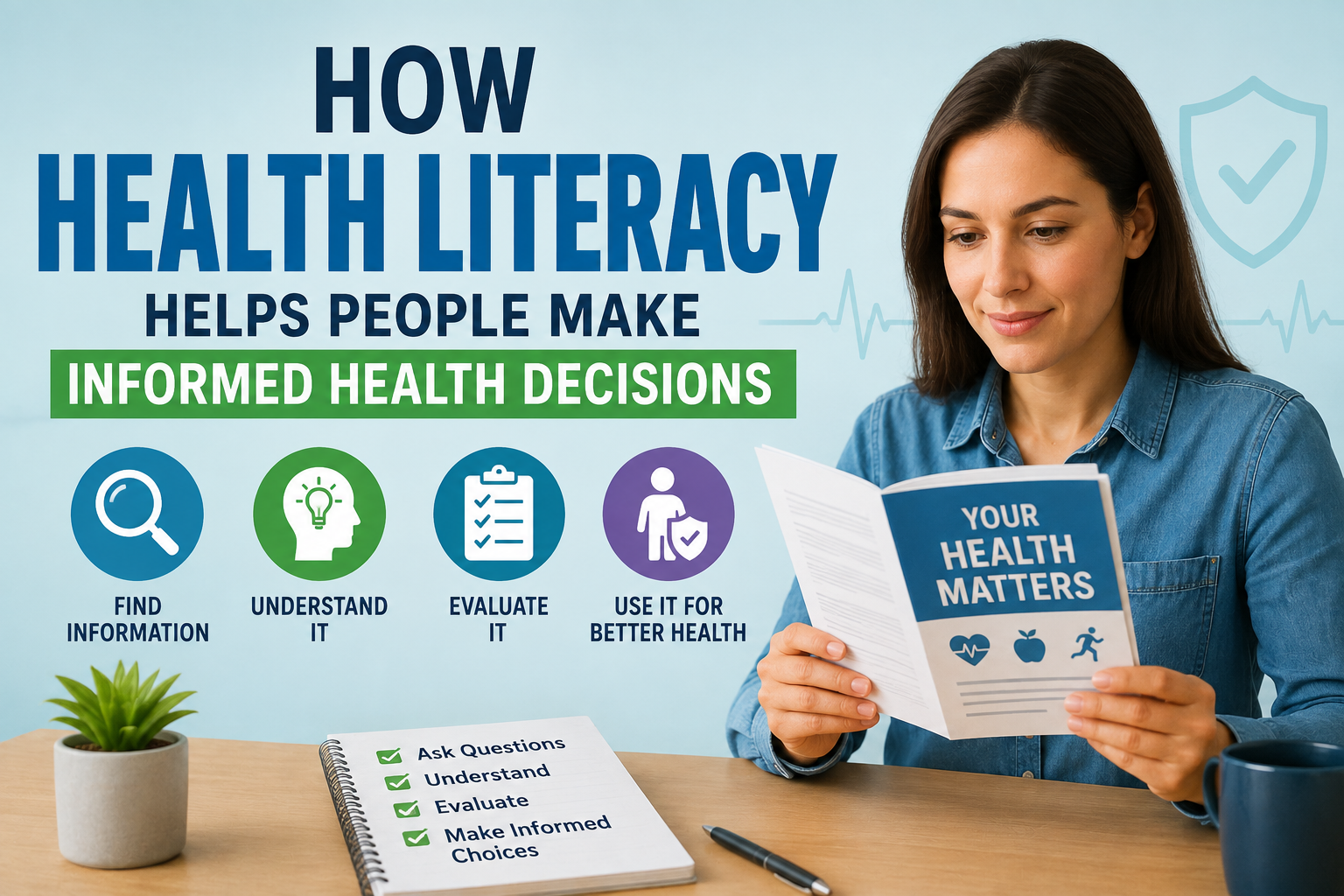
How Health Literacy Helps People Make Informed Health Decisions
Health decisions rarely come with simple answers. Whether someone is deciding whether to get a screening, comparing treatment options, reading a prescription label or trying to understand a new diagnosis, the quality of the decision often depends on how well they can find, understand and use health information.
That ability is known as health literacy.
Health literacy is not simply about knowing medical terms or having a background in science. It involves being able to access trustworthy information, understand what it means, evaluate whether it is reliable and use it to make appropriate decisions. In a world filled with health information from doctors, websites, social media, advertisements and artificial intelligence tools, these skills have become increasingly important.
What Is Health Literacy?
Health literacy describes the ability to obtain, understand, evaluate and use health information and services in ways that support appropriate health decisions.
A person with strong health literacy does not necessarily know everything about medicine. Instead, they know how to ask useful questions, recognize when information is unclear, identify trustworthy sources and seek professional guidance when necessary.
For example, someone reading a medication label may need to understand:
- How much of the medicine to take
- How often to take it
- Whether it should be taken with food
- Which side effects may require medical attention
- Whether other medicines could interact with it
- How the medicine should be stored
These may seem like straightforward instructions, but misunderstanding even one important detail can affect how safely a medication is used.
Health literacy therefore plays a role in everyday decisions as well as major medical choices.
Why Health Literacy Matters
People make health-related decisions constantly, often without realizing how much information is involved.
Choosing foods, deciding whether to seek medical care, following treatment instructions, interpreting health measurements and deciding which health claims to believe all require some level of health literacy.
Good health literacy can help people become more active participants in their own healthcare rather than relying entirely on others to interpret information for them.
It can also make conversations with healthcare professionals more productive. Someone who understands basic health information may be better prepared to describe symptoms, explain concerns and ask questions about available options.
That does not mean patients are expected to diagnose themselves. Rather, health literacy can help people recognize the limits of what they know and understand when professional advice is needed.
Health Literacy Helps People Ask Better Questions
One of the most practical benefits of health literacy is that it can improve the questions people ask.
A patient who has been told that they need a particular test, for example, may want to know:
- Why is this test being recommended?
- What could the results show?
- What happens if the result is normal?
- What happens if it is abnormal?
- Are there alternatives?
- Are there risks or side effects?
- How quickly are the results expected?
These questions can help turn a passive healthcare encounter into a more informed conversation.
Importantly, asking questions does not mean challenging a healthcare professional unnecessarily. It means making sure the person receiving care understands what is being recommended and why.
It Helps People Evaluate Health Information Online
The internet has made health information easier to access than ever, but accessibility does not guarantee accuracy.
Search engines and social media can produce thousands of results for almost any health question. Some may come from hospitals, universities or government health agencies. Others may come from commercial websites, influencers, anonymous accounts or people promoting products.
Health literacy helps people distinguish between these sources.
When reading a health claim online, it can be useful to consider:
- Who published the information?
- Is the source identifiable and credible?
- What evidence supports the claim?
- Is the information current?
- Does the article distinguish between evidence and opinion?
- Is the source trying to sell something?
- Does the headline make a stronger claim than the evidence supports?
These questions are particularly important because health misinformation can spread quickly when emotionally compelling claims are presented as established facts.
Understanding Risk Is a Key Part of Health Literacy
Health decisions often involve risk, and risk can be difficult to interpret.
A statement that something “doubles the risk” of a particular outcome may sound alarming. But without knowing the original risk, the statement may not provide enough information to understand the actual likelihood.
Health-literate decision-making involves looking beyond dramatic numbers and asking what they mean in context.
For example, people may need to distinguish between:
- Absolute risk and relative risk
- Common and rare side effects
- Short-term and long-term risks
- Potential benefits and potential harms
- Association and causation
Understanding these distinctions can make health information less confusing and help people avoid decisions based solely on fear or exaggerated claims.
Health Literacy Can Improve Medication Safety
Medication is another area where health literacy can make a practical difference.
People may encounter complicated instructions involving dosage, timing, food, storage, missed doses and possible interactions. Confusion can become more likely when someone takes several medicines or receives prescriptions from different healthcare providers.
Reading instructions carefully and asking a pharmacist or healthcare professional for clarification can help reduce avoidable mistakes.
People should also be cautious about assuming that a medicine is safe simply because it is available without a prescription. Over-the-counter medicines can still have side effects, interact with other drugs or be inappropriate for certain people.
The same principle applies to supplements. “Natural” does not automatically mean risk-free, and health claims made in advertisements may not reflect the strength of scientific evidence.
Health Literacy Is Especially Important for Preventive Care
Many health decisions involve preventing problems rather than treating an existing illness.
Screenings, vaccinations, healthy eating, physical activity, dental care and routine checkups all involve decisions about potential benefits and risks.
Health literacy can help people understand why preventive measures are recommended and whether a particular recommendation applies to them.
It can also help people avoid two opposite mistakes: ignoring useful preventive care or pursuing unnecessary tests and treatments simply because they sound beneficial.
The goal is not to follow every health recommendation blindly. It is to understand the reasoning behind recommendations and discuss individual circumstances with qualified professionals.
It Can Help People Recognize When They Need Medical Care
Health literacy is not just about interpreting information. It can also help people recognize when a health concern deserves professional attention.
Online information can sometimes encourage people to diagnose themselves based on a list of symptoms. That approach can be misleading because many different conditions can produce similar symptoms.
A health-literate approach is to use general information as a starting point rather than treating an internet search as a diagnosis.
It also means understanding that some symptoms may require prompt medical evaluation, particularly when they are severe, sudden or rapidly worsening.
When in doubt, seeking advice from an appropriate healthcare professional is generally more reliable than attempting to resolve an important medical question through online searches alone.
Health Literacy and Communication Go Hand in Hand
Healthcare is a two-way process.
Doctors, nurses, pharmacists and other healthcare professionals have a responsibility to communicate information clearly. Patients, meanwhile, benefit when they feel comfortable asking questions and explaining when they do not understand something.
A person should not feel embarrassed about asking a healthcare professional to explain a medical term in simpler language.
Useful phrases include:
“Can you explain that in simpler terms?”
“What are my options?”
“What are the benefits and risks?”
“What should I watch for?”
“What should I do if this gets worse?”
These questions can help clarify important information without requiring a person to have specialized medical knowledge.
Health Literacy Does Not Mean Navigating Healthcare Alone
There is sometimes a misconception that people with strong health literacy should be able to solve health problems independently.
That is not the goal.
Healthcare decisions can be complicated, and even highly educated people can struggle to interpret unfamiliar medical information. A diagnosis may involve specialized terminology, uncertain outcomes and multiple treatment options.
Health literacy is better understood as the ability to participate effectively in that process.
It helps people know what information they need, where to find it, what questions to ask and when to rely on professional expertise.
The Growing Challenge of Health Information on Social Media
Social media has changed the way many people encounter health information.
A medical claim can reach millions of people before its accuracy has been properly examined. Videos and posts may present personal experiences as if they were universal evidence, while algorithms can repeatedly expose users to similar claims.
Personal experiences can be meaningful, but they do not necessarily establish that a treatment or lifestyle choice will produce the same result for everyone.
Health literacy encourages people to separate personal anecdotes from broader scientific evidence and to look for reliable sources before making important decisions.
This becomes particularly important when claims involve serious medical conditions, treatments or products that could have significant consequences.
AI Is Adding a New Layer to Health Literacy
Artificial intelligence is making health information even easier to generate and access.
AI tools can explain medical terminology, summarize general information and help users prepare questions for healthcare appointments. At the same time, AI-generated information can be incomplete, outdated, misleading or presented with more confidence than the evidence warrants.
That means modern health literacy increasingly includes knowing how to use AI responsibly.
People should treat AI as an information and preparation tool rather than a substitute for diagnosis or individualized medical care. Important medical decisions should be discussed with qualified healthcare professionals who can consider a person’s circumstances, medical history and other relevant factors.
The ability to question an AI-generated answer is becoming just as important as the ability to understand a traditional health article.
How to Build Better Health Literacy
Improving health literacy does not require memorizing large amounts of medical information.
A few practical habits can make a significant difference:
- Use reliable sources. Favor established healthcare organizations, government health agencies, universities and recognized medical institutions.
- Check the date. Medical guidance and scientific understanding can change.
- Look for evidence. Be cautious when a major health claim is supported only by anecdotes or testimonials.
- Compare information. If a claim appears unusual or dramatic, check whether reputable independent sources report the same thing.
- Ask questions. Healthcare professionals can clarify information that is difficult to interpret.
- Understand numbers in context. Ask whether statistics describe absolute or relative risk.
- Be skeptical of miracle claims. Promises of guaranteed cures or effortless results deserve particular scrutiny.
- Keep personal medical information organized. Knowing your medications, allergies, medical history and relevant test results can make healthcare conversations easier.
- Know your limits. Recognizing when professional help is necessary is itself an important health-literacy skill.
Health Literacy Can Support Better Long-Term Decisions
The value of health literacy extends beyond individual appointments.
People who are more comfortable evaluating health information may be better equipped to make decisions about preventive care, medications, lifestyle choices and when to seek professional help. They may also be less vulnerable to misleading health claims designed to exploit fear, confusion or unrealistic expectations.
But responsibility does not rest entirely with individuals. Healthcare systems, professionals, public agencies and health-information publishers also have an important role in making information understandable and accessible.
Clear communication matters because even accurate information is not very useful if people cannot understand or apply it.
Making Health Information Work for Real Life
Good health decisions rarely come from finding a single perfect answer online. They are more often the result of understanding reliable information, considering personal circumstances, asking informed questions and working with qualified healthcare professionals.
That is what makes health literacy so valuable.
As the volume of medical information continues to grow—and as social media and AI make that information increasingly accessible—the ability to separate useful evidence from misleading claims will become even more important. Health literacy gives people a practical framework for doing exactly that: find better information, understand it, question it when necessary and use it wisely.


2 Comments
Micle harison
June 7, 2019Lorem ipsum dolor sit amet, usu ut perfecto postulant deterruisset, libris causae volutpat at est, ius id modus laoreet urbanitas. Mel ei delenit dolores.
John Doe
June 7, 2019Some consultants are employed indirectly by the client via a consultancy staffing company.