
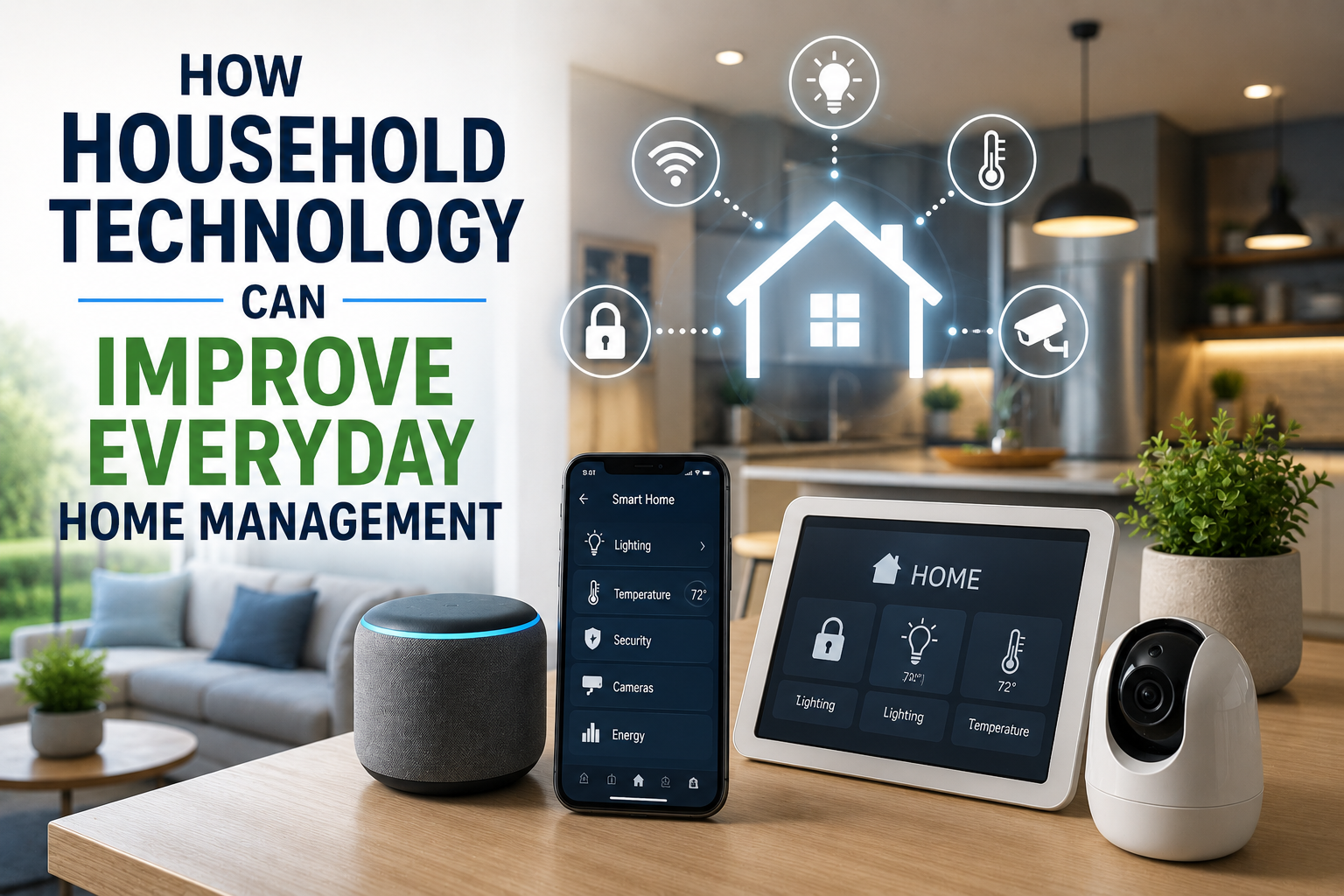
How Household Technology Can Improve Everyday Home Management
Managing a home involves dozens of small tasks that can quickly become overwhelming. Keeping rooms clean, monitoring energy use, remembering maintenance schedules, managing groceries and making sure appliances are working properly all require time and attention.
Household technology is changing how many of these responsibilities are handled.
From smart thermostats and connected lighting to robotic cleaning devices and digital home-management tools, modern technology can automate repetitive jobs, provide useful information and help households make better decisions about how they use their time and resources.
The goal, however, is not to turn every home into a futuristic showcase. The most useful technology is often the technology that quietly solves everyday problems without creating more work.
Smart Technology Can Take Care of Repetitive Tasks
One of the biggest advantages of household technology is automation.
A smart thermostat can adjust heating or cooling according to schedules and occupancy patterns. Smart lights can switch off automatically when rooms are empty. Robotic vacuum cleaners can run according to a schedule rather than waiting for someone to remember to start them.
These features may appear small individually, but repetitive tasks can consume considerable time over weeks and months.
Automation allows households to establish routines once and let technology handle some of the follow-through.
That can be particularly useful for people managing busy work schedules, children, pets or multiple household responsibilities.
Smart Home Devices Can Make Energy Use More Visible
Energy consumption is another area where technology can make household management easier.
Traditional utility bills show how much energy a home used over a billing period, but they provide limited information about which appliances or habits contributed to that consumption.
Smart plugs, connected thermostats and energy-monitoring systems can provide more detailed information.
A household might discover, for example, that an appliance continues drawing power when it is not being actively used or that heating and cooling account for a large portion of its energy consumption.
Once people can see patterns, they can make more informed decisions.
Technology does not automatically reduce energy use. Its value comes from giving households information and control that can make efficient choices easier.
Smart Lighting Can Simplify Daily Routines
Lighting is one of the simplest ways to introduce automation into a home.
Smart bulbs and switches can be programmed to follow schedules, respond to motion or be controlled remotely.
A household could create a routine that turns selected lights on in the evening and switches them off at bedtime. Motion sensors can also reduce the need to search for switches in dark hallways or rooms.
For families, these features can make routines more convenient without requiring complicated systems.
The best lighting automation is often the kind that becomes almost invisible once it is configured.
Connected Appliances Can Help With Household Chores
Modern appliances increasingly include sensors, timers and connectivity features designed to make routine chores easier.
Smart washing machines, dryers, ovens, dishwashers and refrigerators can provide alerts, monitor cycles or allow users to control certain functions remotely.
A washing machine, for example, might notify someone when a cycle has finished. A connected oven could send an alert when cooking is complete.
These functions do not eliminate household chores, but they can reduce the amount of attention required to manage them.
That distinction matters.
Technology is often most useful when it reduces the mental effort associated with routine tasks rather than simply adding another gadget to the home.
Robot Vacuums Can Handle Routine Floor Cleaning
Robotic vacuum cleaners have become one of the more recognizable examples of household automation.
Modern models can map rooms, identify obstacles, schedule cleaning sessions and return to charging stations automatically. Some advanced systems can also mop floors or empty their own dust containers.
Their greatest advantage is consistency.
Instead of relying entirely on a person to find time for frequent vacuuming, a robot can perform routine cleaning according to a predetermined schedule.
However, these devices are not replacements for every type of cleaning. Stairs, corners, cluttered areas and heavily soiled surfaces may still require manual attention.
Their value is greatest when they handle everyday maintenance and reduce the amount of deeper cleaning needed later.
Smart Home Sensors Can Provide Useful Alerts
Sensors can quietly monitor conditions around the house.
Water-leak sensors can detect moisture near washing machines, sinks or water heaters. Smoke and carbon-monoxide detectors can send alerts when potentially dangerous conditions are detected. Door and window sensors can provide notifications when an entry point is opened.
These systems can be particularly useful when nobody is home.
A small leak discovered early can potentially prevent a much larger repair problem. Similarly, an alert about an unexpected door opening can provide useful information when residents are away.
The technology is not a substitute for regular inspections, but it can provide another layer of awareness.
Home Security Technology Has Become More Accessible
Connected cameras, video doorbells and smart locks have also changed how households manage security.
A video doorbell can allow residents to see who is at the door without physically answering it. Smart locks can provide temporary access codes for family members, guests or service providers.
Cameras can offer remote visibility around entrances, driveways and other areas of a property.
But convenience should be balanced with privacy and cybersecurity.
Households should use strong, unique passwords, enable multifactor authentication when available and keep connected devices updated. Devices that connect to the internet can create security risks if they are poorly configured or neglected.
Digital Tools Can Help Organize Household Responsibilities
Not all useful household technology involves physical devices.
Shared calendars, shopping-list applications, budgeting tools and task-management platforms can help families coordinate responsibilities.
A shared digital list can prevent multiple people from buying the same groceries. A calendar can track school events, appointments and household maintenance. A task-management system can make it easier to divide chores among family members.
This can reduce one of the less visible challenges of home management: remembering everything.
A household may not have a shortage of time so much as a shortage of reliable systems for keeping track of what needs to happen and when.
Technology Can Help With Maintenance
Preventive maintenance is one of the easiest household responsibilities to overlook.
Air filters need replacing. Appliances require cleaning. Gutters need attention. Smoke-detector batteries may need checking. Heating and cooling systems require periodic servicing.
Digital reminders can turn these tasks into scheduled routines.
Some connected appliances can go further by monitoring their own condition and notifying users when maintenance may be required.
That can help homeowners move from a reactive approach—fixing things after they fail—to a preventive approach that identifies potential problems earlier.
Smart Irrigation Can Improve Outdoor Home Management
Technology can also extend beyond the walls of the house.
Smart irrigation controllers can adjust watering schedules based on factors such as weather conditions, soil moisture or local requirements.
Instead of running sprinklers according to a fixed schedule regardless of conditions, a connected system can make watering decisions using additional information.
This can help reduce unnecessary water use while keeping landscapes healthy.
As water efficiency becomes increasingly important in many regions, technology can provide households with greater control over outdoor consumption.
Household Technology Can Reduce Mental Load
One of the most important benefits of home technology may be difficult to measure.
It can reduce the number of small decisions people have to make throughout the day.
When lights turn off automatically, a robot vacuum cleans according to schedule, a calendar reminds someone about maintenance and a sensor sends an alert about a leak, the household does not have to rely on memory for every task.
This is sometimes described as reducing mental load.
The technology does not necessarily eliminate responsibility. Instead, it moves some responsibility from constant remembering to setting up systems that handle predictable tasks automatically.
That can make everyday home management feel more manageable.
More Technology Does Not Always Mean a Better Home
There is a potential downside to smart-home technology: complexity.
Adding too many devices can create multiple apps, accounts, passwords and notifications. A system designed to make life easier can become frustrating if it requires constant troubleshooting.
Compatibility is another concern.
Not every smart device works seamlessly with every ecosystem. Before purchasing a connected appliance or accessory, homeowners should consider whether it will integrate with the devices they already own.
A simple timer may sometimes be more useful than an expensive connected device.
The right question is not “What can I automate?” but “What recurring problem am I trying to solve?”
Privacy Should Be Part of the Buying Decision
Connected household devices can collect significant amounts of information.
Depending on the product, that information may include activity patterns, location data, recordings, usage statistics or information about when people are home.
Consumers should therefore look beyond features and prices when choosing smart-home products.
Privacy policies, data-storage practices, security updates and account controls all matter.
Devices with microphones and cameras deserve particular attention because they can collect information from inside or around the home.
A convenient device is not necessarily a good purchase if its privacy and security practices are unacceptable to the household.
Automation Works Best When It Supports Human Habits
Technology is most effective when it fits naturally into existing routines.
A household that rarely uses an app may not benefit from an appliance that requires constant smartphone interaction. Someone who prefers manual controls may find a complicated smart system more frustrating than useful.
Before adopting new technology, homeowners can identify repetitive tasks that are:
- Frequently forgotten
- Time-consuming
- Predictable enough to automate
- Difficult to monitor manually
- Expensive when mistakes occur
Those are usually the strongest candidates for technological assistance.
Starting with one problem can also make it easier to determine whether automation genuinely improves the household.
The Connected Home Is Becoming More Practical
Household technology is gradually moving away from being primarily about novelty and toward solving practical problems.
The most valuable developments are not necessarily the devices with the longest feature lists. They are systems that help households save time, reduce waste, identify problems early and coordinate responsibilities.
A smart thermostat that quietly manages temperature, a leak sensor that provides an early warning or a shared digital calendar that keeps a family organized can have a greater practical impact than a collection of flashy gadgets.
As connected devices become more interoperable and easier to configure, household technology could increasingly operate in the background rather than demanding constant attention.
The best-connected home may ultimately be the one where technology is barely noticed—because it simply makes everyday life work a little more smoothly.





2 Comments
Micle harison
June 7, 2019Lorem ipsum dolor sit amet, usu ut perfecto postulant deterruisset, libris causae volutpat at est, ius id modus laoreet urbanitas. Mel ei delenit dolores.
John Doe
June 7, 2019Some consultants are employed indirectly by the client via a consultancy staffing company.