
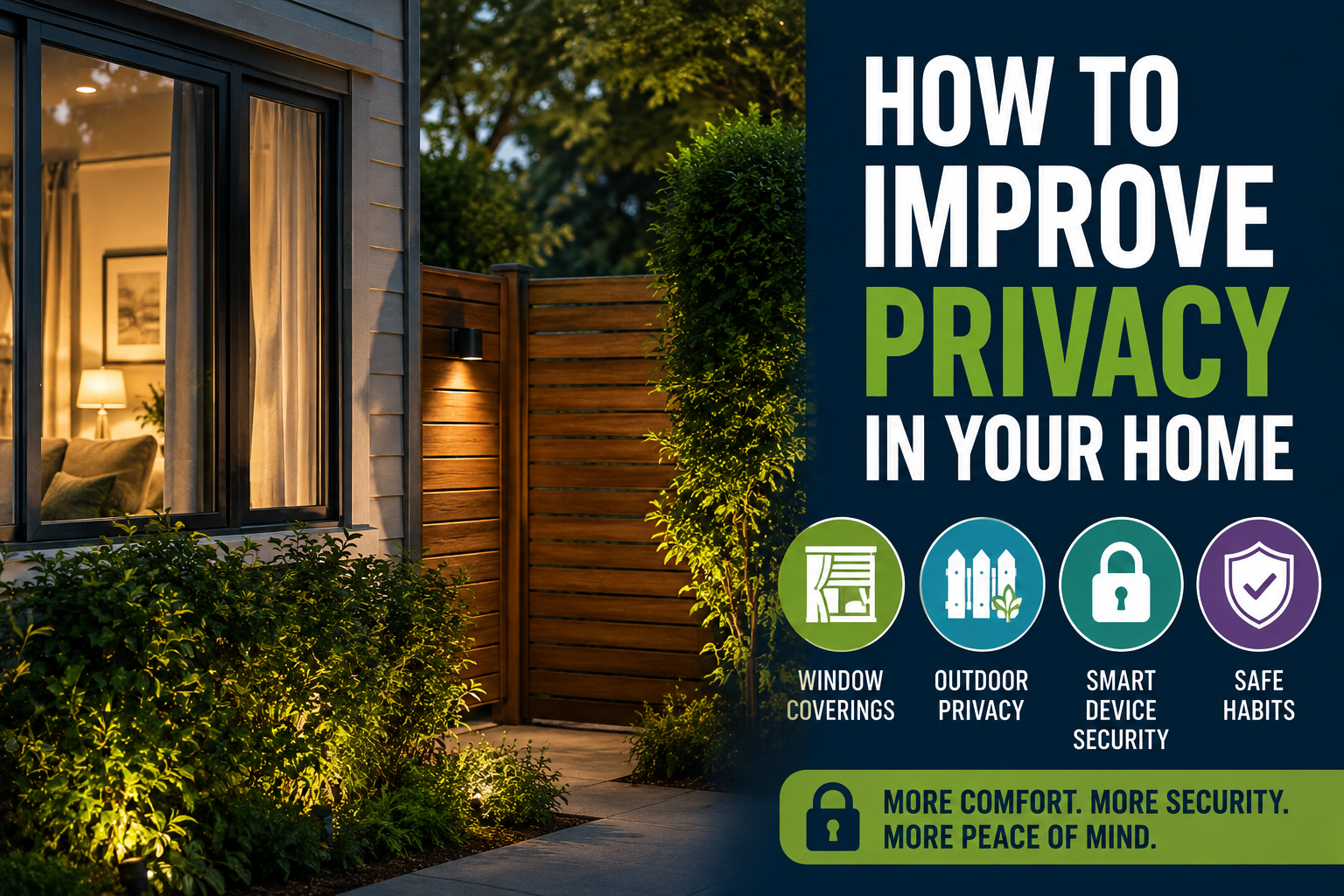
How to Improve Privacy in Your Home
Privacy at home can feel harder to maintain than it once did. Open floor plans, large windows, connected devices, smart doorbells and increasingly dense neighborhoods can all create situations where people feel more exposed.
The good news is that improving home privacy does not always require expensive renovations or elaborate security systems. Small changes to windows, doors, landscaping, lighting and technology can significantly reduce unwanted visibility and limit how much information leaves your home.
The best approach is to think about privacy as a combination of physical barriers, visual control, sound management and digital awareness.
Start by Identifying Where Privacy Is Being Lost
Before buying curtains, installing fencing or changing smart-home settings, walk through your home and identify where privacy is actually weakest.
Look at the property from both inside and outside. Pay attention to:
- Windows that face streets or neighboring homes
- Glass doors that provide direct views indoors
- Bedrooms and bathrooms visible from outside
- Areas overlooked by nearby buildings
- Gaps in fencing or landscaping
- Outdoor spaces exposed to neighbors
- Smart devices that collect information about your household
- Conversations that can easily be heard outside
Privacy problems can be different from room to room. A living room facing a busy street may need visual screening, while a bedroom may benefit from both window coverings and better placement of furniture.
Once the vulnerable areas are identified, solutions become much easier to prioritize.
Improve Window Privacy
Windows are among the biggest sources of unwanted visibility.
During the day, sheer curtains, blinds or privacy films can prevent people outside from having a clear view indoors while still allowing natural light into the room.
For bedrooms, bathrooms and other private areas, more substantial coverings may be appropriate.
Options include:
- Roller shades
- Cellular shades
- Venetian blinds
- Curtains
- Frosted window film
- Decorative privacy film
- Exterior shutters
Window film can be particularly useful when you want to preserve daylight without leaving the glass completely exposed.
However, privacy products should be selected with lighting conditions in mind. A window that appears private during daylight hours may become much more revealing at night when interior lights are switched on.
Use Layered Window Coverings
There is no requirement to choose between natural light and privacy.
Layered window treatments can provide flexibility throughout the day. For example, sheer curtains can soften visibility during daylight hours while heavier curtains can be closed when greater privacy is needed.
Blinds can also be adjusted depending on the direction of sunlight and the viewing angle from outside.
The key is to create a system that is easy to use. A privacy solution that requires constant adjustment may eventually be left open simply because it becomes inconvenient.
Think Carefully About Furniture Placement
Furniture can influence privacy more than people realize.
A sofa positioned directly in front of a street-facing window may leave people sitting inside more exposed than necessary. Similarly, placing a desk or television directly opposite a window can make activities inside easier to see.
Consider positioning furniture so that the most private parts of a room are farther from direct sightlines.
Tall bookcases, cabinets and strategically positioned plants can also break up views without making a room feel completely enclosed.
Create Outdoor Privacy With Landscaping
Plants can provide an attractive alternative to walls and fences.
Trees, shrubs, hedges and climbing plants can create natural visual barriers between a home and surrounding properties.
Evergreen plants can be particularly useful where year-round screening is important. However, landscaping should be planned carefully to avoid creating maintenance problems or blocking important sightlines.
A layered planting approach can work well. Taller trees can provide upper-level screening, while shrubs and smaller plants can protect lower areas.
Landscaping can also improve the appearance of a property while providing shade and habitat for wildlife.
Make Fences Work for You
Fencing can provide an immediate privacy barrier, particularly around patios, gardens and outdoor seating areas.
But a completely solid fence is not always necessary.
Privacy screens, lattice panels, slatted fencing and combinations of fencing with plants can create separation without making an outdoor space feel closed off.
Local regulations, property boundaries and homeowners association rules may affect what can be installed, so homeowners should check applicable requirements before making major changes.
Pay Attention to Second-Story Views
Privacy planning often focuses on people at ground level, but nearby upper-floor windows can create a different problem.
A backyard that feels private from the street may still be visible from a neighboring second story.
Trees, taller shrubs, pergolas, shade structures and carefully positioned outdoor screens can help address these sightlines.
When planning landscaping, look upward as well as outward. Privacy is three-dimensional.
Reduce Noise That Travels Outside
Privacy is not only about what people can see.
Conversations, television sounds, music and other household noises can sometimes travel through open windows, thin walls or poorly sealed doors.
Soft furnishings can help absorb sound inside a room. Rugs, curtains, upholstered furniture and bookshelves can reduce echoes and limit the amount of sound that travels through a space.
For greater sound control, homeowners may consider improvements such as weatherstripping, door sweeps, acoustic panels or additional insulation where appropriate.
These changes can improve both privacy and comfort.
Seal Gaps Around Doors and Windows
Small gaps around doors and windows can create both privacy and energy-efficiency problems.
Weatherstripping around movable doors and windows can reduce air movement and may also reduce the transmission of outdoor noise.
A solid exterior door with a good seal can provide more privacy than a lightweight interior-style door.
Pay particular attention to doors leading directly outside, especially those near bedrooms, home offices and other areas where quiet matters.
Be Strategic With Outdoor Lighting
Outdoor lighting can improve safety, but excessive lighting can sometimes reduce privacy.
Bright lights shining directly into windows can make indoor activity more visible at night.
Instead, consider directing outdoor lights toward pathways, entrances and other areas that actually need illumination. Motion-activated lighting can also reduce unnecessary illumination.
Shielded fixtures can help keep light focused where it belongs rather than sending it into neighboring properties or through windows.
Review Smart Home Devices
Connected devices can introduce a different kind of privacy concern.
Smart speakers, cameras, televisions, doorbells, security systems and other connected products can collect or process information about household activity.
Homeowners should regularly review the privacy and security settings of these devices.
Useful steps include:
- Change default passwords.
- Use strong, unique passwords for important accounts.
- Enable multi-factor authentication when available.
- Keep device software and firmware updated.
- Review which devices have microphones or cameras.
- Disable features that are not needed.
- Check account access and remove old users.
- Review cloud-storage and recording settings.
A device does not need to be dangerous to create a privacy concern. Sometimes the issue is simply collecting more information than the household actually needs to share.
Think About Smart Doorbells and Security Cameras
Security cameras can improve awareness around a property, but their placement matters.
Cameras should generally be aimed at the areas homeowners actually need to monitor rather than unnecessarily capturing neighboring homes or private spaces.
Before installing a camera, consider its field of view, recording settings and who can access the footage.
The same principle applies to indoor cameras. A camera placed inside a living area can provide useful security information, but it also introduces a device capable of observing household activity.
When privacy and security conflict, careful placement and restrictive settings can help achieve both goals.
Protect Your Home Wi-Fi Network
Home privacy increasingly depends on network security.
A poorly secured Wi-Fi network can expose connected devices and potentially give unauthorized users access to information moving across the network.
Homeowners should use the security settings supported by their router, create a strong Wi-Fi password and keep the router’s firmware updated.
It can also be useful to separate unfamiliar or less-trusted smart devices from computers and other devices containing sensitive information when the router supports guest or segmented networks.
Changing the router’s default administrative password is another basic but important step.
Be Careful About What You Share Online
Privacy can be compromised without anyone physically looking through a window.
Public posts can reveal information about a home, daily routines, travel plans and possessions.
Photos can unintentionally show house numbers, street signs, security equipment, keys, documents or views through windows.
Before posting a photograph, consider what information someone could learn by examining the background.
Avoid publicly sharing details that make it easy to determine when a home is unoccupied, particularly while traveling.
Keep Important Documents Out of Sight
Paper documents can contain a surprising amount of personal information.
Bank statements, tax documents, medical correspondence, identification documents and bills should not be left where visitors or people passing through the home can easily see them.
A secure filing cabinet or locked storage container can provide an additional layer of protection.
Sensitive documents that are no longer needed should also be disposed of carefully rather than simply placed intact in an ordinary trash bin.
Consider Privacy When Renovating
Privacy is easiest to address when it is incorporated into a renovation rather than added as an afterthought.
During a remodel, homeowners can consider:
- Window placement
- Frosted or textured glass
- Interior doors
- Sound insulation
- Room layouts
- Landscaping
- Fence placement
- Exterior lighting
- Smart-home wiring and device locations
For example, a bathroom window can be positioned for natural light while using frosted glass to eliminate direct visibility.
A home office can be positioned away from the most visible part of the property, reducing both visual and noise exposure.
Avoid Making the Home Feel Like a Fortress
Privacy improvements do not have to make a home dark, isolated or unwelcoming.
The goal is selective privacy.
A well-designed home can maintain open views toward attractive landscapes while blocking sightlines into bedrooms, bathrooms and other private areas.
Plants, curtains, architectural screens and thoughtful lighting can often achieve this without creating an oppressive environment.
Good privacy design should make residents feel comfortable rather than constantly remind them that they are being protected.
A Practical Privacy Checkup
Improving privacy does not have to happen all at once.
Start with the areas where exposure is most obvious. Close the curtains at night, reposition furniture, add screening to an overlooked patio or adjust a smart camera’s field of view.
Then examine digital privacy. Review connected devices, account permissions and Wi-Fi security.
Finally, reassess the property from the perspective of someone outside. Walk around the home during both daylight and nighttime hours and look for windows, outdoor spaces or household activities that are more visible than expected.
Privacy is rarely created by one expensive product. It is built through a series of small decisions about what people can see, what they can hear and what information your home and devices reveal.
When those decisions become part of everyday home design, a property can remain open, comfortable and connected while giving the people who live there greater control over their personal space.


2 Comments
Micle harison
June 7, 2019Lorem ipsum dolor sit amet, usu ut perfecto postulant deterruisset, libris causae volutpat at est, ius id modus laoreet urbanitas. Mel ei delenit dolores.
John Doe
June 7, 2019Some consultants are employed indirectly by the client via a consultancy staffing company.