
How to Control Home Humidity Levels
Humidity is one of those parts of indoor comfort that can be easy to overlook until it becomes a problem. A home that feels sticky in summer, develops condensation on windows, smells musty or repeatedly struggles with mold may have humidity levels that are too high.
Low humidity can create a different set of problems, including dry skin, irritated airways, static electricity and shrinking or cracking of some wood products.
Keeping indoor humidity within a comfortable range can make a home feel better while also helping protect walls, floors, furniture and other household materials. The good news is that controlling humidity does not always require expensive equipment. Simple changes in ventilation, air conditioning, moisture management and daily habits can make a meaningful difference.
What Is Home Humidity?
Humidity refers to the amount of water vapor present in the air.
The measurement most commonly used inside homes is relative humidity, expressed as a percentage. Relative humidity describes how much moisture the air contains compared with the maximum amount it can hold at a particular temperature.
Warm air can hold more water vapor than cold air. That means the same amount of moisture can produce different relative humidity readings depending on the temperature.
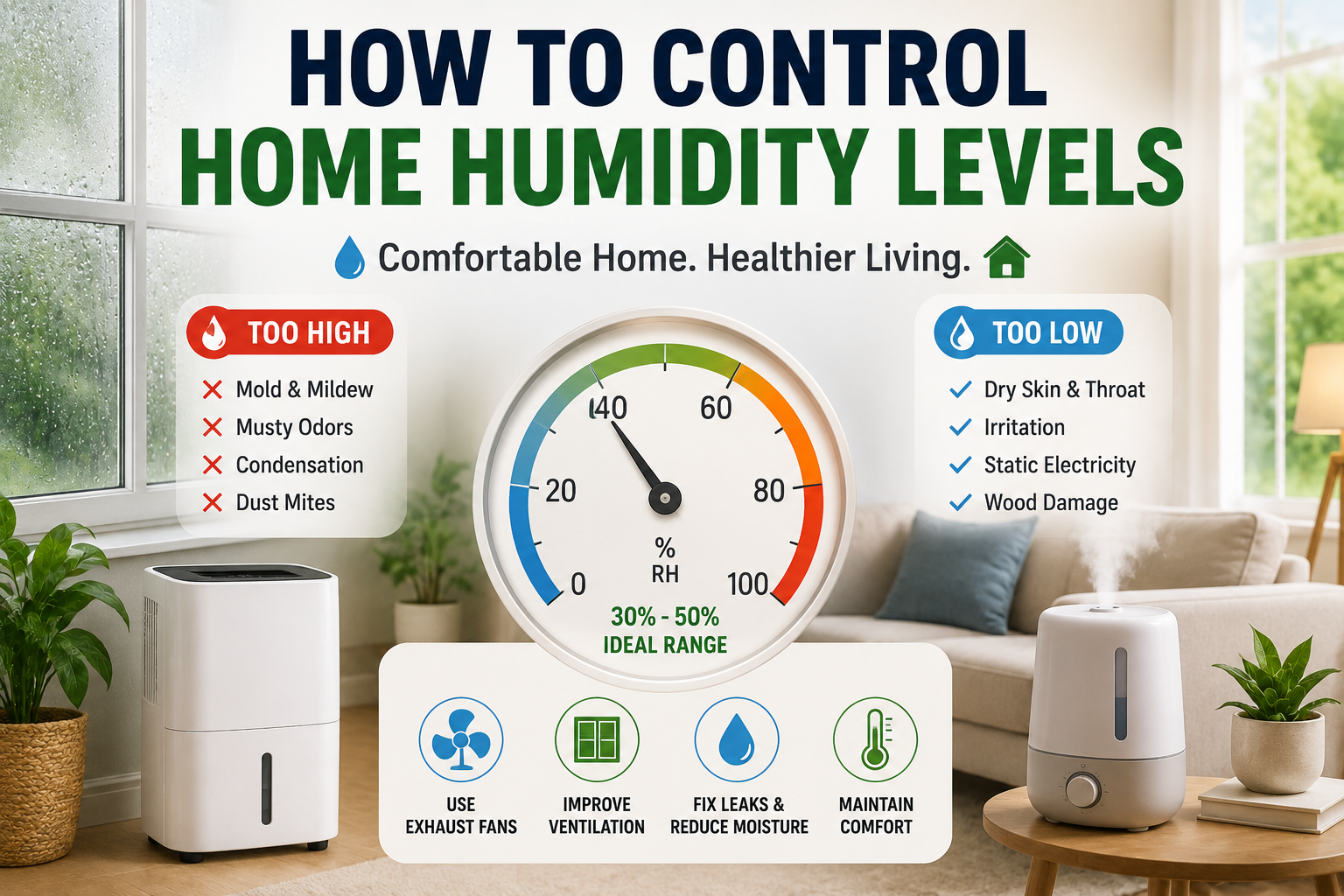
For most homes, an indoor relative humidity of roughly 30% to 50% is a useful general target. Individual circumstances can vary, however, and some people may prefer slightly different levels for comfort.
A simple digital hygrometer can show the relative humidity in a room and is an inexpensive way to determine whether a problem actually exists.
Why Excess Humidity Can Become a Problem
High indoor humidity can make a home feel warmer and less comfortable because sweat evaporates less efficiently from the skin.
More importantly, persistent moisture can contribute to household maintenance problems.
When warm, humid air encounters a sufficiently cold surface, water can condense. This commonly happens around windows, exterior walls, pipes and poorly insulated areas.
Repeated condensation can contribute to:
- Mold and mildew growth
- Musty odors
- Peeling paint
- Damaged wallpaper
- Deterioration of some building materials
- Moisture-related damage to furniture
- Increased dust mite activity
The longer moisture remains uncontrolled, the greater the opportunity for problems to develop.
How to Measure Humidity at Home
Before trying to solve a humidity problem, measure it.
A hygrometer can provide a quick reading of relative humidity. Consider placing meters in areas where humidity problems are most likely, such as bedrooms, bathrooms, kitchens, basements and laundry areas.
Humidity can vary significantly from room to room.
A bathroom may temporarily become very humid after a shower, for example, while a bedroom may remain within a normal range. Short-term increases are generally less concerning than consistently high humidity.
Take readings at different times of day and under different weather conditions. This can help determine whether the problem is occasional or persistent.
Use Bathroom Exhaust Fans
Bathrooms generate substantial amounts of moisture through showers, baths and running hot water.
An exhaust fan can remove humid air before that moisture spreads throughout the home.
Turn the fan on while showering and leave it running for a while afterward. If possible, make sure the fan actually vents outdoors rather than simply moving air into another part of the house.
Cleaning the fan and its grille periodically can also help maintain airflow.
If a bathroom repeatedly develops condensation or mold despite using the fan, inadequate ventilation may be part of the problem.
Ventilate the Kitchen
Cooking can release considerable amounts of water vapor into the air.
Using a range hood that vents outdoors can help remove moisture, heat and cooking odors at the source. When practical, use the hood while cooking and for a short period afterward.
Covering pots can also reduce the amount of steam released into the kitchen.
If an exhaust hood only recirculates air through a filter, it may help with odors and airborne particles but will not remove moisture from the home as effectively as an outdoor-vented system.
Run an Air Conditioner
Air conditioning does more than cool a room.
As warm indoor air passes over the system’s cold evaporator coil, some moisture condenses and is removed from the air. This means an appropriately sized and properly functioning air conditioner can help lower indoor humidity.
However, bigger is not always better.
An oversized air conditioner can cool a room quickly without running long enough to remove as much moisture as a properly sized system. If a home feels cold but still feels damp, the cooling system may not be controlling humidity effectively.
Regular maintenance also matters. Dirty filters, blocked airflow or drainage problems can interfere with normal operation.
Consider a Dehumidifier
When humidity remains high despite adequate ventilation and air conditioning, a dehumidifier can provide additional control.
Portable units can be useful for individual rooms, basements and other areas that experience persistent moisture. Whole-home dehumidifiers can be integrated into some heating and cooling systems.
When choosing a unit, consider the size and moisture level of the space rather than simply buying the largest available model.
A dehumidifier also needs proper maintenance. Empty or drain the collection container regularly, clean filters as recommended and make sure the unit has sufficient airflow.
Some models can connect to a continuous drain, reducing the need to empty the tank manually.
Fix Water Leaks Quickly
A humidity problem is sometimes actually a plumbing or building problem.
A leaking pipe, roof, appliance, gutter or foundation can introduce far more moisture into a home than everyday activities such as cooking and showering.
Look for signs including:
- Water stains on ceilings or walls
- Damp spots
- Peeling or bubbling paint
- Persistent musty odors
- Mold around plumbing fixtures
- Wet basement floors
- Condensation around pipes
Fixing the source is more important than simply running a dehumidifier.
A machine can remove moisture from the air, but it cannot solve an ongoing leak.
Improve Airflow Around the Home
Poor air circulation can allow moisture to accumulate in particular areas.
Keep furniture from tightly blocking exterior walls when possible, especially in rooms that are prone to condensation. Allowing air to circulate around furniture and other objects can help surfaces dry more effectively.
Closets can also benefit from better airflow. Avoid packing them so tightly that air cannot circulate.
If one room consistently has a different humidity level from the rest of the house, improving airflow may help distribute conditioned air more evenly.
Be Careful With Indoor Drying
Drying clothes indoors can release a surprising amount of moisture into the air.
Whenever possible, use a properly vented clothes dryer or dry laundry outdoors. If clothes must be dried indoors, place the drying rack in a well-ventilated area and consider using an exhaust fan or dehumidifier.
A laundry room can become particularly humid if a dryer is not venting properly.
Dryers that exhaust moist air into the home rather than outdoors can create a persistent moisture problem and should be corrected.
Houseplants Can Add Moisture
Plants can improve the appearance of a home, but they also release water vapor through transpiration.
A few houseplants are unlikely to create a major humidity problem in a well-ventilated home. However, a large number of plants, particularly in a small poorly ventilated room, can contribute to elevated moisture levels.
If humidity is already high, avoid turning the room into an indoor greenhouse until the underlying moisture problem is under control.
Use Exhaust Ventilation Strategically
Ventilation is one of the simplest ways to manage moisture because it removes humid indoor air and replaces it with outdoor air.
But ventilation needs to be considered alongside outdoor conditions.
Opening windows can help when outdoor air is relatively dry. During hot and humid weather, however, opening windows may bring additional moisture into the home.
The goal is not simply to introduce more outdoor air. It is to exchange indoor air under conditions that actually improve the home’s moisture balance.
Insulate Cold Surfaces
Condensation occurs when moist air encounters a surface that is cold enough for water vapor to turn into liquid.
Improving insulation can help keep interior surfaces warmer and reduce the likelihood of condensation.
This can be particularly important around windows, exterior walls, roofs and other parts of the building envelope.
Weatherstripping and sealing air leaks can also improve temperature control and reduce uncontrolled movement of humid outdoor air into the home.
For persistent condensation on a particular wall or ceiling, however, it is worth investigating the building assembly rather than simply wiping the surface repeatedly.
Don’t Ignore the Basement
Basements and crawl spaces can be major sources of household moisture.
Groundwater, foundation leaks, poor drainage and humid outdoor air can all contribute to damp conditions.
A basement that smells musty or repeatedly develops condensation may benefit from:
- Improved drainage
- Foundation repairs
- Better ventilation where appropriate
- A dehumidifier
- Proper insulation
- Sealing of moisture entry points
Addressing moisture at its source is generally more effective than continually treating the symptoms.
Keep Indoor Humidity From Getting Too Low
Humidity control is not only about removing moisture.
During cold weather, indoor humidity can fall considerably as heating systems warm incoming air. Very dry conditions can contribute to dry skin, irritated noses and throats, static electricity and discomfort.
Extremely dry indoor air can also affect some wood furniture, flooring and musical instruments.
If humidity becomes consistently low, a humidifier can add moisture. But humidifiers should be used carefully.
Adding too much moisture can create the same problems that homeowners were trying to avoid in the first place. A hygrometer is therefore useful when operating a humidifier.
Clean humidifiers regularly according to the manufacturer’s instructions to prevent them from becoming a source of unwanted biological growth or mineral deposits.
Avoid Using Humidifiers Without Measuring
One common mistake is assuming that dry-feeling air automatically requires a humidifier.
Indoor comfort can be influenced by temperature, airflow and other factors, so the sensation of dryness is not a precise measurement of relative humidity.
A humidity meter provides a better basis for deciding whether additional moisture is actually needed.
The same principle applies to dehumidifiers: if the home feels damp, measure first rather than running equipment continuously without knowing the actual humidity level.
Watch for Condensation
Windows can act as an early warning system.
Occasional condensation during a particularly humid shower or very cold morning may not indicate a serious problem. Persistent condensation, however, deserves attention.
If windows regularly collect water, check indoor humidity and ventilation. Also consider whether the windows are unusually cold because of poor insulation or air leakage.
Water should not be allowed to sit on window frames or surrounding surfaces for long periods because repeated moisture exposure can eventually damage materials.
Balance Comfort With Energy Efficiency
Humidity control does not have to mean running fans, air conditioners and dehumidifiers constantly.
The most efficient approach is usually to address the source of moisture first.
For example, using a bathroom exhaust fan while showering is more efficient than allowing moisture to spread throughout the house and then trying to remove it later.
Similarly, repairing a leaking pipe is more effective than relying on a dehumidifier to compensate for the water entering the building.
A combination of source control, ventilation, appropriate heating and cooling, and targeted moisture removal can keep humidity within a comfortable range without unnecessary energy use.
When a Humidity Problem Needs Professional Attention
Some moisture problems are too complex to solve with a portable device.
Consider getting professional help when you encounter persistent mold, recurring water damage, unexplained dampness, severe condensation, foundation moisture or humidity that remains high despite normal ventilation and dehumidification.
Professionals can investigate hidden leaks, drainage problems, ventilation deficiencies and building-envelope issues that may not be obvious to a homeowner.
The objective should be to identify where the moisture is coming from and why it is staying there.
A Healthier, More Comfortable Indoor Environment
Controlling home humidity is ultimately about balance.
Too much moisture can encourage condensation, mold and material damage, while excessively dry conditions can make indoor spaces uncomfortable and affect certain household materials. Keeping relative humidity in a moderate range—often around 30% to 50%—provides a useful starting point for many homes.
The most effective strategy is not necessarily buying the most powerful humidity-control device. It is understanding where moisture comes from, measuring indoor conditions and dealing with problems at their source.
Use bathroom and kitchen ventilation, maintain heating and cooling equipment, repair leaks promptly, manage indoor laundry and monitor humidity with a simple hygrometer. When those measures are not enough, a properly selected humidifier or dehumidifier can provide additional control.
A comfortable home is not simply one with the right temperature. The amount of moisture in the air matters too, and a small amount of attention to humidity can go a long way toward protecting both the people who live there and the home itself.





2 Comments
Micle harison
June 7, 2019Lorem ipsum dolor sit amet, usu ut perfecto postulant deterruisset, libris causae volutpat at est, ius id modus laoreet urbanitas. Mel ei delenit dolores.
John Doe
June 7, 2019Some consultants are employed indirectly by the client via a consultancy staffing company.