
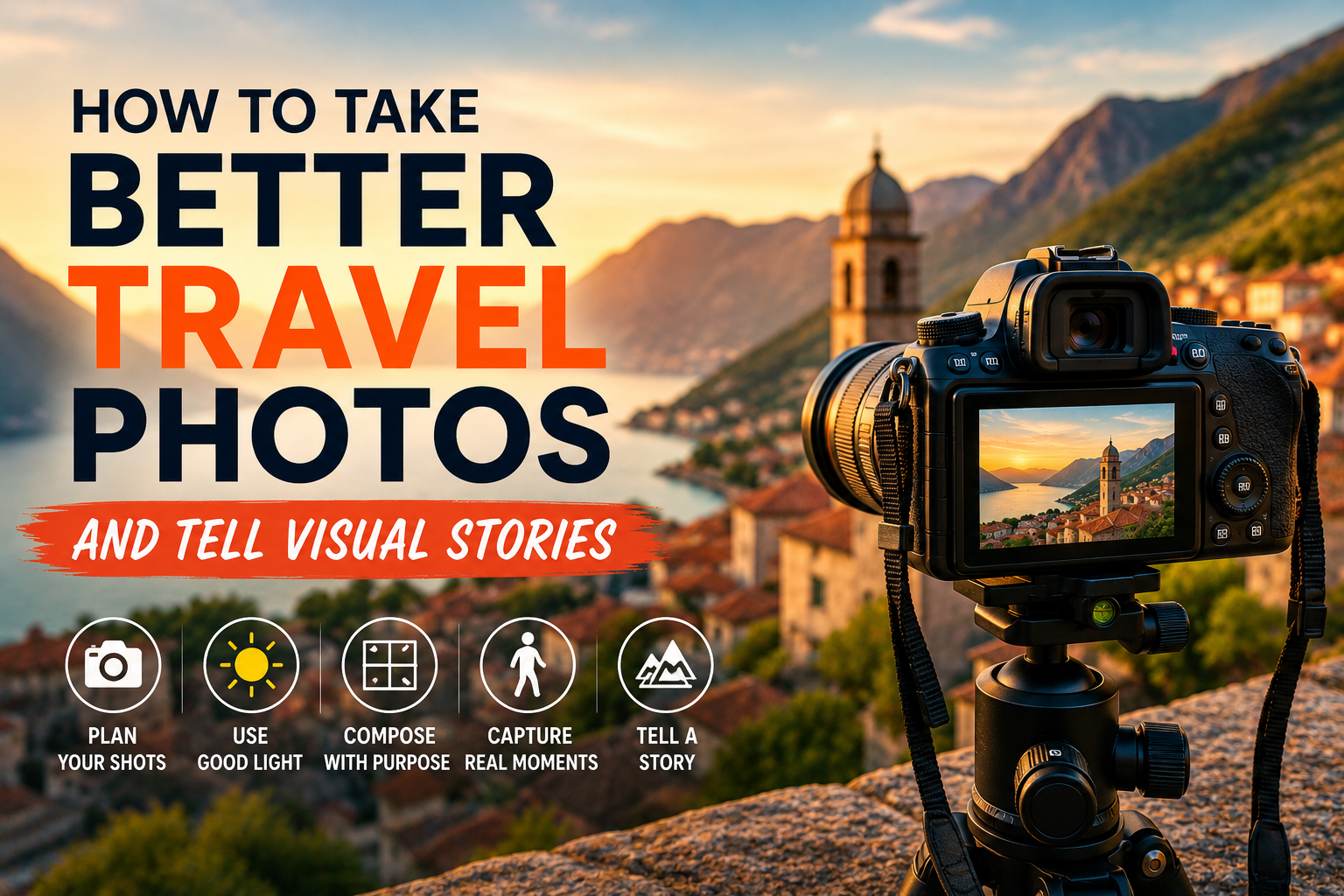
How to Take Better Travel Photos and Tell Visual Stories
Travel photography is often treated as a hunt for spectacular views: a famous landmark, a dramatic sunset, a beautiful beach or a picture-perfect street. But the most memorable travel photos usually do more than show where someone has been. They communicate what a place felt like, reveal something about its people and culture, and give viewers a sense of the journey.
You do not need the most expensive camera to create those images. A smartphone can produce excellent travel photographs when you understand light, composition, timing and storytelling.
The biggest improvement often comes from changing the way you approach photography. Instead of asking only, “What should I photograph?”, start asking, “What story do I want these photographs to tell?”
Think Beyond the Landmark
When arriving somewhere new, it is tempting to photograph the most recognizable attraction immediately. Those photographs have value, but they rarely tell the whole story of a destination.
A stronger travel photo collection combines different types of images.
You might photograph:
- A wide view that establishes the location
- A distinctive building or landmark
- Local streets and architecture
- People going about their daily lives
- Food and market scenes
- Small cultural details
- Transportation
- Landscapes and natural surroundings
- Close-up textures and objects
- Unexpected moments
- Your companions interacting with the destination
Together, these images create a visual narrative.
Think of your trip as a story with an opening, middle and ending. An establishing photograph can introduce the destination, while portraits, details and action photographs reveal what it is like to experience the place.
Look for Good Light
Light is one of the most important elements in photography, regardless of the camera you use.
Harsh midday sunlight can create strong shadows and make portraits difficult. Early morning and late afternoon often provide softer, warmer light that can add depth and atmosphere to photographs.
The period shortly after sunrise and before sunset is commonly known as the golden hour. During these periods, sunlight arrives at a lower angle, producing longer shadows and a warmer appearance.
But good travel photography is not limited to golden hour.
Overcast weather can produce soft, even light that works particularly well for portraits, architecture and colorful streets. Rain can create reflections and atmosphere. Direct sunlight can produce dramatic shadows and patterns.
Instead of waiting for perfect weather, learn to work with whatever light is available.
Pay Attention to Composition
Composition determines how the elements inside your photograph are arranged.
One of the simplest ways to improve composition is to stop placing your subject in the exact center of every frame.
The rule of thirds can help. Imagine dividing the image into a grid of nine sections and positioning important subjects near the intersections or along the lines.
However, the rule of thirds is only a starting point.
Symmetry, leading lines, negative space, framing and repetition can all create stronger compositions.
Look for:
- Roads leading toward a subject
- Doorways framing people
- Architectural lines
- Reflections in water or glass
- Repeating colors or shapes
- Shadows creating patterns
- Empty space that emphasizes a subject
Before pressing the shutter, take a moment to look around the entire frame. Distracting objects at the edges can sometimes make an otherwise excellent photograph feel cluttered.
Change Your Perspective
Many travel photographs are taken from the same standing position.
That is convenient, but it can also make images look predictable.
Try changing your physical position.
Get lower to the ground. Move closer. Step farther back. Photograph from above. Look through a doorway or window. Use a reflection. Photograph a familiar landmark from an unusual angle.
Even a small change in position can completely alter the relationship between objects in the frame.
Rather than zooming immediately, consider whether physically moving closer or farther away creates a better composition.
Capture People Naturally
People can give travel photographs a sense of scale, emotion and place.
A busy market, for example, becomes much more expressive when viewers can see the vendors and customers interacting rather than only rows of products.
Candid photography can be particularly effective because it captures moments as they naturally happen. But photographing people requires respect.
Be aware of local customs and privacy expectations. In some situations, asking permission before taking a close-up portrait is the appropriate choice.
When photographing someone who agrees to be photographed, avoid rushing. Give the person time to become comfortable with the camera and pay attention to expressions, posture, gestures and surroundings.
A strong environmental portrait can tell viewers something about both the individual and the place they inhabit.
Tell Stories With Details
Some of the most powerful travel photographs are not grand landscapes.
They might show a weathered doorway, a plate of local food, a pair of shoes outside a home, handwritten signs, colorful fabrics, market produce or an old bus traveling through the countryside.
Details help establish a destination’s personality.
Imagine photographing a traditional market. A single wide-angle photograph might show the entire market, but a series could include the entrance, a vendor arranging produce, a close-up of the products, customers negotiating prices and the surrounding street.
The combination gives viewers a much richer understanding of the experience.
Photograph the Journey, Not Just the Destination
Travel begins before reaching the main attraction.
Airports, train stations, roads, ferry crossings, hotel rooms and roadside stops can all become part of the visual story.
Photographing the journey helps create a sense of progression.
A sequence might move from:
Leaving home → traveling → arriving → exploring → meeting people → discovering food → experiencing an activity → returning home.
This approach can make a collection of ordinary photographs feel much more meaningful because each image has a role in the larger narrative.
Use Your Smartphone More Deliberately
Modern smartphones are capable of producing impressive travel photographs, but their convenience can encourage people to photograph everything without thinking carefully about composition.
Before taking a picture, clean the camera lens. It is a surprisingly simple step that can make a noticeable difference.
Then check:
- Where is the light coming from?
- What is the main subject?
- Is anything distracting from it?
- Is the horizon straight?
- Would moving closer improve the image?
- Is there a better angle?
- Does the frame need more or less empty space?
Tap on the screen to control focus and exposure when necessary, and avoid excessive digital zoom when possible.
The goal is not to use every camera feature. It is to make intentional decisions.
Learn When to Use Wide and Telephoto Perspectives
Different focal lengths produce different visual effects.
A wide perspective can be useful for landscapes, architecture and interiors because it allows you to include more of the environment.
A longer focal length can isolate a person or detail from a busy background. It can also make distant subjects appear closer.
If your camera or smartphone offers multiple lenses, experiment with each one rather than relying exclusively on the main camera.
The choice should depend on the story you are trying to tell.
A wide photograph can communicate “This is where we are.” A tighter photograph can communicate “This is the detail I want you to notice.”
Use Foreground, Middle Ground and Background
Adding layers can give photographs a stronger sense of depth.
Instead of photographing a mountain with nothing between the camera and the landscape, look for an interesting foreground element such as vegetation, a wall, a person or a road.
A photograph can then contain:
Foreground → subject → background
This technique is particularly useful for landscapes and city scenes because it helps transform a flat image into one that feels more three-dimensional.
Capture Motion
Travel is full of movement.
Cyclists pass through streets. Waves hit beaches. Children play. Trains arrive. Vendors prepare food. Dancers move through performances.
Instead of photographing everything as a static scene, experiment with motion.
Depending on your camera, you can freeze movement with a faster shutter speed or deliberately introduce motion blur to communicate speed.
The important thing is to make the movement intentional.
A photograph of a moving cyclist, for example, can feel more dynamic when there is enough space in front of the cyclist rather than directly against the edge of the frame.
Do Not Photograph Everything
One of the easiest ways to weaken a travel photo collection is to take too many nearly identical photographs.
Digital storage makes it possible to capture hundreds or thousands of images without worrying about film costs. But quantity does not automatically create a better story.
If you photograph the same landmark from 30 slightly different angles, you may eventually discover one excellent frame—but you will also create a large editing problem.
Slow down.
Take several photographs when necessary, but regularly ask yourself whether the next frame is genuinely different from the previous one.
Being selective while shooting can make the editing process much easier later.
Make Time for Observation
Good travel photography requires more than technical knowledge.
You have to notice things.
Spend some time walking without immediately raising your camera. Watch how people move through a space. Look at changing light. Notice colors, sounds, textures and interactions.
Sometimes the best photograph appears after you have been standing in one place for several minutes.
Patience can be particularly valuable when photographing streets and public spaces. Instead of photographing an empty composition, you can wait for the right person to enter the frame and complete the image.
Edit With the Story in Mind
Taking the photographs is only half the process.
Editing determines which images ultimately tell the story.
After a trip, resist the temptation to publish every good photograph. Start by removing technically weak images, including photographs that are blurry, poorly exposed or repetitive.
Then look for variety.
A strong collection might contain:
- An opening image that establishes the destination.
- Wide scenes that provide context.
- People that introduce human stories.
- Details that reveal culture and character.
- Action that adds energy.
- Quiet moments that change the pace.
- A closing image that leaves an impression.
The individual photographs do not all need to be spectacular. Their relationship with one another is what creates the story.
Edit Carefully Rather Than Excessively
Post-processing can improve travel photographs, but heavy editing can quickly make them look unnatural.
Basic adjustments to exposure, contrast, highlights, shadows, white balance and cropping are often enough.
Be particularly careful with saturation and clarity. Increasing them dramatically may make an image look impressive on a phone screen but less realistic and less timeless.
Try to preserve the atmosphere of the place you actually experienced.
If the sky was cloudy, there is no need to turn it into an artificially dramatic sunset. Authenticity can be more compelling than perfection.
Respect Local Culture
Travel photography carries a responsibility.
A destination is not simply a collection of photographic subjects. The people who live there have their own cultures, traditions and expectations.
Avoid turning poverty, hardship or vulnerable situations into visual entertainment. Be particularly sensitive when photographing children, religious ceremonies and people in difficult circumstances.
When in doubt, ask permission and observe how local people behave.
Responsible photography can help travelers connect with places rather than simply collect images from them.
Create a Visual Narrative Before You Leave
You can improve your results by thinking about your photographic goals before the trip begins.
Research the destination and identify the kinds of experiences you want to document.
You might create a loose shot list:
- One strong establishing image
- Several environmental scenes
- Local architecture
- Portraits
- Food
- Transportation
- Markets
- Cultural details
- Landscapes
- Night scenes
- Unexpected moments
Do not treat this as a rigid checklist. The purpose is to prevent you from returning home with hundreds of landmark photographs but very little sense of what the trip actually felt like.
The Best Travel Photos Make People Feel Somewhere
Great travel photography is not necessarily about expensive equipment, perfect weather or famous locations.
It is about observation.
Look for meaningful moments. Use light intentionally. Experiment with composition and perspective. Photograph people respectfully. Include details and ordinary scenes alongside major attractions. Then edit those photographs into a sequence that gives viewers a sense of place and progression.
Most importantly, photograph what genuinely catches your attention.
A technically perfect photograph of a landmark may be forgotten quickly. A simple image of a stranger laughing at a market, sunlight falling across an unfamiliar street or a quiet moment during a long journey can bring an entire trip back to life.
That is the real power of travel photography: not simply showing people where you went, but helping them feel what it was like to be there.



2 Comments
Micle harison
June 7, 2019Lorem ipsum dolor sit amet, usu ut perfecto postulant deterruisset, libris causae volutpat at est, ius id modus laoreet urbanitas. Mel ei delenit dolores.
John Doe
June 7, 2019Some consultants are employed indirectly by the client via a consultancy staffing company.