
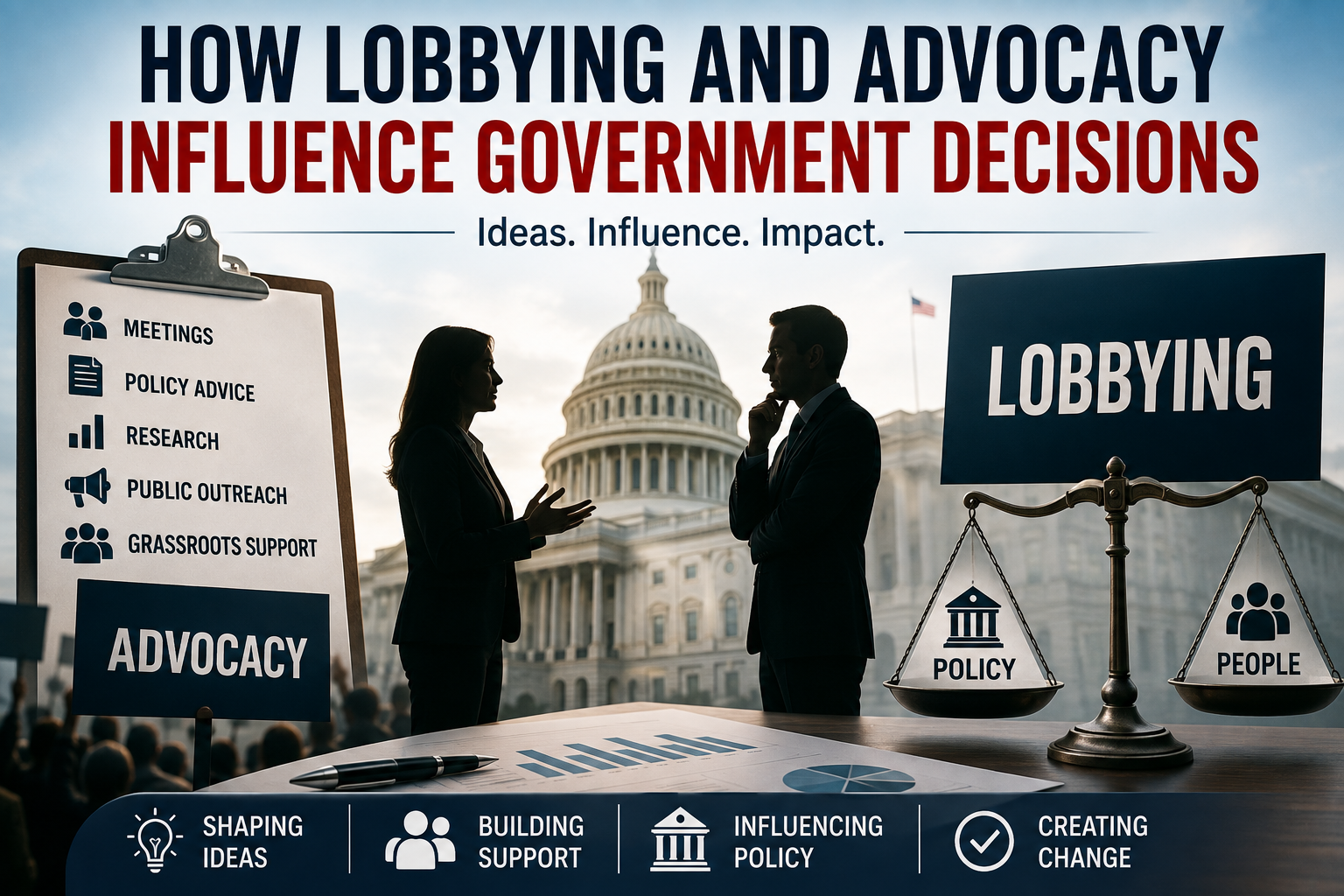
How Lobbying and Advocacy Influence Government Decisions
Government decisions rarely happen in isolation. Behind new laws, regulations, budgets and policy changes are often competing interests trying to persuade public officials that one approach is better than another.
Businesses, labor unions, professional organizations, nonprofit groups, community organizations and ordinary citizens can all attempt to influence government. Two of the most common approaches are lobbying and advocacy.
Although the terms are sometimes used interchangeably, they are not exactly the same. Lobbying generally involves efforts to influence specific legislation or government action, while advocacy is a broader concept that can include educating the public, raising awareness, organizing communities and promoting particular policy goals.
When conducted transparently and within the law, both can be legitimate parts of democratic participation. At the same time, concerns about unequal access, money in politics and conflicts of interest have made lobbying one of the most closely scrutinized forms of political influence.
What Is Lobbying?
Lobbying is the organized effort to influence government officials or public policy.
A lobbyist may communicate directly with legislators, regulators or government staff to explain how a proposed policy could affect a particular industry, organization or group.
Lobbying can involve:
- Meetings with lawmakers
- Written policy recommendations
- Testimony at legislative hearings
- Providing technical research
- Communicating with government agencies
- Organizing constituents to contact elected officials
- Monitoring proposed legislation
- Advocating for amendments to bills
Lobbyists can work on behalf of companies, trade associations, unions, nonprofit organizations and other interest groups.
Their role is often to provide information and arguments that policymakers can consider when making decisions.
Advocacy Is Broader Than Lobbying
Advocacy encompasses a much wider range of activities.
An advocacy campaign might seek to change public attitudes, encourage voters to support a particular issue, persuade policymakers or draw attention to a problem that has received little political attention.
For example, an environmental organization could publish research about pollution, educate communities, organize public events and encourage citizens to contact their representatives.
Some of those activities may constitute lobbying when they involve specific legislation or policy decisions. Others are broader public-awareness efforts.
The distinction matters because different countries and jurisdictions have different legal definitions and reporting requirements for lobbying and political activity.
Why Policymakers Listen to Interest Groups
Government officials face an enormous amount of information.
A legislator may be expected to make decisions about healthcare, education, transportation, agriculture, technology, energy, taxation and hundreds of other issues.
Special-interest organizations often possess detailed knowledge about particular industries or communities.
A trade association, for instance, may understand the practical consequences of a proposed regulation better than a policymaker who has only recently begun studying the issue.
Lobbyists can therefore provide useful technical information.
That does not mean the information is necessarily neutral. An organization naturally presents evidence and arguments that support its interests.
Policymakers must therefore evaluate competing claims and consider information from multiple sources.
Money Can Increase Political Access
One of the most controversial aspects of lobbying is the role of money.
Organizations with substantial financial resources can hire professional lobbyists, legal experts, researchers and communications specialists. They may also have greater capacity to monitor government activity and maintain relationships with policymakers.
This can create differences in political access.
A large corporation may be able to dedicate an entire team to a proposed regulation, while an individual citizen may have only a few minutes to send an email to a representative.
The existence of financial resources does not automatically mean that a group’s position will prevail. Policymakers face electoral, ideological, institutional and public pressures that can outweigh lobbying efforts.
Nevertheless, unequal resources can affect who gets heard and how consistently a particular issue receives attention.
Lobbying Does Not Always Mean Changing a Vote
Political influence is more complicated than convincing a lawmaker to vote “yes” or “no.”
Lobbyists may seek smaller changes that have major consequences for their clients.
They might propose modifications to the wording of a bill, request an exemption, influence how a regulation is implemented or encourage an agency to reconsider a particular provision.
In some cases, the most important lobbying takes place before legislation reaches a final vote.
Organizations may try to shape the initial proposal, influence committee discussions or persuade policymakers that certain provisions should be included or removed.
By the time a bill reaches the floor, many of the most significant decisions may already have been negotiated.
Advocacy Can Put Issues on the Political Agenda
Some policy issues gain political importance because advocacy groups bring them into the public conversation.
Advocacy organizations can use research, media campaigns, public demonstrations, social media and community organizing to persuade people that an issue deserves government attention.
This can change the political environment surrounding a policy.
If enough citizens become concerned about an issue, elected officials may face pressure to respond. Legislators may introduce bills, governments may commission studies or agencies may begin considering regulatory options.
In this way, advocacy can influence government indirectly by changing what voters, journalists and policymakers are talking about.
Grassroots Advocacy Creates Pressure From the Public
Not all political influence comes from powerful organizations.
Grassroots advocacy attempts to mobilize ordinary citizens around a shared issue.
Community groups can organize meetings, petitions, phone campaigns, letter-writing drives and public events. Online platforms have also made it easier for people to coordinate political campaigns quickly.
Grassroots pressure can be particularly powerful when elected officials believe that an issue could influence voters.
A policymaker may pay close attention when constituents repeatedly raise the same concern, especially if the issue affects a large portion of the district or state.
Astroturfing Can Create the Appearance of Grassroots Support
There is an important distinction between genuine grassroots advocacy and astroturfing.
Astroturfing refers to organized campaigns designed to appear as though they represent spontaneous public opinion when they are actually coordinated or funded by a particular organization or interest.
A campaign might encourage people to submit nearly identical messages to policymakers, for example, creating the impression of widespread independent concern.
This can make it harder for officials and the public to determine how much genuine grassroots support exists for a proposal.
Transparency about who funds and organizes an advocacy campaign can therefore be important for evaluating its influence.
Lobbyists Often Have Specialized Expertise
Modern government deals with increasingly technical subjects.
Policies involving artificial intelligence, telecommunications, pharmaceuticals, financial markets, energy infrastructure and environmental regulation can require highly specialized knowledge.
Lobbyists and advocacy organizations may employ experts who understand these subjects in considerable detail.
That expertise can help policymakers identify unintended consequences or technical problems in proposed legislation.
The challenge is ensuring that policymakers hear from a sufficiently broad range of experts rather than relying heavily on information supplied by organizations with a financial stake in the outcome.
The Revolving Door Creates Concerns
Another issue involves the movement of people between government positions and the private sector.
Former lawmakers, regulators and government staff may eventually work as lobbyists or consultants. Their knowledge of government procedures and relationships with former colleagues can make them valuable to private organizations.
This phenomenon is often called the revolving door.
There is nothing inherently improper about someone changing careers. Former public officials can possess valuable expertise, and private-sector experience can also benefit government.
The concern arises when financial incentives or personal relationships create actual or perceived conflicts of interest.
For this reason, many governments impose restrictions on lobbying activities by former officials and employees.
Regulation and Transparency Matter
Because lobbying can influence public policy, governments commonly establish rules governing the activity.
Depending on the jurisdiction, these rules can require lobbyists to register, disclose clients, report certain expenditures or observe restrictions on gifts and interactions with public officials.
Transparency allows journalists, watchdog organizations and citizens to examine who is attempting to influence government and on whose behalf.
The details vary significantly between countries and political systems.
Some jurisdictions have extensive disclosure requirements, while others impose fewer restrictions.
Effective transparency rules do not necessarily eliminate political influence, but they can make that influence easier to understand and scrutinize.
Advocacy Groups Can Represent People Who Lack Resources
Lobbying is sometimes associated primarily with large corporations, but advocacy organizations can also represent groups that might otherwise struggle to gain political attention.
Civil rights organizations, disability advocates, consumer groups, environmental organizations, professional associations and community organizations can all attempt to influence government.
For individuals who lack the time, expertise or access to communicate effectively with policymakers, organized advocacy can provide a collective voice.
This is one reason lobbying and advocacy can serve an important democratic function.
The political process becomes more representative when different groups have meaningful opportunities to present their concerns.
Public Opinion Can Limit Lobbying Power
Money and access do not guarantee success.
Elected officials ultimately operate within a political environment shaped by voters, public opinion, party politics, media coverage and other institutional forces.
A lobbying campaign that conflicts strongly with the views of a policymaker’s constituents may be difficult to sustain.
Public attention can also expose controversial lobbying efforts and create political costs for officials who appear too closely aligned with a particular interest.
This creates an important counterweight to organized lobbying.
Campaign Contributions and Lobbying Are Related but Different
Political campaign contributions are often discussed alongside lobbying, but they are not the same activity.
A campaign contribution supports a political candidate or political committee under applicable campaign-finance rules. Lobbying involves attempts to influence government policy or decisions.
The two can intersect within the broader political influence system, but one should not automatically be interpreted as a direct payment for a particular government decision.
Political systems generally impose separate rules governing campaign finance and lobbying.
Understanding that distinction is important when evaluating claims about political influence.
How Lobbying Can Shape Regulation
Lobbying can be particularly influential when government agencies are writing or implementing regulations.
Businesses and other affected organizations may argue that a proposed rule is too expensive, technically impractical or likely to produce unintended consequences.
Consumer and public-interest groups may make the opposite argument, calling for stronger protections.
Agencies can receive information from both sides before establishing final rules.
In some cases, lobbying results in modifications that make regulations more practical. In others, critics may argue that industry influence has weakened protections.
The quality of the outcome depends heavily on how decision-makers evaluate competing evidence and whether the process remains transparent.
The Role of Research and Data
Modern advocacy increasingly relies on research.
Organizations may commission economic analyses, conduct surveys, publish scientific studies or produce reports examining the potential effects of proposed policies.
Evidence can strengthen an advocacy campaign because policymakers need more than political slogans when evaluating complex decisions.
But research itself must be assessed critically.
Who funded the study? What assumptions were used? Were alternative interpretations considered? Does the evidence come from independent researchers?
These questions help distinguish useful policy analysis from advocacy presented as objective research.
Digital Media Has Changed Political Advocacy
The internet has dramatically reduced the cost of reaching large audiences.
Organizations can now publish reports, create videos, distribute newsletters and communicate directly with supporters without relying entirely on traditional media.
Social media can amplify advocacy campaigns rapidly.
A local issue can sometimes attract national attention within hours if a campaign gains momentum online.
Digital communication also creates new challenges. Misleading claims can spread quickly, and emotionally charged content can receive more attention than carefully researched analysis.
As a result, policymakers and citizens increasingly need to evaluate not only the message but also its source and evidence.
When Influence Becomes a Democratic Concern
Lobbying becomes particularly controversial when citizens believe government decisions are being shaped primarily by powerful interests rather than the broader public interest.
Several factors can contribute to that perception:
- Large disparities in lobbying resources
- Limited transparency
- Excessive access for certain organizations
- Conflicts of interest
- Weak enforcement of lobbying rules
- Hidden funding of political campaigns or advocacy efforts
- Close relationships between officials and regulated industries
These concerns do not mean lobbying itself is inherently undemocratic.
Instead, they highlight the importance of rules that allow legitimate participation while limiting opportunities for corruption, undisclosed influence and abuse of public office.
Citizens Also Have a Role
Ordinary citizens do not need professional lobbyists to participate in policymaking.
People can contact elected representatives, attend public meetings, submit comments on proposed regulations, join community organizations, participate in public consultations and vote.
Individual voices may seem small compared with large organizations, but elected officials are ultimately accountable to constituents.
Collective participation can be particularly influential when citizens provide specific, credible arguments rather than simply expressing anger or repeating slogans.
A Constant Negotiation of Interests
Government policymaking is essentially a process of balancing competing interests.
Businesses want policies that allow them to operate profitably. Workers seek fair wages and safe conditions. Consumers want affordable and reliable products. Environmental organizations push for stronger protections. Communities may want investment, infrastructure and public services.
Lobbying and advocacy give these groups mechanisms for presenting their priorities.
The challenge for democratic institutions is ensuring that policymakers do not simply listen to whoever has the most money or the easiest access. Effective policymaking requires weighing competing arguments, examining evidence and considering the wider public interest.
Why Transparency Is So Important
Lobbying and advocacy are unlikely to disappear from democratic politics—and they do not necessarily need to.
Interest groups can provide expertise, identify problems, represent communities and help policymakers understand the consequences of proposed decisions.
But political influence is healthier when citizens can see who is trying to influence government, whom they represent and what interests are at stake.
Transparency, disclosure rules, ethical standards, independent oversight and meaningful public participation can help create that balance.
Ultimately, lobbying and advocacy are powerful because governments make decisions in an environment filled with competing information, interests and political pressures. Understanding those forces makes it easier for citizens to look beyond the headline announcement and ask a more revealing question: who is trying to shape this decision, what are they asking for, and why?


2 Comments
Micle harison
June 7, 2019Lorem ipsum dolor sit amet, usu ut perfecto postulant deterruisset, libris causae volutpat at est, ius id modus laoreet urbanitas. Mel ei delenit dolores.
John Doe
June 7, 2019Some consultants are employed indirectly by the client via a consultancy staffing company.