
How Earth’s Food Webs Work
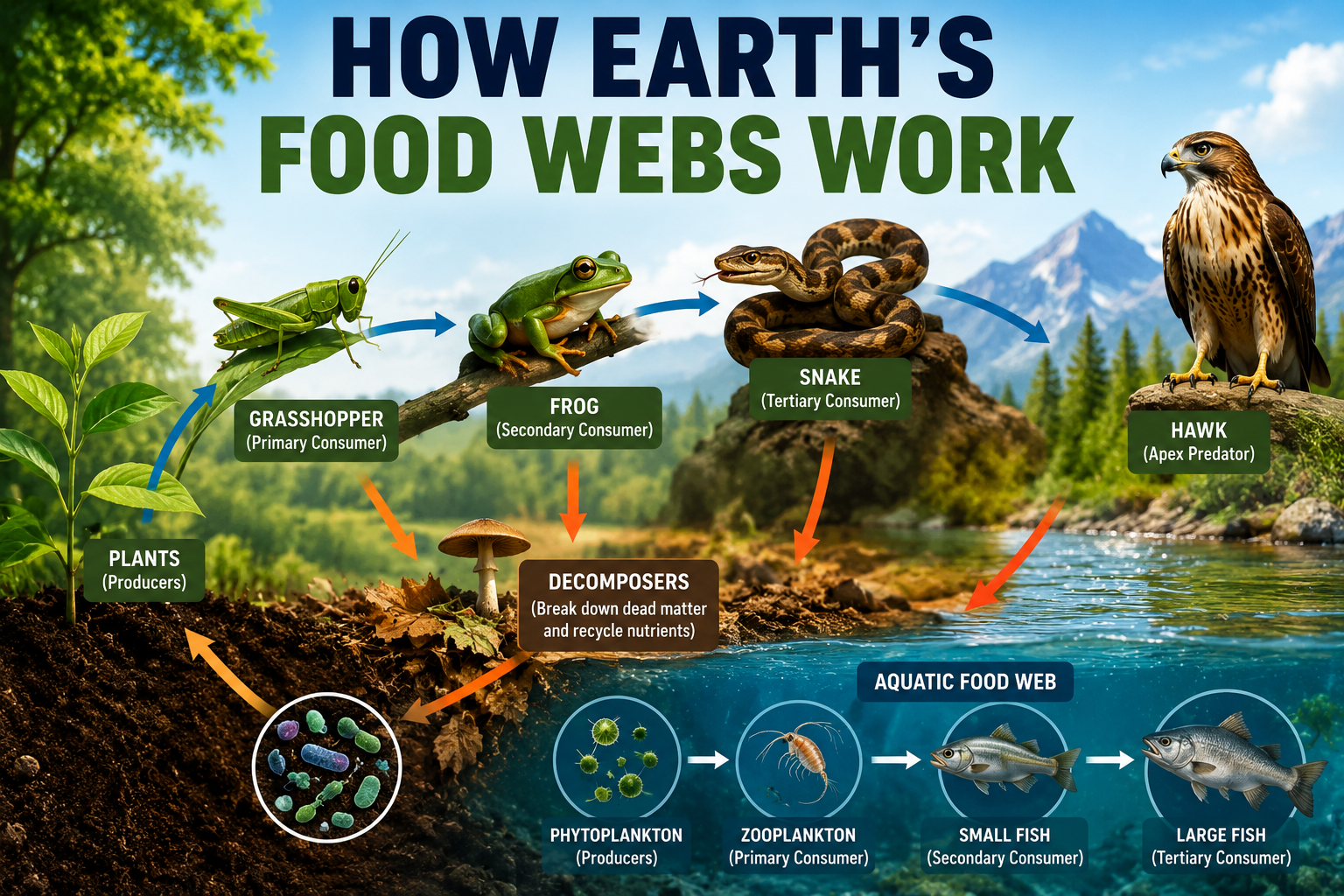
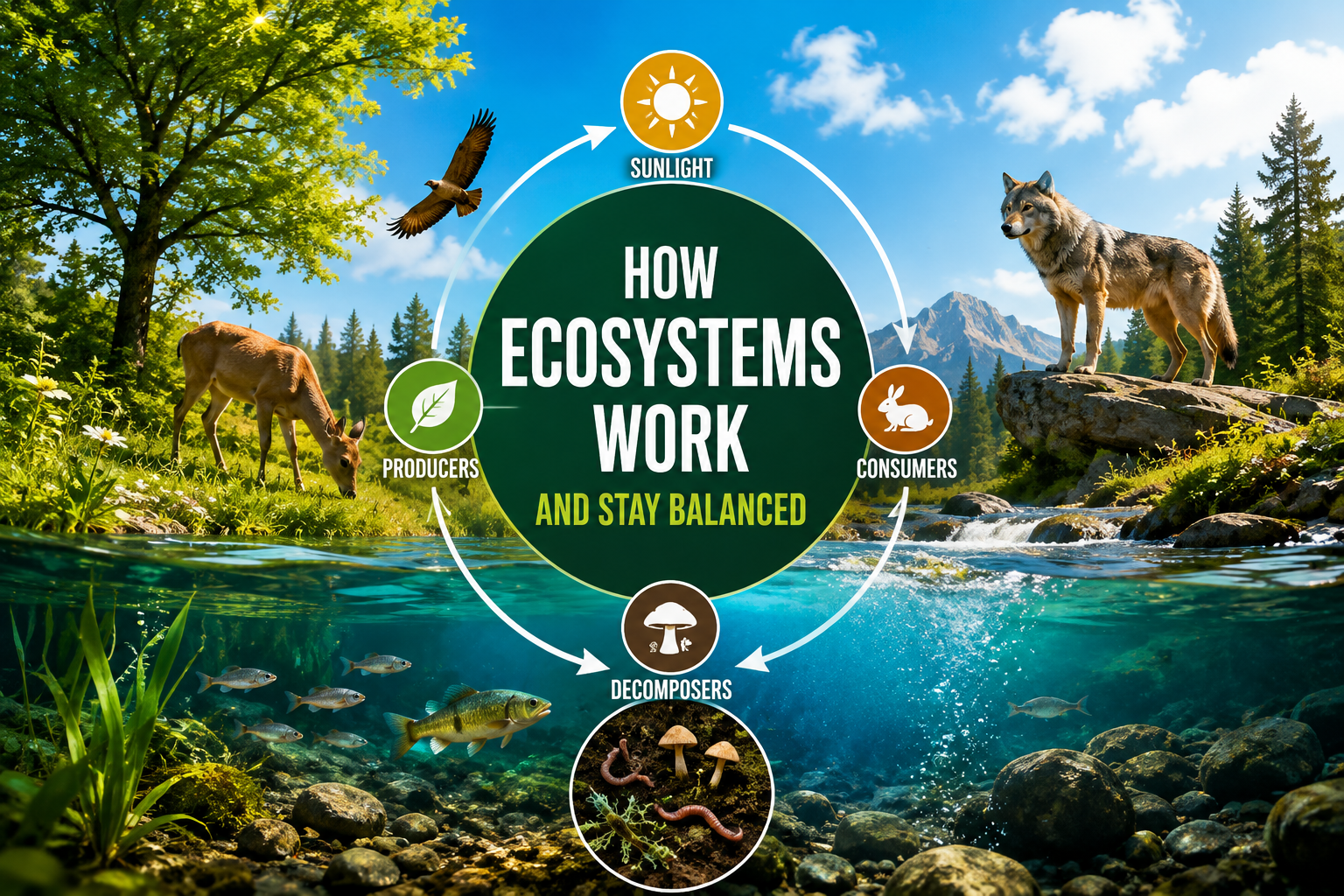
Every ecosystem on Earth is connected by the simple act of eating. Plants capture energy from sunlight, herbivores consume plants, predators feed on other animals, and decomposers break down what remains. Together, these relationships form food webs—the intricate networks that connect organisms and help ecosystems function.
A food web is more than a list of who eats whom. It shows how energy and nutrients move through an ecosystem and explains why changes to one species can sometimes affect dozens of others.
Understanding how Earth’s food webs work offers a clearer picture of the natural systems that support life, from forests and grasslands to oceans, rivers and even urban environments.
What Is a Food Web?
A food web is a network of interconnected food chains within an ecosystem.
A food chain follows a relatively simple pathway. For example:
Grass → Grasshopper → Frog → Snake → Hawk
A food web recognizes that real ecosystems are rarely that simple. A grasshopper may be eaten by frogs, birds and small mammals. A frog may be eaten by snakes, herons and larger fish. A hawk may consume several different kinds of animals.
These overlapping relationships create a web rather than a straight line.
Food webs can vary enormously depending on the ecosystem. A tropical rainforest may contain thousands of interconnected species, while a small pond may have a simpler network involving algae, insects, fish, amphibians, birds and microorganisms.
Producers Form the Foundation
Most food webs begin with organisms known as producers.
Plants, algae and certain microorganisms are producers because they can manufacture their own food. Most plants accomplish this through photosynthesis, using sunlight, carbon dioxide and water to produce chemical energy in the form of sugars.
Because producers convert external energy into biological energy, they form the foundation of most ecosystems.
On land, grasses, trees, shrubs and other plants play this role. In aquatic ecosystems, microscopic organisms called phytoplankton are especially important. Although they are tiny, phytoplankton support enormous marine food webs by providing food for organisms ranging from microscopic zooplankton to larger animals.
Without a steady supply of energy entering an ecosystem through producers, the rest of the food web could not be sustained.
Consumers Transfer Energy Through the Web
Animals and other organisms that obtain energy by eating other organisms are called consumers.
Primary consumers generally eat producers. These include herbivores such as deer, rabbits, caterpillars and many insects.
Secondary consumers eat primary consumers. Frogs that eat insects and spiders that capture insects are examples.
Tertiary consumers can occupy higher positions in the food web by feeding on other predators. Large snakes, eagles, wolves and some marine predators can operate at these higher trophic levels.
However, real ecosystems do not always fit neatly into these categories. An animal can occupy different positions depending on what it eats.
A bear, for example, may consume berries and other plants but also eat fish or small mammals. Its position in the food web therefore changes depending on the food source.
Decomposers Keep Nutrients Moving
Food webs would not function without decomposers.
Fungi, bacteria and numerous microscopic organisms break down dead plants, animals and organic waste. During this process, they help return nutrients to soil, water and other parts of the environment.
This creates an important distinction between energy flow and nutrient cycling.
Energy generally enters an ecosystem through sunlight and moves from producers to consumers and eventually dissipates as heat. Nutrients, however, can be recycled.
When a fallen tree decomposes, for example, its carbon, nitrogen, phosphorus and other elements can eventually become available to plants and microorganisms again.
Decomposition therefore connects the end of one biological process to the beginning of another.
Energy Becomes Scarcer at Higher Levels
One of the most important characteristics of food webs is that relatively little energy is transferred from one trophic level to the next.
When an animal eats another organism, much of the energy contained in that food is used for movement, metabolism, growth, reproduction and maintaining body temperature. A significant portion eventually leaves the ecosystem as heat.
Only a fraction becomes new biomass available to the next consumer.
This is why ecosystems generally support far more plants and small organisms than they do large top predators. A large population of predators would require an enormous amount of prey, which in turn would require a substantial energy base of plants and other producers.
This relationship is sometimes represented using an ecological pyramid, with producers forming the broad base and higher-level consumers occupying progressively narrower levels.
Why Food Webs Are More Resilient Than Food Chains
The interconnected nature of food webs can provide ecosystems with a degree of resilience.
Suppose a particular plant becomes less abundant. An herbivore that depends heavily on it could decline, but if that herbivore can eat several other plants, it may switch food sources.
Similarly, a predator that loses one prey species may be able to survive by consuming another.
This redundancy can help ecosystems absorb some disturbances.
But resilience has limits. If too many species disappear, alternative food sources may no longer be sufficient. A food web can become less stable as biodiversity declines and important ecological relationships are lost.
Keystone Species Can Have Outsized Effects
Not every species has the same influence on its ecosystem.
Some species have effects that are disproportionately large compared with their abundance. These are often described as keystone species.
A predator can be a keystone species if controlling prey populations prevents those prey from overwhelming other organisms. Removing such a predator can trigger a chain of ecological changes known as a trophic cascade.
For example, if a top predator disappears, populations of its prey may increase. Those prey may consume more vegetation, reducing plant abundance. The resulting changes can affect insects, birds, soil conditions and other organisms.
The original change involved one species, but the consequences can spread throughout the food web.
Food Webs Connect Land and Water
Food webs are not confined to individual ecosystems.
Ecological connections frequently cross the boundaries between land and water. Leaves that fall into streams can become food for aquatic organisms. Insects emerging from rivers can provide food for birds and bats. Nutrients carried from land into coastal waters can influence marine ecosystems.
The ocean itself contains interconnected food webs stretching from microscopic plankton to some of the largest animals on the planet.
These connections demonstrate that ecosystems are not isolated compartments. Materials and organisms move between environments, carrying energy and nutrients with them.
Human Activity Can Reshape Food Webs
Human activity can alter food webs in many ways.
Habitat destruction can remove producers and shelter for consumers. Pollution can directly harm organisms or change the conditions they depend on. Overfishing can reduce important marine populations. Invasive species can introduce new predators or competitors into established ecosystems.
Climate change can also alter relationships between species.
As temperatures and precipitation patterns change, some organisms may shift their geographic ranges or change the timing of reproduction, migration and feeding. If species that depend on one another respond differently, established relationships can become disrupted.
For example, a plant may flower earlier because of warmer spring temperatures while an insect that depends on that plant responds to a different environmental signal. A mismatch between the two can affect the wider food web.
What Happens When One Species Disappears?
The effects of losing a species depend on its role in the ecosystem.
If several organisms perform similar ecological functions, another species may partially compensate for the loss. But removing a species that occupies a unique or particularly important role can produce much larger effects.
The consequences can move both upward and downward through the food web.
A decline in plants can reduce herbivore populations, which can then reduce predator populations. Conversely, losing a predator can increase herbivore numbers, potentially putting greater pressure on vegetation.
This interconnectedness is one reason scientists study ecosystems as networks rather than examining species in isolation.
Biodiversity Strengthens the Web of Life
Biodiversity—the variety of life within an ecosystem—can contribute to ecological stability by creating a greater diversity of interactions and ecological functions.
A diverse ecosystem may contain multiple pollinators, predators, decomposers, herbivores and producers performing overlapping roles.
That does not mean every highly diverse ecosystem is automatically immune to environmental change. Ecosystems can still experience severe disruption. But greater biological diversity can provide more pathways through which energy and nutrients move and more opportunities for organisms to adapt to changing conditions.
Protecting biodiversity therefore means protecting more than individual species. It also means maintaining the relationships that connect those species.
Why Understanding Food Webs Matters
Food webs reveal one of the central principles of ecology: life is interconnected.
A plant depends on sunlight, water, nutrients and pollinators. An herbivore depends on plants. A predator depends on prey. Decomposers return nutrients to the environment, helping new plants grow. Changes in one part of this system can eventually influence organisms far removed from the original disturbance.
From a backyard garden to the world’s oceans, these networks operate continuously.
The next time a bird catches an insect, a bee visits a flower or fallen leaves disappear into the soil, it is worth seeing the event as part of something much larger. Each interaction represents one connection in an enormous biological network—one that moves energy, recycles nutrients and helps sustain the extraordinary diversity of life on Earth.


2 Comments
Micle harison
June 7, 2019Lorem ipsum dolor sit amet, usu ut perfecto postulant deterruisset, libris causae volutpat at est, ius id modus laoreet urbanitas. Mel ei delenit dolores.
John Doe
June 7, 2019Some consultants are employed indirectly by the client via a consultancy staffing company.