
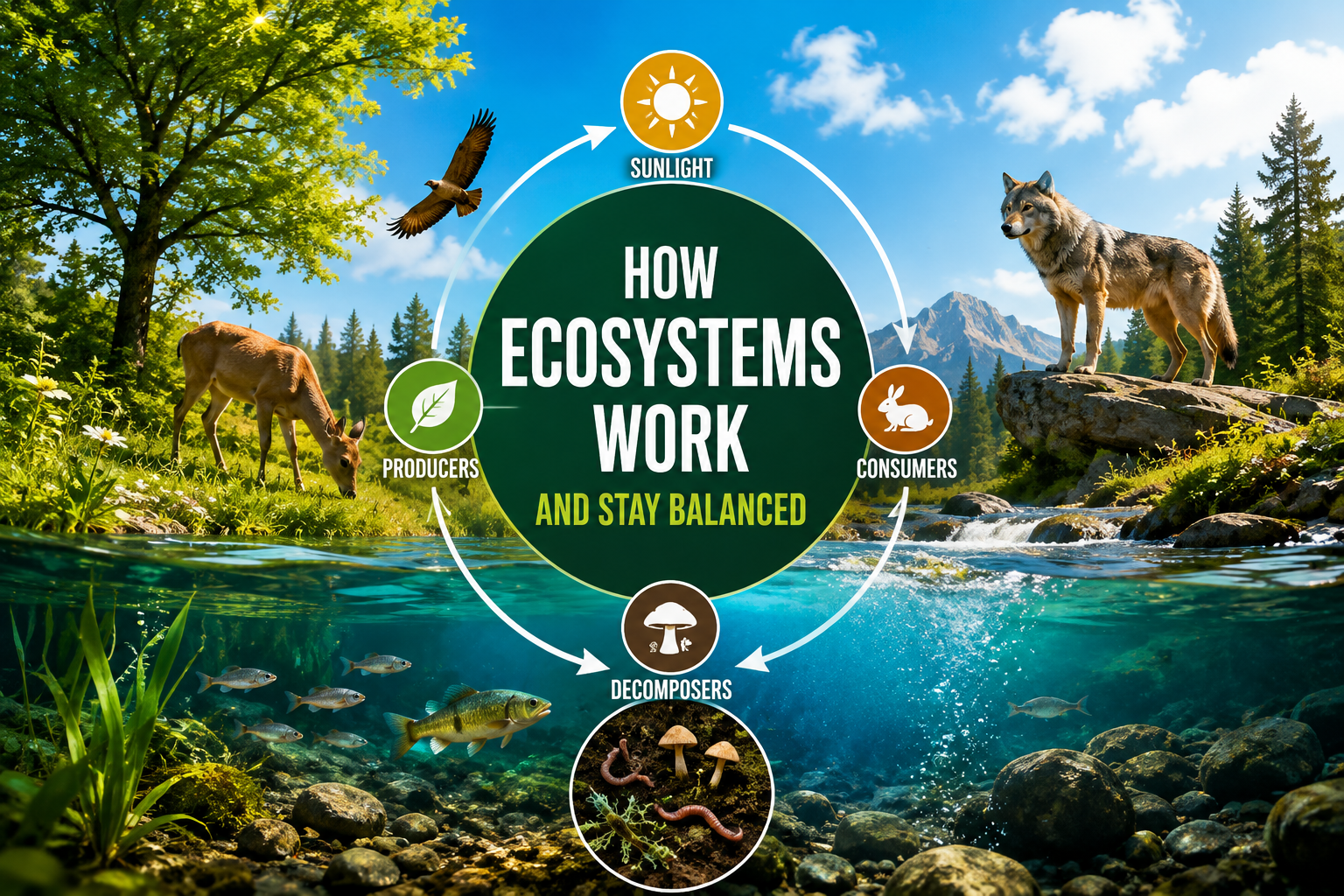
How Ecosystems Work and Stay Balanced
From a tropical rainforest filled with towering trees to a quiet pond surrounded by grasses, every ecosystem is built around relationships. Plants capture energy from sunlight, animals feed on plants or other animals, fungi break down dead material, and microorganisms recycle nutrients back into the environment.
These interactions create complex systems in which living organisms and their surroundings continuously influence one another. An ecosystem does not remain perfectly still or unchanged. Instead, its balance comes from countless interactions that help regulate populations, move nutrients and keep energy flowing.
Understanding how ecosystems work also helps explain why changes to one part of the natural world can sometimes have consequences far beyond the original disturbance.
What Is an Ecosystem?
An ecosystem is a community of living organisms interacting with the nonliving components of their environment.
The living components, known as biotic factors, include:
- Plants and other producers
- Herbivores and carnivores
- Birds, insects and other animals
- Fungi
- Bacteria and other microorganisms
The nonliving components, known as abiotic factors, include:
- Sunlight
- Water
- Temperature
- Soil
- Air
- Minerals
- Nutrients
These elements are connected. A change in temperature can affect plant growth. Changes in plant growth can influence herbivore populations. Those changes can then affect predators and scavengers.
An ecosystem therefore works less like a collection of separate species and more like a network of interconnected relationships.
Energy Flows Through Ecosystems
One of the most important processes in any ecosystem is the movement of energy.
Most ecosystems ultimately depend on energy from the Sun. Plants, algae and some microorganisms capture solar energy through photosynthesis, converting it into chemical energy stored in organic matter.
These organisms are called producers because they create the organic material that supports much of the rest of the food web.
Herbivores obtain energy by eating plants. Predators obtain energy by eating other animals. Decomposers obtain energy and nutrients from dead organisms and organic waste.
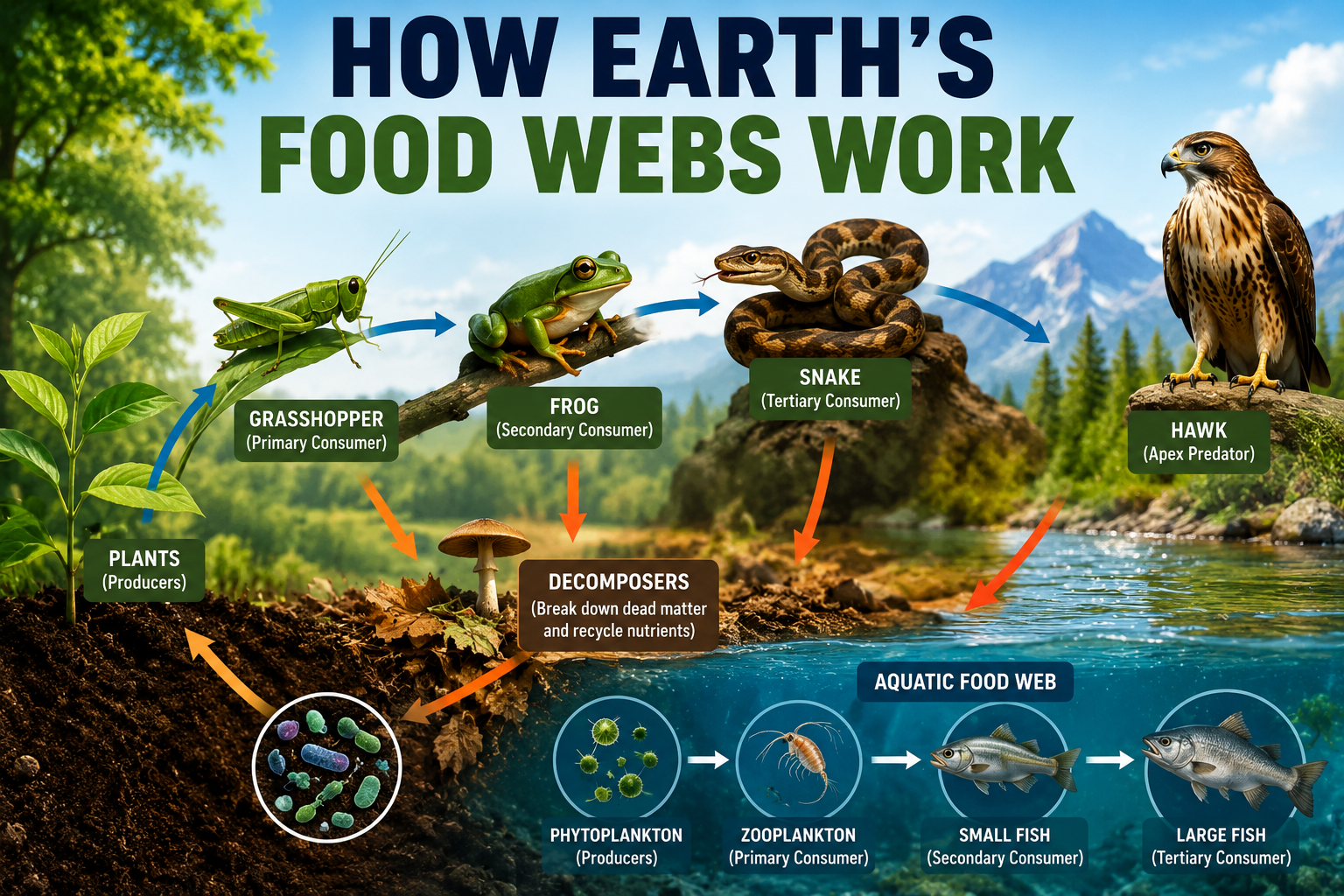
A simplified food chain might look like this:
Sun → grass → grasshopper → frog → snake → hawk
Real ecosystems, however, are rarely this simple. Most organisms eat or are eaten by multiple species, creating interconnected food webs.
At each stage, some energy is lost as heat through metabolism. Consequently, ecosystems generally contain more available energy at lower levels of the food web than at higher levels.
Producers Form the Foundation
Plants and algae play an especially important role because they convert energy from the environment into food that other organisms can use.
In a forest, for example, trees, shrubs and grasses capture sunlight and absorb water and nutrients. They provide food and shelter for insects, birds, mammals and other organisms.
Aquatic ecosystems have their own producers. Phytoplankton and algae can support enormous food webs in lakes, rivers and oceans.
The productivity of these organisms influences how much life an ecosystem can support. When conditions such as sunlight, water availability and nutrients change, the effects can spread through the food web.
Consumers Keep Energy Moving
Animals and other organisms that obtain energy by consuming other organisms are known as consumers.
They can occupy different positions within a food web.
Primary consumers generally feed on producers. Herbivores such as deer, rabbits and many insects fall into this category.
Secondary consumers feed on primary consumers. Frogs that eat insects and small predators that consume herbivores are examples.
Tertiary consumers occupy higher positions in some food webs and may prey on other predators.
These categories are useful for understanding ecosystems, but nature is more complicated than a fixed hierarchy. Many animals are omnivores and consume food from multiple levels of the food web.
Decomposers Are Nature’s Recyclers
When plants and animals die, their nutrients do not simply disappear.
Fungi, bacteria and other decomposers break down dead organic matter. This process releases nutrients that can return to soil and water, where they can become available to plants and other organisms.
Decomposition is essential because ecosystems depend on the continuous recycling of materials.
Without decomposers, dead organic matter would accumulate and important nutrients would remain locked inside it.
This creates an important distinction between energy flow and nutrient cycling. Energy generally moves through an ecosystem and is eventually released as heat, while materials such as carbon, nitrogen and phosphorus can be recycled repeatedly.
Food Webs Create Natural Checks and Balances
One reason ecosystems can remain relatively stable is that species influence one another.
Predators can limit prey populations. Herbivores can influence plant abundance. Competition can prevent a single species from using unlimited resources. Disease can also affect population sizes.
Consider a grassland containing plants, rabbits and foxes. If rabbit numbers increase dramatically, they may consume more vegetation. As food becomes scarce, rabbit populations may eventually decline. A larger rabbit population can also provide more food for foxes, potentially increasing predator numbers.
As fox populations rise, pressure on rabbits may increase again.
These interactions can create feedback loops that help prevent populations from growing indefinitely.
Importantly, this does not mean ecosystems always return to exactly the same state. Natural systems fluctuate constantly. Balance is better understood as a dynamic condition in which populations and environmental processes change while the overall system remains functional.
Biodiversity Strengthens Ecosystems
The variety of organisms in an ecosystem is known as biodiversity.
Biodiversity can contribute to ecosystem stability because different species often perform different roles. If one species declines, another species may sometimes partially compensate for its ecological function.
A diverse ecosystem may contain many pollinators, seed dispersers, predators, decomposers and plant species, each contributing to the system in different ways.
Biodiversity also creates a larger pool of genetic and ecological variation. This can help ecosystems respond to changing conditions, although biodiversity does not make ecosystems immune to environmental damage.
When species disappear, important ecological relationships can also be lost.
Keystone Species Can Have an Outsized Effect
Not every species has the same influence on an ecosystem.
Some species have an unusually large effect relative to their abundance. These are often described as keystone species.
A predator, for example, may help control herbivore populations. Removing that predator could allow herbivores to become unusually abundant, potentially changing vegetation and affecting other species.
Other organisms can shape ecosystems physically. Beavers, for example, can build dams that alter water flow and create wetlands. Their activities can change habitats for many other species.
This illustrates why removing a seemingly small component of an ecosystem can sometimes trigger much larger changes.
Nutrient Cycles Keep Ecosystems Functioning
Ecosystems depend on the movement of essential elements between organisms and their surroundings.
The carbon cycle moves carbon through the atmosphere, living organisms, soil, oceans and geological systems.
The nitrogen cycle allows nitrogen to move between the atmosphere, soil and living organisms. Nitrogen is essential for proteins and genetic material.
The phosphorus cycle moves phosphorus through rocks, soil, water and living organisms and is important for cellular processes and biological growth.
Water also moves continuously through ecosystems through evaporation, precipitation, groundwater, rivers, plants and other processes.
These cycles connect ecosystems to the atmosphere, oceans, soil and geological environment.
What Happens When an Ecosystem Is Disturbed?
Ecosystems can experience natural disturbances such as droughts, floods, wildfires, storms and disease outbreaks.
Some ecosystems have evolved with regular disturbances. Certain forests, grasslands and wetlands can recover from events that occur naturally within their environmental conditions.
Human activities, however, can introduce disturbances that are unusually intense, frequent or persistent.
Examples include:
- Habitat destruction
- Pollution
- Overfishing and overhunting
- Invasive species
- Unsustainable resource extraction
- Changes in land use
- Excessive nutrient runoff
- Human-driven climate change
The consequences can vary dramatically depending on the ecosystem and the severity of the disturbance.
A temporary disruption may be followed by recovery. A major or prolonged disturbance can push an ecosystem into a different state.
Ecosystems Can Recover, but Recovery Has Limits
Many ecosystems possess some ability to recover after disturbance. This capacity is sometimes described as ecological resilience.
After a wildfire, for example, vegetation may gradually return. New plants can colonize the area, insects and other animals can follow, and nutrient cycles can resume.
But recovery is not guaranteed.
If soil is severely degraded, key species have disappeared or environmental conditions have changed permanently, an ecosystem may not return to its previous condition.
The speed and extent of recovery depend on factors including biodiversity, the availability of surviving organisms, habitat connectivity, environmental conditions and the severity of the disturbance.
Humans Are Part of Ecosystems Too
People are sometimes described as separate from nature, but humans are deeply embedded in ecological systems.
Agriculture depends on soil, water, pollinators and nutrient cycles. Fisheries depend on functioning aquatic food webs. Forests influence water cycles, carbon storage and local climates. Communities depend on ecosystems for food, materials and other services.
These benefits are often described as ecosystem services.
They include:
- Pollination
- Clean water
- Soil formation
- Flood regulation
- Carbon storage
- Nutrient cycling
- Food production
- Habitat for wildlife
- Recreation and cultural benefits
Recognizing these connections makes ecosystem conservation more than a question of protecting wildlife. It is also about maintaining the natural processes on which human societies depend.
Why Ecosystem Balance Matters
A balanced ecosystem is not one in which nothing changes. It is a system capable of responding to changes while continuing to perform essential ecological functions.
That balance emerges from relationships among species, energy flows, nutrient cycles and environmental conditions.
The removal or rapid transformation of one component can affect many others because ecosystems are interconnected networks rather than isolated collections of organisms.
Protecting biodiversity, maintaining habitats, reducing pollution and using natural resources responsibly can therefore help preserve the processes that keep ecosystems functioning.
The natural world may look stable from a distance, but underneath that apparent stability is a constant exchange of energy, nutrients and biological interactions. Ecosystem balance is not the absence of change—it is nature’s ability to keep life moving through change.


2 Comments
Micle harison
June 7, 2019Lorem ipsum dolor sit amet, usu ut perfecto postulant deterruisset, libris causae volutpat at est, ius id modus laoreet urbanitas. Mel ei delenit dolores.
John Doe
June 7, 2019Some consultants are employed indirectly by the client via a consultancy staffing company.