
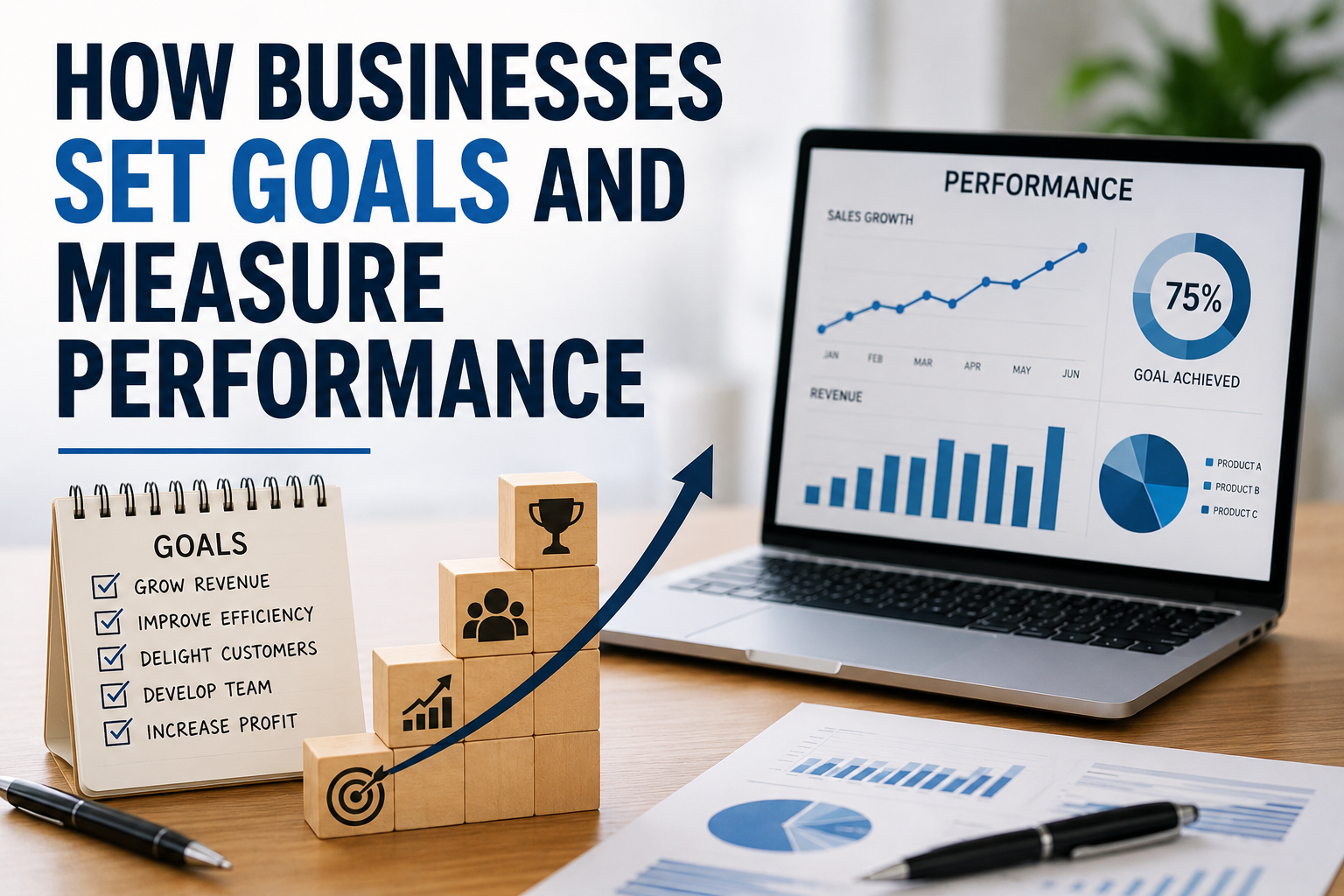
How Businesses Set Goals and Measure Performance
Every successful business needs to know where it is going and whether it is making progress. Setting goals gives an organization a clear direction, while performance measurement shows whether its strategies are producing the desired results.
From small businesses tracking monthly sales to global companies monitoring revenue, customer growth and operational efficiency, goal-setting and performance measurement are central to effective management.
But setting a target is only the beginning. Businesses must establish realistic objectives, choose meaningful measurements and regularly review their results. When those pieces work together, performance data can become a powerful tool for making better decisions.
Why Business Goals Matter
Business goals provide a framework for turning broad ambitions into specific outcomes.
A company may want to become more profitable, expand into new markets, improve customer satisfaction or develop new products. Without clearly defined goals, however, these ambitions can remain vague.
Well-designed goals help answer several important questions:
- What does the business want to achieve?
- When should the result be achieved?
- Who is responsible for delivering it?
- How will progress be measured?
- What resources are required?
- What risks could prevent success?
Clear objectives also help employees understand how their individual responsibilities contribute to the wider direction of the organization.
Different Types of Business Goals
Businesses typically establish goals across several areas rather than focusing on a single number.
Financial Goals
Financial objectives often receive significant attention because they directly relate to the company’s economic performance.
Examples include:
- Increasing revenue
- Improving profit margins
- Reducing operating costs
- Increasing cash flow
- Improving return on investment
- Reducing debt
- Increasing recurring revenue
A company might, for example, aim to increase annual revenue by 10% while maintaining a specific profit margin.
Customer Goals
Financial results do not tell the entire story. Businesses also need to understand how effectively they are attracting and retaining customers.
Customer-related goals may include:
- Increasing customer retention
- Improving customer satisfaction
- Growing market share
- Reducing customer complaints
- Increasing repeat purchases
- Improving customer response times
These measures can provide an early indication of whether a company’s products and services are meeting customer expectations.
Operational Goals
Operational objectives focus on how efficiently the business performs its day-to-day activities.
A manufacturer might seek to reduce production waste. A retailer may want to improve inventory turnover. A software company could target faster product development cycles.
Operational goals often involve productivity, quality, efficiency, delivery times and resource utilization.
Employee and Organizational Goals
Businesses may also establish goals related to their workforce.
These can include improving employee retention, reducing absenteeism, strengthening employee engagement, developing leadership capabilities or increasing participation in training programs.
A company’s ability to achieve financial and operational targets can depend heavily on whether it has the people and skills required to execute its strategy.
The SMART Approach to Goal Setting
One widely used framework for creating effective objectives is the SMART approach.
SMART goals are generally described as:
- Specific — The objective clearly states what needs to happen.
- Measurable — Progress can be tracked using defined metrics.
- Achievable — The target is realistic given available resources and circumstances.
- Relevant — The objective supports broader business priorities.
- Time-bound — There is a defined deadline or time period.
For example, “increase sales” is a broad ambition rather than a particularly useful operational target.
“Increase online sales by 15% over the next six months while maintaining the current gross margin” provides a much clearer basis for action and measurement.
What Are Key Performance Indicators?
Businesses commonly use key performance indicators, or KPIs, to determine whether they are moving toward their objectives.
A KPI is a measurable indicator associated with a particular business outcome.
The right KPIs depend on the organization and its goals.
A subscription-based company might monitor monthly recurring revenue, customer churn and customer acquisition costs. A retailer may focus on sales per store, inventory turnover and average transaction value.
A manufacturing business could track production volume, defect rates, downtime and cost per unit.
The important principle is that a KPI should provide useful information for decision-making rather than simply generate another number on a dashboard.
Leading and Lagging Indicators
Not all performance measurements tell businesses the same thing.
Lagging indicators measure results that have already occurred. Revenue, profit and completed sales are common examples.
Leading indicators, by contrast, can provide clues about future performance. Website inquiries, sales pipeline activity, customer engagement and employee training completion may help indicate what could happen later.
Using both types of indicators can give managers a more complete picture.
For example, declining sales are a lagging signal that something has already gone wrong. A simultaneous decline in qualified leads could provide an earlier warning that future sales may also weaken.
Turning Strategy Into Measurable Objectives
A major challenge for businesses is connecting high-level strategy with measurable targets.
Consider a company whose strategic objective is to improve customer loyalty.
That objective could be translated into measurable targets such as increasing the customer retention rate, reducing the number of unresolved complaints and increasing repeat purchases.
This creates a chain between strategy and execution:
Business strategy → Specific objectives → KPIs → Actions → Results
The connection matters because employees need to understand not only what they are expected to accomplish but also why the objective matters.
Setting Targets That Are Challenging but Realistic
Targets that are too easy may fail to motivate meaningful improvement. Targets that are unrealistic can have the opposite effect, encouraging employees to disengage or manipulate the numbers.
Businesses therefore need to consider their starting point, available resources, market conditions and historical performance when setting targets.
External conditions matter as well.
A company operating in a rapidly changing industry may need to adjust its expectations when customer demand, technology, regulations or economic conditions change.
This does not mean abandoning ambitious goals whenever circumstances become difficult. Instead, management should distinguish between temporary setbacks and fundamental changes in the assumptions behind the original plan.
Measuring Performance Regularly
Performance measurement is most useful when it happens consistently.
A company might review certain operational metrics weekly, financial results monthly and strategic objectives quarterly.
The frequency should depend on how quickly the underlying metric changes.
For example, a business may need to monitor cash flow much more frequently than a long-term brand-awareness objective.
Regular reviews allow managers to identify problems before they become more expensive to fix.
If sales are falling, inventory is accumulating or customer complaints are increasing, management can investigate the cause and respond before the problem becomes severe.
Using Dashboards to Make Data Easier to Understand
Modern businesses often use dashboards to bring performance information together in one place.
A well-designed dashboard can allow managers to quickly see:
- Current performance
- Progress toward targets
- Changes over time
- Areas that are performing above expectations
- Areas requiring attention
- Differences between actual and planned results
The objective should be clarity rather than complexity.
A dashboard containing hundreds of metrics can make it harder—not easier—for managers to determine what actually matters.
The most useful dashboards emphasize a relatively small number of indicators directly connected to important business priorities.
Comparing Actual Results With Targets
One of the simplest ways to evaluate performance is to compare actual results with planned results.
Suppose a business expects quarterly revenue of $500,000 but generates $460,000.
The $40,000 difference is a variance that deserves investigation.
Management may discover that sales volumes were lower than expected, prices changed, a major customer delayed an order or an external event affected demand.
The purpose of variance analysis is not simply to identify that a target was missed. It is to understand why it was missed.
That distinction is crucial because the appropriate response depends on the cause.
Performance Measurement Should Lead to Action
Data has limited value if nobody acts on it.
When a KPI moves in an unexpected direction, managers should investigate the underlying drivers.
For example, falling customer retention could be caused by declining product quality, higher prices, poor customer support or a competitor introducing a better alternative.
The metric identifies the problem, but additional analysis is required to understand its cause.
This is why effective performance management combines quantitative data with operational knowledge and feedback from employees and customers.
Avoiding the Problem of Too Many Metrics
One common mistake is attempting to measure everything.
Businesses have access to more data than ever before, but more information does not automatically lead to better decisions.
Tracking too many KPIs can create several problems:
- Employees lose sight of priorities.
- Managers spend excessive time reviewing reports.
- Important signals become buried in less relevant data.
- Teams may focus on improving individual metrics rather than overall business performance.
A smaller set of carefully selected measures can often provide greater value.
The question should not be “What can we measure?” but rather “What do we need to know to make better decisions?”
Balancing Short-Term and Long-Term Performance
Businesses also need to avoid focusing exclusively on immediate results.
Cutting employee training, reducing product development spending or postponing maintenance could improve short-term financial results while creating larger problems later.
Effective performance measurement therefore considers both immediate outcomes and longer-term health.
A company might track current profitability alongside customer retention, employee development, innovation and capital investment.
This broader approach helps management avoid optimizing one period at the expense of future performance.
Making Employees Part of the Process
Goals are more effective when employees understand them and can see how their work contributes to achieving them.
Managers should communicate objectives clearly and explain how performance will be evaluated.
Employees can also provide valuable insight into whether a target is realistic.
People working directly with customers, products or operational processes often understand obstacles that may not be obvious from a management dashboard.
Involving employees in goal-setting can therefore improve both accountability and the quality of the targets themselves.
What Happens When Businesses Miss Their Goals?
Missing a target does not necessarily mean that a business has failed.
Performance reviews should examine the reasons behind the result.
A missed target could reflect poor execution, unrealistic assumptions, insufficient resources or unexpected external conditions.
For example, a company may have set a revenue target based on strong market growth, only to encounter a sudden decline in consumer demand.
The appropriate response may be to improve execution—or it may be to revise the underlying assumptions.
The key is to learn from the variance rather than simply assigning blame.
Technology Is Changing Performance Management
Technology has made it easier for businesses to collect, analyze and visualize performance data.
Cloud-based accounting platforms, customer relationship management systems, enterprise software and business intelligence tools can provide managers with increasingly detailed information about operations.
Artificial intelligence is also being incorporated into analytics and forecasting systems. Businesses can use AI-assisted tools to identify patterns, summarize large datasets and potentially highlight unusual changes in performance.
However, technology does not eliminate the need for sound judgment.
A sophisticated dashboard cannot compensate for poorly chosen KPIs or unclear business objectives.
A Continuous Cycle of Improvement
The strongest performance-management systems operate as a continuous cycle:
Set goals → Measure results → Analyze performance → Take action → Review outcomes → Adjust goals
This process allows businesses to learn as they operate.
Successful companies do not necessarily achieve every target they establish. Instead, they develop systems that help them understand what is working, identify what is not and make informed adjustments.
That ability to adapt can become a competitive advantage in markets where customer expectations and economic conditions change quickly.
Building a Business That Knows What Progress Looks Like
Setting goals and measuring performance are ultimately about turning ambition into something a business can manage.
Clear objectives tell people what the organization is trying to accomplish. KPIs provide evidence of progress. Regular reviews reveal where performance is improving and where intervention may be necessary.
The most effective businesses also recognize that metrics are tools, not the objective itself. A company can hit a sales target while damaging customer relationships, or increase short-term profits while weakening its long-term prospects.
Good performance management therefore combines numbers with context, accountability with flexibility and short-term results with long-term thinking.
When businesses create that balance, performance measurement becomes more than a reporting exercise. It becomes part of the decision-making system that helps an organization learn, adapt and grow.



2 Comments
Micle harison
June 7, 2019Lorem ipsum dolor sit amet, usu ut perfecto postulant deterruisset, libris causae volutpat at est, ius id modus laoreet urbanitas. Mel ei delenit dolores.
John Doe
June 7, 2019Some consultants are employed indirectly by the client via a consultancy staffing company.