
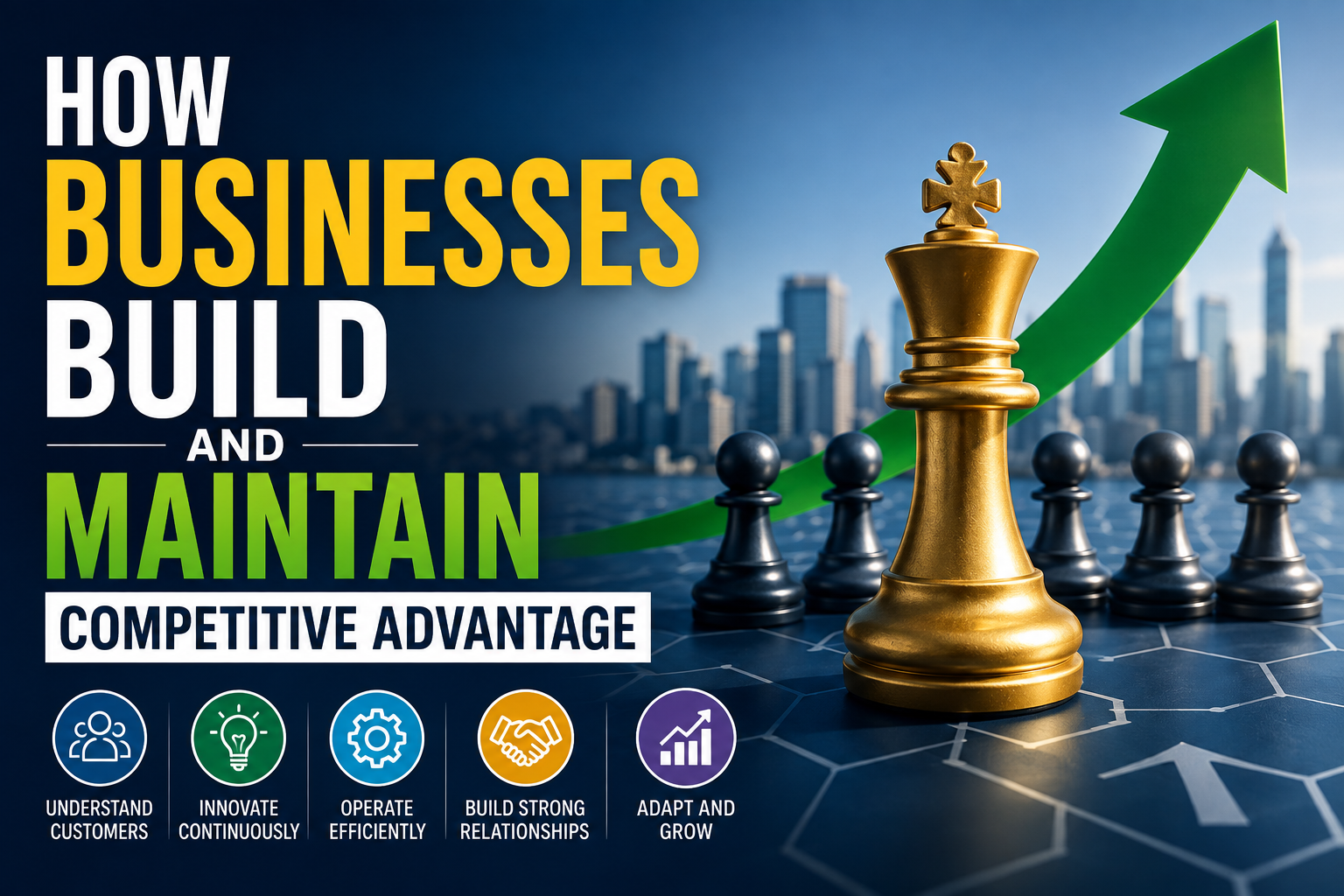
How Businesses Build and Maintain Competitive Advantage
In crowded markets, having a good product is rarely enough to guarantee long-term success. Competitors can copy features, lower prices, adopt new technologies and target the same customers. What separates resilient companies from businesses that struggle is often their ability to build and maintain a competitive advantage.
Competitive advantage is the reason customers choose one business over alternatives and why a company can continue creating value more effectively than its competitors. It can come from many sources, including lower costs, stronger brands, better technology, superior customer experiences, specialized expertise or an operating model that competitors find difficult to replicate.
Building that advantage takes time. Maintaining it requires businesses to keep adapting as customers, technology, competitors and economic conditions change.
What Is Competitive Advantage?
Competitive advantage refers to the characteristics, capabilities or resources that allow a business to perform better than its competitors in ways that matter to customers and the company’s financial performance.
A company might have an advantage because it:
- Produces goods at a lower cost
- Offers a product customers perceive as superior
- Has a powerful and trusted brand
- Provides an exceptional customer experience
- Owns valuable intellectual property
- Has specialized knowledge or expertise
- Operates an unusually efficient supply chain
- Has strong relationships with customers or suppliers
- Uses technology more effectively
- Has access to scarce resources or distribution channels
The key is that an advantage must create meaningful value. A business may possess something competitors do not have, but if customers do not care about it and it does not improve the company’s economics, it may not represent a meaningful competitive advantage.
The Difference Between a Short-Term Edge and a Sustainable Advantage
Not every business success represents a durable competitive advantage.
A company might temporarily gain market share because a competitor experiences a supply shortage. Another might attract customers through a promotional discount. A new product could generate significant attention for several months before competitors introduce similar alternatives.
These can be useful advantages, but they may not last.
A sustainable competitive advantage is more difficult for competitors to copy or overcome. It typically comes from a combination of capabilities rather than one easily replicated feature.
For example, a competitor might copy a company’s product design, but replicating its brand reputation, supplier relationships, distribution network, organizational culture and accumulated customer data could be considerably harder.
This is why businesses seeking long-term success need to think beyond individual products and focus on building systems of capabilities that reinforce one another.
Start With a Clear Understanding of Customers
One of the strongest foundations for competitive advantage is understanding what customers actually value.
Businesses sometimes invest heavily in features, technology or operational improvements without establishing whether those investments solve meaningful customer problems.
Companies can strengthen their position by identifying:
- Who their most valuable customers are
- What problems those customers are trying to solve
- What alternatives customers currently use
- Why customers choose competitors
- Which frustrations remain unresolved
- What customers value most when making purchasing decisions
- Which needs are likely to change in the future
Customer understanding should go beyond demographic information. A business needs to understand the motivations, constraints and priorities behind purchasing decisions.
When companies consistently solve important customer problems better than alternatives, they create a foundation for differentiation.
Compete on More Than Price
Price can be a powerful competitive weapon, but relying exclusively on low prices can create a difficult business model.
Competitors can respond by lowering their own prices, potentially triggering a price war that reduces profitability across the market.
Instead, businesses can differentiate themselves through factors such as:
- Quality
- Reliability
- Convenience
- Speed
- Design
- Customer service
- Customization
- Expertise
- Trust
- Brand reputation
A company that gives customers compelling reasons to choose it beyond price may have greater pricing power and stronger customer loyalty.
This does not mean price is unimportant. Cost efficiency can itself be a competitive advantage. The difference is between having a structurally lower cost base and simply cutting prices whenever competition increases.
Build a Strong Brand
A recognizable brand can become one of a company’s most valuable strategic assets.
Strong brands reduce uncertainty for customers. When people recognize and trust a company, they may be more willing to purchase its products even when competing alternatives are available.
Brand strength can influence:
- Customer loyalty
- Purchase decisions
- Pricing power
- Reputation
- Employee recruitment
- Partnerships
- Customer acquisition costs
Building a brand requires consistency. Companies need to deliver experiences that match the promises they make through advertising and communications.
A business cannot sustainably build a premium reputation while repeatedly delivering poor quality or unreliable service.
Over time, the combination of consistent performance and clear positioning can create an advantage that is difficult for competitors to reproduce quickly.
Invest in Capabilities Competitors Struggle to Copy
One of the most effective ways to create durable competitive advantage is to develop organizational capabilities rather than relying on individual products.
A product can often be copied.
A sophisticated organization is much harder to copy.
For example, a company might develop exceptional capabilities in:
- Product development
- Supply-chain management
- Data analysis
- Customer support
- Logistics
- Sales
- Manufacturing
- Research and development
- Talent development
These capabilities become especially powerful when they reinforce one another.
A business with an efficient manufacturing system, strong supplier relationships and experienced production teams may be able to introduce products faster and at lower cost than competitors.
The advantage does not come from one isolated asset. It comes from the system working together.
Use Technology as a Capability, Not Just a Feature
Technology can create competitive advantage, but simply adopting the latest technology does not guarantee one.
If every competitor can purchase the same software, cloud services or artificial intelligence tools, the technology itself may not provide a lasting advantage.
The greater opportunity comes from using technology in ways that improve the company’s unique capabilities.
Businesses can use technology to:
- Automate repetitive work
- Analyze customer behavior
- Improve forecasting
- Reduce operational costs
- Personalize customer experiences
- Accelerate product development
- Improve inventory management
- Detect operational problems
- Support employees with better information
Artificial intelligence is an increasingly important example.
Companies may have access to similar AI models, but their ability to integrate those tools with proprietary data, specialized workflows, experienced employees and customer relationships can differ substantially.
The competitive advantage therefore comes less from owning a particular tool and more from learning how to use technology better than competitors.
Develop and Retain Valuable Talent
People can be a major source of competitive advantage, particularly in industries where expertise, creativity and relationships are important.
Experienced employees develop institutional knowledge that cannot always be purchased or replicated quickly.
Businesses can strengthen this advantage by creating environments that encourage:
- Continuous learning
- Collaboration
- Innovation
- Accountability
- Knowledge sharing
- Internal career development
- Strong leadership
Recruitment matters, but retention matters too.
If a company repeatedly loses experienced employees, it may lose customer relationships, technical knowledge and organizational memory along with them.
A strong workplace can therefore become more than an employee benefit. It can become part of the company’s strategic capability.
Create Switching Costs and Customer Loyalty
Some businesses maintain competitive advantage by making it valuable and convenient for customers to stay with them.
These switching costs do not necessarily have to be financial.
Customers may stay because changing providers would require:
- Learning a new system
- Moving large amounts of data
- Rebuilding workflows
- Retraining employees
- Losing accumulated benefits
- Establishing new relationships
- Giving up personalized experiences
Loyalty programs, integrated software ecosystems, subscriptions and customized services can all contribute to customer retention when they provide genuine value.
However, businesses should be careful not to confuse inconvenience with loyalty. Customers who stay only because switching is difficult may leave when a significantly better alternative appears.
The strongest retention strategies combine reasonable switching costs with consistently good customer experiences.
Protect Valuable Intellectual Property
Intellectual property can provide businesses with protection against direct imitation.
Patents, trademarks, copyrights, trade secrets and proprietary technologies can all play different roles in protecting a company’s assets.
But legal protection is only one part of the equation.
Companies also need to protect confidential information, research, customer data and specialized processes through appropriate security and internal controls.
In technology-intensive industries, the combination of intellectual property, specialized expertise and accumulated knowledge can become a significant barrier to competitors.
Take Advantage of Economies of Scale
Large businesses can sometimes achieve lower costs per unit as production increases.
This is known as economies of scale.
A company with significant purchasing volume may negotiate better supplier terms. A large distribution network may spread logistics costs across more products. A major technology platform may distribute infrastructure expenses across millions of users.
Scale can therefore become a competitive advantage when larger operations genuinely improve economics.
However, scale is not automatically beneficial. Large organizations can also become slower, more bureaucratic and less responsive to customers.
The strongest companies learn how to combine the efficiencies of scale with the flexibility of smaller competitors.
Build Network Effects Where Appropriate
Some businesses become more valuable as more people use them.
This is known as a network effect.
Social networks, marketplaces and certain digital platforms can benefit from this dynamic. More users can attract more participants, which can make the platform increasingly useful.
For example, a marketplace with many buyers may attract more sellers, while a larger selection of sellers can attract more buyers.
Network effects can create powerful competitive barriers because a new competitor may struggle to attract users when an established platform already has a large active community.
However, network effects are not universal. Businesses should not assume that simply having more customers automatically creates a self-reinforcing advantage.
Keep Improving the Customer Experience
Customer experience can become a competitive advantage when businesses consistently make interactions easier, faster and more reliable.
This includes everything from discovering a product to purchasing it, receiving it, using it and obtaining support afterward.
Small improvements can accumulate.
A company might reduce checkout friction, make its website easier to navigate, provide faster delivery, simplify returns or improve customer support.
When these improvements are repeated across thousands or millions of interactions, they can meaningfully differentiate a business.
The challenge is consistency. A great marketing campaign cannot compensate indefinitely for a frustrating product or poor customer service.
Make Innovation Part of the Business Model
Maintaining competitive advantage requires continuous innovation.
Competitors do not remain still. Customer expectations change. New technologies emerge. Regulations evolve. New business models can transform entire industries.
Businesses therefore need mechanisms for identifying and responding to change.
Innovation can involve:
- New products
- New services
- New distribution channels
- New technologies
- New pricing models
- Process improvements
- New customer segments
- More efficient operating methods
Importantly, innovation does not always mean creating something completely new.
Sometimes the most valuable innovation involves making an existing process dramatically faster, cheaper or easier.
Monitor Competitors Without Becoming Obsessed With Them
Competitive analysis helps businesses understand how their position is changing.
Companies can track competitors’ products, pricing, customer feedback, marketing strategies, hiring patterns and technological investments.
But there is a danger in becoming too focused on competitors.
A company that constantly copies competitors can lose its own strategic identity. Instead of determining what customers genuinely need, it begins reacting to every move made by another company.
The better approach is to monitor competitors while maintaining a clear understanding of the business’s own strengths, customers and long-term objectives.
Build an Organization That Can Adapt
One of the biggest threats to competitive advantage is complacency.
A business can dominate its market for years and still lose its position when conditions change.
Technological disruption, changing consumer preferences, new regulations, economic shocks and unexpected competitors can weaken advantages that once appeared permanent.
Adaptable organizations tend to have several characteristics:
- They make decisions using reliable information.
- They encourage employees to identify problems.
- They experiment with new ideas.
- They learn from unsuccessful initiatives.
- They invest in relevant skills.
- They are willing to change established processes.
- They maintain awareness of emerging threats.
Adaptability does not mean constantly changing direction. It means having the ability to change when evidence shows that change is necessary.
Avoid the Trap of Short-Term Thinking
Competitive advantage is often built through investments that do not produce immediate returns.
Research and development, employee training, customer service, brand building and technology infrastructure can require significant resources before their benefits become obvious.
Businesses focused exclusively on quarterly performance may underinvest in these capabilities.
That can create a dangerous cycle: short-term financial results improve while the underlying competitive position gradually weakens.
Long-term thinking requires businesses to balance current performance with investments that protect future growth.
Measure Whether the Advantage Is Actually Working
A competitive strategy should produce measurable outcomes.
Depending on the business, useful indicators may include:
- Customer retention
- Market share
- Customer acquisition costs
- Profit margins
- Revenue growth
- Repeat purchase rates
- Customer satisfaction
- Product adoption
- Employee retention
- Operating efficiency
- Return on invested capital
The purpose of measurement is not to create more reports. It is to determine whether the capabilities the company is investing in are producing meaningful results.
A company might believe that it has exceptional customer loyalty, for example, but retention data may reveal that customers are leaving at an increasing rate.
Good measurement turns assumptions into evidence.
Competitive Advantage Must Keep Evolving
Perhaps the most important characteristic of competitive advantage is that it is never truly finished.
A successful strategy attracts competitors. Once an advantage becomes visible and profitable, others will attempt to replicate it.
That means businesses need to continuously strengthen the foundations of their position.
The most resilient companies do not rely on a single advantage. They build combinations of capabilities—strong customer relationships, efficient operations, valuable talent, trusted brands, useful technology and a culture of continuous improvement.
These capabilities can reinforce one another and make the business more difficult to imitate.
In a rapidly changing economy, the ultimate competitive advantage may therefore be the ability to keep creating new advantages.
Companies that understand their customers, invest in distinctive capabilities, adapt to technological and market changes, and remain disciplined about delivering value are better positioned to defend their place in the market.
Competitive advantage is not simply about being better than competitors today. It is about building an organization capable of remaining valuable when tomorrow’s competitive landscape looks very different from today’s.



2 Comments
Micle harison
June 7, 2019Lorem ipsum dolor sit amet, usu ut perfecto postulant deterruisset, libris causae volutpat at est, ius id modus laoreet urbanitas. Mel ei delenit dolores.
John Doe
June 7, 2019Some consultants are employed indirectly by the client via a consultancy staffing company.