
How Businesses Manage Supply Chains Effectively
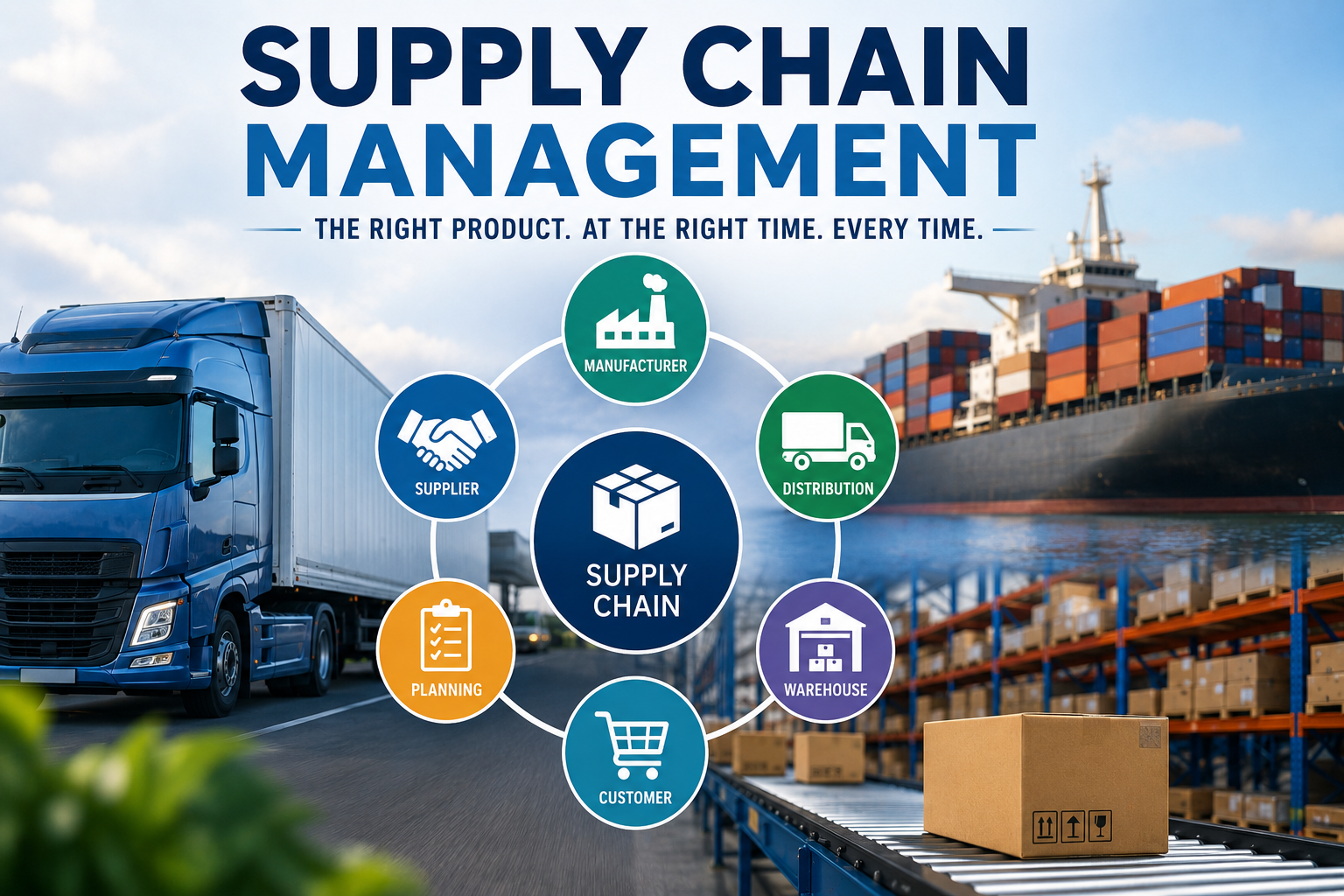
A product may look simple when it reaches a customer, but getting it there can involve a surprisingly complicated network of suppliers, manufacturers, warehouses, transportation providers, distributors and retailers.
That network is a company’s supply chain, and managing it effectively has become one of the most important challenges for modern businesses.
A well-managed supply chain helps companies keep products available, control costs, maintain quality and respond quickly when conditions change. A poorly managed one can result in shortages, excess inventory, delayed deliveries, rising expenses and frustrated customers.
Effective supply chain management is therefore about much more than moving products from one location to another. It involves coordinating people, information, technology, suppliers and financial resources so that the entire system works as efficiently as possible.
What Supply Chain Management Means
Supply chain management is the process of planning and coordinating the activities involved in sourcing materials, producing goods, storing inventory and delivering products or services to customers.
Depending on the business, a supply chain can include:
- Raw-material suppliers
- Manufacturers and production facilities
- Warehouses and distribution centers
- Shipping and logistics providers
- Wholesalers and distributors
- Retail stores
- E-commerce fulfillment operations
- Customers and end users
Businesses must coordinate these different parts while balancing competing priorities.
Customers generally want products to be available quickly and at competitive prices. Companies, meanwhile, need to avoid holding excessive inventory, paying unnecessary transportation costs or depending too heavily on a single supplier.
Effective management means finding the right balance.
Why Supply Chains Matter to Business Performance
Supply chains directly influence several areas of business performance.
One of the most obvious is cost. Companies spend money on materials, manufacturing, storage, transportation, labor and inventory management. Small inefficiencies repeated across thousands of products can become significant expenses.
Supply chains also affect customer satisfaction.
A company can have an excellent product, but customers may still be disappointed if orders arrive late or products are frequently out of stock.
Reliability can therefore become a competitive advantage.
A business that consistently delivers the right product at the right time can build stronger relationships with customers and reduce the operational problems associated with missed orders and emergency shipments.
Businesses Start With Accurate Demand Forecasting
One of the most difficult supply chain decisions is determining how much inventory will be needed in the future.
Ordering too little can create shortages. Ordering too much ties up money in inventory that may sit in warehouses for months.
Businesses use demand forecasting to estimate future sales based on historical information, current orders, market conditions, seasonal patterns and other relevant factors.
Modern companies can also use analytical software and machine-learning systems to identify patterns in large datasets.
Forecasting will never be perfect because customer behavior can change unexpectedly. The objective is to improve the quality of planning and reduce avoidable surprises.
Companies may also create multiple forecasts based on different scenarios rather than relying on one fixed prediction.
Inventory Management Requires Balance
Inventory is one of the most visible parts of supply chain management.
Businesses need enough stock to meet expected demand while avoiding unnecessary accumulation.
Several approaches can help.
Safety stock provides a buffer against unexpected increases in demand or supplier delays.
Reorder points identify when inventory should be replenished.
Economic order quantity models can help businesses determine appropriate order sizes by considering factors such as purchasing and holding costs.
Some companies also use just-in-time inventory systems, where materials arrive relatively close to when they are needed in production. This can reduce storage requirements, although it may increase exposure to supply disruptions if there is insufficient backup capacity.
The right strategy depends on the product, industry and level of supply-chain risk.
Strong Supplier Relationships Are Essential
A business is only as resilient as some of the suppliers it depends on.
Companies therefore need to carefully evaluate potential suppliers before entering into long-term relationships.
Important considerations can include:
- Product quality
- Pricing
- Production capacity
- Delivery reliability
- Financial stability
- Geographic location
- Regulatory compliance
- Environmental and labor practices
- Ability to respond to changing demand
Effective businesses often treat important suppliers as strategic partners rather than simply as vendors.
Regular communication can help both sides understand changes in demand, production schedules and potential problems.
Long-term relationships can also make it easier to negotiate better terms and resolve problems quickly when they arise.
Businesses Avoid Excessive Dependence on One Supplier
Supplier diversification can be an important component of supply-chain resilience.
If a company obtains a critical component from only one supplier or one geographic region, an unexpected disruption can affect the entire operation.
Businesses may therefore develop relationships with multiple suppliers for strategically important materials.
This does not mean every component needs several suppliers. Maintaining multiple sources can increase administrative complexity and sometimes raise costs.
Instead, companies typically identify the materials and suppliers that represent the greatest risks and develop appropriate contingency plans.
The goal is to balance efficiency with resilience.
Technology Gives Companies Better Visibility
Modern supply chains generate enormous amounts of information.
Businesses can track orders, inventory levels, shipments, production schedules and supplier performance using specialized software.
Enterprise resource planning systems can connect information across departments, while warehouse-management and transportation-management systems can provide more detailed operational visibility.
Internet-connected sensors and tracking technologies can also provide information about the location or condition of goods as they move through the supply chain.
Better visibility allows companies to identify problems earlier.
If a shipment is delayed, for example, managers may be able to see the problem before it affects customers and find an alternative solution.
Without timely information, businesses may not discover the problem until the consequences are already significant.
Data Helps Companies Make Better Decisions
Supply chain management increasingly depends on data analysis.
Businesses can examine information such as:
- Sales trends
- Inventory turnover
- Supplier delivery performance
- Transportation costs
- Warehouse capacity
- Order accuracy
- Product returns
- Customer demand
- Production efficiency
These measurements can reveal bottlenecks and recurring problems.
For example, if a particular supplier consistently delivers late, the business can investigate whether the issue is caused by production capacity, transportation, ordering practices or another factor.
Data can also help companies compare suppliers using objective performance measures rather than relying entirely on relationships or assumptions.
Transportation Must Be Managed Carefully
Getting products from suppliers to warehouses and from warehouses to customers can represent a significant portion of supply-chain costs.
Businesses therefore consider factors such as transportation mode, distance, fuel costs, delivery speed and shipment size.
Air freight can be fast but expensive. Ocean shipping is generally slower but can be economical for large international shipments. Road and rail transportation can provide different combinations of flexibility, cost and capacity.
Companies often combine several transportation methods depending on the urgency and characteristics of the products being moved.
Route optimization can also reduce unnecessary mileage and improve delivery efficiency.
For businesses with large distribution networks, even small improvements in routing can produce substantial savings.
Warehouses Are More Than Storage Facilities
Modern warehouses increasingly function as highly organized logistics centers.
Their responsibilities can include receiving products, inspecting shipments, storing inventory, picking orders, packaging goods and preparing them for transportation.
Businesses use warehouse layouts and inventory systems to minimize unnecessary movement.
Products that sell frequently may be positioned closer to packing areas, while automated systems can help workers locate and retrieve inventory more efficiently.
Automation is also becoming increasingly important.
Robotic systems, automated storage technologies and barcode or radio-frequency identification systems can improve accuracy and reduce repetitive manual work.
The objective is not necessarily to automate everything. Businesses need to determine where technology provides a meaningful operational or financial benefit.
Supply Chain Resilience Matters During Disruptions
Supply chains inevitably face disruptions.
Weather events, transportation problems, geopolitical developments, labor shortages, cyber incidents, supplier failures and unexpected changes in demand can all affect operations.
Businesses cannot eliminate every risk, but they can prepare for foreseeable problems.
A resilient supply chain may include:
- Alternative suppliers
- Emergency inventory reserves
- Multiple transportation options
- Backup production capacity
- Business continuity plans
- Supplier risk assessments
- Regular disruption simulations
Companies can also rank risks according to their potential impact and probability.
This allows managers to focus resources on the disruptions most likely to cause serious damage.
Communication Connects the Entire Supply Chain
Even sophisticated technology cannot replace effective communication.
Suppliers need to understand what customers are ordering. Manufacturers need accurate production forecasts. Warehouses need reliable information about incoming and outgoing shipments. Transportation providers need accurate delivery schedules.
Poor communication can create problems throughout the chain.
For example, if sales teams suddenly expect a major increase in demand but the information does not reach procurement and production teams, the business may discover too late that it does not have enough inventory or manufacturing capacity.
Companies can reduce this risk by establishing clear communication channels and ensuring that important information reaches the people responsible for making operational decisions.
Businesses Track the Right Performance Indicators
Effective supply chain management requires measurable goals.
Companies commonly track indicators such as:
Inventory turnover: how quickly inventory is sold and replaced.
Order fulfillment rate: the percentage of customer orders successfully fulfilled.
On-time delivery: how consistently products reach their destinations when promised.
Order accuracy: how often customers receive the correct products and quantities.
Carrying costs: the expenses associated with holding inventory.
Supplier performance: measures such as quality, reliability and delivery consistency.
Cash-to-cash cycle time: the period between paying suppliers and receiving cash from customers.
These metrics help businesses identify where improvements are needed.
However, companies should avoid optimizing one measurement at the expense of the entire supply chain. Reducing inventory dramatically, for example, may improve carrying costs while simultaneously increasing the risk of stockouts.
Sustainability Is Becoming Part of Supply Chain Strategy
Environmental considerations are increasingly influencing supply-chain decisions.
Companies may examine the carbon emissions associated with transportation, packaging and manufacturing. Some are reducing unnecessary packaging, consolidating shipments or sourcing materials closer to production facilities.
Sustainability can also involve supplier practices.
Businesses may evaluate whether suppliers follow environmental regulations and responsible labor standards.
These efforts can reduce environmental impact while potentially improving efficiency. Less packaging can mean lower material costs, for example, while better transportation planning can reduce both fuel consumption and expenses.
Artificial Intelligence Is Changing Supply Chain Planning
Artificial intelligence is increasingly being used to support supply-chain decisions.
AI systems can analyze large quantities of information and identify patterns that may be difficult for humans to detect manually.
Potential applications include:
- Demand forecasting
- Inventory optimization
- Route planning
- Warehouse scheduling
- Supplier risk monitoring
- Predictive maintenance
- Automated customer-service responses
- Disruption detection
AI does not eliminate the need for experienced supply-chain professionals. Instead, it can give managers better information and allow them to spend more time addressing complex decisions.
The quality of the results still depends on the quality of the data and the assumptions built into the system.
Effective Supply Chains Balance Efficiency and Resilience
One of the biggest lessons from recent supply-chain disruptions is that the cheapest system is not always the best system.
For years, businesses often focused heavily on minimizing inventory, reducing supplier numbers and optimizing transportation costs.
Those strategies can improve efficiency under normal conditions. But they can also leave companies vulnerable when something unexpected happens.
Modern supply-chain management increasingly seeks a balance between efficiency and resilience.
Maintaining additional inventory, alternative suppliers or backup transportation options can cost more in the short term. But those investments may protect a company from much larger losses during a major disruption.
The right balance varies by industry and product.
A company selling inexpensive, easily replaceable products may tolerate different risks from a manufacturer that depends on a specialized component with a long replacement lead time.
Supply Chain Management Is Becoming a Strategic Function
Supply chains were once often viewed primarily as operational systems concerned with purchasing, warehousing and transportation.
Today, they can influence a company’s broader competitive strategy.
A reliable supply chain can allow a business to launch products faster, respond to demand changes more effectively and provide better customer service.
It can also influence pricing decisions, working capital requirements and expansion into new markets.
As supply networks become more global and interconnected, businesses increasingly need to understand not only their direct suppliers but also the risks deeper within the chain.
Companies that build strong visibility, maintain productive supplier relationships, use data effectively and prepare for disruptions can be better positioned to operate when conditions change.
The most effective supply chains are not necessarily the largest or most technologically advanced. They are the ones that connect planning, purchasing, production, inventory, transportation and customer demand into a coordinated system.
For businesses, that coordination can make the difference between simply moving products and building an operation capable of delivering reliably, controlling costs and adapting when the unexpected happens.



2 Comments
Micle harison
June 7, 2019Lorem ipsum dolor sit amet, usu ut perfecto postulant deterruisset, libris causae volutpat at est, ius id modus laoreet urbanitas. Mel ei delenit dolores.
John Doe
June 7, 2019Some consultants are employed indirectly by the client via a consultancy staffing company.