
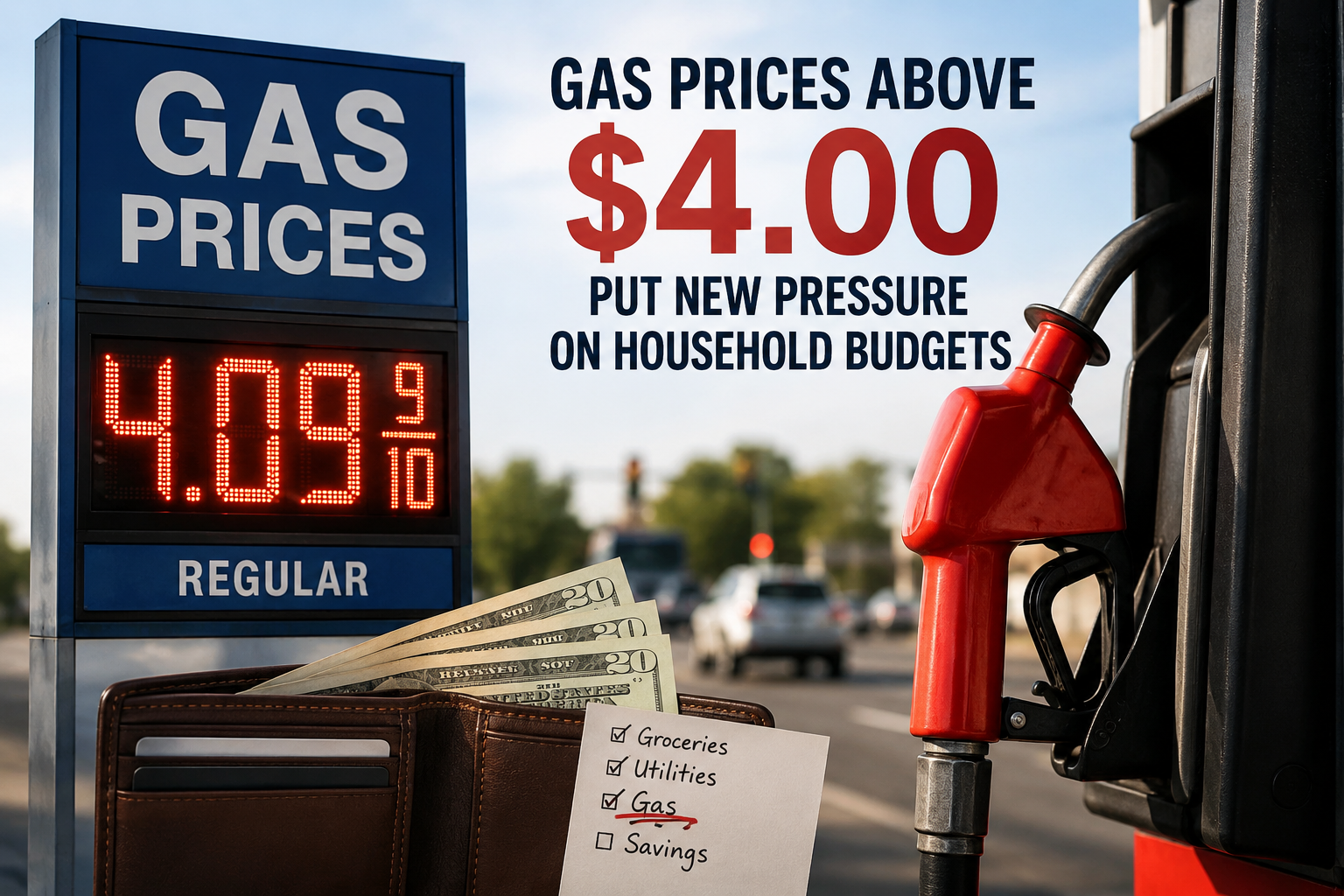
Gas Prices Above Four Dollars Put New Pressure on Household Budgets
For millions of American households, filling up the car has become an increasingly expensive part of the monthly budget. The national average price for regular gasoline reached about $4.10 per gallon in late August, according to AAA, putting fuel costs well above the levels consumers were paying a year ago. The average is also at its highest level for this point in August on record. (AAA Oregon/Idaho)
The increase comes at a difficult time for households already dealing with elevated prices for food, housing, insurance and other essentials. Because gasoline is difficult to avoid for many workers and families, higher pump prices can quickly force consumers to make adjustments elsewhere.
Why Gas Prices Are Rising
The latest increase is closely tied to higher crude oil prices and continuing uncertainty in global energy markets.
Oil prices have been affected by disruptions associated with the conflict involving Iran, restrictions on shipping through the Strait of Hormuz and attacks affecting Russian refining capacity. Crude oil has remained above $80 per barrel, creating upward pressure on gasoline prices. (AAA Oregon/Idaho)
Crude oil is the largest component of the price consumers pay at the pump. AAA notes that, on average, roughly half of the retail price of gasoline reflects the cost of crude oil, with the remainder coming from refining, distribution, marketing and taxes. (AAA Oregon/Idaho)
That means even relatively modest changes in global oil prices can eventually show up in household budgets.
The Extra Cost Can Add Up Quickly
A few cents more per gallon may not sound significant, but the impact becomes much larger for drivers who fill their tanks frequently.
Consider a household that uses about 50 gallons of gasoline each month. At $3 per gallon, that represents roughly $150 in monthly fuel spending. At $4.10 per gallon, the same amount of gasoline costs about $205.
That is an additional $55 per month, or approximately $660 over a year, without the household driving any more than it did previously.
For commuters with long daily drives, households with multiple vehicles or families that regularly travel long distances, the difference can be considerably larger.
The burden is also uneven across the country. AAA reported that 27 states and the District of Columbia had average gasoline prices of at least $4 per gallon as of August 25. California, Hawaii and Washington were above $5 per gallon, while several other Western states were approaching that level. (AAA Oregon/Idaho)
Higher Fuel Costs Don’t Stop at the Gas Station
The financial impact of expensive gasoline extends beyond personal transportation.
Businesses depend on fuel to move products, operate vehicles and transport workers. Trucking companies, delivery services, airlines and other transportation-intensive businesses can face higher operating costs when energy prices rise.
Those expenses can eventually be passed on to consumers through higher prices for goods and services.
That creates a broader inflation problem. A family may be paying more to fill its vehicle while simultaneously facing higher prices at the supermarket or paying more for delivered goods because transportation costs have increased.
The effect can be particularly noticeable for households that have little flexibility in their transportation choices.
Commuters Face Some of the Biggest Challenges
For workers who drive to work every day, gasoline is often a relatively fixed expense.
Someone who commutes 30 or 40 miles each way may not be able to simply stop driving because fuel prices rise. Public transportation may not be available, remote work may not be an option, and changing jobs because of commuting costs is rarely an immediate solution.
This makes gasoline different from many discretionary purchases.
A household can postpone buying new furniture or reduce restaurant visits. It cannot necessarily postpone getting to work, taking children to school or visiting the doctor.
As a result, higher fuel prices can function like a reduction in disposable income.
Families May Cut Back on Other Spending
When gasoline consumes more of a paycheck, households generally have to find the money somewhere else.
That can mean fewer restaurant meals, delayed purchases, reduced entertainment spending or postponement of larger household projects.
Recent consumer data already show signs that Americans are becoming more selective about discretionary spending. Reuters reported that middle-income consumers have been prioritizing necessities and postponing major purchases amid elevated gasoline prices and broader economic pressures. (Reuters)
This matters for the wider economy because consumer spending represents a major source of economic activity.
If households spend more on fuel but do not receive corresponding increases in income, they have less money available for other businesses.
The Pressure Is Greater for Lower-Income Households
Higher gasoline prices do not affect every household equally.
A family with a substantial income may be able to absorb an additional $50 or $100 in monthly fuel costs without making major changes. A household living closer to the edge of its budget may have to choose between gasoline and another essential expense.
Transportation can also represent a larger share of total household spending for workers who live farther from employment centers or depend heavily on older, less fuel-efficient vehicles.
That makes energy prices an important household-finance issue, not simply a commodity-market story.
What Households Can Do While Prices Stay High
Consumers cannot control global crude oil prices, but there are several practical ways to limit the damage to a household budget.
Recalculate the Monthly Fuel Budget
Instead of relying on an old gasoline estimate, households can calculate actual monthly fuel consumption and update their budgets accordingly.
Knowing the likely cost in advance makes it easier to identify other expenses that can be adjusted before the higher fuel bill creates a cash-flow problem.
Combine Trips
Planning several errands around a single trip can reduce unnecessary mileage. Even small changes in driving habits can add up over several weeks.
Compare Local Prices
Gasoline prices can vary significantly between stations, even within the same area. Checking prices before filling up can help drivers avoid unnecessarily expensive stations.
The savings may be modest on an individual purchase, but frequent drivers can benefit over time.
Keep Tires Properly Inflated
Underinflated tires can reduce fuel efficiency. Keeping tires at the manufacturer’s recommended pressure is a simple maintenance step that can help limit unnecessary fuel consumption.
Avoid Unnecessary Idling
Leaving a vehicle running while parked wastes fuel. Turning the engine off when practical can help reduce consumption over time.
Reconsider Large Trips
When fuel prices are unusually high, households may want to calculate the transportation cost of longer recreational trips before making plans. That does not necessarily mean canceling travel, but understanding the full cost can prevent unpleasant surprises.
A Potential Source of Relief Could Be Coming
There are some reasons consumers may eventually see gasoline prices ease.
The federal government announced that it would end summer-blend gasoline requirements earlier than usual, beginning September 1, in an effort to increase fuel availability and reduce prices. The move comes as gasoline prices have risen sharply because of the disruption to global oil markets. (Reuters)
Gasoline prices also typically decline in the fall as the industry transitions toward less expensive winter-blend fuel. AAA noted that the seasonal change begins in September, although geopolitical conditions remain an important factor in determining how much relief drivers actually receive. (AAA Oregon/Idaho)
Still, cheaper gasoline is far from guaranteed. Continued disruptions to global oil supplies could keep crude prices elevated and reverse any temporary improvement at the pump.
Why Gasoline Matters for the Broader Economy
The economic significance of $4 gasoline goes beyond individual household budgets.
Consumer confidence has already weakened. The Conference Board’s consumer confidence index fell to 89.4 in August from 90.2 in July, while concerns about inflation and gasoline prices remained important factors weighing on consumers’ outlook. (AP News)
Persistent fuel inflation can also complicate the Federal Reserve’s efforts to manage price pressures. If energy costs feed into transportation and other consumer prices, inflation can remain elevated even when some other categories begin to cool.
That creates a difficult environment for policymakers and households alike.
What Families Should Watch Next
The biggest variable for household budgets is likely to remain the global oil market.
If geopolitical tensions ease and oil supplies become more predictable, gasoline prices could eventually move lower. Rising inventories and softer demand could also provide some relief. Recent U.S. data showed crude inventories increasing, while gasoline stocks also rose, potentially easing some supply concerns. (MarketWatch)
If disruptions intensify, however, gasoline could remain expensive for longer.
For households, the safest approach is to treat today’s higher fuel costs as a genuine budget risk rather than assuming prices will quickly return to previous levels. Building a little extra room into the transportation category, reducing unnecessary driving and reviewing other discretionary expenses can help families absorb the shock.
The Bigger Household Budget Picture
Gasoline above $4 a gallon is more than an inconvenience for drivers. It represents another recurring expense competing for a share of household income at a time when many families are already carefully managing their spending.
Whether the pressure fades will depend largely on developments in global energy markets. Until then, households that understand exactly how much they spend on transportation—and where they can realistically cut consumption—will be better positioned to manage another period of elevated fuel costs without allowing a higher gas bill to destabilize the rest of the budget.




2 Comments
Micle harison
June 7, 2019Lorem ipsum dolor sit amet, usu ut perfecto postulant deterruisset, libris causae volutpat at est, ius id modus laoreet urbanitas. Mel ei delenit dolores.
John Doe
June 7, 2019Some consultants are employed indirectly by the client via a consultancy staffing company.