
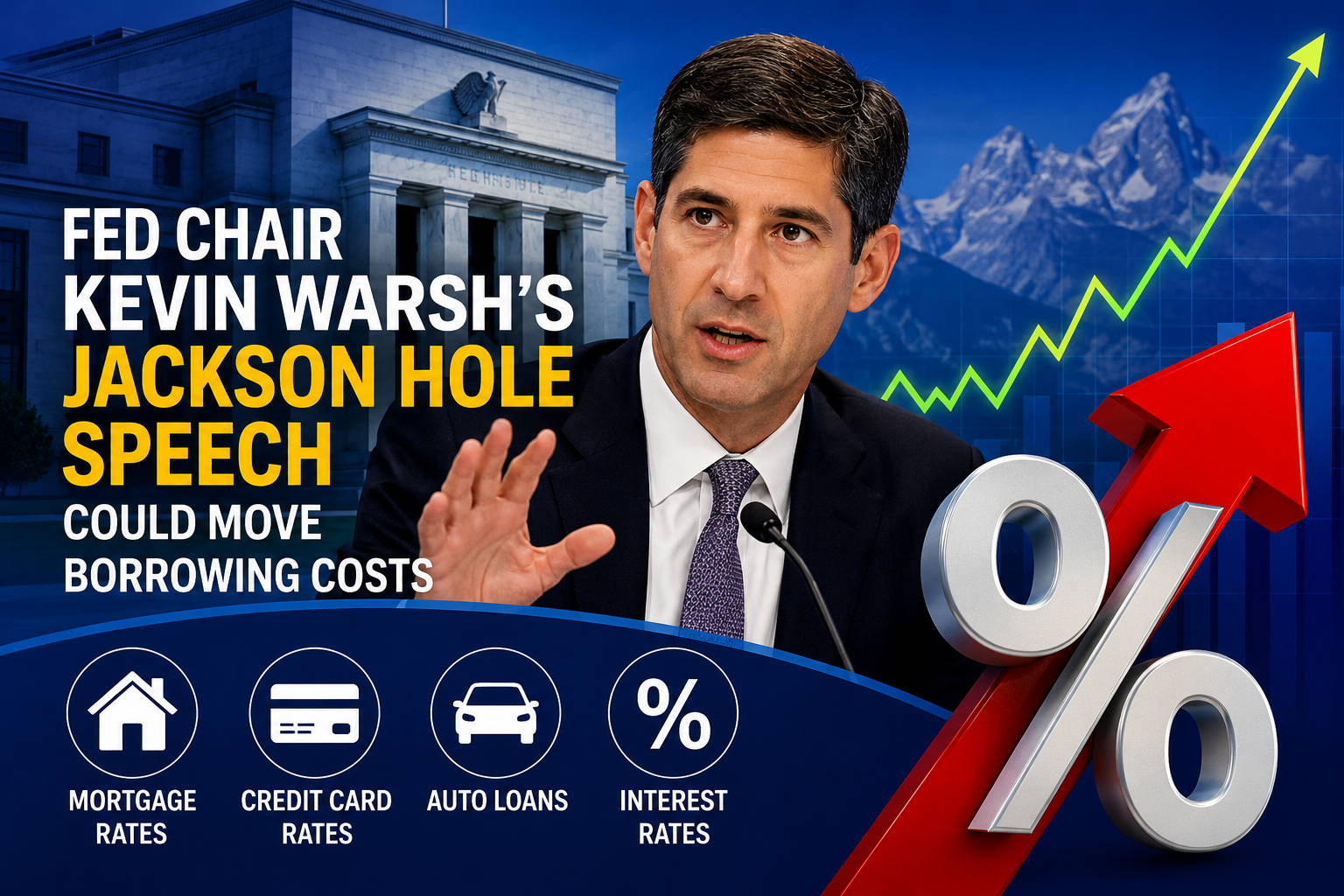
Fed Chair Kevin Warsh’s Jackson Hole Speech Could Move Borrowing Costs
Federal Reserve Chair Kevin Warsh is heading into his first Jackson Hole economic symposium as the central bank’s leader at a moment when investors are unusually sensitive to every signal about interest rates.
His speech on Friday, August 28, is expected to draw intense attention from bond traders, banks, businesses and households because the Fed is confronting a difficult combination of persistent inflation, elevated Treasury yields and concerns about the economy’s longer-term growth outlook. (Reuters)
For consumers, the significance goes well beyond Wall Street. The direction of interest rates influences mortgage costs, credit-card rates, auto loans, business financing and the returns available on savings.
Why Jackson Hole Matters This Year
The annual Jackson Hole Economic Policy Symposium has long been an important venue for Federal Reserve chairs to discuss the broader economic outlook and provide clues about monetary policy.
This year’s meeting carries additional weight because Warsh is still defining his approach to communication as Fed chair. Unlike his predecessors, he has favored less detailed forward guidance, leaving investors to interpret economic data rather than relying heavily on explicit signals about upcoming rate decisions. (Reuters)
That strategy can make a speech more consequential.
If Warsh gives investors a clearer picture of how he views inflation, employment, productivity and financial conditions, markets could quickly adjust their expectations for future interest rates. If his remarks remain deliberately vague, uncertainty could persist.
Borrowing Costs Could React Quickly
The most immediate market reaction would likely come through Treasury yields.
Treasury yields are important because they influence the broader cost of borrowing across the economy. Mortgage rates, corporate borrowing costs and some consumer lending rates are closely connected to movements in the bond market.
Long-term Treasury yields have already been under pressure. Recent concerns about inflation, government borrowing and the Fed’s policy direction have pushed investors to demand greater compensation for holding longer-term U.S. debt. The 10-year Treasury yield recently climbed back toward 4.7%, despite Treasury efforts to support the bond market through expanded buybacks. (AP News)
That means even if the Fed does not change its benchmark interest rate immediately, Warsh’s words could influence borrowing costs by changing expectations about where rates are heading.
A Hawkish Message Could Keep Rates Higher
One possibility is that Warsh emphasizes the need to bring inflation firmly back toward the Fed’s 2% objective.
Inflation has remained above target for an extended period, creating a difficult policy environment. Reuters reported that core personal consumption expenditure inflation has remained above the Fed’s target for 65 months, highlighting how persistent the problem has become. (Reuters)
A strongly hawkish message could lead investors to expect interest rates to remain elevated for longer—or even increase the possibility of future rate hikes.
That could push Treasury yields higher.
For households, the consequences could include:
- Higher mortgage rates or slower declines in mortgage rates
- More expensive credit-card borrowing
- Higher rates on personal and business loans
- Greater financing costs for cars and other large purchases
- Better yields on some savings products
For borrowers who are already carrying significant debt, another period of elevated rates could put additional pressure on monthly budgets.
A More Dovish Signal Could Ease Financial Pressure
The opposite scenario could produce a very different market reaction.
If Warsh signals greater confidence that inflation is moving lower and that economic growth or employment risks deserve more attention, investors could bring forward expectations for lower interest rates.
Falling Treasury yields could then help reduce some long-term borrowing costs.
Markets have already demonstrated how sensitive they are to Warsh’s upcoming remarks. Treasury yields moved lower ahead of the speech as investors positioned for potential clues about the Fed’s next moves. (Pluang)
A dovish message would not automatically mean cheaper mortgages or credit cards overnight. Banks and lenders consider many factors when setting consumer rates. But a sustained decline in market yields could eventually feed into borrowing costs.
Mortgages May Be One of the Biggest Consumer Effects
Homebuyers are likely to pay particularly close attention.
Mortgage rates are influenced heavily by longer-term bond yields rather than simply the Fed’s overnight policy rate. Consequently, the housing market can respond to changes in bond-market expectations even when the Fed leaves its benchmark rate unchanged.
A Warsh speech that pushes 10-year Treasury yields higher could make mortgage financing more expensive. Conversely, a significant decline in yields could provide some relief to prospective buyers.
That matters at a time when housing affordability is already strained by high home prices and elevated financing costs.
For existing homeowners with fixed-rate mortgages, the immediate impact would generally be limited. But people with adjustable-rate debt, prospective homebuyers and homeowners considering refinancing could be more exposed to changes in borrowing costs.
Credit Cards and Consumer Loans Tell a Different Story
Credit-card rates tend to be more closely connected to short-term interest rates.
That means the Fed’s policy outlook can have a more direct effect on consumers carrying revolving balances.
If markets begin expecting rates to stay higher for longer, households with variable-rate debt may continue facing expensive borrowing. Consumers who can reduce high-interest balances or avoid taking on unnecessary variable-rate debt may therefore have more financial flexibility if rates remain elevated.
Auto loans and personal loans can also be affected by the broader interest-rate environment, although lender-specific factors and creditworthiness remain important.
Savers Could Get a Different Message
Higher rates are painful for borrowers but can be beneficial for savers.
If Warsh signals that monetary policy will remain restrictive, banks and other financial institutions may continue offering relatively attractive yields on certain savings accounts and fixed-income products.
That creates an important trade-off for households.
People with substantial savings may benefit from elevated interest income, while households carrying credit-card balances or other variable-rate debt may face significantly higher costs.
The direction of rates therefore matters differently depending on whether a household is primarily a lender or a borrower.
The Bond Market Is Watching More Than the Fed Funds Rate
One reason Warsh’s speech could have such a broad impact is that financial markets care about more than the Fed’s next rate decision.
Investors will also be watching what he says about inflation expectations, productivity, demographics, government debt and the long-term structure of the economy.
Warsh is expected to discuss several of these broader issues rather than simply previewing the Fed’s next meeting. Analysts have also highlighted concerns surrounding the large U.S. fiscal deficit and elevated long-term Treasury yields. (Barron’s)
Those issues matter because long-term borrowing costs can remain high even if the Fed eventually cuts its short-term policy rate.
In other words, a few rate cuts would not necessarily return mortgage and other long-term borrowing costs to the unusually low levels seen during the 2020–2021 period.
What Households Should Watch After the Speech
Consumers do not need to predict every word Warsh will say. Instead, they can watch how markets respond.
Three indicators will be particularly useful:
Treasury yields: A sustained rise could signal that investors expect higher long-term borrowing costs.
Mortgage rates: These will provide a more direct indication of whether changes in bond yields are reaching the housing market.
Expectations for future Fed policy: Changes in interest-rate futures can show whether traders believe the speech made rate cuts or hikes more likely.
The key distinction is between a temporary market reaction and a lasting change in expectations. One volatile trading session does not necessarily determine where borrowing costs will be several months from now.
Why Warsh’s Communication Strategy Matters
Warsh’s approach to communication could itself become an important part of the market story.
Investors have become accustomed to extracting detailed clues from Federal Reserve statements, press conferences and speeches. Warsh has indicated a preference for reducing the amount of forward guidance, potentially giving markets less certainty about the Fed’s next move. (Reuters)
That could increase the importance of economic data.
Instead of assuming that the Fed will follow a clearly communicated path, investors may place greater emphasis on inflation, employment, consumer spending and growth figures as they arrive.
For households, that could mean interest-rate conditions remain more difficult to predict.
A Speech That Could Reach Main Street
The Jackson Hole gathering may take place far from ordinary household budgets, but its financial consequences can eventually reach consumers.
A hawkish Warsh could reinforce expectations for higher rates and put upward pressure on borrowing costs. A dovish message could lower yields and strengthen expectations for easier monetary policy. A deliberately neutral speech could leave markets searching for clues in upcoming economic data.
The stakes are particularly high because the Fed is operating in an environment where inflation remains persistent while long-term borrowing costs are already elevated. Investors are also watching whether the central bank can maintain credibility as concerns over government debt and Treasury-market conditions intensify. (Reuters)
For consumers, the most important takeaway is simple: the Fed does not need to change interest rates on Friday for borrowing costs to move.
Sometimes, a change in expectations is enough.
As Warsh steps onto the Jackson Hole stage, investors will be listening not only for what he says about the next rate decision, but for what his comments reveal about the longer-term path of U.S. interest rates. That distinction could determine whether households see meaningful relief in borrowing costs—or face another stretch of expensive credit.


2 Comments
Micle harison
June 7, 2019Lorem ipsum dolor sit amet, usu ut perfecto postulant deterruisset, libris causae volutpat at est, ius id modus laoreet urbanitas. Mel ei delenit dolores.
John Doe
June 7, 2019Some consultants are employed indirectly by the client via a consultancy staffing company.