
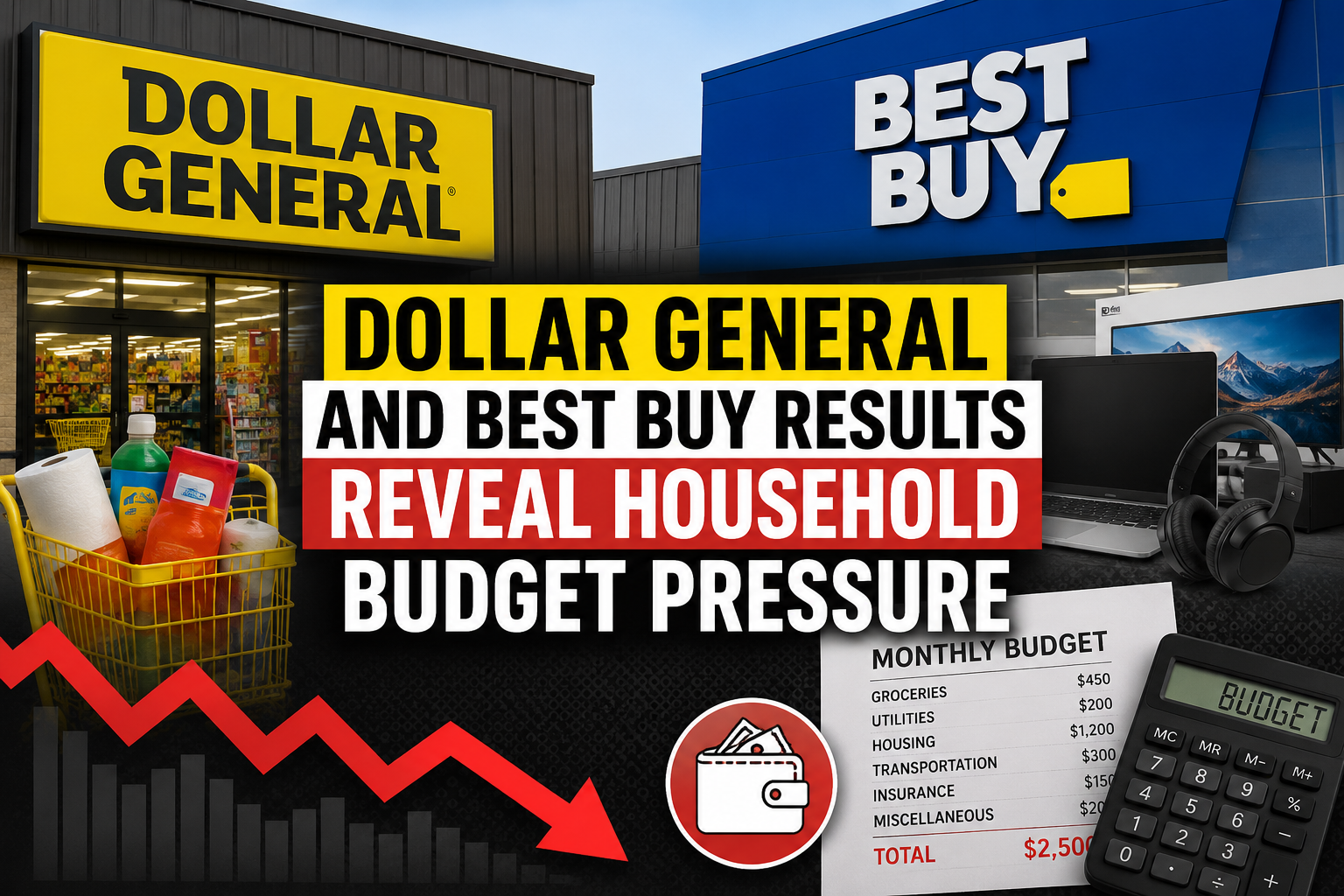
Dollar General and Best Buy Results Reveal Household Budget Pressure
The latest results and outlook from Dollar General and Best Buy offer two very different windows into the same consumer story: American households are still spending, but many are becoming more deliberate about where their money goes.
Dollar General sits at the value end of the retail market, selling everyday necessities at relatively low prices. Best Buy, by contrast, depends heavily on consumers being willing to spend on electronics, appliances and other discretionary purchases. The fact that both retailers are being closely watched at the same time makes their results particularly useful for understanding household finances.
The broader picture is not one of a consumer collapse. Instead, it points to households adjusting their budgets as essential costs remain elevated and larger purchases require more careful consideration.
Dollar General Shows Why Value Matters
Dollar General’s business model makes it an important indicator of financial pressure among lower- and middle-income households. The retailer’s first-quarter fiscal 2026 results showed net sales of $10.79 billion, up 3.4% year over year, while earnings per share reached $2.00, beating analysts’ expectations. (Reuters)
But beneath the headline numbers was a more complicated consumer picture.
Dollar General previously warned that its core customers, particularly households earning $35,000 or less, were dealing with financial strain from higher gasoline costs and reductions in food assistance. At the same time, the company said it was seeing more higher-income shoppers trading down toward cheaper products. (Reuters)
That combination is significant for household budgets. When consumers with higher incomes begin looking for cheaper alternatives while lower-income shoppers remain under pressure, it suggests that value-seeking behavior is spreading beyond Dollar General’s traditional customer base.
The company was scheduled to release its second-quarter fiscal 2026 results on August 27, making the report an important test of whether that trend has continued. Wall Street expectations before the release called for roughly $11.2 billion in revenue and about $2.01 in earnings per share. (Dollar General Investor Relations)
Best Buy Provides the Other Side of the Story
Best Buy offers a useful contrast because electronics purchases are generally easier for households to postpone than groceries, cleaning products or other basic necessities.
The company’s first-quarter fiscal 2027 results were relatively strong. Revenue reached $8.94 billion, while comparable sales increased 2%. Adjusted diluted earnings per share rose to $1.28 from $1.15 a year earlier. (Best Buy Corporate News and Information)
That does not necessarily mean consumers have stopped worrying about their finances.
A household can remain willing to buy a smartphone, laptop or television while still changing how it makes that purchase. Consumers may wait for promotions, compare prices more aggressively, choose less expensive models or postpone replacing products that still work.
Best Buy’s previous full-year outlook also reflected uncertainty. The company projected fiscal 2027 revenue of between $41.2 billion and $42.1 billion and comparable sales ranging from a 1% decline to a 1% increase, describing the broader economic environment as mixed. (investors.bestbuy.com)
The company’s second-quarter results, scheduled for August 27, were therefore expected to provide another important read on whether consumers are maintaining spending on discretionary goods. Analysts were looking for approximately $9.59 billion in revenue and $1.39 in earnings per share ahead of the release. (MarketBeat)
The Important Signal Is How Consumers Are Spending
Taken together, the two retailers illustrate a phenomenon that has become increasingly important for personal finance: spending can remain relatively strong even while household budgets become tighter.
A consumer who switches from a premium grocery brand to a private-label product is still spending money. A family that buys a discounted laptop instead of a high-end model is still contributing to retail sales. A homeowner who repairs an appliance rather than replacing it is still spending, but in a very different way.
This helps explain why aggregate consumer spending can appear resilient while individual households feel financially stretched.
Recent retail data provided another warning sign. U.S. retail sales fell 0.6% in July, the first monthly decline in nine months, while core retail sales fell 0.4%. The figures raised concerns about a cooling consumer sector even though sales remained higher than a year earlier. (Reuters)
Meanwhile, retailers across different categories have increasingly emphasized value. Recent industry results have shown shoppers visiting stores but spending less per trip, delaying expensive purchases and becoming more selective about discretionary items. (Reuters)
Essential Costs Leave Less Room for Discretionary Spending
One of the biggest issues for household finances is that consumers cannot easily eliminate many of their largest expenses.
Housing, food, transportation, insurance, utilities and healthcare can absorb a substantial share of monthly income. When those costs rise, households often respond by cutting spending in areas that are easier to control.
That can mean fewer restaurant meals, postponed vacations, delayed electronics upgrades, smaller home-improvement projects or less frequent purchases of clothing and other discretionary goods.
The result is a form of budget compression.
Consumers may continue spending, but they have less flexibility. A family that once had $500 left after paying its regular monthly bills might have only $250 or $300 available after higher essential expenses. Even if income has not fallen, the household can feel considerably more financially constrained.
This is one reason retailer earnings can be useful for personal finance analysis. They provide clues about how households are adapting to changes that may not immediately appear in headline employment or income statistics.
Higher-Income Consumers Are Also Trading Down
The shift toward value is not limited to households with the smallest budgets.
Dollar General has reported seeing higher-income consumers shop at its stores, suggesting that some households are deliberately trading down even when they can afford more expensive alternatives. (Reuters)
This behavior can be financially rational.
When prices remain elevated, consumers may decide that paying significantly more for a brand-name product does not provide enough additional value. Choosing the cheaper option allows them to preserve cash for savings, debt payments or larger financial goals.
In other words, trading down does not always indicate financial distress. It can also indicate greater financial discipline.
For households trying to improve their finances, that distinction matters. Reducing unnecessary spending while maintaining income can create additional room in a budget without requiring a major lifestyle change.
What the Retail Results Mean for Household Budgets
The message for consumers is relatively straightforward: flexibility is becoming increasingly valuable.
A household budget built around fixed assumptions can become vulnerable when food, transportation or housing costs rise. A more flexible budget allows spending to be adjusted as circumstances change.
Several strategies can help.
Review recurring expenses. Subscriptions, insurance policies, phone plans and other recurring bills can quietly consume hundreds of dollars each month.
Separate needs from upgrades. Replacing something because it is broken is different from replacing it because a newer model has been released.
Compare prices before major purchases. Best Buy’s category is particularly sensitive to promotions and product cycles, making patience potentially valuable for consumers who do not need an immediate replacement.
Use value shopping strategically. Dollar General’s growing appeal demonstrates how much households can potentially save by comparing brands, package sizes and retailers.
Protect emergency savings. When budgets are under pressure, maintaining a cash buffer becomes more important because unexpected expenses are harder to absorb.
The Bigger Economic Picture
The combination of value-oriented spending and cautious discretionary purchases suggests that the U.S. consumer remains resilient, but that resilience should not be confused with unlimited financial capacity.
Recent market data has shown the same tension. Consumer spending has remained substantial, but inflation continues to affect purchasing decisions, while a low savings rate raises questions about how much additional spending households can sustain. (Reuters)
That makes upcoming retail earnings particularly important. Strong sales at a discount retailer can indicate that consumers are actively searching for affordability. Stable sales at an electronics retailer can show that households still have room for discretionary purchases. But weaker spending on higher-priced products can reveal where budget pressure is becoming most visible.
The key question is therefore not simply whether consumers are spending.
It is what they are buying, what they are avoiding and how hard they are working to get a better price.
A More Selective Consumer Could Shape the Months Ahead
Dollar General and Best Buy occupy opposite ends of the retail spectrum, yet their results point toward the same fundamental change in consumer behavior: households are becoming more intentional about their money.
For personal finances, that means the old distinction between a strong consumer and a weak consumer is becoming less useful. A household can have income, continue spending and still be under pressure because the cost of maintaining its normal lifestyle has increased.
The emerging consumer appears more selective rather than simply weaker. Essentials come first, discounts matter more, major purchases face greater scrutiny and spending decisions increasingly depend on perceived value.
For households, that environment makes budgeting, comparison shopping and maintaining an emergency cushion more important than ever. For investors and economists, the spending patterns at retailers such as Dollar General and Best Buy provide an early look at whether American consumers can continue carrying economic growth without putting additional strain on their finances.


2 Comments
Micle harison
June 7, 2019Lorem ipsum dolor sit amet, usu ut perfecto postulant deterruisset, libris causae volutpat at est, ius id modus laoreet urbanitas. Mel ei delenit dolores.
John Doe
June 7, 2019Some consultants are employed indirectly by the client via a consultancy staffing company.