
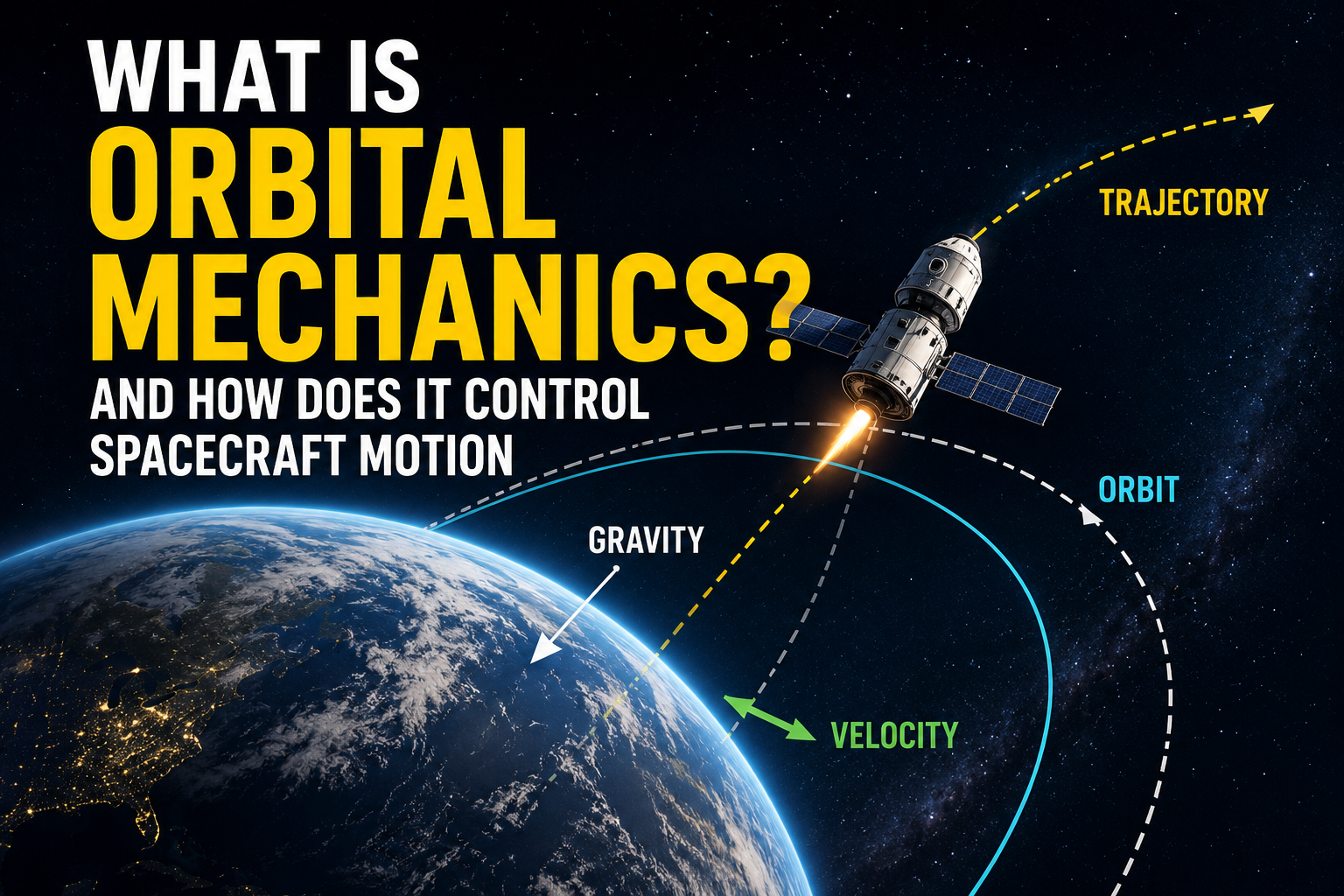
What Is Orbital Mechanics and How Does It Control Spacecraft Motion?
Spacecraft may appear to move through space in straight lines, but their journeys are governed by a precise set of physical principles. A spacecraft orbiting Earth, traveling to the Moon or heading toward another planet is constantly responding to gravity and its own velocity.
The field that explains these movements is known as orbital mechanics.
Orbital mechanics combines physics, mathematics and astronomy to determine how objects move under the influence of gravity. It allows engineers to calculate spacecraft trajectories, plan launches, design orbital maneuvers and determine how much fuel a spacecraft needs to reach its destination.
Without orbital mechanics, modern spaceflight would be impossible to plan with any meaningful accuracy.
What Is Orbital Mechanics?
Orbital mechanics is the study of the motion of artificial and natural objects under gravitational forces.
It is closely related to celestial mechanics, which examines the movement of planets, moons, asteroids, comets and other astronomical bodies. Orbital mechanics generally focuses more specifically on spacecraft and other objects whose trajectories can be controlled or predicted for space missions.
The basic idea is surprisingly simple: gravity changes the direction of an object’s motion, while its velocity determines how it moves through the gravitational field.
The interaction between these factors produces orbits, flybys, transfers between orbits and many other types of trajectories.
Gravity Is the Main Force
Gravity is at the heart of orbital motion.
Every object with mass exerts a gravitational force on other objects. The larger the mass, the stronger its gravitational influence. This is why Earth can keep satellites in orbit, while the Sun dominates the motion of the planets.
Newton’s law of universal gravitation describes the force between two masses:
F = G(m₁m₂/r²)
In simple terms, gravitational force becomes stronger as the masses increase and weaker as the distance between them increases.
A spacecraft traveling near Earth is therefore constantly being pulled toward the planet. But it also has substantial sideways velocity. The combination of its forward motion and Earth’s gravitational pull produces an orbit.
Why Satellites Don’t Simply Fall to Earth
An orbiting spacecraft is technically falling toward Earth.
The reason it does not hit the ground is that it is moving sideways fast enough that the Earth’s curved surface falls away beneath it.
Imagine throwing a ball horizontally. It follows a curved path as gravity pulls it downward. If the ball could travel extremely fast and there were no atmosphere or mountains in its path, the curvature of its trajectory could eventually match the curvature of Earth.
The object would continue falling around the planet rather than falling directly onto it.
That is essentially what happens with an orbiting satellite.
This is why orbit is often described as continuous free fall.
Velocity Determines the Shape of an Orbit
The speed and direction of a spacecraft are critical.
For a spacecraft in a simple two-body system, changing its velocity can alter its orbit dramatically.
A spacecraft can enter:
- A nearly circular orbit
- An elliptical orbit
- A highly elongated orbit
- An escape trajectory
- A collision trajectory
The direction of a maneuver matters as much as the amount of acceleration.
A spacecraft that accelerates in the direction it is already traveling generally raises the opposite side of its orbit. A maneuver in the opposite direction can lower the spacecraft’s orbit.
This relationship is one of the fundamental tools mission planners use to change spacecraft trajectories.
Orbital Altitude and Speed Are Connected
A common misconception is that spacecraft always move faster when they are closer to Earth.
In an elliptical orbit, that is generally true.
A spacecraft speeds up as it approaches the body it is orbiting and slows down as it moves farther away. This behavior follows from the conservation of energy and angular momentum.
The point closest to Earth in an elliptical orbit is called perigee, while the farthest point is called apogee.
For an orbit around another celestial body, different terminology is used. Around the Sun, for example, the closest and farthest points are called perihelion and aphelion.
These changing speeds are an important part of orbital planning.
Circular and Elliptical Orbits
A circular orbit has a constant distance from the central body, assuming an idealized two-body system.
An elliptical orbit, by contrast, changes its distance continuously.
Many spacecraft use elliptical orbits because they can be useful for transferring between different orbital altitudes.
One of the most famous examples is the Hohmann transfer, a fuel-efficient method for moving a spacecraft between two circular orbits around the same central body.
Instead of continuously accelerating toward its destination, the spacecraft performs carefully timed burns that reshape its orbit.
What Is Delta-V?
One of the most important concepts in spacecraft operations is delta-v, usually written as Δv.
Delta-v represents a change in velocity. It is commonly used as a measure of how much maneuvering capability a spacecraft needs.
Mission planners use delta-v budgets to estimate whether a spacecraft has enough propulsion capability to complete its planned trajectory.
For example, a mission may require delta-v for:
- Leaving a launch orbit
- Raising or lowering an orbit
- Changing orbital inclination
- Performing a planetary transfer
- Entering orbit around another world
- Landing
- Taking off again
- Making course corrections
Fuel is closely connected to delta-v, but the relationship depends on the spacecraft’s propulsion system, mass and exhaust velocity.
This is why spacecraft design involves careful trade-offs between fuel, payload, propulsion and mission objectives.
How Rockets Change Orbits
A spacecraft changes its trajectory by applying thrust.
During a rocket burn, the spacecraft expels propellant in one direction and gains momentum in the opposite direction.
The resulting velocity change can alter the spacecraft’s orbit.
One of the most useful techniques is the prograde burn, in which a spacecraft accelerates in roughly the direction of its orbital motion.
For example, a spacecraft in a circular Earth orbit can perform a prograde burn to enter an elliptical orbit with a higher apogee.
A retrograde burn, which reduces orbital velocity, can lower the opposite side of the orbit.
These maneuvers can look counterintuitive because a spacecraft may burn its engines in one location and experience the most noticeable change in altitude somewhere else along its new orbit.
Changing Orbital Planes Is Expensive
Spacecraft do not only need to change altitude. Sometimes they need to change the orientation of their orbit.
This is known as an orbital plane change.
Changing an orbital plane can require a significant amount of delta-v, particularly when the spacecraft is traveling at high speed.
Because of this, mission designers often try to launch into an orbital inclination that is already close to the desired trajectory.
Launch sites matter for this reason. The Earth’s rotation can also provide a useful velocity boost when a spacecraft launches in an appropriate direction.
Careful planning before launch can therefore save substantial amounts of fuel later.
Spacecraft Can Use Gravity as a Tool
Gravity is not always something spacecraft have to fight.
Mission planners can use planetary gravity to change a spacecraft’s speed and direction through a technique called a gravity assist.
A spacecraft can pass close to a planet or moon and use the body’s gravitational field to alter its trajectory.
Depending on the geometry of the encounter, the spacecraft can gain or lose energy relative to the Sun or another reference frame.
Gravity assists have enabled spacecraft to reach destinations that would have required much more propellant using conventional propulsion alone.
They are particularly valuable for missions traveling throughout the solar system.
Lagrange Points Offer Unique Locations
Orbital mechanics also explains special regions known as Lagrange points.
In a simplified system involving two large bodies, such as the Sun and Earth, there are five locations where gravitational and orbital effects can create useful conditions for spacecraft.
These points are labeled L1 through L5.
Spacecraft can operate near some of these locations with relatively stable or predictable trajectories.
The concept is particularly useful for astronomy and space observation missions because certain locations can provide favorable views of Earth, the Sun or deep space.
However, spacecraft near Lagrange points still require careful navigation and occasional corrections.
Why Spacecraft Navigation Is So Precise
Space missions rarely follow a perfectly fixed trajectory from launch to destination.
Engineers continuously monitor a spacecraft’s position and velocity. Small uncertainties can accumulate over time, so missions often include trajectory correction maneuvers.
Navigation teams can use observations from Earth-based tracking stations and onboard instruments to determine whether the spacecraft is following its intended path.
A tiny correction made early in a mission can sometimes prevent a much larger correction from being necessary later.
This is especially important for missions traveling millions of kilometers through space.
Orbital Mechanics Around Other Worlds
The principles of orbital mechanics apply throughout the solar system.
A spacecraft orbiting Mars responds primarily to Mars’ gravity. A spacecraft traveling through the outer solar system may be strongly influenced by the gravitational fields of the Sun and multiple planets.
The calculations can become increasingly complicated when several bodies have significant gravitational effects.
Modern mission planners use sophisticated computer models to account for these interactions and identify trajectories that meet the mission’s objectives.
The underlying principles, however, remain rooted in classical mechanics.
Why Spacecraft Sometimes Appear to Take Strange Routes
A spacecraft does not necessarily travel in a straight line between Earth and its destination.
A direct route may require too much energy or may be physically impossible with the spacecraft’s available propulsion.
Instead, mission planners can design trajectories that take advantage of existing gravitational fields.
A spacecraft might first move into a larger orbit around the Sun, pass near another planet, use a gravity assist and then continue toward its final destination.
From the outside, such a route may seem unnecessarily complicated. From an orbital mechanics perspective, however, it can be one of the most efficient ways to travel through the solar system.
Orbital Mechanics Makes Spaceflight Possible
Every major phase of a space mission depends on orbital mechanics.
It determines how a spacecraft reaches orbit, how satellites remain around Earth, how probes travel between planets and how spacecraft can conserve fuel through carefully planned maneuvers.
The most important lesson is that spacecraft do not simply “fly” through space in the way an airplane travels through the atmosphere. They move through constantly changing gravitational environments, with their trajectories shaped by velocity, distance and the masses of nearby objects.
A successful mission is therefore less about pointing a rocket directly at a destination and more about finding the right path through gravity.
That combination of physics, mathematics and precise navigation is what allows spacecraft to cross vast distances and arrive at places millions or even billions of kilometers away with remarkable accuracy.


2 Comments
Micle harison
June 7, 2019Lorem ipsum dolor sit amet, usu ut perfecto postulant deterruisset, libris causae volutpat at est, ius id modus laoreet urbanitas. Mel ei delenit dolores.
John Doe
June 7, 2019Some consultants are employed indirectly by the client via a consultancy staffing company.