
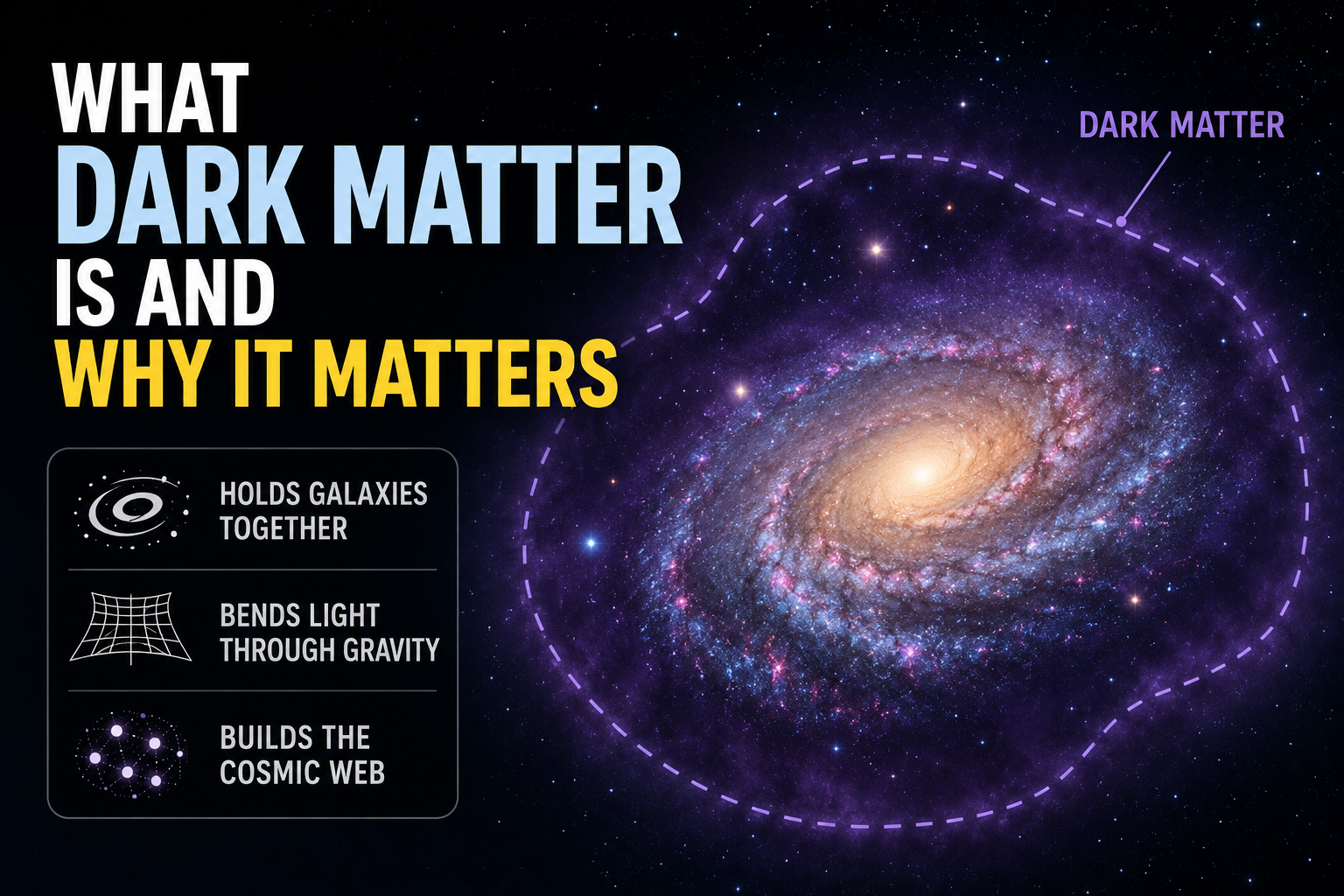
What Dark Matter Is and Why It Matters
The universe contains far more matter than we can see.
Stars, planets, galaxies, gas and dust make up the ordinary matter familiar from everyday life. Yet when astronomers measure how galaxies move, how clusters of galaxies interact and how light travels across the universe, they find evidence for a mysterious component that does not appear to emit, absorb or reflect light in the usual way.
Scientists call it dark matter.
Dark matter has never been directly observed through its own light, but its gravitational influence appears throughout the cosmos. Without it, many of the structures astronomers observe—including galaxies themselves—would be difficult to explain.
Understanding dark matter is therefore one of the biggest unresolved questions in modern physics and astronomy.
What Is Dark Matter?
Dark matter is the name scientists give to an unseen form of matter that appears to interact with ordinary matter primarily through gravity.
Unlike ordinary matter, dark matter does not appear to interact significantly with electromagnetic radiation. That means it does not shine like a star, reflect light like a planet or absorb light in the same familiar way as clouds of gas and dust.
Its presence is instead inferred from its gravitational effects.
This distinction is important. Scientists have strong evidence that something with gravitational influence exists, but they do not yet know exactly what that substance is made of.
In other words, dark matter is a description of an observed cosmic phenomenon, not yet a confirmed identification of a specific particle.
How Scientists Know Something Is There
One of the strongest clues comes from the way galaxies rotate.
Stars located far from the centers of many galaxies orbit much faster than expected based on the amount of visible matter astronomers can observe. If visible stars, gas and dust were the only sources of gravity, some of these stars should not remain in stable orbits.
Instead, galaxies remain intact.
This suggests that a large amount of additional mass is providing gravitational attraction.
Astronomers infer that this unseen material forms an extended halo around galaxies, with much of the mass existing outside the regions where most visible stars are concentrated.
The phenomenon is observed across many galaxies, making it difficult to explain as simply an unusual property of one particular galaxy.
Gravity Reveals What Telescopes Cannot See
Another major line of evidence comes from gravitational lensing.
According to Einstein’s theory of general relativity, massive objects bend spacetime. Light traveling near a massive object can therefore be deflected, producing effects similar to looking through a giant cosmic lens.
By studying how galaxies and other background objects appear distorted, astronomers can estimate how much mass lies along the line of sight.
Sometimes the amount of mass inferred from gravitational lensing is substantially greater than the visible matter in the region.
This provides another way to map the distribution of unseen mass without needing to see the dark matter itself.
Galaxy Clusters Provide a Particularly Powerful Clue
Galaxy clusters are among the largest gravitationally bound structures in the universe.
They contain enormous numbers of galaxies, vast quantities of extremely hot gas and, apparently, substantial amounts of dark matter.
The motion of galaxies within clusters provides information about the cluster’s total gravitational mass. Measurements of gravitational lensing provide another independent estimate.
When scientists compare these observations with the amount of ordinary matter they can detect, a significant mass discrepancy remains.
Some observations become especially striking when galaxy clusters collide.
In certain collisions, most of the ordinary matter in the cluster—including hot gas—interacts and slows down, while gravitational lensing indicates that much of the unseen mass remains distributed differently.
These observations are among the reasons dark matter has become such a central concept in modern cosmology.
Dark Matter Helps Explain How Galaxies Formed
Dark matter may have played a critical role long before modern galaxies existed.
In the early universe, matter was not distributed perfectly evenly. Tiny differences in density provided seeds from which larger structures could eventually grow.
Because dark matter interacts strongly through gravity but appears to interact only weakly, if at all, with light and ordinary matter, it could begin gathering into gravitational structures early in cosmic history.
Ordinary matter could then fall into these gravitational wells.
Over billions of years, these regions grew into increasingly large structures, eventually producing the cosmic web of galaxies and galaxy clusters observed today.
Computer simulations that include dark matter can reproduce many of the large-scale patterns astronomers see in the universe.
The Cosmic Web May Be Built Around Dark Matter
On the largest scales, galaxies are not scattered randomly through space.
They form enormous structures known as the cosmic web, consisting of filaments, clusters, walls and enormous regions of relatively low density called voids.
Dark matter is believed to form the underlying gravitational framework of this structure.
Galaxies tend to form within regions where matter has accumulated. Dark matter’s gravitational influence helps guide the movement of ordinary matter and contributes to the formation of the dense environments where galaxies emerge.
This means dark matter may be less like isolated invisible objects floating randomly through space and more like an enormous underlying framework that helps organize the universe.
Dark Matter Is Not the Same as Dark Energy
The names can be confusing, but dark matter and dark energy are fundamentally different concepts.
Dark matter appears to contribute gravitational attraction and helps explain the formation and behavior of cosmic structures.
Dark energy is the name given to whatever is responsible for the observed accelerated expansion of the universe.
Dark matter pulls structures together through gravity. Dark energy is associated with the large-scale acceleration of cosmic expansion.
Scientists do not yet know the fundamental nature of either one.
Together, however, they represent two of the biggest unanswered questions in cosmology.
How Much of the Universe Is Dark Matter?
Measurements of the universe indicate that ordinary matter represents only a relatively small portion of the total cosmic energy budget.
Dark matter accounts for a substantially larger share, while dark energy represents the largest component.
This makes the mystery especially significant.
The atoms that make up people, planets, stars and everything directly visible through conventional telescopes represent only a fraction of what exists in the universe.
Much of the cosmos appears to be governed by components whose fundamental nature remains unknown.
What Could Dark Matter Be Made Of?
Scientists have proposed numerous candidates, but no specific dark matter particle has been confirmed.
One leading possibility has historically been a class of hypothetical particles known as weakly interacting massive particles, or WIMPs.
These particles would have mass and interact through gravity while interacting only weakly with ordinary matter.
Another possibility involves extremely light particles called axions. These hypothetical particles were originally proposed in connection with a problem in particle physics and could, under certain conditions, also account for dark matter.
Other possibilities include sterile neutrinos, primordial black holes and other theoretical candidates.
Each idea comes with different predictions that experiments can test.
Why Haven’t Scientists Detected It Directly?
This is one of the most frustrating aspects of the dark matter problem.
Astronomers can observe its gravitational influence, but attempts to detect dark matter particles directly have so far failed to produce a universally accepted detection.
Researchers operate extremely sensitive detectors deep underground and in other carefully controlled environments, hoping to observe the extremely rare interaction between a dark matter particle and ordinary matter.
The challenge is that if dark matter interacts only very weakly, the signal could be extraordinarily faint.
Experiments must also distinguish potential dark matter interactions from background radiation and other ordinary particles.
The absence of a confirmed detection has not eliminated the dark matter hypothesis, but it has narrowed the range of possible properties that a dark matter particle could have.
Particle Accelerators Are Searching Too
Scientists are also looking for clues at particle accelerators.
Instead of waiting for dark matter particles to pass naturally through a detector, researchers can collide ordinary particles at extremely high energies and search for evidence of new particles or unexplained energy and momentum.
If dark matter particles could be produced in such collisions, they might escape the detector without interacting normally.
Researchers could potentially infer their presence from missing energy or momentum.
So far, no definitive dark matter discovery has emerged from these searches.
The lack of a confirmed result has encouraged physicists to explore an increasingly broad range of theoretical possibilities.
Could Our Understanding of Gravity Be Wrong?
There is another possibility worth considering.
Rather than dark matter being a previously unknown substance, perhaps our understanding of gravity needs to be modified under certain conditions.
Several alternative theories of gravity have been proposed to explain some of the observations attributed to dark matter.
These ideas remain subjects of active research, but they face significant challenges.
A successful explanation must account not only for the rotation of individual galaxies but also for gravitational lensing, galaxy clusters, the cosmic microwave background and the large-scale structure of the universe.
Dark matter models currently provide a powerful framework for explaining many of these observations simultaneously.
That does not mean the mystery is solved. It means any competing explanation has a demanding set of observations to reproduce.
Dark Matter Shapes What We See
One of the most interesting aspects of dark matter is that something invisible can have such a profound influence on visible objects.
The stars inside a galaxy respond to its gravitational field.
Galaxies move within clusters according to the total mass of those clusters.
Light from distant galaxies can be bent by invisible mass between the source and Earth.
And the distribution of galaxies across enormous cosmic distances appears connected to the underlying distribution of dark matter.
In this sense, astronomers are not searching for dark matter simply because they are curious about an invisible substance. They are trying to understand the gravitational architecture that appears to shape the observable universe.
Why Dark Matter Matters to Everyday Science
Dark matter might seem impossibly distant from everyday life, but solving the mystery could have consequences far beyond astronomy.
A confirmed dark matter particle would represent physics beyond the current Standard Model of particle physics.
It could reveal previously unknown fundamental forces, particles or interactions and force scientists to revise our understanding of how nature works at the most basic level.
Historically, discoveries in fundamental physics have also produced technologies and scientific methods that later found applications outside their original purpose.
The immediate goal, however, is more fundamental: understanding what the universe is actually made of.
New Observations Could Change the Picture
The search for dark matter is being pursued across multiple fronts.
Astronomers are creating increasingly detailed maps of galaxies and gravitational lensing. Space telescopes are examining distant galaxies and the early universe. Ground-based observatories are measuring cosmic structure at unprecedented precision.
Meanwhile, underground experiments continue searching for direct particle interactions, while particle physicists investigate possible new particles at accelerators.
Each approach looks at a different part of the puzzle.
If several independent observations eventually point toward the same particle or physical mechanism, the mystery could move rapidly from speculation to discovery.
Conversely, if increasingly sensitive experiments continue finding nothing, scientists may be forced to rethink some of their assumptions about what dark matter can be.
The Biggest Mystery May Be the Matter We Cannot See
For centuries, astronomy advanced by observing objects that emitted or reflected light. Dark matter presents a different challenge.
Scientists are trying to understand something that cannot be seen directly, using its effects on everything around it.
That makes the problem unusually difficult—but also unusually revealing.
Dark matter appears to influence the rotation of galaxies, the behavior of galaxy clusters, the bending of light and the development of the universe’s enormous cosmic web. Yet despite decades of research, its fundamental identity remains unknown.
The eventual answer could be a new particle, an unexpected physical phenomenon, a modification of our understanding of gravity or something scientists have not yet considered.
Whatever the solution turns out to be, solving the dark matter mystery would do more than explain an invisible component of the cosmos. It could reveal that the universe is fundamentally different from the picture we have built from everything we can see.


2 Comments
Micle harison
June 7, 2019Lorem ipsum dolor sit amet, usu ut perfecto postulant deterruisset, libris causae volutpat at est, ius id modus laoreet urbanitas. Mel ei delenit dolores.
John Doe
June 7, 2019Some consultants are employed indirectly by the client via a consultancy staffing company.