
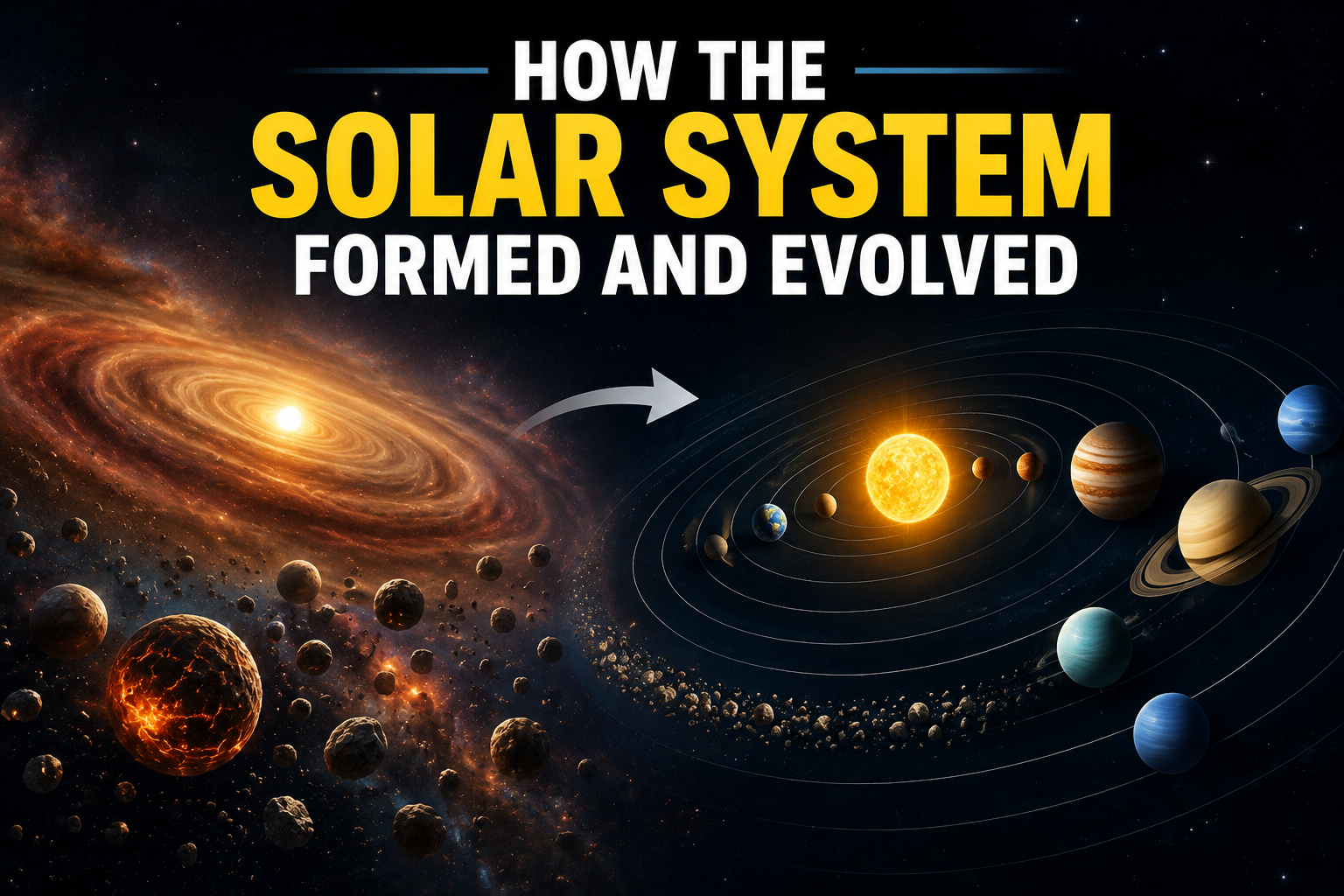
How the Solar System Formed and Evolved
The Solar System is the product of a vast cosmic transformation that began more than 4.5 billion years ago. What is now a system of eight planets, dozens of moons, millions of asteroids and countless smaller objects began as a rotating cloud of gas and dust surrounding a young star.
Over billions of years, gravity, collisions, radiation and chemical processes gradually shaped that material into the planets and other objects we see today.
Although scientists continue to refine the details, observations of other young planetary systems and evidence preserved in ancient meteorites have provided a remarkably detailed picture of how the Solar System formed and changed over time.
The Solar System Began With a Cloud of Gas and Dust
The story begins with a molecular cloud containing gas and microscopic particles of dust.
Most of the material in this cloud consisted of hydrogen and helium, along with heavier elements created by earlier generations of stars. At some point, part of the cloud began to collapse under its own gravity.
The exact trigger for the collapse is still studied by scientists. A disturbance such as a nearby stellar explosion may have contributed, but the precise sequence of events is not completely known.
As gravity pulled material inward, the collapsing cloud became increasingly dense and began to rotate faster.
This process transformed the roughly spherical cloud into a flattened, rotating structure known as a protoplanetary disk.
At its center, material continued falling together until pressure and temperature became high enough for nuclear fusion to begin.
The Sun was born.
The Young Sun Became the Center of the System
Once the Sun formed, it contained the overwhelming majority of the Solar System’s mass.
The remaining material stayed in orbit around the young star, forming the disk from which planets, moons, asteroids and other objects would eventually develop.
The disk was not uniform.
Temperature varied dramatically with distance from the Sun. The region close to the young star was extremely hot, while material farther away was much colder.
That temperature difference played an important role in determining what kinds of planets could form in different parts of the Solar System.
Close to the Sun, only materials capable of remaining solid at high temperatures could readily accumulate. Farther away, water and other volatile substances could freeze, providing additional material for growing planetary bodies.
Tiny Particles Began Building Larger Objects
Planet formation did not happen in a single dramatic event.
It was a gradual process.
Dust particles within the disk collided and sometimes stuck together. Over time, these particles formed larger aggregates. Those aggregates could collide again, eventually producing objects ranging from pebbles and rocks to kilometer-scale bodies known as planetesimals.
Gravity became increasingly important as these bodies grew.
Larger objects exerted stronger gravitational forces, allowing them to attract more surrounding material. Through repeated collisions and accumulation, some bodies grew into protoplanets.
This stage was chaotic.
Young planetary systems contained enormous numbers of objects moving through overlapping orbits. Collisions were common, and some were violent enough to shatter developing worlds while others helped them grow.
The Inner Planets Became Rocky Worlds
The four planets closest to the Sun—Mercury, Venus, Earth and Mars—are known as the terrestrial or rocky planets.
Their formation was strongly influenced by the hotter conditions of the inner Solar System.
Because lighter gases and many volatile materials could not easily remain condensed close to the young Sun, the planets that formed there were dominated by rock and metal.
Over millions of years, repeated collisions caused these worlds to grow.
Earth, for example, accumulated material through countless impacts. As it became larger, its interior heated up through gravitational compression, radioactive decay and the energy released by collisions.
The young planet eventually became partially or extensively molten, allowing dense materials such as iron to sink toward the center while lighter rocky material moved upward.
This process helped produce Earth’s layered structure, including its metallic core, mantle and crust.
The Outer Planets Took a Different Path
Farther from the Sun, temperatures were low enough for water and other volatile compounds to freeze.
This allowed planetary cores to accumulate much larger quantities of solid material.
Jupiter and Saturn became the Solar System’s two largest planets. They accumulated massive cores and then captured enormous amounts of surrounding hydrogen and helium.
Uranus and Neptune also developed in the outer Solar System, although they did not become as massive as Jupiter and Saturn.
These four worlds are commonly divided into two groups.
Jupiter and Saturn are gas giants, dominated by hydrogen and helium.
Uranus and Neptune are ice giants. Their interiors contain significant amounts of water, ammonia and methane-related compounds beneath their thick atmospheres.
The differences between these planets provide important clues about how conditions varied across the early Solar System.
Jupiter Helped Shape the Young Solar System
Jupiter’s enormous mass gave it a powerful gravitational influence over the developing Solar System.
Its gravity affected the orbits of countless smaller bodies and helped shape the distribution of material between the inner and outer planets.
The region between Mars and Jupiter became home to the asteroid belt, where large numbers of rocky bodies orbit the Sun.
Jupiter’s gravitational influence prevented these objects from easily combining into another planet, although the asteroid belt is far less densely packed than popular images sometimes suggest.
The giant planet also influenced the trajectories of smaller objects throughout the Solar System, including some comets and asteroids.
The Formation of Earth Was Violent
Earth’s early history was far from peaceful.
The young planet experienced frequent impacts from asteroids and other planetary bodies. These collisions delivered additional material and enormous amounts of energy.
One of the most significant events in Earth’s early history may have been a collision involving the young Earth and a Mars-sized body.
The leading scientific explanation is that debris from this enormous impact eventually gathered in orbit around Earth and formed the Moon.
The Moon therefore represents an important piece of evidence about the violent conditions that characterized the early Solar System.
The Young Planets Were Transformed From the Inside
Planet formation did not end when the major worlds reached approximately their current sizes.
Early planets continued to evolve internally.
On Earth, heavier materials sank toward the center while lighter materials rose. Volcanic activity released gases that contributed to the development of an early atmosphere.
As the planet cooled, a solid crust developed.
Water accumulated at the surface through a combination of sources, including water-bearing materials delivered by impacts and gases released through volcanic activity. Over time, oceans and an atmosphere created an environment dramatically different from the hot, partially molten world that existed earlier.
Mars and Venus followed different evolutionary paths, demonstrating that planetary formation does not guarantee similar long-term conditions.
The Solar System Eventually Became More Stable
The early Solar System was crowded with developing planets and leftover debris.
As planets grew, their gravitational interactions changed the orbits of smaller objects. Some were captured, some collided with planets or the Sun, and others were ejected into distant regions or even expelled from the Solar System entirely.
Eventually, the system became more dynamically stable.
The eight major planets settled into the broad orbital arrangement we recognize today, although their positions and orbital characteristics have changed somewhat over the Solar System’s history.
Not every piece of the original planetary material became part of a planet.
Large quantities remain as asteroids, comets, dwarf planets and other small bodies.
Asteroids and Comets Preserve Ancient Material
Small Solar System bodies are especially valuable to scientists because many preserve material dating back to the earliest stages of planetary formation.
Asteroids are mostly found in the region between Mars and Jupiter, although populations exist throughout the Solar System.
Comets are generally richer in volatile materials and originate primarily in the colder outer regions.
Because these objects experienced less geological processing than planets such as Earth, they can provide clues about the chemical ingredients present when the Solar System was young.
Meteorites that fall to Earth offer scientists physical samples of some of this ancient material.
Laboratory analysis of meteorites has helped establish the age of the Solar System at roughly 4.6 billion years.
The Solar System Has Continued to Change
The Solar System may look stable today, but it remains a dynamic environment.
Planets continue to orbit the Sun. Moons interact gravitationally with their planets. Asteroids collide. Comets occasionally enter the inner Solar System. The Sun itself is gradually changing as it consumes hydrogen in its core.
Even Earth’s surface continues to evolve through geological activity, erosion, atmospheric processes and the movement of tectonic plates.
The Solar System’s current appearance is therefore only one stage in a much longer story.
The Sun Will Eventually Transform the System Again
The Solar System’s evolution has a future as well as a past.
The Sun is currently a middle-aged star, roughly halfway through the period during which it can sustain hydrogen fusion in its core.
In several billion years, the Sun will begin running out of hydrogen in its core. It will expand dramatically into a red giant.
During that transformation, the inner Solar System will become an increasingly hostile environment.
Mercury and Venus are expected to be engulfed or severely transformed as the Sun expands. Earth’s ultimate fate is less certain, but conditions on the planet will become unsuitable for life long before the Sun reaches its most expanded state.
Eventually, the Sun will shed its outer layers and leave behind a dense stellar remnant known as a white dwarf.
The planets and other surviving objects will continue orbiting that remnant.
What the Solar System’s History Tells Us
The formation of the Solar System is not an isolated story.
Astronomers have discovered thousands of planets orbiting other stars, including systems with planetary arrangements very different from our own.
Some stars appear to host planets extremely close to their parent stars. Others contain giant planets on unusual orbits. Many systems seem to have formed through processes similar to those that shaped our own.
By comparing these systems with the Solar System, scientists can investigate which aspects of planetary formation are common and which may be unusual.
Observations of young stars surrounded by disks of gas and dust provide another valuable piece of evidence. They offer astronomers opportunities to observe planetary systems at stages that the Solar System passed through billions of years ago.
A Planetary System Still in Motion
The Solar System began as a cloud of ancient material collapsing under gravity and gradually became a complex collection of worlds. The Sun formed at its center, while a rotating disk of gas and dust supplied the ingredients for planets and smaller bodies.
Rocky planets emerged in the hotter inner region, while the colder outer Solar System produced enormous gas and ice giants. Violent collisions shaped young worlds, moons formed, leftover debris populated regions such as the asteroid belt, and gravitational interactions gradually transformed the chaotic early system into the more orderly arrangement observed today.
Yet the story is not finished.
The Solar System will continue changing as long as the Sun shines and its planets remain in motion. Understanding how this system formed—and comparing it with planetary systems around other stars—offers scientists one of the clearest ways to understand not only our cosmic neighborhood, but also how planets and potentially habitable worlds arise throughout the universe.


2 Comments
Micle harison
June 7, 2019Lorem ipsum dolor sit amet, usu ut perfecto postulant deterruisset, libris causae volutpat at est, ius id modus laoreet urbanitas. Mel ei delenit dolores.
John Doe
June 7, 2019Some consultants are employed indirectly by the client via a consultancy staffing company.