
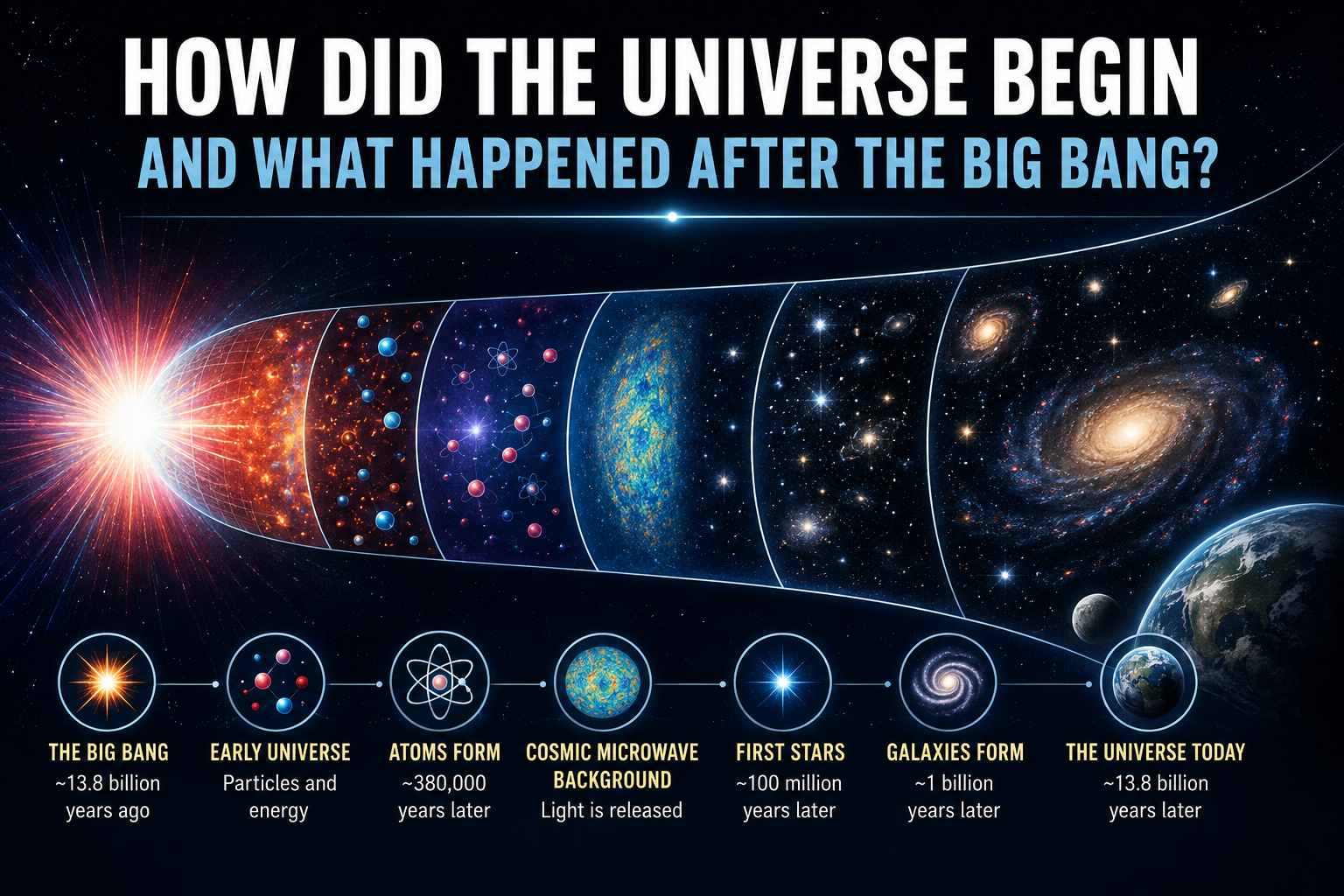
How Did the Universe Begin and What Happened After the Big Bang?
The universe is filled with billions of galaxies, enormous clouds of gas and dust, stars, planets and countless other objects. Yet everything we can observe today traces its history back to an extremely hot, dense early state.
The leading scientific explanation for the universe’s early development is known as the Big Bang model. Despite its name, the Big Bang was not an explosion that occurred at one particular point in empty space. Instead, it describes the expansion of space itself from an early state that was extraordinarily hot and dense.
Scientists have built a remarkably detailed picture of what happened during the universe’s first stages. But one major question remains open: what, if anything, happened before the earliest moment that our current theories can describe?
What Was the Big Bang?
The Big Bang refers to the rapid expansion and evolution of the early universe.
About 13.8 billion years ago, the observable universe was much hotter and denser than it is today. As space expanded, the universe cooled. That cooling allowed particles to form, followed by atoms, stars, galaxies and eventually planets.
It is important to avoid imagining the Big Bang as matter exploding outward from a central location.
There is no known central point from which the universe expanded. Instead, galaxies are generally moving away from one another because the space between them has expanded. From any sufficiently distant galaxy, an observer would see other galaxies receding in a similar way.
The expansion is still happening today.
How Do Scientists Know the Universe Is Expanding?
One of the most important discoveries in modern astronomy came from observing distant galaxies.
Light from many galaxies is shifted toward longer, redder wavelengths—a phenomenon called cosmological redshift. In general, more distant galaxies show greater redshifts, indicating that space has been expanding as their light has traveled toward us.
In the late 1920s, astronomers including Georges Lemaître and Edwin Hubble helped establish the relationship between a galaxy’s distance and its apparent recession.
If the universe is expanding today, scientists can mathematically trace that expansion backward. The farther back they look, the hotter and denser the universe becomes.
That provides the foundation for the Big Bang model.
The Earliest Moments Remain a Mystery
Scientists cannot currently describe the universe’s beginning with complete certainty.
Our established theories of physics work extremely well under many conditions, but the earliest conceivable instant of the universe presents an extraordinary challenge. General relativity describes gravity and the structure of spacetime on large scales, while quantum mechanics describes the behavior of matter and energy at very small scales.
At extreme conditions, these theories are not yet unified into a complete theory of quantum gravity.
For this reason, scientists generally avoid claiming that they know exactly what happened at “time zero.”
The Big Bang model is much more reliable as a description of the universe’s evolution from an extremely hot, dense early state than as a definitive explanation of why the universe exists in the first place.
The First Fractions of a Second
The earliest period scientists can discuss involved conditions far more extreme than anything found in the universe today.
One important idea is cosmic inflation. According to inflationary models, the universe underwent an extraordinarily rapid expansion during a very early phase.
Inflation helps explain several otherwise puzzling features of the observable universe, including why large regions of space appear remarkably uniform and why the geometry of the universe is close to flat on large scales.
It also provides a mechanism for turning tiny quantum fluctuations into differences in density that eventually became the seeds of galaxies and larger cosmic structures.
However, the precise physical process responsible for inflation remains an active area of research.
The Universe Becomes a Soup of Particles
As the universe expanded and cooled, energy could transform into different types of particles.
During the early universe, conditions were energetic enough for particles and antiparticles to be created and destroyed in enormous numbers.
Eventually, the universe cooled sufficiently for more stable particles—including quarks and electrons—to exist under less extreme conditions.
Quarks eventually became bound together to form protons and neutrons, the building blocks of atomic nuclei.
The universe at this stage was still nothing like the transparent night sky we see today. It was an extremely hot environment filled with particles and radiation.
The First Elements Were Forged
Within the first few minutes, the universe had cooled enough for some protons and neutrons to combine.
This process, known as Big Bang nucleosynthesis, produced most of the universe’s primordial hydrogen and helium, along with small amounts of other light elements such as deuterium and lithium.
It did not produce significant quantities of heavier elements such as carbon, oxygen, silicon or iron.
Those elements would come much later.
The predicted proportions of primordial light elements are one of the important pieces of evidence supporting the Big Bang model. Observations broadly match the predictions, although some discrepancies—particularly involving lithium—remain subjects of scientific investigation.
The Universe Was Once Opaque
For hundreds of thousands of years after the Big Bang, the universe remained filled with a hot plasma.
Electrons were not yet permanently bound to atomic nuclei. Because free electrons interact strongly with light, photons could not travel freely across space for long distances.
As the universe continued expanding and cooling, electrons eventually combined with nuclei to form neutral atoms.
This period is called recombination, even though it was effectively the first major formation of neutral atoms after the plasma era.
Once enough free electrons disappeared, light could travel much more freely through space.
That ancient light is still detectable today.
The Cosmic Microwave Background
The cosmic microwave background, or CMB, is one of the strongest pieces of evidence for the hot Big Bang model.
It is faint microwave radiation that fills the universe and comes from an early period when the universe became transparent.
Today, the CMB has cooled to a temperature of roughly 2.7 kelvin above absolute zero because its wavelengths have been stretched by the expansion of the universe.
Space missions and observatories have measured tiny variations in the temperature of the CMB.
Those variations are extremely important because they represent small differences in density in the early universe. Over billions of years, gravity amplified these differences, helping produce galaxies and clusters of galaxies.
In a sense, the CMB provides scientists with an ancient snapshot of the young universe.
The Cosmic Dark Ages
After the first atoms formed, the universe entered a period sometimes called the cosmic Dark Ages.
There were no stars shining yet.
The universe contained mostly hydrogen and helium gas, along with the gravitational seeds that would eventually grow into increasingly complex structures.
Gravity gradually pulled matter into denser regions.
Some areas accumulated enough material to collapse under their own gravity. These collapsing clouds eventually produced the first stars.
Exactly when the first stars formed remains an area of active astronomical research, but scientists know they appeared hundreds of millions of years after the Big Bang.
The First Stars Changed the Universe
The first stars were transformative.
Inside stars, nuclear fusion converted lighter elements into heavier ones. Massive stars eventually produced elements that were not created in significant quantities during Big Bang nucleosynthesis.
When some massive stars died in powerful explosions, they scattered newly formed elements into surrounding space.
Later generations of stars incorporated these materials.
This means that elements found in planets and living organisms today—including carbon, oxygen and many other heavier elements—were produced through processes that occurred after the Big Bang.
The universe therefore became chemically richer over time.
Galaxies Begin to Take Shape
Stars did not remain isolated forever.
Gravity brought stars together into increasingly large structures. Over immense periods of time, these structures developed into galaxies.
Galaxies themselves evolved through collisions, mergers and the continuing formation and destruction of stars.
Some galaxies grew to enormous sizes, while others remained relatively small.
Our own galaxy, the Milky Way, has a history extending billions of years and has grown through the accumulation and merger of smaller structures.
The large-scale universe eventually developed a vast cosmic web of galaxies, galaxy clusters and enormous regions of comparatively empty space.
Where Does Dark Matter Fit In?
Another crucial component of cosmic history is dark matter.
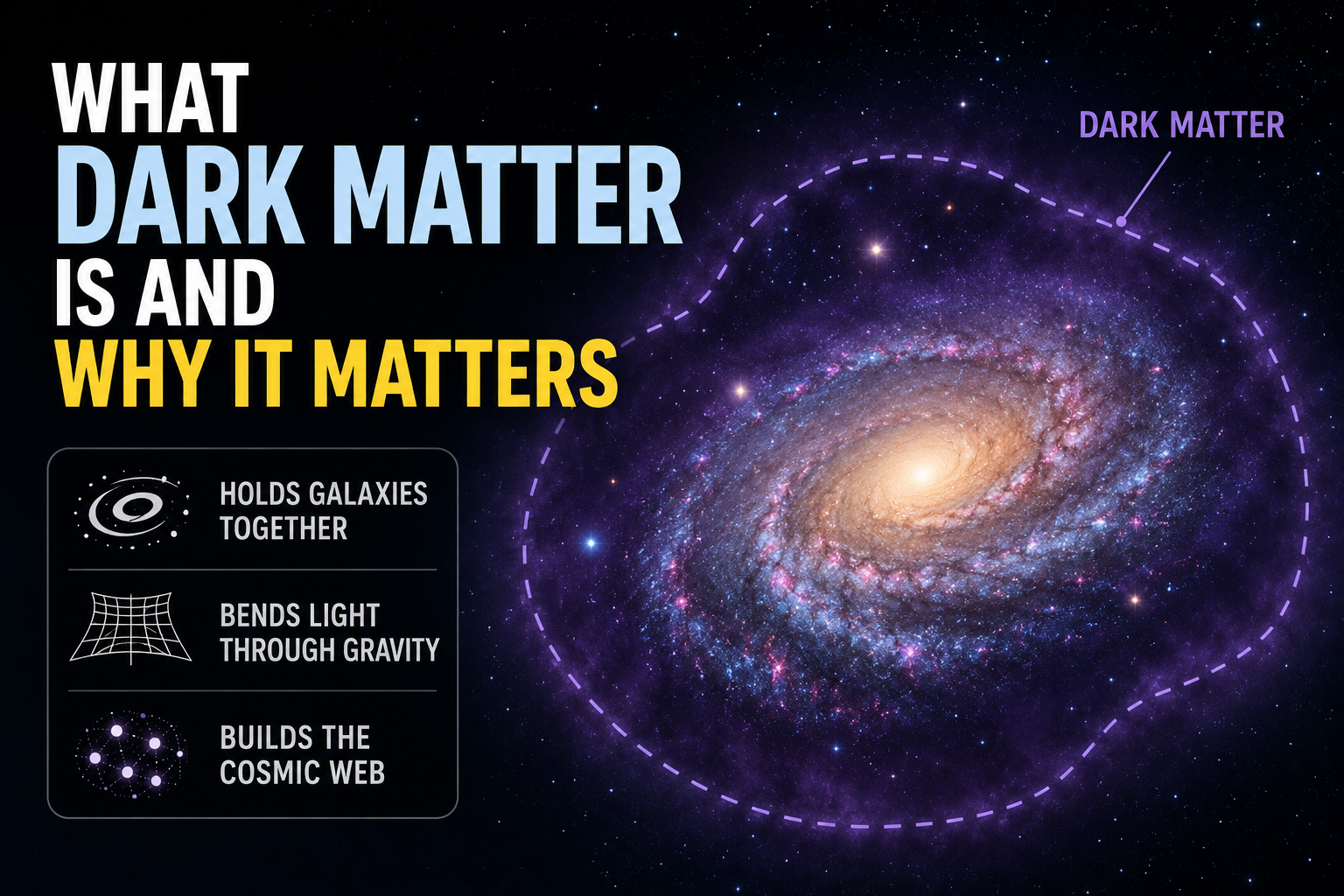
Astronomers cannot directly see dark matter because it does not appear to interact with light in the same way ordinary matter does. However, its gravitational effects can be observed.
Dark matter appears to have played an important role in the formation of cosmic structures.
As the early universe evolved, dark matter’s gravitational influence helped matter gather into dense regions. These structures provided environments in which gas could accumulate and eventually form stars and galaxies.
The nature of dark matter remains unknown, making it one of the biggest unanswered questions in modern physics.
And What About Dark Energy?
The universe’s story contains another surprising development.
In the late 1990s, observations of distant supernovae showed that the expansion of the universe is not simply continuing—it is accelerating.
Scientists use the term dark energy for whatever is responsible for this accelerated expansion.
The simplest explanation is a cosmological constant associated with the energy of empty space, but scientists do not yet know whether that is the complete answer.
Current measurements suggest that ordinary matter makes up only a small fraction of the universe’s overall energy budget, with dark matter and dark energy accounting for much of the rest.
The exact nature of both remains unknown.
The Formation of Our Solar System Came Much Later
The Sun and planets did not exist during the Big Bang.
Our solar system formed roughly 4.6 billion years ago—more than 9 billion years after the universe began expanding.
By then, several generations of stars had already lived and died.
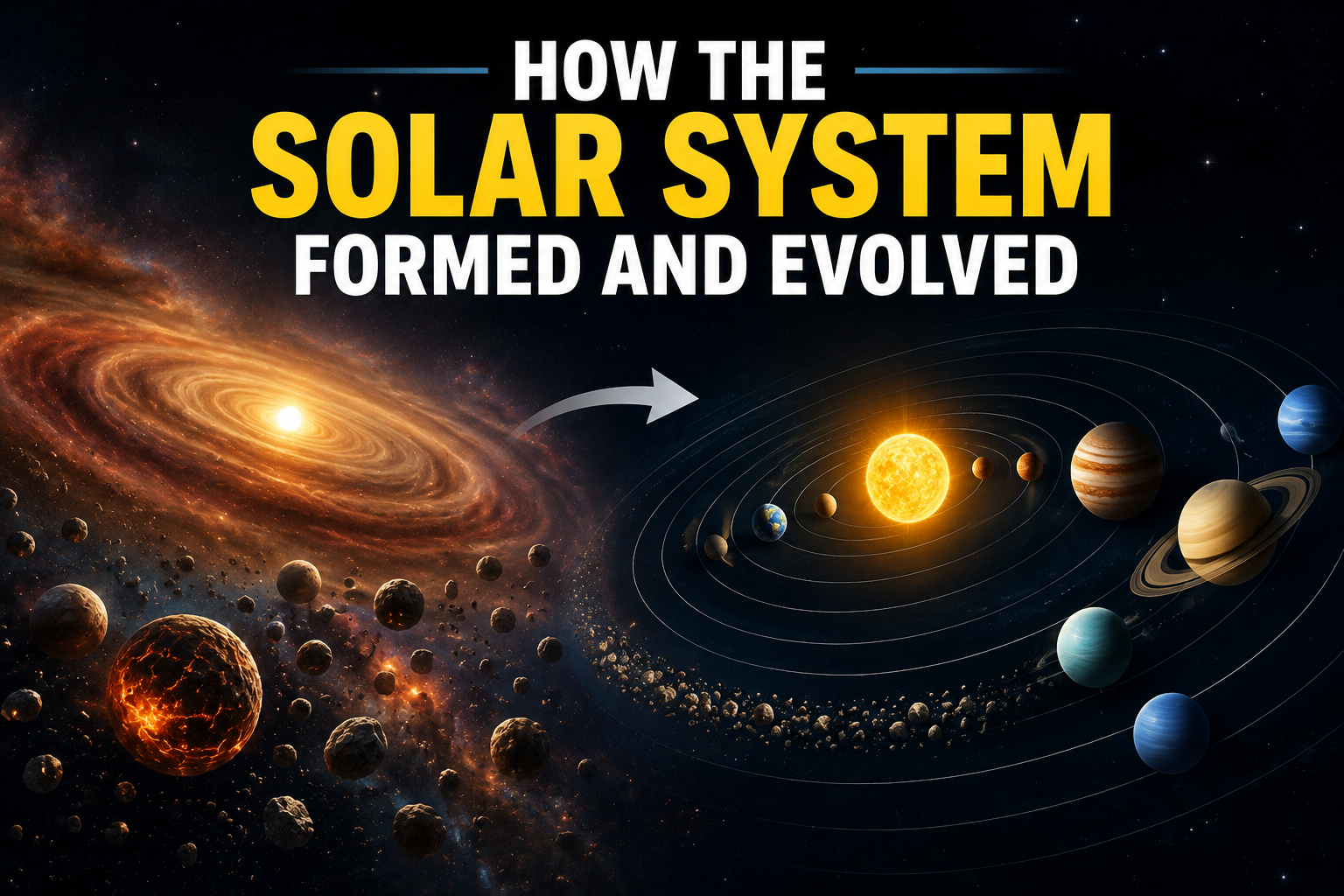
A cloud containing gas, dust and heavier elements collapsed under gravity to form the young Sun. Material left in a rotating disk around it gradually clumped together, eventually producing planets, moons, asteroids and other objects.
Earth therefore contains material with a very long cosmic history.
The hydrogen in Earth’s water is largely associated with the early universe, while many heavier elements in Earth’s rocks and living organisms were created inside stars or during stellar explosions and other astrophysical processes.
How Did Life Fit Into This Cosmic Timeline?
Life appeared extremely late in the universe’s history.
Earth formed about 4.6 billion years ago, and evidence indicates that life emerged relatively early in Earth’s geological history. Over billions of years, biological evolution produced the extraordinary diversity of organisms that exists today.
Human beings arrived only in the most recent fraction of cosmic history.
If the universe’s 13.8-billion-year history were compressed into a single calendar year, modern humans would appear extremely close to midnight on December 31.
That comparison illustrates how young humanity is compared with the universe itself.
What Happened Before the Big Bang?
This is where the limits of current knowledge become especially important.
Scientists do not yet have a confirmed answer to what happened before the earliest phase described by the Big Bang model.
Several theoretical possibilities have been proposed. Some models suggest that our universe could have emerged from a previous cosmic state. Others explore cyclic universes, quantum cosmological scenarios or other possibilities.
But these ideas remain theoretical.
There is also a deeper question: does the word “before” even make sense at the beginning of the universe?
If time itself is part of the universe’s physical structure and began with the earliest state described by our theories, asking what happened before it could be similar to asking what lies north of the North Pole.
Scientists continue investigating the question, but there is currently no universally accepted answer.
Why the Big Bang Model Remains So Powerful
The Big Bang model is supported by several independent observations.
These include the expansion of the universe, the cosmic microwave background and the observed abundance of light elements. The large-scale distribution and evolution of galaxies also fit into the broader framework of modern cosmology.
No scientific model is considered unquestionable. Scientists continually test predictions, search for inconsistencies and refine their theories as new observations become available.
The discovery of new phenomena could eventually require important changes to our understanding of cosmic history.
That is one of the strengths of science: unanswered questions are not necessarily weaknesses. They provide opportunities for further investigation.
The Universe Is Still Writing Its History
The story that began in an extraordinarily hot and dense early universe has not reached its end.
Stars continue to form and die. Galaxies continue to merge. Black holes grow by consuming matter and colliding with other black holes. New planetary systems continue to emerge from clouds of gas and dust.
Meanwhile, the expansion of space continues on the largest scales.
The Big Bang did not simply explain an event that happened billions of years ago. It provides the starting framework for understanding how the universe evolved from a hot, dense early state into the immense and structured cosmos we observe today.
Yet some of the biggest questions remain open: What caused the earliest expansion? What is dark matter? What is dark energy? Did anything exist before the earliest moment we can describe? And why does the universe have the laws of physics that it does?
Astronomy has answered an extraordinary number of questions about our cosmic past, but the deeper we look into the universe’s history, the clearer it becomes that its beginning is not the end of the mystery—it is where some of the most fascinating questions begin.


2 Comments
Micle harison
June 7, 2019Lorem ipsum dolor sit amet, usu ut perfecto postulant deterruisset, libris causae volutpat at est, ius id modus laoreet urbanitas. Mel ei delenit dolores.
John Doe
June 7, 2019Some consultants are employed indirectly by the client via a consultancy staffing company.