
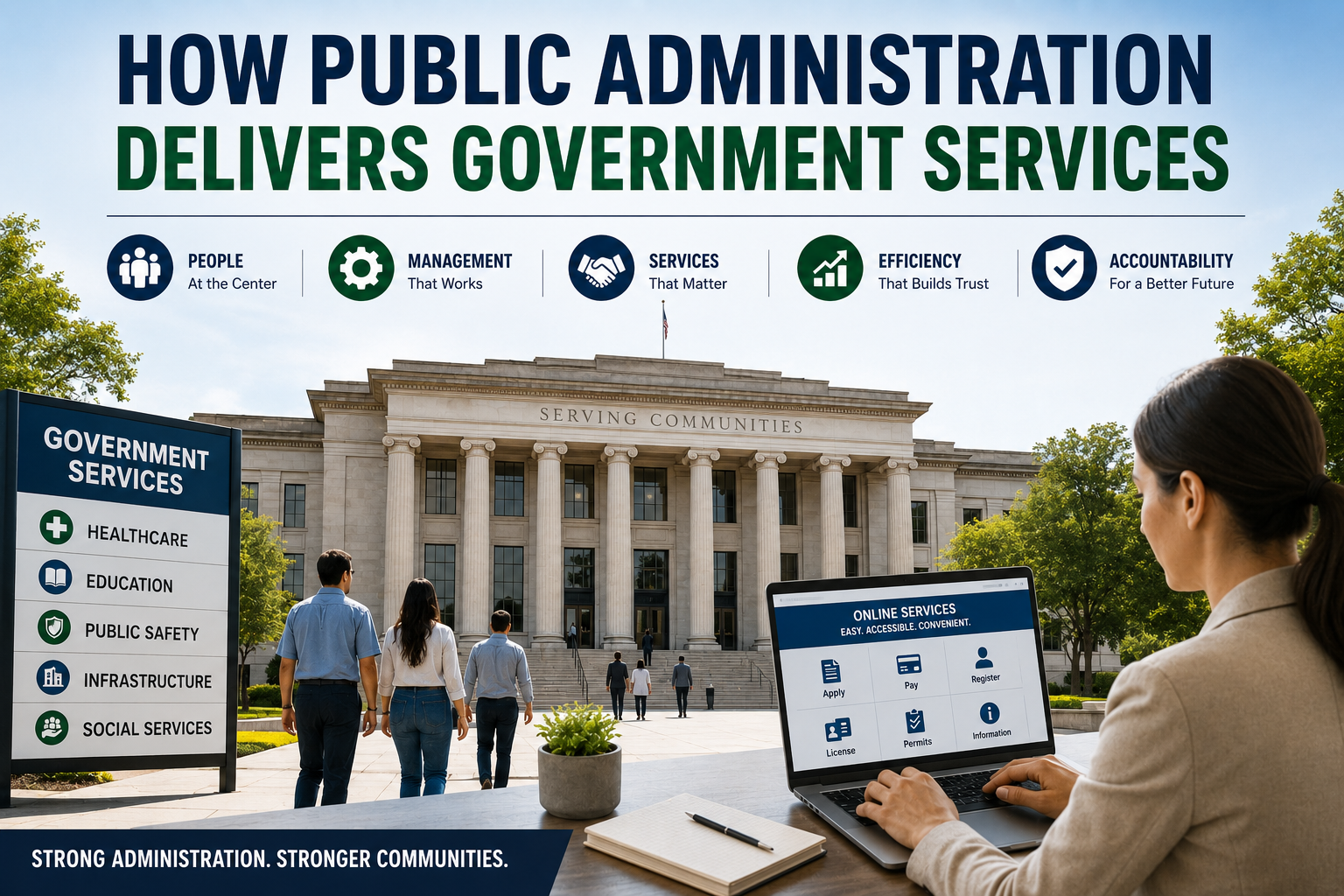
How Public Administration Delivers Government Services
When people interact with government, they often experience public administration without necessarily thinking about it by name. Applying for a passport, registering a business, obtaining a birth certificate, receiving public health services or enrolling a child in a public school all involve systems managed by government institutions and the people who work within them.
Public administration is the machinery that turns government policies and laws into services, programs and practical outcomes. Elected leaders may establish priorities and approve legislation, but public administrators are responsible for putting many of those decisions into practice.
The quality of public administration can therefore have a direct effect on everyday life. Efficient institutions can make services easier to access and public resources more effective, while poorly managed systems can lead to delays, waste, confusion and unequal access.
What Is Public Administration?
Public administration refers broadly to the organization and management of government activities.
It includes the institutions, employees, procedures and systems responsible for implementing public policies and delivering services to citizens.
Public administrators can work at different levels of government, including:
- National or central government
- Regional or state governments
- County, provincial or municipal authorities
- Public agencies and commissions
- Government-owned service institutions
Their responsibilities vary considerably. Some administrators manage budgets and employees, while others oversee healthcare programs, transportation systems, education services, environmental regulations or social assistance programs.
Although elected officials establish political priorities, professional public administration provides much of the continuity needed to keep government operating from one administration to another.
Turning Government Policy Into Action
One of the central functions of public administration is implementing policy.
A government may decide, for example, to expand access to healthcare. Turning that decision into an operational program requires considerably more than announcing the policy.
Administrators may need to determine eligibility requirements, allocate funding, hire or assign personnel, establish facilities, procure equipment, create application systems and monitor whether the program is reaching its intended beneficiaries.
This process illustrates the difference between making a policy decision and delivering it.
A policy only produces meaningful results when institutions have the capacity to implement it effectively.
How Government Services Reach Citizens
Government services can be delivered through physical offices, public facilities, digital platforms, mobile services and partnerships with other organizations.
A citizen seeking a government service may encounter several stages:
- Information: The person learns what service is available and whether they qualify.
- Application: They submit forms, documents or other required information.
- Verification: Government officials check the information provided.
- Decision: The relevant authority determines whether the request meets applicable requirements.
- Delivery: The service, document, payment, permit or other outcome is provided.
- Follow-up: The government may monitor the service, handle complaints or require renewal.
Each stage creates opportunities for efficiency—or for delays and administrative problems.
The Role of Government Employees
Public servants are central to service delivery.
They include teachers, nurses, social workers, police officers, inspectors, engineers, administrative officers, tax officials, planners and many other professionals.
Their responsibilities vary, but they generally operate within laws, regulations, budgets and established procedures.
Good public administration requires employees to understand both the rules they are responsible for enforcing and the needs of the people they serve.
Training is therefore an important part of government capacity. Employees need appropriate technical skills, communication abilities and knowledge of changing laws and technologies.
Budgets Determine What Government Can Deliver
Even well-designed policies cannot operate without adequate resources.
Public administrators are responsible for managing government budgets and ensuring that available funds are directed toward approved priorities.
Budget management can involve forecasting expenses, allocating resources, monitoring expenditures and reporting financial results.
Administrators must also balance competing demands.
A government may need to fund schools, hospitals, roads, security, environmental programs and social services at the same time. Because resources are limited, decisions about where money is allocated can have significant consequences.
Financial controls help reduce waste and ensure that public funds are used for their intended purposes.
Procurement Is a Major Part of Service Delivery
Governments purchase enormous quantities of goods and services.
Hospitals need medicines and medical equipment. Schools need books and technology. Public works departments need construction materials and machinery. Government offices need everything from computer systems to basic supplies.
Public procurement systems are designed to ensure that these purchases are made according to established rules.
Competitive bidding, contract management, supplier evaluation and financial oversight can help governments obtain value for money.
Procurement also requires strong safeguards because large public contracts can create opportunities for fraud, favoritism or conflicts of interest when oversight is weak.
Digital Government Is Changing Service Delivery
Technology has transformed the way many governments interact with citizens.
Instead of requiring people to visit government offices for every service, digital platforms can allow them to submit applications, make payments, obtain documents and track requests online.
Digital government can provide several advantages:
- Faster processing
- Reduced paperwork
- Lower administrative costs
- Greater convenience
- Easier access to information
- Better tracking of applications
- Improved data management
However, digitization does not automatically make government services better.
Systems need to be reliable, secure and accessible. Citizens who lack internet access, digital skills or appropriate devices can otherwise be excluded from services that have moved online.
Data Helps Governments Make Decisions
Modern public administration increasingly depends on data.
Government agencies collect information about populations, budgets, public health, transportation, education, employment and other areas of public life.
When managed responsibly, this information can help administrators understand where resources are needed and whether programs are achieving their objectives.
For example, transportation authorities can analyze traffic patterns when planning infrastructure. Health agencies can use disease data to allocate resources. Education departments can examine enrollment and performance information to identify areas requiring additional support.
However, collecting and using government data also creates responsibilities concerning privacy, security and accuracy.
Incorrect information can lead to poor decisions, while inadequate security can expose sensitive personal information.
Accountability Keeps Public Administration in Check
Because public administrators exercise authority and manage public resources, accountability is essential.
Different countries use different mechanisms, but public institutions may be subject to:
- Legislative oversight
- Audits
- Courts and administrative tribunals
- Independent regulators
- Anti-corruption agencies
- Freedom-of-information systems
- Public reporting
- Internal controls
- Citizen complaints and appeals
These mechanisms can help identify mistakes, misconduct and inefficient use of public resources.
Accountability also gives citizens a way to challenge decisions or seek explanations when government services fail to meet expected standards.
Transparency Builds Public Trust
People are more likely to trust government institutions when they can understand how decisions are made and how public resources are used.
Transparency can include publishing budgets, procurement information, performance reports, policies and administrative procedures.
Clear communication is equally important.
Citizens should be able to understand what a service requires, how long processing is expected to take and where to seek assistance if something goes wrong.
Unclear procedures can create frustration and may encourage people to rely on personal connections or intermediaries to navigate government systems.
Public Administration and Equal Access
Government services are generally intended to serve the public rather than a narrow group of individuals.
This makes fairness an important principle of public administration.
Rules should be applied consistently, while service systems should consider barriers that can prevent certain populations from accessing government programs.
Geography, disability, income, language, age and limited digital access can all affect a person’s ability to use a service.
For example, moving a service entirely online may be efficient for many people but difficult for those without reliable internet access.
Effective administrators therefore have to balance efficiency with accessibility.
Why Administrative Procedures Matter
Government procedures can sometimes appear unnecessarily complicated, but many exist for legitimate reasons.
Documentation requirements can help establish identity. Verification processes can reduce fraud. Approval procedures can ensure that public funds are spent legally. Record-keeping allows decisions to be reviewed later.
The challenge is preventing necessary controls from becoming excessive bureaucracy.
When citizens have to provide the same information repeatedly, visit multiple offices or wait unnecessarily for routine decisions, administrative systems can become costly for both government and the public.
Good administration seeks to maintain appropriate controls while simplifying processes wherever possible.
Measuring Whether Services Actually Work
Delivering a service is not necessarily the same as delivering a good service.
Public administrators increasingly use performance measures to assess whether programs are achieving their objectives.
Depending on the service, administrators may examine:
- Processing times
- Service costs
- Number of people served
- Customer satisfaction
- Error rates
- Program outcomes
- Geographic coverage
- Complaint levels
- Resource utilization
These measures can reveal whether a program is working as intended.
For example, a government may process thousands of applications quickly but still fail to achieve its broader objective if eligible people are unable to access the program.
Performance measurement therefore needs to focus on outcomes as well as activity.
The Importance of Coordination
Government services often involve multiple agencies.
A person applying for a business permit, for example, may need approvals involving local authorities, tax agencies, environmental regulators or other institutions.
If these organizations operate independently without effective coordination, citizens can become responsible for navigating complicated administrative structures themselves.
Better coordination can allow agencies to share information appropriately, reduce duplication and create simpler service pathways.
This is one reason governments increasingly try to develop integrated service centers and unified digital platforms.
Managing Emergencies Requires Strong Administration
Public administration becomes particularly visible during emergencies.
Natural disasters, disease outbreaks, major infrastructure failures and other crises can require government institutions to respond quickly.
Emergency management can involve coordinating medical services, law enforcement, transportation agencies, local authorities, humanitarian organizations and communication systems.
Preparation matters.
Governments that establish emergency plans, maintain critical supplies, train personnel and conduct exercises are generally better positioned to respond when unexpected events occur.
The quality of administration during a crisis can have direct consequences for public safety.
Public Administration Is Not the Same as Politics
Politics and public administration are closely connected, but they serve different functions.
Political leaders establish priorities, propose policies and make decisions that reflect electoral mandates and political judgments.
Public administrators generally focus on implementing those decisions within the framework of law and established government procedures.
The distinction can help explain why governments need professional institutions capable of maintaining services even when political leadership changes.
A new administration may change policies, budgets or priorities, but schools still need to operate, hospitals still need supplies and government records still need to be maintained.
Administrative continuity provides that stability.
Improving Government Services
Improving public administration does not always require creating entirely new institutions.
In many cases, significant improvements can come from simplifying existing processes.
Governments can reduce unnecessary paperwork, improve staff training, modernize outdated technology, establish clearer performance standards and make information easier for citizens to understand.
Feedback can also be valuable.
Citizens who use government services experience problems that may not be obvious to administrators. Surveys, complaint systems, public consultations and service evaluations can reveal where processes are creating unnecessary barriers.
The most effective reforms often combine better technology with better organizational practices.
The Human Side of Government Services
Technology and administrative systems can make government more efficient, but public service ultimately remains a human activity.
A citizen applying for a document may be dealing with an important life event. A family seeking social assistance may already be under financial pressure. A patient entering a public health facility may be anxious or vulnerable.
How government employees communicate with people can therefore matter almost as much as the formal procedure.
Respectful treatment, clear explanations and accessible assistance can make institutions easier to navigate and can strengthen public confidence.
Efficiency should not mean treating citizens as numbers.
Building Government That Works in Practice
Public administration is the bridge between government decisions and the services people experience in their daily lives.
It manages budgets, employs public servants, purchases goods, operates digital systems, enforces regulations, coordinates agencies and delivers programs. It also provides the procedures and accountability mechanisms that allow public institutions to operate consistently.
When administrative systems are well designed, citizens can access services more easily, public resources can be used more effectively and governments can respond more reliably to changing needs.
The challenge is ongoing. As populations grow, technology changes and public expectations evolve, governments must continually examine how their institutions work.
Ultimately, effective public administration is not measured simply by how many rules an institution has or how many forms it processes. It is measured by whether government can turn public resources and decisions into services that are accessible, accountable, reliable and genuinely useful to the people they are intended to serve.




2 Comments
Micle harison
June 7, 2019Lorem ipsum dolor sit amet, usu ut perfecto postulant deterruisset, libris causae volutpat at est, ius id modus laoreet urbanitas. Mel ei delenit dolores.
John Doe
June 7, 2019Some consultants are employed indirectly by the client via a consultancy staffing company.