
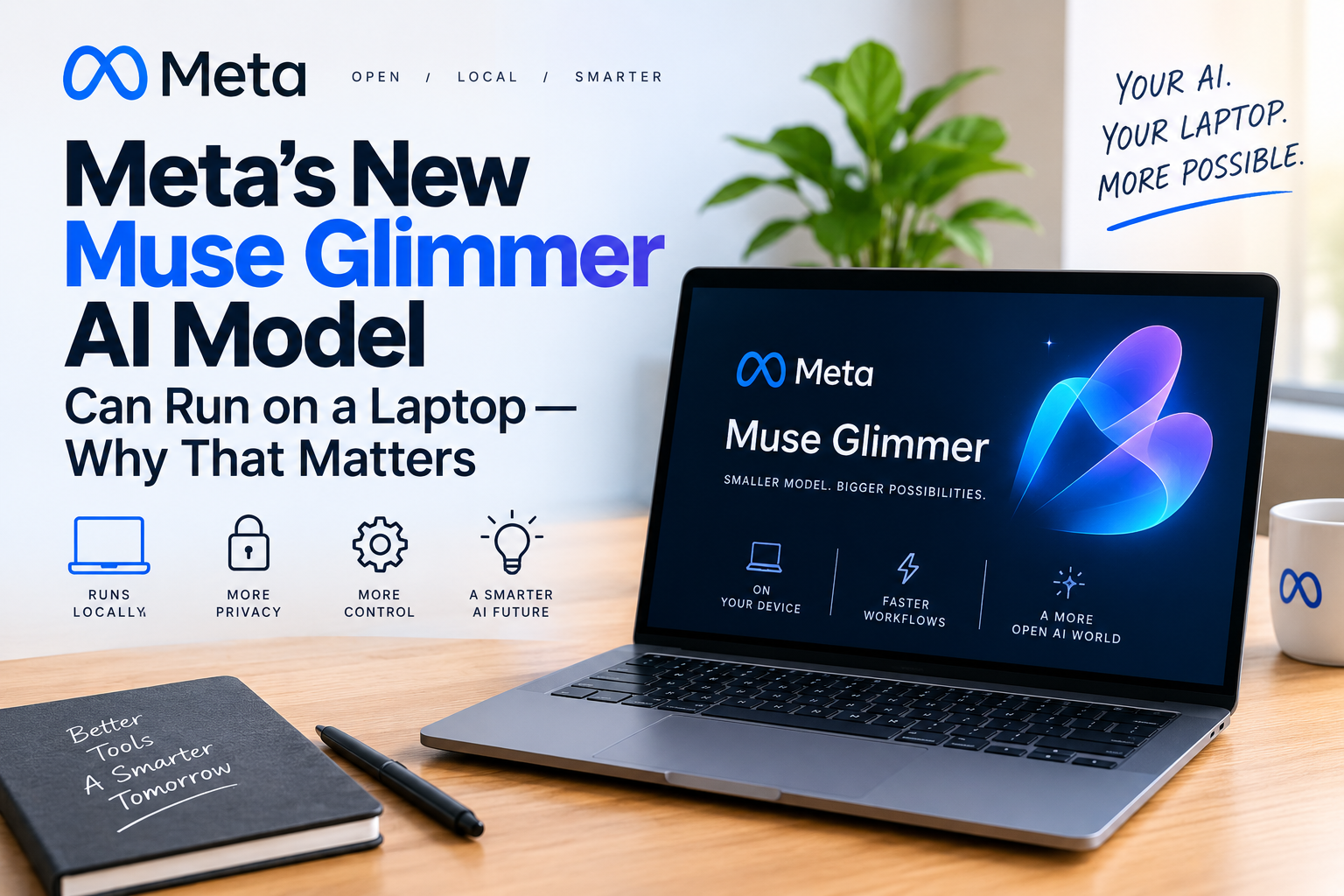
Meta’s New Muse Glimmer AI Model Can Run on a Laptop—Why That Matters
Meta is making a significant bet on a future where powerful artificial intelligence does not always need a data center.
The company has introduced Muse Glimmer, a compact open-weight AI model designed to handle agentic tasks directly on personal computers. Unlike many of today’s most capable AI systems, which depend heavily on cloud infrastructure, Glimmer is designed to operate locally using consumer-grade hardware.
That may sound like a technical distinction, but it could have major implications for how people use AI in the years ahead.
What Is Meta Muse Glimmer?
Muse Glimmer is a smaller AI model developed by Meta’s Superintelligence Labs and designed primarily for local, agentic AI workflows.
Instead of simply answering questions, agentic models are designed to perform multi-step tasks. That can include working with software tools, writing and modifying code, handling administrative tasks and recovering from errors during longer workflows.
Meta’s approach follows the company’s broader push toward what it calls “personal superintelligence”—AI that can understand a user’s context and take action rather than simply generate responses. Earlier Muse models, including Muse Spark and Muse Spark 1.1, have focused on reasoning, coding, multimodal understanding, tool use and computer interaction.
Glimmer takes that philosophy in a different direction: make capable AI small enough to run closer to the user.
Why Running AI on a Laptop Is Important
Most people interact with powerful AI through a remote server.
You type a prompt into an application, that request travels to a company’s data center, the model processes it using specialized hardware, and the result is sent back to your device.
Local AI changes that equation.
If a model can run effectively on a laptop or consumer GPU, some tasks can potentially be processed without sending every piece of information to a remote cloud service.
That creates several potential advantages.
Lower Dependence on Cloud Servers
Running AI locally can reduce reliance on centralized data centers for certain workloads.
This does not mean cloud AI is going away. Large models will continue to require enormous amounts of computing power. But smaller models can handle specific jobs locally, potentially reducing the amount of work that needs to be sent to the cloud.
For developers and businesses, that could eventually mean using a combination of cloud models and smaller local models depending on the task.
Better Privacy for Certain Tasks
Local processing can also be attractive for privacy-sensitive workflows.
If an AI task can be completed entirely on a user’s computer, the underlying information does not necessarily have to leave that machine.
That could be particularly useful for developers working with private code, businesses handling internal documents or individuals using AI with sensitive personal information.
However, users should not automatically assume that every local AI application is private. The privacy outcome depends on how the software is configured and whether it connects to external services.
Local AI Could Change AI Agents
The most interesting part of Glimmer may not be that it can generate text or write code.
It is the emphasis on agentic behavior.
Traditional AI assistants generally operate in a simple pattern: ask a question, receive an answer.
An AI agent can instead break a goal into multiple steps, interact with software, evaluate what happened and continue working.
That distinction becomes much more important when the AI is running locally.
Imagine a developer asking an AI assistant to inspect a project, identify a bug, modify several files, run tests and correct problems that appear during testing.
A cloud-based model can already perform versions of these tasks. But a capable local model could potentially perform them without continuously transmitting the developer’s project information to a remote server.
That combination—local execution plus agentic behavior—is where Glimmer becomes especially interesting.
Meta Is Betting on Smaller AI Models
The release also fits into a broader change happening across the AI industry.
The first wave of generative AI was dominated by increasingly large models that required enormous amounts of computing infrastructure.
The next phase may involve a much wider range of models.
Some will remain extremely large and operate primarily in data centers. Others will be optimized for phones, laptops, vehicles, smart glasses and other devices.
Meta has already been developing its Muse family along several directions. Muse Spark was introduced in April as the first model from Meta Superintelligence Labs, while Muse Spark 1.1 later added improvements in tool use, computer use, coding and multimodal reasoning.
Glimmer represents another piece of that strategy: bringing useful intelligence closer to the hardware people already own.
The Economics Could Be Significant
There is also a financial argument behind local AI.
Running large AI models in the cloud is expensive. Every request requires computing resources in a data center, and those costs increase as AI applications become more capable and users interact with them more frequently.
Local models shift some of that computing burden from the data center to the user’s hardware.
That does not make AI free—users still need capable processors, memory and, in some cases, powerful GPUs. But once the hardware is available, running additional local inference can be fundamentally different from paying for every interaction with a remote service.
Reuters reported that Meta positioned Glimmer as a model capable of handling smaller agentic tasks on personal devices using a single graphics card.
That could make local AI increasingly attractive for developers, power users and organizations that need to run AI repeatedly.
It Could Be Especially Useful for Developers
Developers are among the groups most likely to benefit from capable local models.
Coding assistants routinely interact with source code, configuration files, documentation and development environments. For some projects, sending all of that information to an external AI service may not be desirable.
A local coding agent could instead operate within the developer’s own environment.
Potential uses include:
- Explaining unfamiliar code
- Finding bugs
- Writing tests
- Refactoring files
- Generating documentation
- Searching a local codebase
- Automating repetitive development tasks
- Running tools and responding to errors
The quality of these workflows will ultimately depend on the model, hardware and software surrounding it. A model being able to run locally does not automatically mean it will outperform larger cloud systems.
But the option itself is important.
Open-Weight AI Makes the Move More Interesting
Meta is also emphasizing the open-weight nature of Glimmer.
Open-weight models allow developers to obtain and run model weights rather than interacting exclusively with a proprietary cloud API. That can give developers more control over deployment, customization and infrastructure.
Meta has made open models a major part of its AI strategy in the past, although the company’s newer Muse Spark model initially took a more closed approach.
With Glimmer, Meta is once again pushing the idea that powerful AI models should be available outside a centralized cloud environment. Reuters reported that CEO Mark Zuckerberg is simultaneously arguing for a broader open-weight AI ecosystem and fewer barriers to developing such systems.
That creates an interesting strategic contrast with AI companies whose most powerful systems remain primarily accessible through hosted services.
There Are Still Important Limitations
It would be a mistake to interpret Glimmer’s laptop capability as meaning that a laptop can now replace an AI data center.
It cannot.
Large frontier models can contain vastly more parameters and require enormous computational resources during training and, depending on the model and workload, during inference as well.
A smaller local model therefore has to make trade-offs.
Those trade-offs can involve:
- Reasoning capability
- Response speed
- Context length
- Memory requirements
- Hardware requirements
- Tool-use reliability
- Multimodal capabilities
- Accuracy on complex tasks
The practical experience will also vary considerably depending on the laptop or GPU being used.
The important development is not that local AI has suddenly become equivalent to the largest cloud models. Rather, the gap between useful AI and hardware that ordinary users can access continues to narrow.
What This Means for Everyday AI
For ordinary users, the significance of Glimmer may become clearer over time.
If smaller models continue improving, future laptops could increasingly function as AI computers rather than simply computers that connect to AI services.
A local assistant could potentially organize files, help write documents, analyze personal data, assist with software and perform routine tasks without requiring every operation to happen remotely.
The same principle could extend to phones, vehicles, smart glasses and other connected devices.
Meta’s broader AI strategy already points in this direction. Its Muse models are being developed for products ranging from the Meta AI app to AI glasses and creative tools across its platforms.
The Bigger AI Shift Is From Chatbots to Agents
Perhaps the most important takeaway from Muse Glimmer is that the AI industry is moving beyond the chatbot era.
The next generation of AI products is increasingly being designed around doing things, not simply talking about them.
Meta’s own recent updates illustrate that transition. Muse Spark 1.1 powers features that allow Meta AI to make plans, connect with email and calendar applications, create slides and carry out tasks on a user’s behalf.
Glimmer takes the same concept toward local hardware.
That combination could eventually produce AI assistants that are more persistent, more private and less dependent on a constant connection to centralized AI infrastructure.
A Potential Turning Point for Personal AI
Muse Glimmer is unlikely to eliminate cloud AI, and users should not expect every laptop to suddenly run the world’s most powerful AI models.
Its importance lies elsewhere.
It demonstrates how the AI landscape is expanding beyond the idea that advanced intelligence must always live inside massive data centers. Smaller, specialized models can increasingly bring useful reasoning and agentic capabilities directly onto personal hardware.
For consumers, that could mean greater privacy and faster local processing. For developers, it could mean more control over AI-powered tools. For businesses, it could open new possibilities for keeping sensitive workloads closer to their own infrastructure.
And for the AI industry, it reinforces a larger trend: the future may not belong to one giant model running in the cloud, but to an ecosystem of models operating wherever they make the most sense.
That could make the laptop itself one of the most important places where the next generation of AI takes shape.




2 Comments
Micle harison
June 7, 2019Lorem ipsum dolor sit amet, usu ut perfecto postulant deterruisset, libris causae volutpat at est, ius id modus laoreet urbanitas. Mel ei delenit dolores.
John Doe
June 7, 2019Some consultants are employed indirectly by the client via a consultancy staffing company.