
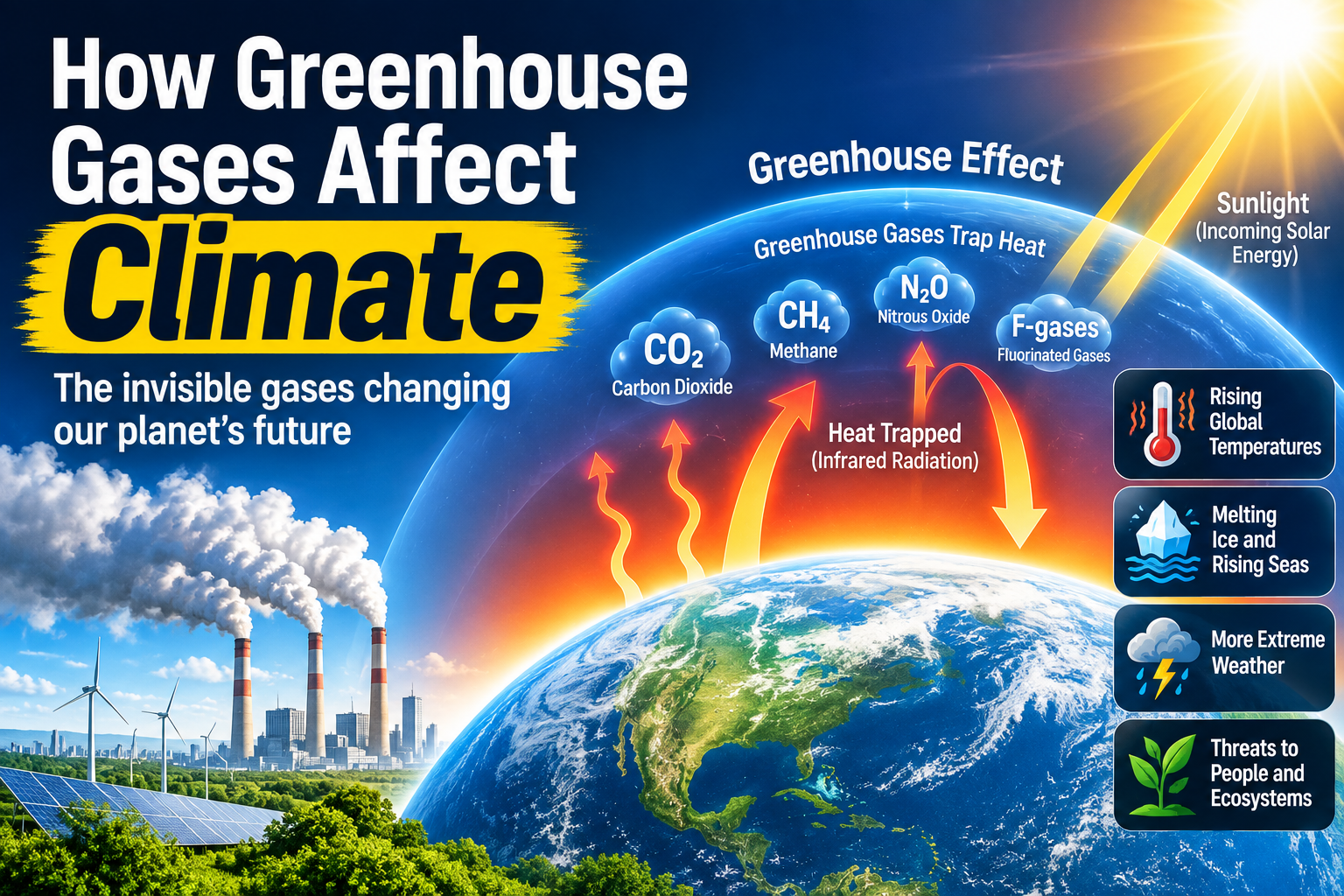
How Greenhouse Gases Affect Climate
Greenhouse gases are a natural part of Earth’s atmosphere, but changes in their concentration are reshaping the planet’s climate. From carbon dioxide released by burning fossil fuels to methane from agriculture and energy production, these gases influence how much heat remains in the Earth’s climate system.
Understanding how greenhouse gases work is essential to understanding climate change, because the relationship between atmospheric gases, heat and the Earth’s energy balance helps explain many of the changes scientists are observing today.
What Are Greenhouse Gases?
Greenhouse gases are gases in the atmosphere that absorb and emit infrared radiation, helping retain heat within Earth’s climate system.
The main greenhouse gases include carbon dioxide (CO₂), methane (CH₄), nitrous oxide (N₂O), water vapor and ozone. Human activities also produce synthetic greenhouse gases, including several fluorinated gases.
The presence of these gases is not inherently harmful. In fact, the natural greenhouse effect is essential for life as we know it. Without the atmosphere’s natural ability to retain some heat, Earth would be far colder.
The problem arises when human activities significantly increase the concentrations of greenhouse gases that trap additional heat.
How the Greenhouse Effect Works
Earth receives energy from the Sun. Some of that energy is reflected back into space, while the rest is absorbed by the planet’s surface and atmosphere.
The warmed Earth then releases energy in the form of infrared radiation.
Greenhouse gases absorb some of this outgoing infrared radiation and emit radiation in different directions, including back toward the Earth’s surface. This process affects the planet’s energy balance and contributes to warming.
A useful way to picture the process is to think of the atmosphere as a heat-regulating blanket.
A thicker concentration of greenhouse gases means more outgoing heat is absorbed and redistributed within the climate system. As the Earth’s energy balance changes, temperatures and other aspects of climate can change as well.
Why Greenhouse Gas Concentrations Matter
The climate impact of a greenhouse gas depends on several factors, including how much of it is present, how long it remains in the atmosphere and how effectively it absorbs energy.
This means greenhouse gases cannot all be treated as equally powerful.
Carbon dioxide, for example, is emitted in very large quantities and can remain influential in the climate system for a long time. Methane is present at much lower concentrations but is much more effective at trapping heat per molecule over relevant time periods.
Scientists therefore use measurements such as global warming potential (GWP) to compare the warming effects of different gases.
Carbon Dioxide and Climate Change
Carbon dioxide is the greenhouse gas most closely associated with human-caused global warming.
CO₂ naturally moves through Earth’s carbon cycle, with carbon exchanged among the atmosphere, oceans, soil, plants and other parts of the planet. Human activities have disrupted that balance by adding large quantities of additional carbon dioxide to the atmosphere.
The largest human source is the burning of fossil fuels such as:
- Coal
- Oil
- Natural gas
CO₂ is also released through certain industrial processes, including cement production, as well as land-use changes such as deforestation.
Because carbon dioxide is emitted in such large quantities and accumulates in the atmosphere, reducing CO₂ emissions is a central part of efforts to limit long-term global warming.
Methane Has a Powerful Warming Effect
Methane is another important greenhouse gas.
It can be released through both natural processes and human activities. Major human-related sources include livestock production, agriculture, landfills, coal mining and oil and natural gas production and transportation.
Methane does not remain in the atmosphere as long as carbon dioxide, but it has a much stronger warming effect per unit of emissions over shorter time horizons.
That makes methane reductions particularly important for slowing the rate of warming.
Nitrous Oxide and Agriculture
Nitrous oxide is another heat-trapping gas with important links to human activity.
Agriculture is a major source, particularly through the use of nitrogen fertilizers. Fossil fuel combustion and industrial processes also contribute to nitrous oxide emissions.
Because agricultural systems are closely connected to food production, reducing nitrous oxide emissions can require changes in fertilizer management, farming practices and other aspects of agricultural production.
Fluorinated Gases Are Powerful Greenhouse Gases
Some greenhouse gases are synthetic compounds used in industrial and commercial applications.
Fluorinated gases include substances such as hydrofluorocarbons, perfluorocarbons, nitrogen trifluoride and sulfur hexafluoride.
Many of these gases have extremely high global warming potentials. Some can also remain in the atmosphere for hundreds or thousands of years.
Their concentrations may be much lower than those of carbon dioxide, but their high warming effectiveness means they can still have significant climate impacts.
How Greenhouse Gases Change Global Climate
Increasing greenhouse gas concentrations do more than raise average temperatures.
They alter the Earth’s overall energy balance, which can influence many components of the climate system.
Scientists have observed changes involving:
- Global and regional temperatures
- Ocean temperatures
- Sea levels
- Precipitation patterns
- Glaciers and ice sheets
- Sea ice
- Ecosystems
- Extreme weather patterns
The EPA notes that multiple lines of evidence show changes in weather, oceans and ecosystems associated with a warming climate.
The effects are not necessarily identical everywhere. Climate change can produce different consequences depending on geography, local ecosystems and existing environmental conditions.
Why Oceans Are Important
The oceans play a major role in Earth’s climate system.
They absorb large amounts of heat from the atmosphere and also take up carbon dioxide. This means changes in atmospheric greenhouse gas concentrations affect the ocean as well as the air.
As the climate warms, ocean temperatures rise, while increased carbon dioxide uptake contributes to ocean acidification.
Changes in the oceans can then influence weather, ecosystems, sea levels and marine life.
This illustrates an important point about climate change: greenhouse gases do not simply warm the air. They influence an interconnected planetary system.
Greenhouse Gases and Extreme Weather
A warmer climate can affect the conditions under which extreme weather events occur.
For example, higher temperatures can increase the likelihood or intensity of some heat extremes. Changes in temperature and atmospheric moisture can also influence precipitation, drought and flooding patterns.
The precise effect varies by location and by the type of event.
This is why scientists generally avoid saying that every individual flood, drought or storm is caused entirely by climate change. Instead, climate change can alter the background conditions that influence the probability, intensity or characteristics of particular events.
The EPA reports that a changing climate is associated with changes in extreme weather patterns and can affect agriculture, water resources, ecosystems and human health.
Greenhouse Gases and Sea-Level Rise
Greenhouse gas-driven warming also contributes to rising sea levels.
As temperatures increase, seawater expands. Warming also contributes to the loss of land-based ice, including glaciers and ice sheets.
Together, these processes contribute to higher global sea levels.
For coastal communities, the consequences can include increased coastal flooding, erosion and pressure on coastal ecosystems.
Climate Feedbacks Can Amplify Change
The climate system contains feedback mechanisms that can strengthen or weaken an initial change.
For example, warming can contribute to the loss of reflective ice and snow. Darker surfaces exposed when ice melts can absorb more solar energy, potentially contributing to additional warming.
Other feedbacks involve water vapor, clouds, vegetation and the carbon cycle.
These interactions make Earth’s climate system considerably more complex than simply adding greenhouse gases and measuring the resulting temperature increase.
Are Greenhouse Gases the Only Climate Influence?
No.
Earth’s climate is influenced by numerous factors, including changes in solar activity, volcanic activity, land-surface characteristics, aerosols and other components of the atmosphere.
However, the increase in greenhouse gas concentrations caused by human activities has become a major driver of the warming observed over the modern period. The EPA notes that natural factors continue to influence climate, but the net global effect of human activities since the industrial era has been an increase in greenhouse gas concentrations and associated warming.
This distinction is important because natural climate variability does not contradict the evidence for human-caused warming.
What Happens When Emissions Continue?
Greenhouse gases differ in their atmospheric lifetimes.
Some remain in the atmosphere for relatively short periods, while others persist for decades, centuries or even much longer.
As a result, the effects of today’s emissions are not necessarily limited to today’s weather.
Long-lived greenhouse gases can influence the climate system far into the future. This is one reason climate scientists focus not only on reducing current emissions but also on understanding the cumulative effect of greenhouse gas concentrations over time.
Why Reducing Greenhouse Gas Emissions Matters
Reducing greenhouse gas emissions can slow the rate at which additional heat accumulates in the climate system.
Strategies can involve many sectors, including:
- Electricity generation
- Transportation
- Industry
- Agriculture
- Buildings
- Waste management
- Land use and forestry
Different gases require different approaches.
Reducing carbon dioxide largely involves transitioning away from fossil-fuel-intensive energy systems and protecting or increasing natural carbon sinks. Methane reductions can involve changes in energy production, agriculture and waste management, while nitrous oxide reductions can involve improved fertilizer practices.
The challenge is therefore not simply about reducing one gas or changing one industry. It involves managing a broad network of human activities that influence the atmosphere.
The Bigger Climate Picture
Greenhouse gases are invisible, but their effects are measurable across the planet’s climate system.
They influence how much energy Earth retains, how temperatures change, how oceans respond and how ecosystems adapt. Carbon dioxide remains the largest contributor to human-caused warming because of the scale of its emissions and accumulation, while gases such as methane, nitrous oxide and fluorinated compounds also play important roles.
Understanding the greenhouse effect therefore provides a foundation for understanding climate change itself. The central issue is not whether greenhouse gases are naturally present—they are—but how human activities have altered their concentrations and, consequently, the Earth’s energy balance.
As scientists continue to monitor temperatures, oceans, ice, ecosystems and atmospheric composition, greenhouse gases remain one of the most important pieces of the climate story.




2 Comments
Micle harison
June 7, 2019Lorem ipsum dolor sit amet, usu ut perfecto postulant deterruisset, libris causae volutpat at est, ius id modus laoreet urbanitas. Mel ei delenit dolores.
John Doe
June 7, 2019Some consultants are employed indirectly by the client via a consultancy staffing company.