
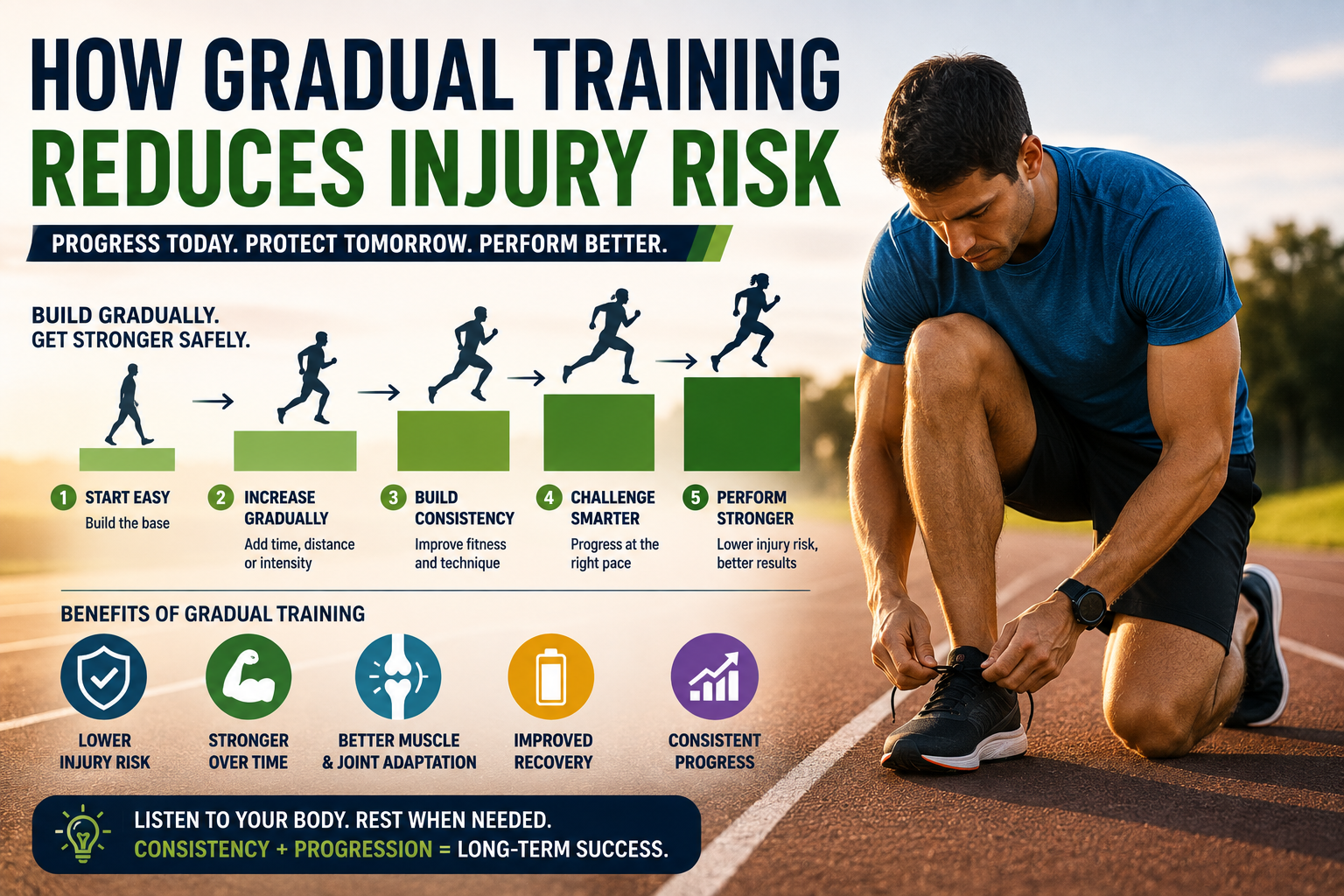
How Gradual Training Reduces Injury Risk
Getting better at a sport rarely happens overnight. Whether an athlete is learning to run longer distances, lifting heavier weights, improving speed, or preparing for competition, the body needs time to adapt to increasing demands.
Training that progresses gradually can help athletes build strength, endurance, coordination, and sport-specific capacity without repeatedly placing demands far beyond what their bodies are prepared to handle. Sports medicine research emphasizes that injury risk can increase when training loads substantially exceed an athlete’s current physical capacity.
That makes progression an important part of both performance development and injury prevention.
What Does Gradual Training Mean?
Gradual training means increasing the demands placed on the body in a controlled and appropriate way rather than making large, sudden changes.
Training load can involve several factors, including:
- Exercise duration
- Distance
- Frequency
- Intensity
- Weight lifted
- Number of repetitions
- Speed
- Competition exposure
- Sport-specific movements
For example, a recreational runner who normally runs 15 minutes should not suddenly attempt a 90-minute run simply because they feel motivated. A more appropriate approach would be to build running time progressively while allowing enough recovery between sessions.
The right progression is not identical for everyone. An athlete’s training history, fitness, sport, age, recovery, and individual circumstances all influence how quickly they can adapt.
Why Sudden Training Increases Can Cause Problems
The muscles, tendons, bones, joints, cardiovascular system, and nervous system all need time to adapt to training.
When training demands increase faster than the body can adapt, the athlete may experience excessive fatigue or accumulate stress faster than they can recover.
The International Olympic Committee has highlighted rapid changes in training and competition load as an important consideration in managing athlete health.
This does not mean that hard training is inherently dangerous. Challenging the body is necessary for improvement. The issue is often the relationship between the amount of stress being applied and the athlete’s current capacity to tolerate it.
Training Builds Capacity Over Time
One of the most important ideas behind progressive training is capacity.
Training provides a stimulus that encourages the body to adapt. With appropriate loading and recovery, an athlete can gradually become capable of handling more work.
For example:
Beginner runner → consistent short runs → longer runs → increased training volume → greater endurance
Similarly:
Beginner lifter → correct technique → manageable weights → progressive resistance → greater strength
The goal is not simply to avoid demanding exercise. The goal is to build the physical capacity necessary to tolerate demanding exercise.
Research published in the British Journal of Sports Medicine describes progressively applied, sport-specific training as a way of improving physical capacities such as strength, power, and endurance. It also notes that injury risk can increase when training loads substantially exceed current tissue capacity.
The Importance of Training Load
Training load refers broadly to the amount of work an athlete experiences.
It can be considered from two perspectives.
External Training Load
External load describes the work performed, such as:
- Running distance
- Number of sprints
- Weight lifted
- Number of repetitions
- Training duration
- Number of throws or kicks
Internal Training Load
Internal load describes how the athlete responds to that work.
It can include factors such as:
- Perceived exertion
- Heart rate
- Fatigue
- Muscle soreness
- General well-being
The same workout can therefore represent very different levels of stress for two athletes.
A highly conditioned athlete may find a particular session relatively manageable, while someone returning from a long break may find the same session extremely demanding.
Why Consistency Matters
One of the simplest ways to improve training progression is to build consistency before dramatically increasing workload.
An athlete who trains sporadically may have difficulty developing the capacity needed for more demanding sessions.
Consistent training allows the body to repeatedly experience manageable workloads and adapt over time.
This is particularly important when returning to exercise after:
- A long break
- An injury
- Illness
- A major change in lifestyle
- A period of reduced activity
Instead of immediately returning to previous training levels, athletes may need to rebuild capacity progressively.
Avoiding Large Training Spikes
A training spike occurs when workload increases sharply over a relatively short period.
For example, someone who normally exercises twice per week might suddenly begin training six days a week.
Another example would be a runner who dramatically increases weekly mileage while simultaneously adding hills and high-intensity intervals.
Such changes can create a mismatch between the demands of training and the athlete’s existing capacity.
Some sports research has associated large increases in training load with greater injury risk, although the precise relationship varies by athlete, sport, and context.
This is why progression should be individualized rather than based on a universal formula.
Does the 10 Percent Rule Always Apply?
The commonly repeated “10 percent rule” suggests that athletes should increase training volume by no more than about 10 percent per week.
It is important not to treat this as a universal medical rule.
Some sports literature has recommended small weekly increases, with one IOC consensus statement noting evidence suggesting weekly increments below 10 percent in the context of load management. However, the same consensus emphasizes that responses vary considerably between individuals.
In other words, the broader principle is more useful than memorizing a specific percentage:
Increase training gradually and adjust progression according to the athlete’s response.
A coach, sports physician, or qualified exercise professional can help determine an appropriate progression for athletes with specific training or medical considerations.
Recovery Is Part of Training
Training and recovery work together.
An athlete does not become fitter simply because they repeatedly train hard. The body needs sufficient time and resources to adapt to the stress created by training.
Recovery can involve:
- Adequate sleep
- Sufficient nutrition
- Hydration
- Rest days
- Lower-intensity sessions
- Managing overall stress
The IOC consensus on training load recommends individualized planning that includes recovery measures such as nutrition, hydration, sleep, and psychological recovery.
This is particularly important when athletes are balancing sports with school, work, travel, or other physical and psychological demands.
Why Technique Matters During Progression
Increasing workload is not the only way to make training more difficult.
Athletes can also progress by improving movement quality and technique.
For example, a strength-training program might progress from:
Learning the movement → improving technique → increasing repetitions → increasing resistance
This approach can help athletes develop the skills necessary to handle greater demands.
Poor technique combined with increasing fatigue can make some movements more difficult to perform effectively, which is one reason coaches often emphasize movement quality before adding substantial intensity or volume.
Gradual Training for Young Athletes
Young athletes require particular attention to appropriate progression because physical growth and biological maturation are constantly changing.
The IOC recommends age-appropriate strength and conditioning, varied athletic exposure, appropriate rest and recovery, and training that accounts for individual development.
For young athletes, gradual progression is therefore about more than simply reducing injury risk. It can also support long-term athletic development.
Programs should avoid unnecessarily repetitive workloads and should allow young athletes to develop a broad range of physical skills.
Gradual Training After an Injury
Returning to sport after an injury is different from simply starting a new training program.
An athlete may have regained basic movement but still need to rebuild strength, endurance, confidence, and sport-specific capacity.
Sports physical therapy guidance emphasizes graded progression through return-to-sport stages rather than treating return as a single event.
The progression might move through stages such as:
- Basic rehabilitation
- Modified training
- Sport-specific training
- Increased training intensity
- Full participation
- Return to previous performance levels
The appropriate progression depends heavily on the injury and the athlete.
Anyone recovering from a significant injury should follow the advice of an appropriate healthcare professional rather than using a generic training schedule.
Listening to Early Warning Signs
Athletes sometimes interpret discomfort as something they simply need to push through.
That approach can be risky when symptoms are persistent, worsening, or associated with a known injury.
Warning signs that deserve attention can include:
- Persistent pain
- Swelling
- Reduced range of motion
- Unusual weakness
- Persistent fatigue
- Declining performance
- Changes in normal movement
- Pain that becomes worse during training
These signs do not automatically mean an athlete has a serious injury, but they can indicate that training needs to be reviewed.
Early communication between athletes, coaches, and healthcare professionals can help identify problems before they become more disruptive.
How Coaches Can Manage Training Progression
Coaches play an important role in controlling training load.
Effective planning can involve monitoring:
- Training duration
- Intensity
- Frequency
- Competition schedules
- Athlete feedback
- Performance
- Recovery
- Previous training exposure
The IOC recommends monitoring both external and internal training loads as part of individualized load management.
A coach can then adjust the next session based on how the athlete responded to previous work.
This creates a more flexible approach than following a rigid program regardless of fatigue or changing circumstances.
A Simple Example of Progressive Training
Imagine a person preparing for a 5-kilometer run after several months without regular exercise.
Instead of immediately attempting the full distance at maximum effort, a gradual program might begin with manageable sessions involving walking and short running intervals.
Over time, the athlete could progress toward:
Walking → run/walk intervals → continuous easy running → longer runs → controlled speed work → race preparation
The exact schedule would depend on the individual’s fitness and circumstances.
The important principle is that each stage prepares the body for the next one.
Common Mistakes That Increase Training Risk
Doing Too Much Too Soon
Motivation can lead athletes to increase training dramatically after deciding to improve their fitness.
Increasing Multiple Variables at Once
Increasing distance, intensity, frequency, and duration simultaneously can make it difficult to determine how much additional stress the body is experiencing.
Ignoring Recovery
More training is not always better if the athlete cannot recover adequately.
Copying Another Athlete’s Program
A professional athlete’s training schedule may be completely inappropriate for a beginner.
Returning to Previous Levels Too Quickly
After an injury or long break, previous fitness levels may no longer represent current capacity.
Ignoring Persistent Symptoms
Continuing through worsening pain can potentially turn a manageable problem into a more serious one.
How Athletes Can Build Safer Progression
A practical approach is to focus on several principles:
Start From Your Current Ability
Base training on what you can safely handle now, not what you could do months or years ago.
Increase Demands Gradually
Make changes small enough to allow adaptation.
Avoid Dramatic Spikes
Large changes in workload can create unnecessary stress.
Build Recovery Into the Schedule
Rest and lower-intensity sessions should be considered part of the program rather than wasted training time.
Monitor Your Response
Pay attention to performance, fatigue, soreness, sleep, and other changes.
Adjust When Necessary
A training plan should be flexible enough to change when circumstances change.
Seek Professional Guidance When Needed
Athletes dealing with injuries, persistent pain, medical conditions, or major return-to-sport decisions should work with qualified healthcare or sports professionals.
Why Sustainable Progress Often Beats Fast Progress
Athletic improvement is a long-term process.
Trying to make rapid gains can sometimes produce short-term progress while creating problems that interrupt training later.
Gradual progression offers a different approach: build capacity, allow recovery, monitor the response, and continue increasing the challenge when the athlete is ready.
That philosophy is consistent with modern approaches to training-load management, which emphasize individualized progression rather than treating every athlete the same.
Building Fitness Without Overloading the Body
The central lesson is simple: training should challenge the body without consistently exceeding its ability to adapt.
Progressive training gives muscles, connective tissues, bones, and other systems an opportunity to become better prepared for the demands of sport. It does not eliminate injury risk—no training method can—but sensible progression, adequate recovery, appropriate technique, and attention to warning signs can form an important part of a broader injury-prevention strategy.
For athletes, the goal is not merely to train harder. It is to build the capacity to train consistently, recover effectively, and keep progressing over time.





2 Comments
Micle harison
June 7, 2019Lorem ipsum dolor sit amet, usu ut perfecto postulant deterruisset, libris causae volutpat at est, ius id modus laoreet urbanitas. Mel ei delenit dolores.
John Doe
June 7, 2019Some consultants are employed indirectly by the client via a consultancy staffing company.