
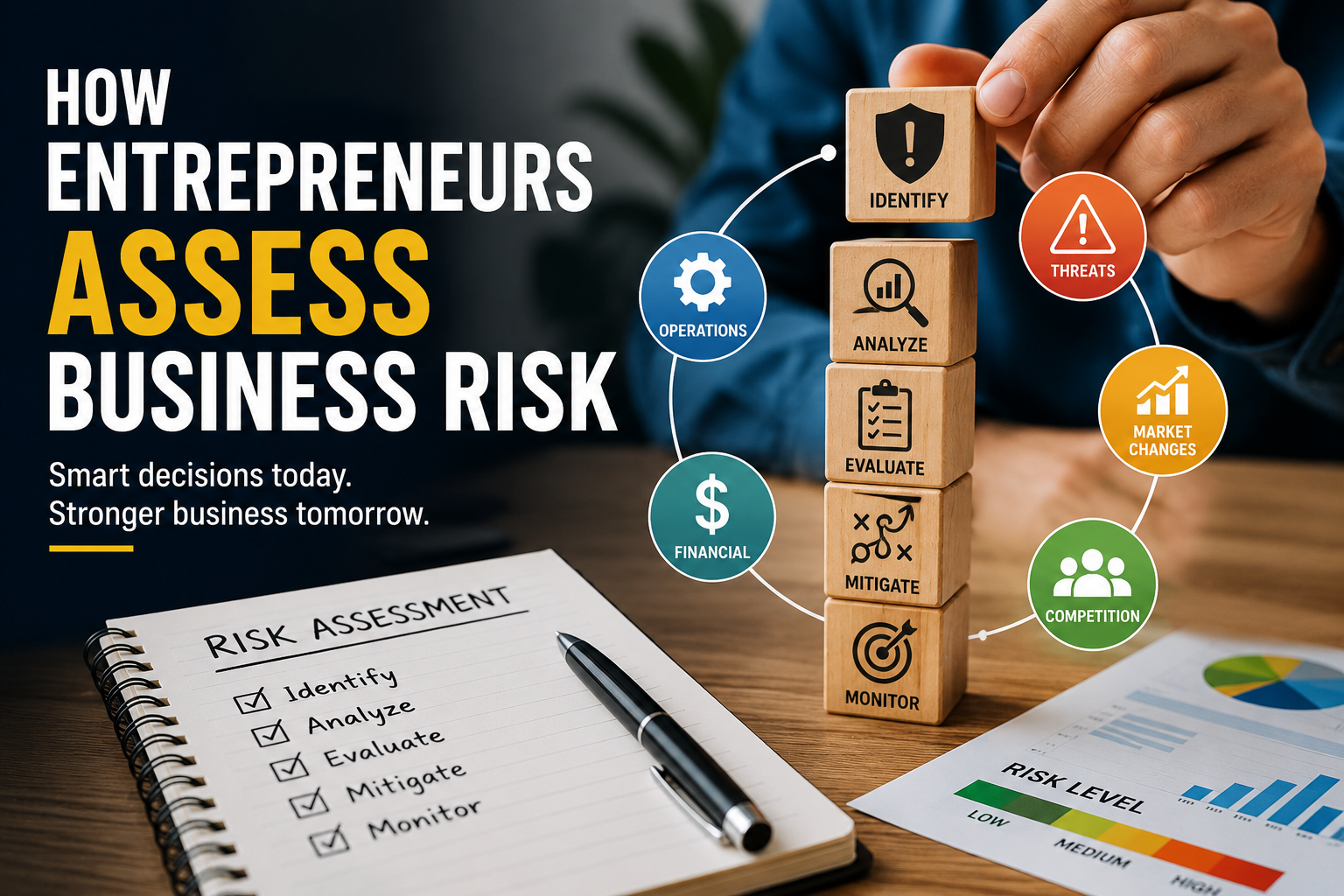
How Entrepreneurs Assess Business Risk
Every business decision involves some degree of uncertainty. Entrepreneurs may have a promising idea, a growing customer base or an attractive investment opportunity, but none of these guarantees that a business will succeed.
Successful entrepreneurs therefore do more than look at potential rewards. They also ask what could go wrong, how likely those problems are to occur and whether the business can survive them.
This process is known as business risk assessment. It helps entrepreneurs make better-informed decisions, protect resources and prepare for challenges before they become expensive problems.
What Is Business Risk?
Business risk is the possibility that an event, decision or circumstance could prevent a company from achieving its goals.
Risk can come from inside or outside the business. A company might face declining sales, rising costs, employee shortages, technology failures, changing customer preferences or increased competition.
Not every risk is necessarily negative. Entrepreneurs often take calculated risks to create opportunities. Launching a new product, entering a new market or investing in technology can all involve uncertainty, but the potential reward may justify the exposure.
The goal of risk assessment is therefore not to eliminate every risk. Instead, entrepreneurs try to understand and manage the risks they can reasonably control.
Identify the Biggest Risks First
The first step is identifying what could potentially threaten the business.
Entrepreneurs may examine several areas, including:
- Financial risk: Problems with cash flow, debt, costs or profitability.
- Market risk: Changes in demand, customer behavior or market conditions.
- Competitive risk: New or stronger competitors entering the market.
- Operational risk: Problems involving suppliers, employees, equipment or internal processes.
- Technology risk: System failures, cybersecurity incidents or outdated technology.
- Legal and regulatory risk: Changes in laws, regulations, licenses or contractual obligations.
- Reputational risk: Events that could damage customer trust or the company’s reputation.
- Strategic risk: Decisions that could move the company in the wrong direction.
A business does not need to treat every risk equally. The most important risks are usually those that could cause significant financial, operational or strategic damage.
Measure Likelihood and Potential Impact
Once risks have been identified, entrepreneurs can evaluate two basic questions:
How likely is this risk to happen?
How serious would the consequences be if it happened?
For example, imagine a small retailer depends heavily on one supplier.
If that supplier has a temporary delivery problem, the business might experience a few days of disruption. But if the supplier permanently closes, the retailer could face serious inventory shortages.
The likelihood and impact of these scenarios are different, so the entrepreneur may need different responses.
A simple risk matrix can help businesses prioritize their attention:
| Risk Level | Likelihood | Potential Impact | Typical Response |
|---|---|---|---|
| Low | Low | Low | Monitor |
| Moderate | Medium | Medium | Prepare controls |
| High | High | High | Take immediate action |
| Critical | High | Severe | Prioritize mitigation |
This approach prevents entrepreneurs from spending excessive time and money on risks that have little practical significance while ignoring major threats.
Look at the Financial Numbers
Financial risk is one of the most important areas entrepreneurs assess.
A business can generate revenue and still experience financial problems if cash is poorly managed. Entrepreneurs therefore examine factors such as:
- Revenue trends
- Operating expenses
- Gross and net margins
- Cash flow
- Debt obligations
- Accounts receivable
- Inventory costs
- Break-even point
- Available cash reserves
- Customer concentration
Cash-flow analysis is particularly important for smaller businesses.
For example, a company might have strong sales on paper but struggle to pay its bills because customers take 60 days to pay invoices while suppliers require payment within 30 days.
Understanding this mismatch allows the entrepreneur to identify the risk before it becomes a cash crisis.
Test the Business Model
Entrepreneurs also need to determine whether the underlying business model can withstand changes in conditions.
A useful question is:
What would happen if our assumptions were wrong?
Suppose an entrepreneur expects to sell 1,000 products every month. What happens if actual sales are only 600?
What if advertising costs increase?
What if a major customer leaves?
What if the price of raw materials rises significantly?
Testing these scenarios can reveal weaknesses that may not be obvious when everything is going according to plan.
This is where scenario analysis becomes useful. Entrepreneurs can create different versions of the future, such as a best-case, expected-case and worst-case scenario.
Study the Market and Customers
Market conditions can change quickly, and entrepreneurs need to understand the external factors that could affect demand.
They may examine:
- Customer preferences
- Market size
- Purchasing behavior
- Competitor pricing
- New competitors
- Substitute products
- Economic conditions
- Distribution channels
- Industry regulations
- Technological changes
Customer feedback can also reveal risks that financial reports cannot.
A product may be technically excellent but fail because customers do not consider it valuable enough to purchase. Speaking with customers, reviewing complaints and monitoring purchasing patterns can help entrepreneurs identify these issues early.
Assess Competitors
Competition is another major source of business risk.
Entrepreneurs should understand not only who their competitors are, but also what makes those businesses attractive to customers.
Questions may include:
- What products or services do competitors offer?
- How do their prices compare?
- What markets do they serve?
- What are their strengths?
- Where are their weaknesses?
- How easily could customers switch between businesses?
- What prevents a new competitor from entering the market?
A competitor does not necessarily need to offer an identical product to create a threat. A substitute solution can also change customer behavior.
For example, a company selling physical business software could face competition from a cloud-based service even if the two businesses use completely different delivery models.
Consider Operational Weaknesses
A business can be financially healthy while still having serious operational risks.
Entrepreneurs may examine how the company depends on:
- Key employees
- Critical suppliers
- Specialized equipment
- Software systems
- Delivery partners
- Physical locations
- Manufacturing processes
- Third-party service providers
One useful question is:
What happens if this stops working tomorrow?
If the answer is that the entire business would effectively stop operating, the company has identified a significant point of vulnerability.
Entrepreneurs can then develop alternatives, such as backup suppliers, documented procedures, cross-trained employees or redundant systems.
Evaluate People-Related Risks
Employees are central to most businesses, which makes workforce risk another important consideration.
Entrepreneurs may assess:
- Difficulty recruiting skilled workers
- Employee turnover
- Dependence on individual employees
- Training gaps
- Leadership succession
- Workplace safety
- Productivity problems
- Lack of documented processes
A small business can be especially vulnerable when too much knowledge is concentrated in one person.
If only one employee knows how to operate a critical system or manage an important customer relationship, losing that employee could create significant disruption.
Documenting processes and developing employees with overlapping skills can reduce this dependency.
Consider Technology and Cybersecurity
Technology has become deeply connected to modern business operations.
Entrepreneurs therefore need to consider risks involving data, software, hardware and online services.
Potential problems include:
- System outages
- Data loss
- Cyberattacks
- Weak passwords
- Unauthorized access
- Software incompatibility
- Outdated systems
- Internet disruptions
- Loss of access to important accounts
Businesses that collect customer information should pay particular attention to how that information is stored, accessed and protected.
Technology risk is not limited to large corporations. Small businesses can also suffer significant disruption when essential systems become unavailable.
Examine Legal and Regulatory Risks
Businesses operate within legal and regulatory frameworks that vary depending on their industry and location.
Entrepreneurs may need to consider:
- Business licenses
- Employment requirements
- Taxes
- Contracts
- Consumer protection rules
- Intellectual property
- Data protection
- Health and safety requirements
- Industry-specific regulations
Ignoring these areas can result in financial penalties, disputes or operational restrictions.
For complex legal questions, entrepreneurs should seek advice from appropriately qualified professionals rather than relying solely on general business information.
Understand Risk Concentration
One of the most dangerous situations for a business is excessive dependence on a single factor.
Examples include:
- One major customer providing most revenue
- One supplier providing essential materials
- One employee holding critical knowledge
- One sales channel generating most leads
- One geographic market providing most revenue
- One product accounting for most sales
This is known as concentration risk.
Entrepreneurs can reduce concentration risk by diversifying customers, suppliers, products, markets or distribution channels where practical.
Diversification does not eliminate risk, but it can prevent one failure from threatening the entire company.
Calculate the Cost of Doing Nothing
Risk assessment should not focus only on the cost of preventing a problem.
Entrepreneurs should also consider the potential cost of not taking action.
For example, a company may hesitate to invest in backup systems because they are expensive. But if a system failure could cause several days of lost sales, damage customer relationships and require expensive emergency repairs, the cost of prevention may be justified.
This comparison helps entrepreneurs make more rational decisions about risk management.
Create a Risk Response Plan
After identifying and prioritizing risks, entrepreneurs can decide how to respond.
Common approaches include:
Avoid the Risk
The entrepreneur may decide not to pursue an activity if the potential downside is unacceptable.
Reduce the Risk
The business can introduce measures that reduce either the likelihood or impact of the problem.
Transfer the Risk
Insurance, contracts or outsourcing arrangements can sometimes transfer part of the financial exposure to another party.
Accept the Risk
Some risks are relatively small or unavoidable. In those cases, the entrepreneur may consciously accept the risk while monitoring it.
The important point is that acceptance should be a deliberate decision rather than an oversight.
Use Data Instead of Guesswork
Experience and intuition can be valuable, but entrepreneurs should support major decisions with evidence whenever possible.
Useful information can come from:
- Financial statements
- Customer surveys
- Sales data
- Market research
- Competitor analysis
- Industry reports
- Supplier performance
- Website analytics
- Customer-support records
- Operational metrics
Data does not eliminate uncertainty, but it can reduce the amount of guesswork involved in evaluating a decision.
Review Risks Regularly
Risk assessment should not be treated as a one-time exercise.
A company’s risk profile can change as it grows.
A startup may initially worry about finding customers and maintaining cash flow. A larger company may face more complex risks involving employees, technology, suppliers, regulation and international operations.
Entrepreneurs should therefore revisit their risk assessments when:
- Launching a new product
- Entering a new market
- Taking on significant debt
- Hiring substantially more employees
- Changing suppliers
- Adopting major technology
- Acquiring another company
- Losing a major customer
- Experiencing a significant operational failure
Regular reviews help businesses respond to changing conditions instead of relying on outdated assumptions.
Turning Uncertainty Into Better Decisions
Entrepreneurs cannot predict every event that could affect their businesses. What they can do is build a structured way to think about uncertainty.
The strongest approach combines financial analysis, market research, operational planning, customer feedback and scenario testing. It also recognizes that risk is not necessarily something to avoid entirely. Some of the most important business opportunities involve uncertainty.
The difference is between taking a calculated risk and taking an uninformed one.
By identifying potential problems, measuring their likelihood and impact, preparing practical responses and reviewing assumptions regularly, entrepreneurs can make decisions with a clearer understanding of both the opportunities and the risks ahead.




2 Comments
Micle harison
June 7, 2019Lorem ipsum dolor sit amet, usu ut perfecto postulant deterruisset, libris causae volutpat at est, ius id modus laoreet urbanitas. Mel ei delenit dolores.
John Doe
June 7, 2019Some consultants are employed indirectly by the client via a consultancy staffing company.