
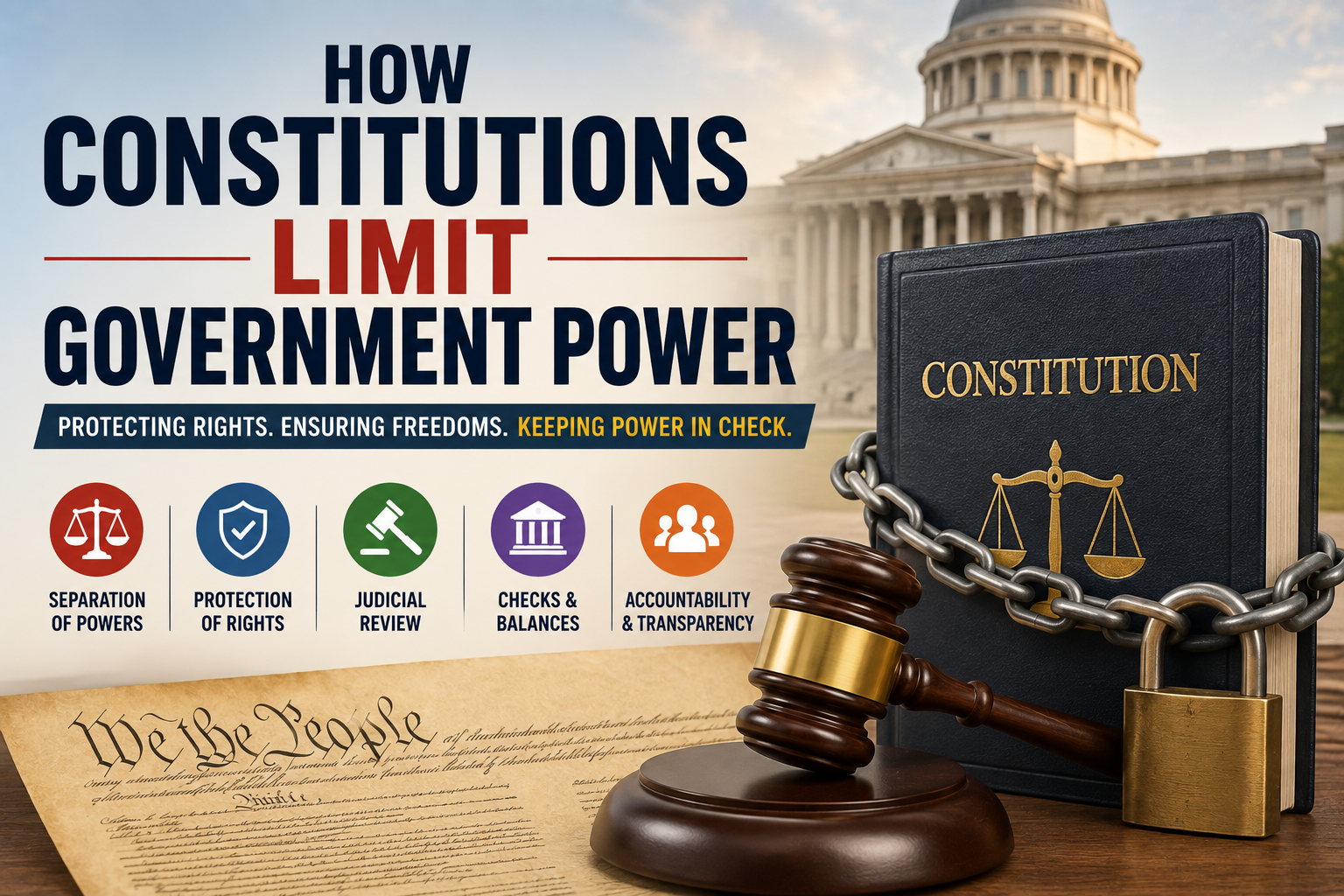
How Constitutions Limit Government Power
A constitution is more than a document that establishes the structure of a government. In many countries, it serves as the legal framework that determines what government officials can do, what they cannot do, and how public power must be exercised.
Without meaningful limits, governments can potentially expand their authority at the expense of individual rights, political accountability, and the rule of law. Constitutions are designed to reduce that risk by placing legal boundaries around public institutions and creating mechanisms for challenging abuses of power.
Understanding how these limits work helps explain why constitutions are central to democratic government and the protection of civil liberties.
What Is a Constitution?
A constitution is the fundamental legal framework of a state. It establishes the basic institutions of government, defines their powers, and often sets out fundamental rights and freedoms.
Constitutions vary significantly from one country to another. Some are contained primarily in a single written document, while others draw on legislation, judicial decisions, conventions, and historical practices.
Despite these differences, constitutions commonly address several core questions:
- How is government organized?
- Who has authority to make laws?
- What powers does the executive have?
- What role does the legislature play?
- How are judges appointed and what authority do courts have?
- What rights are protected?
- How can government officials be held accountable?
- How can the constitution itself be changed?
These rules create a framework within which government is expected to operate.
How Constitutions Restrict Government Authority
The most important way a constitution limits government power is by establishing legal boundaries.
Government institutions generally cannot exercise unlimited authority simply because they believe an action would be useful or politically popular. Their powers must have a legal foundation.
For example, a constitution may assign lawmaking powers to a legislature while giving an executive branch responsibility for implementing laws. It may also establish an independent judiciary capable of interpreting the constitution and reviewing government actions.
This division prevents all major powers of the state from being concentrated in one institution.
Separation of Powers
One of the most important constitutional safeguards is the separation of powers.
Under this principle, government authority is divided among different institutions, commonly including:
- The legislature, which makes laws
- The executive, which administers and enforces laws
- The judiciary, which interprets laws and resolves legal disputes
The exact structure differs between political systems, but the underlying idea is similar: government power should not be concentrated entirely in one set of hands.
Separation of powers creates opportunities for one institution to restrain another. A legislature may scrutinize executive decisions, courts may determine whether government actions comply with constitutional requirements, and executives may have limited powers to participate in the legislative process.
Checks and Balances
Separation of powers is closely connected to checks and balances.
Checks and balances give government institutions specific mechanisms for supervising or limiting one another.
Depending on the constitution, these mechanisms can include:
- Legislative approval of certain executive actions
- Judicial review
- Parliamentary oversight
- Requirements for public officials to follow established procedures
- Constitutional limits on executive authority
- Legislative investigations
- Impeachment or other removal procedures
- Independent institutions with oversight responsibilities
The objective is not necessarily to make government unable to act. Instead, the system is intended to make the exercise of significant power subject to accountability.
Protecting Fundamental Rights
Constitutions can also limit government power by protecting individual rights.
These protections may include freedoms relating to:
- Expression
- Religion
- Association
- Privacy
- Movement
- Property
- Due process
- Equality before the law
- Political participation
When such rights receive constitutional protection, ordinary government decisions cannot necessarily override them whenever officials choose.
For example, if freedom of expression is constitutionally protected, government restrictions on speech may have to satisfy specific legal and constitutional requirements.
This creates a barrier between government authority and individual liberty.
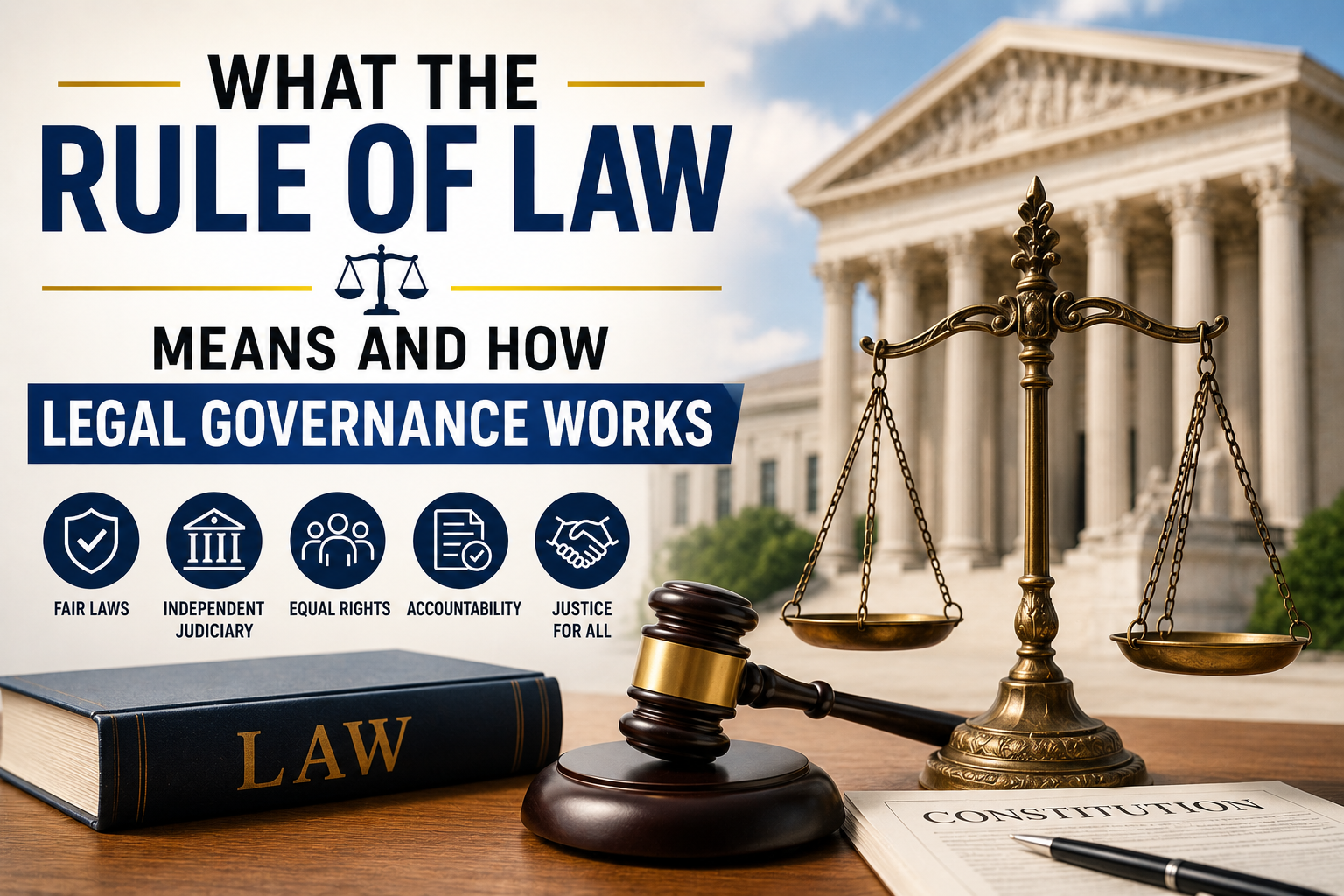
The Rule of Law
Constitutions reinforce the principle that government officials are subject to the law.
The rule of law means that public authority should be exercised according to established legal rules rather than personal preference, arbitrary decisions, or unchecked political power.
This principle applies to government leaders as well as ordinary citizens.
A president, minister, legislator, police officer, or public administrator generally does not acquire unlimited authority simply by holding office. Constitutional and statutory rules establish the boundaries within which that authority can be exercised.
The rule of law therefore turns government power from a matter of personal discretion into a matter of legally defined authority.
Judicial Review
Courts can play a particularly important role in enforcing constitutional limits.
In systems that recognize judicial review, courts may examine whether legislation or government actions are consistent with the constitution.
If a law violates a constitutional provision, a court may have authority to declare it invalid or otherwise provide a legal remedy, depending on the country’s constitutional system.
Judicial review can therefore provide an additional layer of protection when political institutions fail to respect constitutional restrictions.
However, the precise powers of courts differ considerably between countries. The strength and scope of judicial review depend on the constitutional framework and the legal system in which it operates.
Limiting Emergency Powers
Constitutions can also establish restrictions on government authority during emergencies.
Governments may need additional powers during situations such as armed conflict, natural disasters, or serious threats to public safety. At the same time, extraordinary powers can create risks if they are allowed to continue indefinitely or without oversight.
Constitutional systems may therefore establish rules concerning:
- When emergency powers can be declared
- Which government institution can declare them
- How long they can remain in effect
- Whether legislatures must approve extensions
- Which rights can or cannot be restricted
- Whether courts can review emergency measures
The purpose is to allow governments to respond to serious threats while reducing the possibility that temporary powers become permanent expansions of state authority.
Constitutional Procedures Matter
Constitutions limit government not only through the powers they prohibit but also through procedures they require.
A government may have legitimate authority to make a particular decision, but it may still be required to follow specific procedures before doing so.
For example, constitutional rules may require:
- A proposal to be introduced through a particular institution.
- A vote to meet a specified threshold.
- Public officials to provide certain information.
- A decision to receive approval from another institution.
- Affected individuals to receive legal protections.
- Courts or other oversight bodies to remain available.
Procedural requirements make government action more transparent and predictable.
They can also make it more difficult for officials to bypass established safeguards.
Constitutional Amendments Create Another Barrier
A constitution can be difficult to change by design.
If governments could easily rewrite constitutional restrictions whenever they encountered an inconvenient rule, many constitutional protections would provide little long-term protection.
Constitutions therefore often establish special amendment procedures. These may require:
- Supermajority votes
- Approval by multiple legislative chambers
- Referendums
- Approval by regional governments
- Constitutional conventions
- Other special procedures
The specific requirements vary widely.
The underlying principle is that fundamental rules governing political power should generally require a higher level of agreement to change than ordinary legislation.
Independent Institutions Strengthen Constitutional Limits
Constitutional government can also depend on institutions that operate with some degree of independence from political leaders.
These may include courts, electoral bodies, auditors, ombudsman offices, human rights institutions, legislatures, and other oversight organizations.
Their roles can differ, but they may provide mechanisms for investigating government conduct, enforcing legal requirements, resolving disputes, or ensuring that public officials remain accountable.
Constitutional text alone cannot perform these functions. Institutions must have the authority, independence, resources, and public legitimacy needed to apply constitutional principles in practice.
What Happens When Government Violates Constitutional Limits?
When government exceeds constitutional authority, the consequences depend on the country’s legal and political system.
Possible responses can include:
- Court challenges
- Invalidation of unlawful actions
- Legislative investigations
- Administrative review
- Removal proceedings
- Elections
- Public accountability mechanisms
- Constitutional complaints
- Other legal remedies
In a functioning constitutional system, these mechanisms create routes through which government decisions can be challenged.
Their effectiveness, however, depends on factors beyond the wording of the constitution. Courts must be capable of operating independently, institutions must follow the law, and citizens must have meaningful access to legal and political remedies.
Why Constitutional Limits Matter
The central purpose of constitutional limits is to prevent public power from becoming unlimited power.
Government needs authority to make laws, provide services, protect public safety, collect revenue, administer institutions, and respond to national challenges. But those powers can also affect people’s freedoms and property.
A constitution attempts to balance these competing interests.
It gives government enough authority to function while establishing boundaries intended to prevent arbitrary or abusive exercise of that authority.
This balance is one of the defining features of constitutional government.
Constitutional Limits Are Only as Strong as Their Enforcement
A written constitution can establish powerful protections, but constitutional rules do not enforce themselves.
The effectiveness of constitutional limits depends on institutions, courts, political culture, public participation, legal traditions, and respect for the rule of law.
Where institutions are strong and constitutional procedures are respected, constitutional restrictions can provide meaningful barriers against abuses of power. Where those institutions are weakened or ignored, constitutional protections may become much less effective in practice.
That is why understanding a constitution requires looking beyond the document itself. The real measure of constitutional government is not simply what the constitution promises, but how consistently those promises shape the way power is exercised.



2 Comments
Micle harison
June 7, 2019Lorem ipsum dolor sit amet, usu ut perfecto postulant deterruisset, libris causae volutpat at est, ius id modus laoreet urbanitas. Mel ei delenit dolores.
John Doe
June 7, 2019Some consultants are employed indirectly by the client via a consultancy staffing company.