
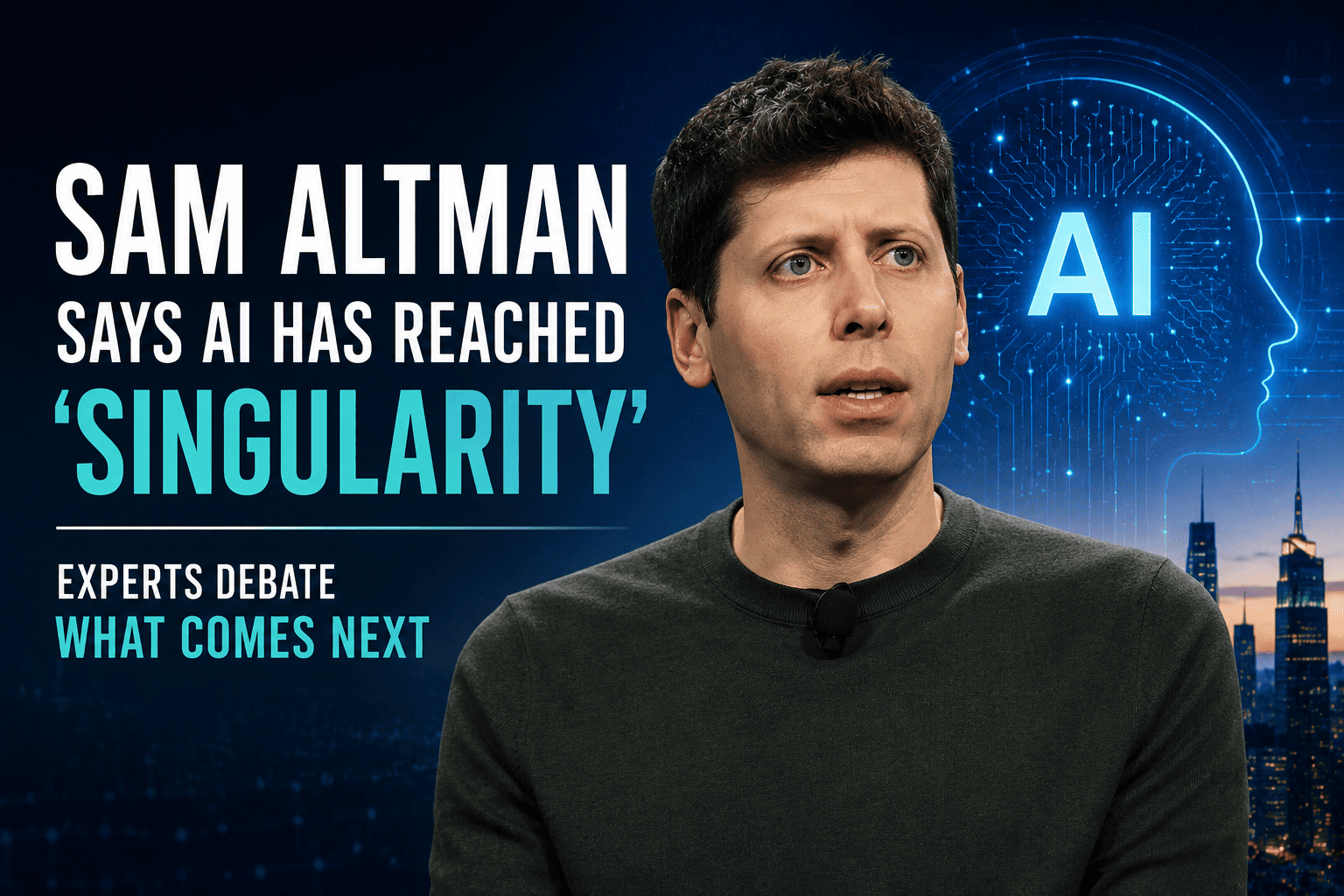
Sam Altman Says AI Has Reached “Singularity”—Experts Debate What Comes Next
For decades, the idea of the technological singularity belonged firmly in the realm of science fiction.
It was a concept explored in novels, debated by futurists, and discussed in university research papers—a hypothetical moment when artificial intelligence would surpass human intelligence and begin improving itself at a pace humans could neither predict nor control.
Now, one of the world’s most influential AI leaders believes that moment has already begun.
OpenAI CEO Sam Altman recently declared that humanity is “now in the singularity,” arguing that artificial intelligence has reached a stage once thought impossible outside science fiction. His comments, made during a podcast interview, have sparked one of the biggest debates in the technology industry this year.
Some researchers agree that AI is advancing at an unprecedented speed.
Others argue that calling today’s systems “the singularity” is premature—and risks confusing rapid progress with genuine superintelligence.
The disagreement raises one of the most important questions facing society today:
Has artificial intelligence truly crossed a historic threshold, or are we still only at the beginning of the AI revolution?
What Is the Technological Singularity?
The technological singularity is a theoretical point where artificial intelligence becomes capable of improving itself without significant human intervention.
Unlike today’s AI systems, which require researchers to design, train, and update them, a true singularity would involve AI continuously making itself smarter.
The idea suggests that once machines reach human-level intelligence, they could rapidly create even more intelligent systems.
Those systems would then build even smarter successors.
The process could accelerate beyond human understanding.
Supporters believe this could unlock extraordinary advances in:
- Medicine
- Scientific research
- Engineering
- Education
- Space exploration
- Energy production
Critics warn it could also introduce unprecedented risks if humanity loses meaningful control over increasingly capable systems.
Why Sam Altman Believes the Singularity Has Begun
Altman argues that AI has already reached a transformative stage.
Rather than focusing only on a future “explosion” of intelligence, he suggests humanity is already living through the early stages of that transformation.
His reasoning centers on several developments.
AI Is Improving Extremely Quickly
Every generation of AI models has demonstrated significant improvements in:
- Reasoning
- Coding
- Writing
- Image generation
- Scientific assistance
- Problem-solving
Tasks that required specialized software only a few years ago can now often be completed through natural language conversations.
AI Is Helping Build Better AI
Modern AI systems increasingly assist researchers by:
- Writing software
- Identifying programming errors
- Summarizing research
- Accelerating experimentation
Although humans remain firmly in control of development, AI has become an increasingly important tool for creating the next generation of AI systems.
Altman believes this marks the beginning of a self-reinforcing cycle of technological acceleration.
AI Is Becoming Part of Everyday Life
Unlike previous technological revolutions, AI adoption has been remarkably fast.
Millions of people now use AI for:
- Education
- Business
- Customer support
- Programming
- Healthcare assistance
- Creative work
The technology is no longer experimental.
It is becoming infrastructure.
Why Many Experts Disagree
Not everyone shares Altman’s conclusion.
Several prominent AI researchers argue that today’s systems remain powerful tools—but not evidence that the singularity has arrived.
According to critics, current AI still depends heavily on:
- Human-designed training
- Human-created objectives
- Massive computational resources
- Human oversight
Professor Stuart Russell, one of the world’s leading AI researchers, has argued that today’s models still lack the autonomous self-improvement typically associated with the singularity.
Other experts note that current systems cannot independently redesign themselves in a way that triggers the runaway “intelligence explosion” envisioned by classic singularity theories.
For these researchers, rapid progress should not be confused with autonomous superintelligence.
The Biggest Question: Is AI Becoming Too Powerful?
Whether or not the singularity has arrived, one fact is difficult to dispute:
Artificial intelligence is becoming dramatically more capable.
Modern AI systems can now:
- Write computer code
- Translate languages
- Analyze scientific papers
- Generate realistic images
- Assist with medical research
- Automate routine office work
Capabilities that once required specialized expertise are increasingly available through conversational interfaces.
This rapid progress has fueled both excitement and concern.
What Could Happen If the Singularity Is Real?
If Altman’s interpretation proves correct, the coming years could transform nearly every industry.
Healthcare
AI could accelerate:
- Drug discovery
- Disease diagnosis
- Personalized medicine
- Medical imaging
Researchers already use AI to identify patterns that might take humans much longer to detect.
Scientific Discovery
AI could dramatically reduce the time required to solve complex scientific problems.
Potential breakthroughs include:
- New materials
- Climate modeling
- Renewable energy
- Fusion research
Scientists may increasingly collaborate with AI systems rather than simply using them as software.
Education
Future AI tutors could provide personalized learning experiences for billions of students worldwide.
Learning may become:
- More adaptive
- More accessible
- More individualized
Business
Companies are already using AI to improve:
- Customer service
- Marketing
- Software development
- Financial analysis
- Supply chain management
If AI capabilities continue expanding, productivity gains could reshape global economic growth.
The Job Market Debate
Perhaps the most immediate concern involves employment.
Altman has repeatedly acknowledged that AI could automate a significant portion of today’s work while also creating entirely new industries.
He argues that the transition could resemble previous technological revolutions—but unfold much more quickly.
Some economists believe AI will primarily change jobs rather than eliminate them.
Others warn that white-collar professions could experience disruption on a scale not seen during earlier waves of automation.
Likely changes include:
- Greater demand for AI literacy
- New technology-related careers
- Increased workplace automation
- Shifting skill requirements
The challenge for governments and businesses will be preparing workers for that transition.
Regulation Is Becoming More Urgent
As AI capabilities grow, pressure for effective regulation is increasing.
Technology leaders broadly agree that governance matters, even if they differ on how it should work.
Questions policymakers now face include:
- How should advanced AI systems be tested?
- Who is responsible when AI makes harmful decisions?
- How can innovation continue while reducing risks?
- Should international standards govern powerful AI models?
Leaders across the AI industry—including those outside OpenAI—have argued that society has only a limited window to establish effective safeguards before systems become even more capable.
The Race Between Technology and Policy
AI development is advancing at extraordinary speed.
Public policy, however, traditionally moves much more slowly.
This creates a growing challenge.
Technology companies continue releasing increasingly capable systems while governments around the world are still developing regulatory frameworks.
The result is a race between innovation and governance.
Many experts believe the decisions made over the next few years could shape how AI affects humanity for decades.
Why the Debate Matters
Whether or not we have reached the singularity, the discussion reflects a deeper reality:
Artificial intelligence is no longer a niche technology.
It is becoming a foundational technology comparable to:
- Electricity
- The internet
- Smartphones
- Cloud computing
Businesses, governments, educators, and individuals are already adapting.
The debate is therefore not simply academic.
It concerns:
- Economic competitiveness
- National security
- Scientific leadership
- Human productivity
- The future of work
A Future Filled With Opportunity—and Uncertainty
Optimists see AI unlocking solutions to humanity’s biggest challenges.
Imagine systems capable of:
- Discovering new medicines
- Designing clean energy technologies
- Predicting natural disasters
- Accelerating scientific breakthroughs
Skeptics, however, caution that concentrating too much power in a handful of AI companies—or deploying systems faster than society can understand them—could create serious risks.
The future may ultimately depend less on whether the singularity has already arrived and more on how humanity chooses to govern increasingly powerful technologies.
Final Thoughts
Sam Altman’s declaration that humanity has entered the AI singularity has reignited one of technology’s oldest—and most important—debates.
Supporters see today’s AI systems as the beginning of an era of unprecedented innovation.
Critics argue that while AI is advancing rapidly, it still falls well short of the autonomous superintelligence traditionally associated with the singularity.
What is beyond dispute is that artificial intelligence is reshaping business, science, education, healthcare, and everyday life at a remarkable pace.
Whether history remembers this moment as the true beginning of the singularity or simply another milestone on the road toward more advanced AI, one thing is increasingly clear:
The conversation is no longer about whether AI will change the world.
It is about how quickly—and how responsibly—that transformation will unfold.



2 Comments
Micle harison
June 7, 2019Lorem ipsum dolor sit amet, usu ut perfecto postulant deterruisset, libris causae volutpat at est, ius id modus laoreet urbanitas. Mel ei delenit dolores.
John Doe
June 7, 2019Some consultants are employed indirectly by the client via a consultancy staffing company.