
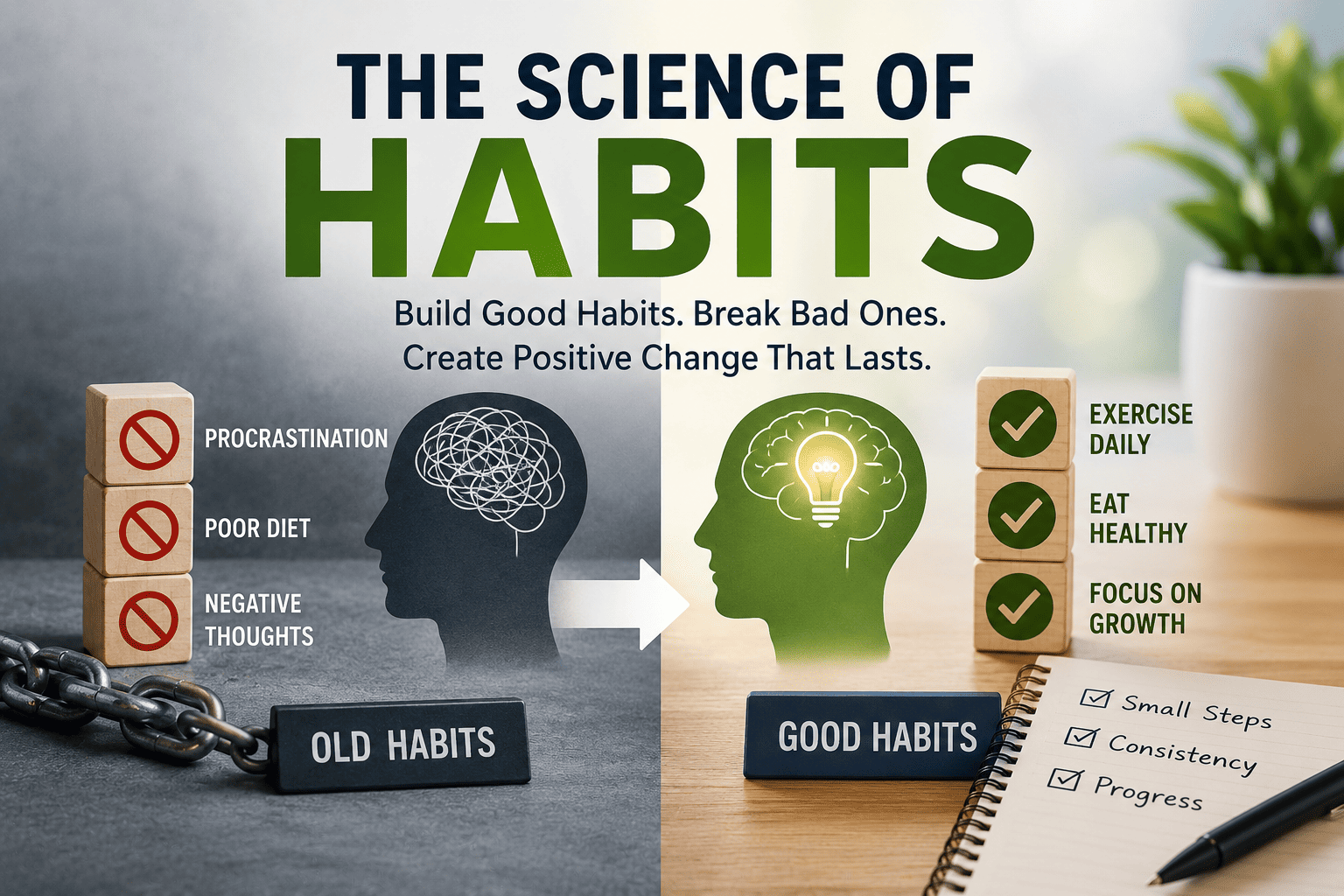
The Science of Habits: How to Build Good Habits, Break Bad Ones, and Make Positive Changes That Last
Every January, millions of people make promises to themselves. They’ll exercise more, eat healthier, save money, read more books, or finally quit smoking. Yet by February, many of those resolutions have quietly disappeared.
Why?
It’s rarely because people lack motivation or intelligence.
The real reason is much more interesting—and much more hopeful.
Human behavior is largely driven by habits, not conscious decisions. Research suggests that a significant portion of our daily actions happen automatically, with little deliberate thought. From brushing your teeth in the morning to checking your phone before bed, much of what you do each day follows patterns your brain has built over time.
The good news is that habits aren’t fixed.
Modern neuroscience and psychology show that habits can be created, strengthened, weakened, and even replaced. Understanding how habits work gives you the tools to make lasting positive changes in nearly every area of life—from health and productivity to relationships and financial success.
In this guide, we’ll explore the science behind habit formation, why breaking bad habits is so difficult, and practical, research-backed strategies for building routines that truly last.
What Is a Habit?
A habit is a behavior that becomes automatic through repetition.
When you perform the same action repeatedly in a similar situation, your brain gradually requires less conscious effort to complete it.
Eventually, the behavior feels almost effortless.
Habits can be:
-
Positive
- Exercising regularly
- Reading every evening
- Drinking enough water
- Saving money
-
Negative
- Procrastinating
- Smoking
- Excessive social media use
- Overeating
- Nail biting
The brain treats both types similarly.
It simply learns patterns that save mental energy.
Why Your Brain Loves Habits
Your brain is designed for efficiency.
Every day, it processes enormous amounts of information.
If every decision required deep thinking, even simple tasks would become exhausting.
Habits solve this problem.
Once a behavior becomes familiar, the brain transfers much of its control from conscious decision-making areas to regions involved in automatic behavior, particularly the basal ganglia.
This allows you to perform routine activities while conserving mental energy for new challenges.
In other words:
Habits are the brain’s way of putting repeated behaviors on autopilot.
The Habit Loop Explained
One of the most influential models in behavioral psychology is the Habit Loop.
According to this framework, every habit consists of three parts:
1. Cue
A trigger tells your brain to begin the behavior.
Examples include:
- Waking up
- Feeling stressed
- Hearing a notification
- Walking into the kitchen
- Seeing your running shoes
2. Routine
This is the behavior itself.
Examples include:
- Going for a run
- Eating a snack
- Checking your phone
- Brushing your teeth
3. Reward
The reward teaches your brain that the habit is worth repeating.
Rewards may include:
- Feeling relaxed
- Satisfaction
- Reduced stress
- Pleasure
- Achievement
- Social connection
Over time, your brain begins craving the reward whenever the cue appears.
That expectation strengthens the habit.
Why Good Habits Feel Difficult at First
When beginning a new habit, the brain hasn’t yet built efficient neural pathways.
Everything requires conscious effort.
Think about learning to drive a car.
Initially, every action feels complicated.
Months later, many experienced drivers complete familiar routes almost automatically.
Habits develop through the same process.
Repeated actions strengthen connections between neurons.
Eventually, the behavior becomes increasingly automatic.
Consistency matters far more than intensity.
Why Bad Habits Are So Hard to Break
Many bad habits survive because they satisfy an immediate need.
Examples include:
| Habit | Immediate Reward |
|---|---|
| Smoking | Stress relief |
| Social media scrolling | Entertainment |
| Junk food | Pleasure |
| Procrastination | Temporary relief |
| Online shopping | Excitement |
The brain values immediate rewards much more strongly than distant benefits.
That’s why eating cake today often feels more appealing than improving long-term health.
Behavioral scientists call this present bias.
Our brains naturally prioritize instant gratification over future rewards.
The Role of Dopamine
Many people think dopamine is the brain’s “pleasure chemical.”
In reality, dopamine plays an even more important role.
It drives motivation and anticipation.
Dopamine rises before expected rewards.
It encourages repetition.
Every time a behavior consistently produces a satisfying outcome, dopamine strengthens the likelihood that you’ll repeat it.
This process helps explain why:
- Habits become automatic.
- Addictions develop.
- Small rewards can reinforce positive behaviors.
How Long Does It Take to Build a Habit?
One of the biggest myths is that habits always take 21 days.
Scientific research tells a different story.
The time varies depending on:
- The behavior
- The individual
- The environment
- Consistency
Some simple habits develop within a few weeks.
More complex behaviors may require several months.
The key insight is this:
Missing one day rarely matters. Giving up entirely does.
Progress comes from repetition—not perfection.
Habit Stacking: Build on What Already Exists
One of the easiest ways to create a new habit is to attach it to an existing one.
This strategy is known as habit stacking.
Instead of relying on memory, you use an established routine as the trigger.
Examples:
- After brushing my teeth, I’ll floss.
- After making coffee, I’ll meditate for five minutes.
- After lunch, I’ll take a short walk.
- After turning off my alarm, I’ll drink a glass of water.
The existing habit becomes the cue for the new one.
Start Small
Many people fail because they attempt dramatic lifestyle changes overnight.
Instead of:
“I’ll exercise every day for two hours.”
Start with:
“I’ll walk for ten minutes.”
Instead of:
“I’ll read fifty books.”
Start with:
“I’ll read one page.”
Small habits feel easy.
Easy habits get repeated.
Repeated habits become lasting habits.
Design Your Environment
Your surroundings strongly influence behavior.
Rather than relying on willpower, make good habits easier.
Examples:
For healthy eating:
- Keep fruit visible.
- Store unhealthy snacks out of sight.
For reading:
- Leave a book on your bedside table.
For exercise:
- Lay out workout clothes the night before.
For productivity:
- Remove distracting apps during work hours.
The easier a habit becomes, the more likely you’ll repeat it.
Breaking Bad Habits
Eliminating a habit is often harder than replacing it.
Instead of simply stopping a behavior, identify the cue and reward.
Ask yourself:
- What triggered it?
- What need was I trying to satisfy?
Then replace the routine.
Example:
Cue: Feeling stressed.
Old routine: Eat junk food.
New routine: Take a short walk.
The reward—stress relief—remains.
Only the behavior changes.
Why Identity Matters
Perhaps the most powerful habit strategy involves changing how you see yourself.
Instead of saying:
“I want to run.”
Say:
“I’m becoming someone who exercises regularly.”
Instead of:
“I want to save money.”
Say:
“I’m someone who manages money wisely.”
People naturally behave in ways that match their identity.
Every repeated action becomes evidence supporting that identity.
Common Mistakes That Prevent Habit Formation
Many people unknowingly sabotage their own progress.
Common mistakes include:
Setting Unrealistic Goals
Starting too big often leads to burnout.
Depending on Motivation
Motivation changes daily.
Systems and routines last much longer.
Trying to Change Everything at Once
Focus on one or two habits before adding more.
Expecting Perfection
Missing one workout doesn’t ruin progress.
Consistency over months matters far more than isolated mistakes.
Ignoring Triggers
Habits rarely occur randomly.
Understanding your cues helps you control them.
Real-Life Examples of Powerful Habits
Some of the world’s highest performers rely on consistent routines rather than extraordinary bursts of motivation.
Examples include:
- Reading daily
- Exercising regularly
- Planning tomorrow before sleeping
- Prioritizing sleep
- Journaling
- Practicing gratitude
- Limiting distractions
- Continuous learning
Individually, these actions appear small.
Collectively, they produce remarkable long-term results.
The Compound Effect of Small Habits
One healthy meal won’t transform your body.
One workout won’t make you fit.
One chapter won’t make you an expert.
But repeated consistently, these small actions accumulate.
Like compound interest in finance, habits grow over time.
Tiny improvements repeated daily often outperform dramatic changes that last only briefly.
Frequently Asked Questions
Can anyone change their habits?
Yes.
Although change can be challenging, research consistently shows that habits remain adaptable throughout life.
Why do I keep returning to old habits?
Old neural pathways don’t disappear immediately.
Stress, fatigue, or environmental triggers often reactivate familiar behaviors.
Is willpower enough?
No.
Willpower helps initially, but successful habits usually depend on systems, routines, and supportive environments.
What’s the best first habit to build?
Choose something so small that failure feels almost impossible.
Consistency is more important than ambition.
Final Thoughts
Habits quietly shape nearly every aspect of our lives.
They influence our health, careers, finances, relationships, and overall happiness—often without us realizing it.
The encouraging news is that lasting change doesn’t require extraordinary motivation or perfect discipline.
It begins with understanding how your brain works.
By recognizing the habit loop, designing supportive environments, starting with small, manageable actions, and focusing on consistent repetition instead of perfection, anyone can reshape daily routines over time.
Every healthy meal, every short walk, every page read, every mindful decision is a vote for the person you want to become.
The science is clear:
Big transformations rarely happen overnight. They happen through small habits repeated every day until they become part of who you are.



2 Comments
Micle harison
June 7, 2019Lorem ipsum dolor sit amet, usu ut perfecto postulant deterruisset, libris causae volutpat at est, ius id modus laoreet urbanitas. Mel ei delenit dolores.
John Doe
June 7, 2019Some consultants are employed indirectly by the client via a consultancy staffing company.