
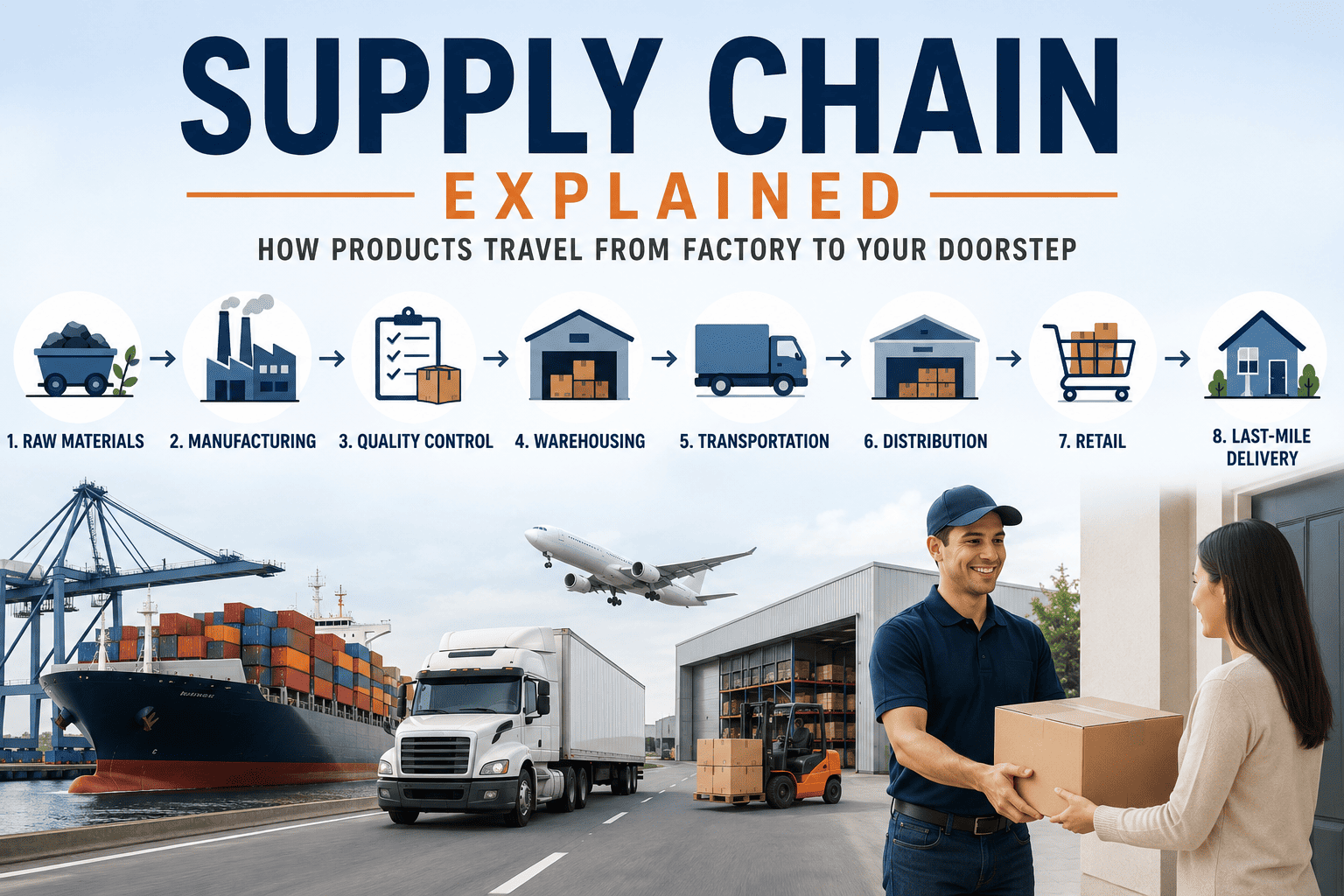
Supply Chain Explained: How Products Travel from Factory to Your Doorstep
You click “Buy Now” on an online store. A few days later, a package arrives at your doorstep. It feels almost effortless. But behind that simple delivery is one of the most complex systems ever created—a global supply chain involving factories, warehouses, ships, trucks, airplanes, software, and millions of people working together.
Every product we use, from smartphones and sneakers to groceries and furniture, travels through a carefully coordinated journey before reaching consumers.
Most people only see the beginning and the end.
They buy a product.
It arrives.
Everything in between remains largely invisible.
Yet modern supply chains are responsible for moving trillions of dollars worth of goods across continents every year, powering the global economy and making everyday life possible.
Recent events—including the COVID-19 pandemic, shipping delays, geopolitical conflicts, and inflation—have also revealed how fragile these systems can be.
When supply chains break down, entire industries feel the impact.
Store shelves empty.
Prices rise.
Manufacturers pause production.
Consumers wait longer for deliveries.
Understanding how supply chains work has never been more important.
Whether you’re a business owner, student, investor, or curious shopper, knowing how products move around the world provides valuable insight into the modern economy.
What Is a Supply Chain?
A supply chain is the network of people, companies, technologies, and transportation systems involved in creating and delivering a product from raw materials to the final customer.
Rather than being a single company, a supply chain is a connected ecosystem.
It typically includes:
- Raw material suppliers
- Manufacturers
- Warehouses
- Distribution centers
- Shipping companies
- Retailers
- Delivery providers
- Consumers
Every step depends on the one before it.
If one link fails, the entire chain can be affected.
Why Supply Chains Matter
Without supply chains, modern life would be impossible.
They make it possible to:
- Buy products from around the world
- Keep supermarkets stocked
- Deliver medicines to hospitals
- Supply factories with components
- Support online shopping
- Enable international trade
Efficient supply chains reduce costs, improve delivery speeds, and ensure businesses can meet customer demand.
When they work well, consumers rarely notice them.
When they fail, everyone does.
Step 1: Sourcing Raw Materials
Every product begins with raw materials.
Examples include:
| Product | Raw Materials |
|---|---|
| Smartphone | Lithium, copper, silicon, rare earth metals |
| T-shirt | Cotton or synthetic fibers |
| Wooden furniture | Timber |
| Bread | Wheat |
| Car | Steel, aluminum, rubber, plastics |
Companies source these materials from farms, mines, forests, and chemical producers located around the world.
The quality and availability of raw materials influence everything that follows.
Step 2: Manufacturing
Once raw materials are collected, they are transported to manufacturing facilities.
Factories transform materials into finished products through a combination of:
- Machinery
- Automation
- Skilled workers
- Robotics
- Quality control
Modern manufacturing often spans multiple countries.
For example, a smartphone may include:
- Chips made in Taiwan
- Screens produced in South Korea
- Cameras manufactured in Japan
- Batteries assembled in China
- Software developed in the United States
Global manufacturing allows companies to specialize while reducing production costs.
Step 3: Quality Control
Before products leave the factory, they undergo inspection.
Quality control helps ensure products meet required standards for:
- Safety
- Performance
- Durability
- Appearance
- Compliance with regulations
Detecting problems early prevents expensive recalls and protects customer trust.
Many manufacturers use automated inspection systems alongside human specialists to maintain consistent quality.
Step 4: Warehousing
Finished products are usually stored in warehouses before shipment.
Warehouses act as temporary storage locations that help balance supply and demand.
Modern warehouses are highly sophisticated.
Many use:
- Barcode scanning
- RFID tracking
- Robotics
- Automated sorting systems
- Artificial intelligence
Efficient warehouse management allows businesses to process thousands of orders every day with remarkable speed and accuracy.
Step 5: Transportation
Transportation is one of the most visible parts of the supply chain.
Products move using different methods depending on cost, speed, and destination.
Ships
Around 90% of global trade by volume moves by sea.
Container ships transport enormous quantities of goods between continents.
They are cost-effective but relatively slow.
Trucks
Trucks connect factories, warehouses, ports, and retail stores.
They provide flexibility for short- and medium-distance transportation.
Rail
Rail freight efficiently transports heavy goods over long distances, particularly across large countries.
Air Cargo
Air freight is the fastest but most expensive option.
It is commonly used for:
- Electronics
- Medical supplies
- Luxury goods
- Perishable products
- Urgent shipments
Businesses often choose transportation based on balancing speed and cost.
Step 6: Distribution Centers
Distribution centers differ slightly from warehouses.
Rather than storing products for long periods, they quickly organize incoming goods before sending them to retailers or customers.
Here, products are:
- Sorted
- Packed
- Grouped by destination
- Loaded for final delivery
Efficient distribution centers reduce delivery times significantly.
Step 7: Retail
Products eventually reach retailers.
These may include:
- Supermarkets
- Electronics stores
- Clothing shops
- Online marketplaces
- Specialty retailers
Retailers forecast demand to ensure shelves remain stocked without holding excessive inventory.
Finding that balance is one of retail’s biggest challenges.
Step 8: Last-Mile Delivery
The final stage is often the most expensive.
Known as last-mile delivery, this involves transporting products from distribution centers directly to customers.
Delivery methods include:
- Courier vans
- Postal services
- Motorcycles
- Bicycles
- Pickup lockers
- Drones (in limited trials)
Although the shortest part of the journey, last-mile delivery can account for a significant share of total shipping costs.
Technology Is Transforming Supply Chains
Modern supply chains rely heavily on technology.
Artificial Intelligence
AI helps businesses:
- Predict customer demand
- Optimize delivery routes
- Detect equipment failures
- Reduce inventory shortages
Internet of Things (IoT)
Smart sensors monitor:
- Temperature
- Humidity
- Vehicle location
- Package conditions
This is especially important for food and pharmaceuticals.
Robotics
Robots increasingly handle:
- Picking products
- Packing orders
- Moving inventory
- Sorting parcels
Automation improves speed while reducing errors.
Blockchain
Some companies use blockchain technology to improve transparency and traceability throughout complex supply chains.
Consumers can sometimes track where products originated and how they moved through the supply chain.
Why Supply Chains Sometimes Fail
Even highly efficient systems face disruptions.
Common causes include:
Natural Disasters
Earthquakes, floods, hurricanes, and wildfires can interrupt production and transportation.
Pandemics
COVID-19 demonstrated how quickly factory closures and transportation restrictions can affect global commerce.
Geopolitical Conflicts
Wars, sanctions, and political instability can disrupt international trade routes and manufacturing operations.
Labor Shortages
A lack of workers in ports, trucking, or manufacturing can delay shipments.
Cyberattacks
Modern supply chains depend heavily on digital systems.
Cybersecurity incidents can temporarily halt operations across multiple countries.
Why Diversification Matters
Many companies previously relied heavily on a single supplier or manufacturing region.
Recent disruptions have encouraged businesses to diversify by:
- Using multiple suppliers
- Expanding regional manufacturing
- Increasing inventory
- Investing in local production
While diversification can increase costs, it also improves resilience.
Sustainability and the Future of Supply Chains
Businesses increasingly focus on making supply chains more environmentally responsible.
Common initiatives include:
- Reducing carbon emissions
- Using electric delivery vehicles
- Sustainable packaging
- Recycling materials
- Improving energy efficiency
- Ethical sourcing
Consumers increasingly expect companies to demonstrate responsible environmental and social practices.
The Rise of Supply Chain Automation
Automation is reshaping logistics faster than ever.
Emerging technologies include:
- Autonomous warehouse robots
- Self-driving delivery vehicles
- Drone deliveries
- AI-powered forecasting
- Smart inventory systems
Although human workers remain essential, technology continues improving efficiency throughout the supply chain.
What Consumers Can Learn from Supply Chains
Understanding supply chains helps explain many everyday experiences.
Why some products suddenly become expensive.
Why certain items temporarily disappear from stores.
Why international shipping times vary.
Why local manufacturing sometimes costs more.
The next time a package arrives at your door, you’ll know it likely passed through factories, warehouses, ports, trucks, distribution centers, and countless hands before reaching you.
Frequently Asked Questions
What is the difference between logistics and a supply chain?
A supply chain includes the entire process of producing and delivering goods.
Logistics focuses specifically on transporting and storing those goods efficiently.
Why did supply chains struggle during COVID-19?
Factory shutdowns, transportation restrictions, labor shortages, and sudden changes in consumer demand disrupted nearly every stage of global supply chains.
Which industries depend most on supply chains?
Virtually every industry relies on supply chains, including manufacturing, healthcare, agriculture, retail, construction, and technology.
Will AI replace supply chain workers?
AI is expected to automate repetitive tasks while creating new roles focused on managing technology, data analysis, and system optimization.
Final Thoughts
Every product tells a story long before it reaches a store shelf or your front door.
Behind every smartphone, loaf of bread, pair of shoes, or online purchase is a vast network of suppliers, manufacturers, transport companies, warehouses, retailers, and delivery services working together to keep the global economy moving.
While most supply chains operate quietly in the background, recent global disruptions have shown just how essential—and vulnerable—they can be.
As technology continues to transform logistics through artificial intelligence, automation, robotics, and smarter forecasting, supply chains are becoming faster, more efficient, and increasingly resilient.
At the same time, businesses face growing pressure to build systems that are not only profitable but also sustainable and adaptable to future challenges.
The next time a package arrives at your doorstep, remember:
Its journey likely began thousands of kilometers away, passing through countless people, technologies, and transportation networks before reaching your hands—a remarkable example of modern global cooperation in action.


2 Comments
Micle harison
June 7, 2019Lorem ipsum dolor sit amet, usu ut perfecto postulant deterruisset, libris causae volutpat at est, ius id modus laoreet urbanitas. Mel ei delenit dolores.
John Doe
June 7, 2019Some consultants are employed indirectly by the client via a consultancy staffing company.