
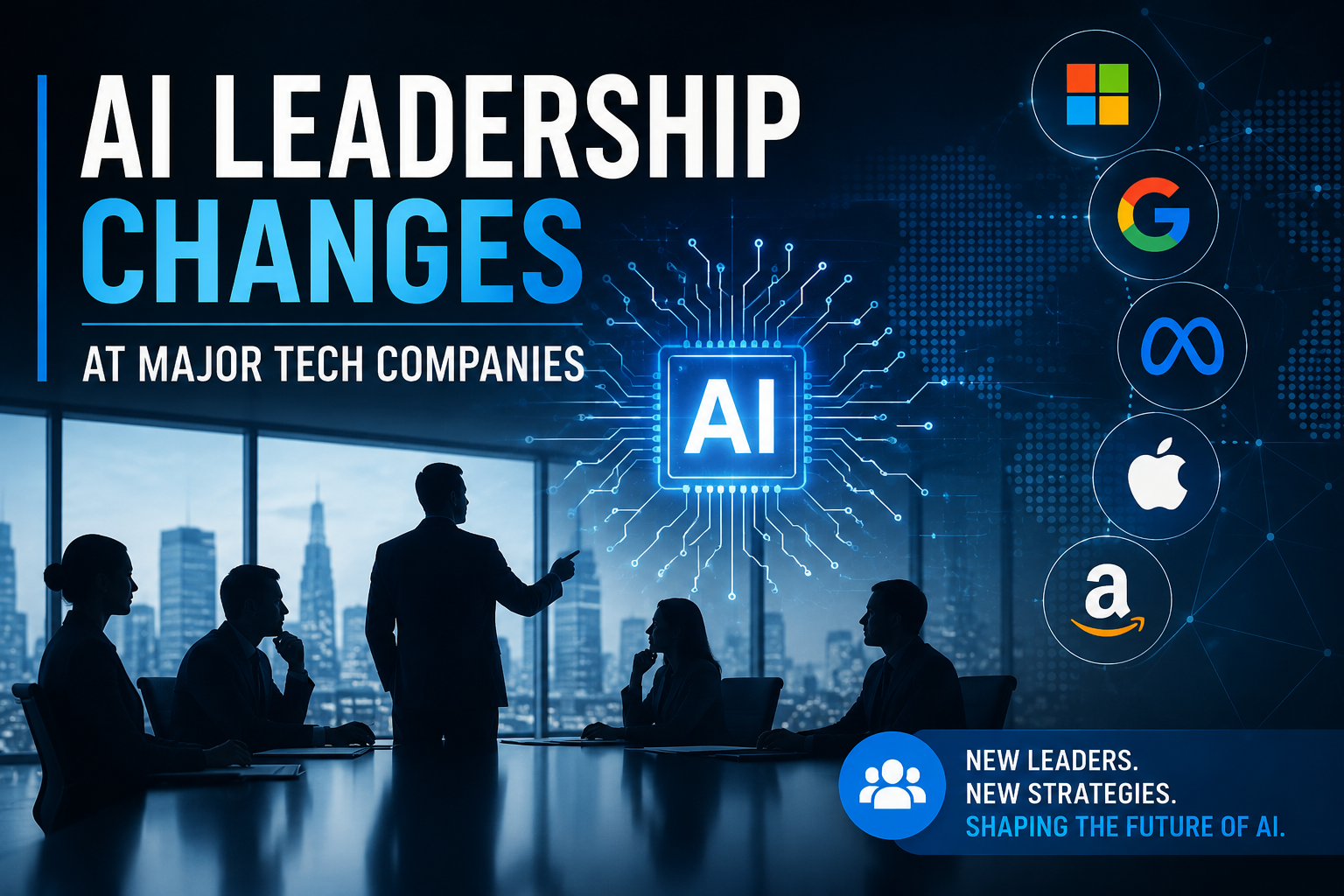
AI Leadership Changes at Major Tech Companies
Artificial intelligence has become the defining technology driving innovation across the global tech industry. As companies invest billions in AI research, infrastructure, and product development, leadership teams are evolving to meet new challenges and opportunities. Executive appointments, organizational restructurings, and the creation of dedicated AI leadership roles highlight how central artificial intelligence has become to long-term business strategy.
Rather than treating AI as a specialized research field, major technology companies are integrating it into nearly every aspect of their operations—from cloud computing and software development to cybersecurity, enterprise solutions, and consumer products. These leadership changes are shaping how companies compete in an increasingly AI-driven marketplace.
Why AI Leadership Matters
Leadership decisions play a crucial role in determining how organizations develop, deploy, and govern artificial intelligence technologies.
AI executives help guide:
- Research and development priorities
- Product innovation
- Responsible AI initiatives
- Infrastructure investments
- Talent acquisition
- Strategic partnerships
- Regulatory compliance
- Long-term business planning
Strong leadership enables companies to balance rapid innovation with responsible development while responding to changing market demands.
AI Becomes a Company-Wide Priority
Artificial intelligence is no longer confined to dedicated research teams. Many technology companies are embedding AI across their core business units to accelerate innovation and improve customer experiences.
AI capabilities are increasingly integrated into:
- Search engines
- Productivity software
- Cloud platforms
- Smartphones
- Customer service systems
- Software development tools
- Business analytics
- Smart home technologies
This shift allows organizations to bring AI-powered features to market more quickly while encouraging collaboration across departments.
The Rise of Dedicated AI Leadership Roles
As AI initiatives expand, companies are creating specialized executive positions focused entirely on artificial intelligence.
Common leadership responsibilities include:
- AI strategy
- Machine learning research
- Generative AI development
- AI infrastructure
- Enterprise AI solutions
- Responsible AI governance
- Data strategy
- Innovation management
These roles help coordinate large-scale AI projects while aligning technical development with broader business objectives.
Competition for AI Talent
The demand for AI expertise continues to grow as organizations compete for highly skilled professionals.
Companies are actively recruiting specialists in:
- Machine learning
- Large language models
- Computer vision
- Natural language processing
- Robotics
- AI infrastructure
- Data engineering
- AI security
Leadership teams play an important role in attracting top talent by fostering innovation, supporting research, and investing in long-term development.
Responsible AI Takes Center Stage
As AI systems become more capable, technology companies face increasing expectations around transparency, accountability, and ethical development.
Many organizations are strengthening policies related to:
- Data privacy
- Bias reduction
- Human oversight
- Model transparency
- AI safety
- Intellectual property
- Security
- Regulatory compliance
Leadership teams are working to ensure AI technologies remain trustworthy while meeting evolving legal and societal expectations.
Investing in AI Infrastructure
Building advanced AI systems requires enormous computing power and sophisticated infrastructure.
Technology companies continue investing in:
- Data centers
- High-performance computing
- Graphics processing units (GPUs)
- AI accelerators
- Custom AI chips
- Cloud infrastructure
- Energy-efficient computing
- Scalable networking
These investments support increasingly powerful AI models capable of handling complex tasks across industries.
AI Transforms Enterprise Technology
Businesses of all sizes are rapidly adopting AI-powered tools to improve efficiency and productivity.
Common enterprise applications include:
- Customer support automation
- Document analysis
- Software development assistance
- Marketing content generation
- Predictive analytics
- Workflow automation
- Cybersecurity monitoring
- Business intelligence
Leadership teams are prioritizing enterprise AI solutions that deliver measurable value while helping organizations adapt to changing business needs.
Regulatory Changes Influence AI Strategy
Governments around the world continue developing policies to regulate artificial intelligence.
Technology companies are preparing for evolving requirements involving:
- Consumer protection
- Data governance
- Transparency standards
- Risk management
- Copyright considerations
- AI accountability
- International compliance
- Security standards
Executives increasingly work alongside legal and policy experts to ensure AI products comply with emerging regulations while supporting continued innovation.
Challenges Facing AI Leaders
Despite rapid progress, AI leadership comes with significant challenges.
Organizations must balance:
- Fast-paced innovation
- Product reliability
- Responsible deployment
- Infrastructure costs
- Competitive pressure
- Talent shortages
- Public trust
- Regulatory uncertainty
Successfully navigating these challenges will play a major role in determining which companies lead the next generation of AI innovation.
Future of AI Leadership
Artificial intelligence is expected to remain a central focus for the technology industry for years to come.
Future leadership priorities are likely to include:
- Developing more capable AI systems
- Expanding enterprise AI adoption
- Improving AI safety
- Increasing energy efficiency
- Strengthening cybersecurity
- Supporting global AI governance
- Building responsible AI ecosystems
- Accelerating scientific research
As AI becomes increasingly integrated into everyday products and services, leadership decisions will continue influencing how businesses innovate and compete.
Final Thoughts
Leadership changes at major technology companies reflect the growing importance of artificial intelligence as a strategic business priority. By investing in experienced executives, expanding AI-focused teams, and integrating artificial intelligence across their organizations, companies are positioning themselves for the next phase of technological transformation.
As competition intensifies and regulations continue to evolve, effective AI leadership will play a critical role in balancing innovation, responsibility, and long-term growth. For businesses, consumers, and investors alike, these leadership decisions will shape the future of AI-powered technologies and their impact on everyday life.




2 Comments
Micle harison
June 7, 2019Lorem ipsum dolor sit amet, usu ut perfecto postulant deterruisset, libris causae volutpat at est, ius id modus laoreet urbanitas. Mel ei delenit dolores.
John Doe
June 7, 2019Some consultants are employed indirectly by the client via a consultancy staffing company.