
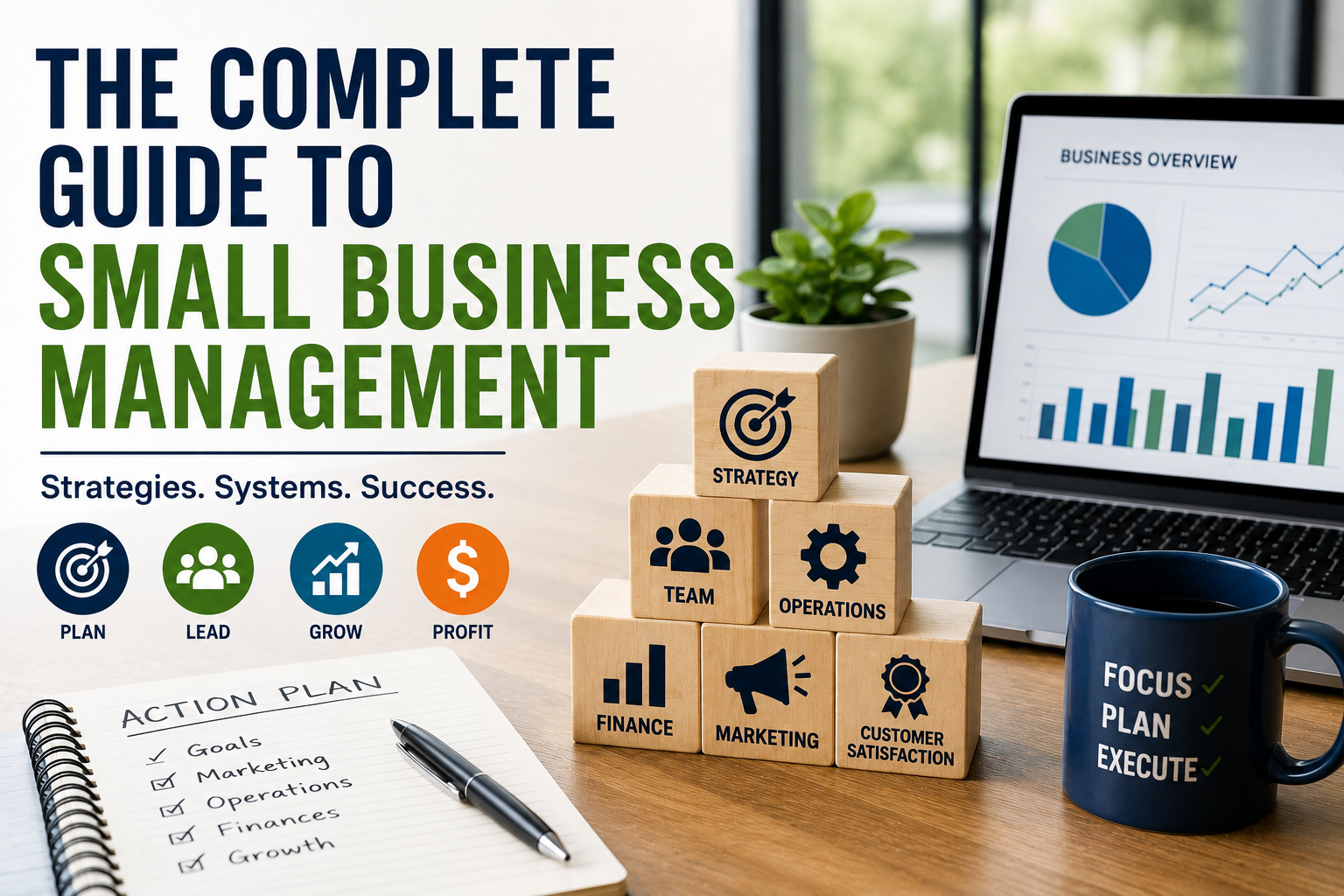
The Complete Guide to Small Business Management
Running a small business involves far more than selling a product or providing a service. Owners and managers must balance finances, employees, customers, operations, marketing, technology, and long-term planning—often while working with limited time and resources.
Effective small business management is about bringing these moving parts together so the business can operate efficiently, serve customers well, remain financially healthy, and create a foundation for sustainable growth.
What Is Small Business Management?
Small business management is the process of planning, organizing, operating, and improving a small company. It includes the day-to-day decisions that keep the business running as well as the long-term strategies that determine where it is headed.
Depending on the business, management responsibilities can include:
- Creating budgets and monitoring cash flow
- Setting prices and managing expenses
- Hiring and supervising employees
- Managing inventory and suppliers
- Serving and retaining customers
- Developing marketing strategies
- Maintaining business records
- Managing technology and business systems
- Identifying risks
- Setting growth goals
In a small company, one person may be responsible for several of these areas. That makes organization and prioritization especially important.
Why Good Management Matters
A business can have a strong product and still struggle if its operations and finances are poorly managed.
Good management helps owners understand what is working, identify problems early, and make informed decisions. It also creates consistency, which can improve both the customer experience and employee performance.
Strong management can help a small business:
- Control unnecessary costs
- Improve productivity
- Maintain healthy cash flow
- Reduce operational mistakes
- Build stronger customer relationships
- Retain valuable employees
- Respond to changing market conditions
- Make growth more manageable
The goal is not simply to keep the business busy. It is to build systems that allow the business to operate effectively and profitably.
Create a Clear Business Plan
A business plan provides a framework for how the company will operate and grow.
It does not have to be an extremely long document. What matters most is that it clearly explains the business, its customers, its competitive environment, and its financial objectives.
A useful business plan should address:
- What the business sells
Explain the products or services and the problem they solve. - Who the customers are
Define the people or organizations most likely to buy. - How the business makes money
Identify the primary revenue streams. - Who the competitors are
Understand alternative products, services, and businesses customers may consider. - How customers will be reached
Outline the primary marketing and sales channels. - What the business wants to achieve
Establish realistic short-term and long-term goals.
A business plan should also be reviewed periodically. Markets, customers, costs, and business priorities can change.
Manage Business Finances Carefully
Financial management is one of the most important responsibilities of a small business owner.
Revenue alone does not determine whether a business is financially healthy. A company can generate significant sales while still experiencing cash-flow problems if money comes in too slowly or expenses are poorly controlled.
Separate Business and Personal Finances
Maintaining separate business and personal accounts makes financial records easier to manage and provides a clearer picture of the company’s performance.
It also makes it easier to track business expenses and prepare accurate financial records.
Monitor Cash Flow
Cash flow shows how money moves into and out of the business.
Owners should regularly monitor:
- Sales revenue
- Operating expenses
- Payroll
- Supplier payments
- Loan obligations
- Taxes
- Outstanding customer invoices
- Available cash reserves
A simple cash-flow forecast can help identify periods when the business may need additional working capital.
Understand Profitability
Sales figures should always be considered alongside costs.
Important measures may include:
- Gross profit
- Net profit
- Gross margin
- Operating expenses
- Customer acquisition costs
- Average transaction value
Understanding these numbers allows owners to determine which products, services, customers, and activities are actually contributing to the business.
Build an Effective Budget
A budget provides a financial roadmap for the business.
Start by estimating expected revenue and then identifying fixed and variable expenses.
Fixed expenses may include:
- Rent
- Insurance
- Software subscriptions
- Salaries
- Loan payments
Variable expenses may include:
- Inventory
- Packaging
- Shipping
- Advertising
- Transaction fees
The budget should not be treated as a document that is created once and forgotten. Comparing actual results with budgeted figures can reveal where the business is exceeding expectations or spending more than planned.
Develop Efficient Business Operations
Operations are the processes that turn resources into products or services for customers.
Efficient operations reduce wasted time, unnecessary expenses, and avoidable errors.
Start by documenting important recurring processes. For example, a retailer might document how inventory is ordered, received, stored, and sold. A service company might document how a new customer is contacted, scheduled, served, invoiced, and followed up with.
Clear processes make it easier to:
- Train employees
- Maintain consistent quality
- Identify bottlenecks
- Reduce mistakes
- Delegate responsibilities
- Improve productivity
As the company grows, documented processes can become increasingly valuable.
Hire and Manage Employees Effectively
Employees can have a major impact on the success of a small business.
Hiring should therefore focus on more than technical qualifications. Managers should consider whether candidates can communicate effectively, solve problems, work reliably, and fit the company’s working environment.
Once employees are hired, managers should establish clear expectations.
Employees should understand:
- Their responsibilities
- Performance expectations
- Reporting relationships
- Work schedules
- Business policies
- How their work contributes to company goals
Regular feedback is also important. Waiting until an annual review to discuss performance can allow small problems to become larger ones.
Delegate Instead of Doing Everything Yourself
One of the common challenges for small business owners is trying to control every task.
Delegation allows owners to focus on activities that require their direct attention while giving employees opportunities to take responsibility.
Good candidates for delegation often include:
- Administrative tasks
- Routine customer support
- Inventory updates
- Scheduling
- Basic reporting
- Repetitive operational work
Delegation works best when the expected outcome is clear and employees have the authority and resources needed to complete the task.
Focus on Customer Experience
Customers are central to almost every small business.
A strong customer experience can encourage repeat purchases, referrals, and positive reviews.
Businesses should look at the entire customer journey, including:
- How customers discover the business
- How easily they can obtain information
- How simple the purchasing process is
- What happens after the sale
- How complaints and problems are handled
Customer feedback can provide valuable information about weaknesses that management may not notice internally.
Create a Practical Marketing Strategy
Small businesses do not necessarily need to be present on every marketing channel.
Instead, they should identify where their target customers spend time and concentrate resources there.
A marketing strategy may include:
- Search engine optimization
- Content marketing
- Email marketing
- Social media
- Local marketing
- Partnerships
- Referral programs
- Paid advertising
The most important consideration is whether a marketing activity produces meaningful business results.
Tracking leads, conversions, sales, and customer acquisition costs can help determine which channels deserve additional investment.
Use Technology Strategically
Technology can help small businesses automate repetitive work and improve access to information.
Common technology categories include:
- Accounting software
- Customer relationship management systems
- Inventory management tools
- Project management platforms
- Payroll systems
- Communication tools
- Cybersecurity software
- Data backup solutions
However, adding more software does not automatically make a business more efficient.
Every technology investment should solve a specific problem. Businesses should also consider training requirements, subscription costs, data security, and whether different systems can work together.
Protect Business Data
Small businesses increasingly depend on digital systems, which makes data protection an important management responsibility.
Basic safeguards can include:
- Strong, unique passwords
- Multi-factor authentication
- Regular software updates
- Secure backups
- Access controls
- Employee security training
- Reliable antivirus and security tools
Sensitive customer, employee, and financial information should only be accessible to people who need it for their work.
Manage Inventory Efficiently
For businesses that sell physical products, inventory management can directly affect cash flow and customer satisfaction.
Too much inventory can tie up capital and increase storage costs. Too little inventory can result in missed sales and unhappy customers.
Businesses should monitor:
- Inventory levels
- Sales velocity
- Reorder points
- Supplier lead times
- Damaged or obsolete products
- Inventory carrying costs
Accurate inventory records also make purchasing decisions easier.
Set Measurable Business Goals
A goal such as “grow the business” is too broad to guide daily decision-making.
Instead, establish measurable objectives.
For example, a business might aim to:
- Increase monthly revenue by a specific percentage
- Reduce operating expenses
- Improve customer retention
- Increase average order value
- Reduce order-processing time
- Add a specific number of customers
- Launch a new service
Goals should have clear timeframes and measurable indicators so managers can determine whether progress is being made.
Track Key Performance Indicators
Key performance indicators, or KPIs, help management understand how the business is performing.
Useful KPIs vary by industry, but may include:
| Area | Example KPI |
|---|---|
| Sales | Monthly revenue |
| Profitability | Net profit margin |
| Customers | Customer retention rate |
| Marketing | Conversion rate |
| Operations | Order fulfillment time |
| Employees | Employee turnover |
| Finance | Operating cash flow |
| Inventory | Inventory turnover |
The objective is not to track every possible number. A small set of meaningful KPIs is usually more useful than a dashboard filled with data that does not influence decisions.
Manage Business Risks
Every business faces risks.
These can include financial, operational, legal, technological, supply-chain, and reputational risks.
Risk management starts by identifying what could seriously disrupt the business.
Managers can then consider ways to reduce the impact, such as:
- Maintaining appropriate insurance
- Diversifying suppliers
- Creating backup procedures
- Protecting important data
- Maintaining financial reserves
- Documenting critical processes
- Reviewing contracts carefully
The specific risks depend heavily on the industry and business model.
Learn to Make Better Decisions
Small business management often involves making decisions with incomplete information.
A practical decision-making process can help.
Start by defining the problem clearly. Then gather the most relevant information, identify available options, consider the potential costs and benefits, and determine how the decision will be measured.
Not every decision requires extensive analysis. Routine decisions can often be handled through established processes, while major financial or strategic decisions deserve deeper consideration.
Avoid Common Small Business Management Mistakes
Several management mistakes can create unnecessary problems.
Mixing Personal and Business Money
This makes financial tracking more difficult and can obscure the company’s actual performance.
Ignoring Cash Flow
A profitable business can still face difficulties if it does not have enough cash available when bills are due.
Hiring Without Clear Roles
Employees who do not understand their responsibilities may duplicate work, miss important tasks, or become frustrated.
Failing to Document Processes
When important knowledge exists only in the owner’s head, the business can become overly dependent on one person.
Expanding Too Quickly
Rapid growth can strain cash flow, employees, inventory, and customer service.
Focusing Only on Revenue
Higher sales are not necessarily better if the additional revenue comes with disproportionately high costs.
How to Improve Small Business Management
Improvement does not have to happen all at once.
Start by identifying the areas causing the greatest problems.
For example, if cash flow is unpredictable, financial forecasting may be the first priority. If employees repeatedly make the same mistakes, documenting processes and improving training may have a greater impact.
A practical improvement cycle looks like this:
Identify → Measure → Improve → Review → Repeat
This approach allows businesses to make gradual improvements rather than attempting to redesign every part of the company simultaneously.
Building a Business That Can Grow
The best small business management systems are designed with future growth in mind.
As a company expands, informal processes that worked with a few customers may become inefficient. Owners may need clearer financial controls, better technology, additional employees, documented procedures, and stronger management structures.
The goal is to create systems that can handle increased demand without allowing costs, errors, or complexity to grow at the same rate.
A well-managed business should become less dependent on improvisation and more dependent on repeatable systems.
The Management Habits That Matter Most
Successful small business management ultimately comes down to consistent attention to a few fundamentals: understand the numbers, know the customer, build reliable processes, communicate clearly, manage people well, control risks, and make decisions based on useful information.
There is no single management formula that works for every company. A local service business, online retailer, professional practice, and manufacturing company will all have different operational requirements.
What they share is the need for disciplined management.
By building strong financial controls, efficient operations, capable teams, customer-focused systems, and measurable goals, small businesses can create a stronger foundation for profitability and sustainable growth.





2 Comments
Micle harison
June 7, 2019Lorem ipsum dolor sit amet, usu ut perfecto postulant deterruisset, libris causae volutpat at est, ius id modus laoreet urbanitas. Mel ei delenit dolores.
John Doe
June 7, 2019Some consultants are employed indirectly by the client via a consultancy staffing company.