
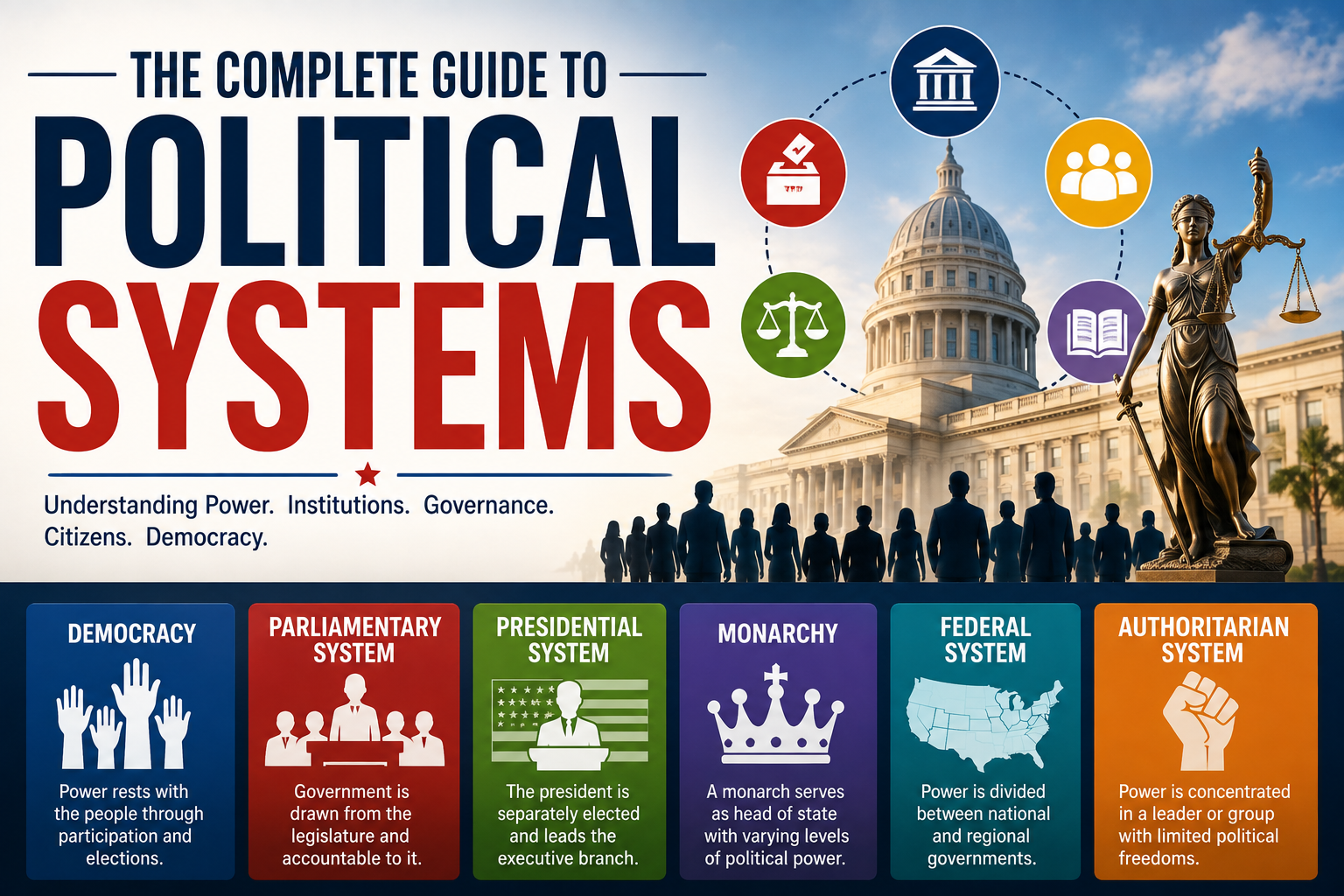
The Complete Guide to Political Systems
Political systems determine how societies organize power, make collective decisions, establish laws, and hold leaders accountable. Although countries around the world share some political institutions, they can differ significantly in how authority is distributed and how citizens participate in government.
Understanding political systems provides a useful foundation for understanding governments, elections, public institutions, political parties, and the relationship between citizens and the state.
What Is a Political System?
A political system is the framework through which political authority is organized and exercised within a society.
It includes the institutions, rules, processes, and relationships that determine:
- Who holds political power
- How leaders are selected
- How laws are created
- How government decisions are made
- How political authority is limited
- How citizens participate
- How disputes are resolved
- How governments are held accountable
Political systems can take many forms. Some emphasize direct participation by citizens, while others concentrate decision-making among elected representatives or a smaller group of political leaders.
The Main Components of Political Systems
Although political structures vary, most political systems contain several important components.
Government Institutions
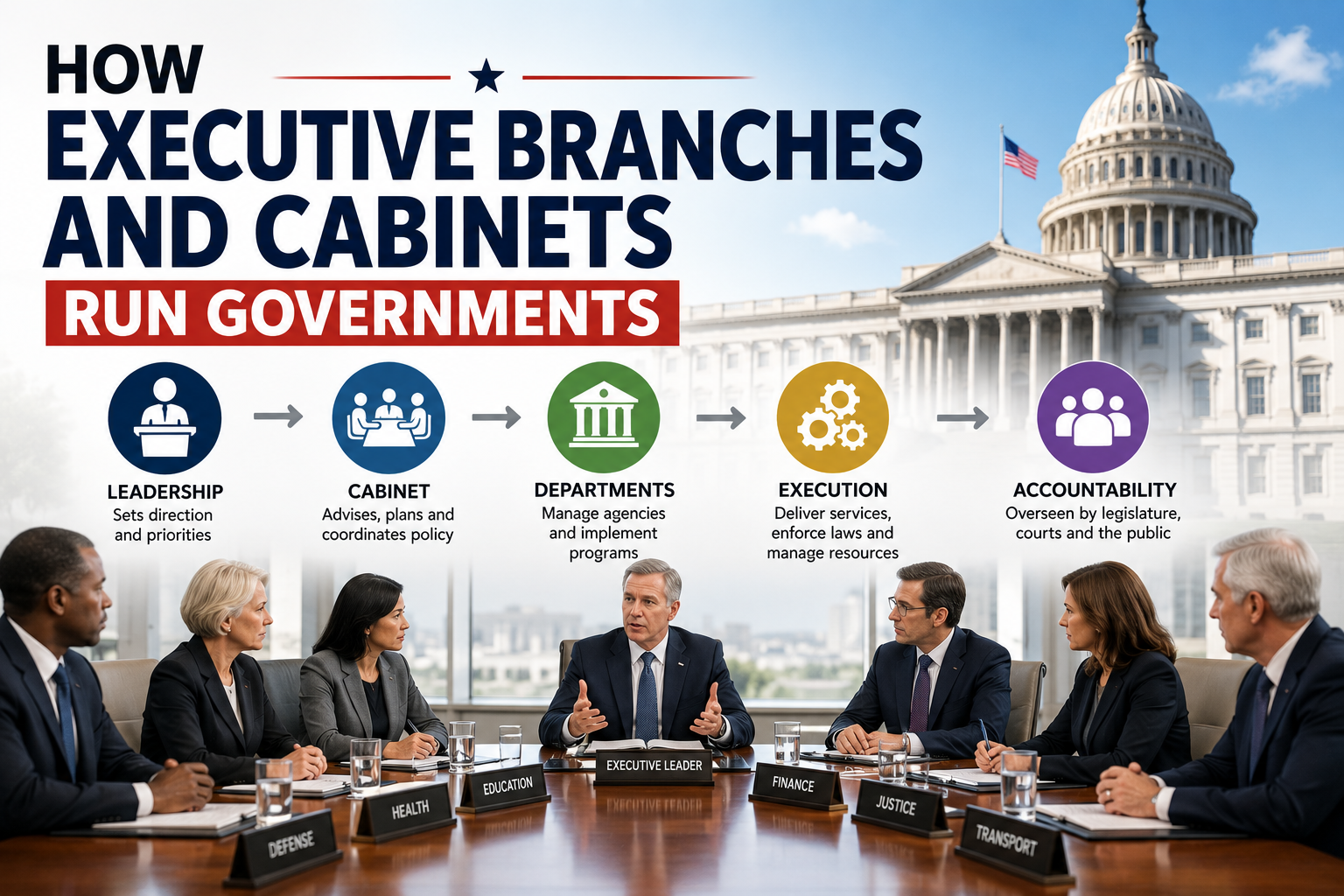
Government institutions carry out the functions of the state. These can include legislatures, executives, courts, electoral bodies, regulatory agencies, and local governments.
Each institution may have different responsibilities and powers.
Political Leadership
Political leaders make decisions on behalf of governments and political organizations. Depending on the system, leaders may be elected directly by citizens, selected by legislatures, appointed, or chosen through other constitutional processes.
Political Parties
Political parties organize people around shared political ideas and policy objectives.
They can recruit candidates, participate in elections, develop policies, represent different interests, and provide a link between citizens and government.
Citizens
Citizens are central participants in political systems, particularly in democratic societies.
Participation can include voting, joining political organizations, contacting representatives, attending public meetings, campaigning, peaceful protest, or engaging in civic discussions.
Laws and Constitutions
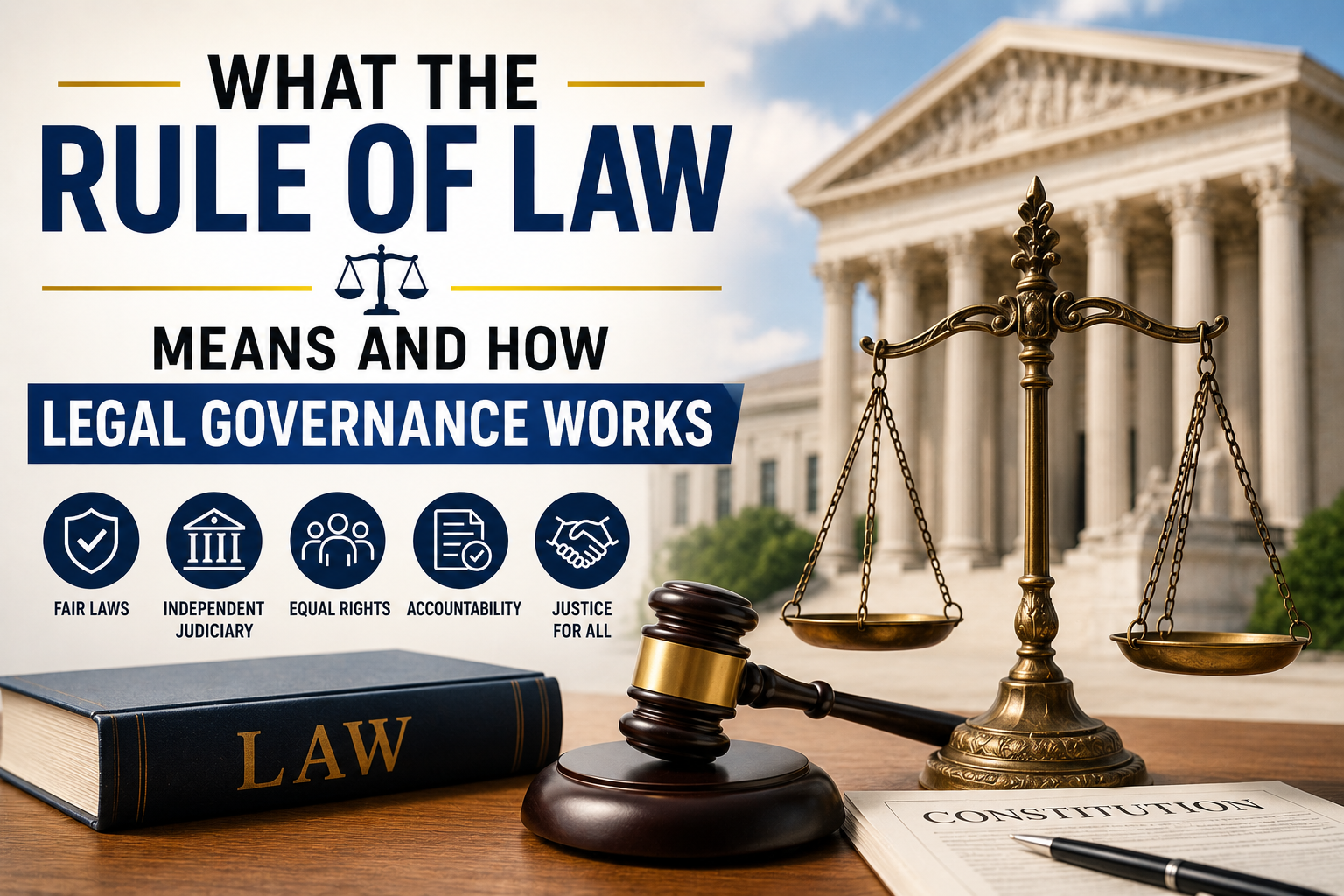
Legal frameworks establish the rules under which political institutions operate.
A constitution may define government powers, establish institutions, protect individual rights, and specify how political authority is transferred.
Democracy as a Political System
Democracy is a political system in which political authority is ultimately connected to the people.
Democratic systems generally emphasize participation, political competition, accountability, and the protection of rights.
There are several different forms of democracy.
Direct Democracy
In a direct democracy, citizens participate directly in making certain political decisions rather than relying exclusively on elected representatives.
Referendums and citizen initiatives can provide mechanisms for direct participation.
Representative Democracy
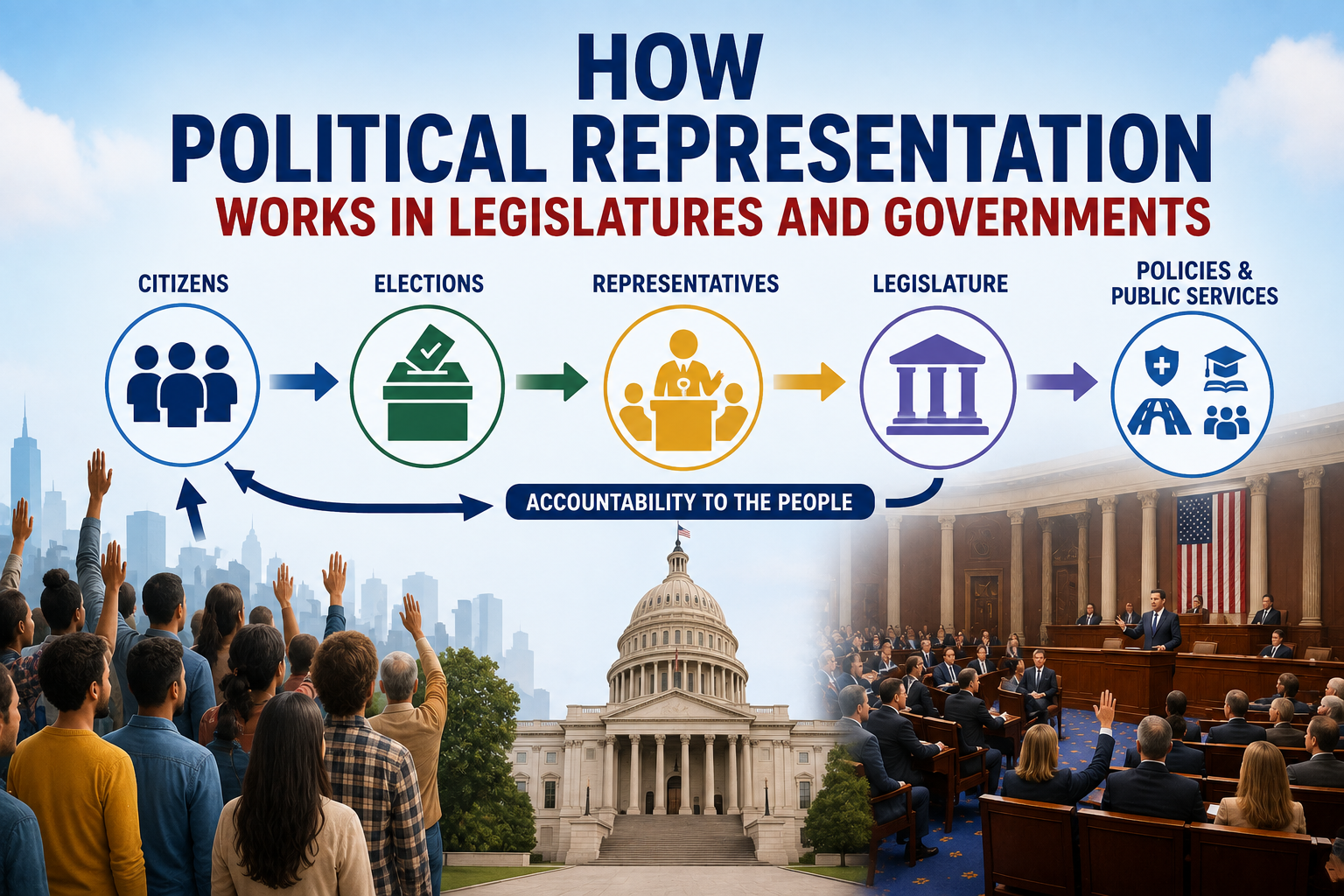
In representative democracies, citizens elect officials who make political decisions on their behalf.
This model is common because large populations cannot realistically participate directly in every government decision.
Representative democracy typically depends on competitive elections, political rights, functioning institutions, and mechanisms for holding elected officials accountable.
Parliamentary Systems
A parliamentary system organizes government around a legislature.
The executive government is generally drawn from the legislature, and the head of government is usually a prime minister.
The head of state and head of government may be different positions. For example, a country may have a president or monarch serving as head of state while a prime minister leads the government.
One characteristic of parliamentary government is the relationship between the executive and legislature. Governments normally need sufficient legislative support to remain in office.
Advantages of Parliamentary Government
Parliamentary systems can provide relatively close cooperation between the executive and legislative branches.
They may also allow governments to change when they lose legislative support without requiring a separate nationwide executive election.
Potential Challenges
Coalition governments can sometimes make decision-making more complicated. Political instability may also occur when governments repeatedly lose legislative support.
The actual experience varies significantly depending on a country’s constitution, electoral system, political culture, and party structure.
Presidential Systems
In a presidential system, the president typically serves as both head of state and head of government.
The president is generally elected separately from the legislature, although the exact method of election varies between countries.
Presidential systems often create a clearer separation between executive and legislative authority.
Potential Advantages
Separate elections can provide distinct mandates for the executive and legislature. Fixed terms can also provide continuity in executive leadership.
Potential Challenges
A president and legislature controlled by different political parties may disagree over legislation, budgets, appointments, or other policies.
This can create political gridlock when institutions have difficulty reaching agreements.
Semi-Presidential Systems
Semi-presidential systems combine elements of presidential and parliamentary government.
They generally have both a president and a prime minister, with executive responsibilities divided between them.
The exact balance of power varies considerably from one country to another.
In some systems, the president has substantial authority over foreign affairs and national security, while the prime minister manages much of domestic government. In others, the distribution of power can be different.
Constitutional Monarchy
A constitutional monarchy has a monarch as head of state while political authority is constrained by constitutional rules.
The monarch’s role can range from largely ceremonial to possessing limited formal constitutional responsibilities, depending on the country.
In many constitutional monarchies, elected institutions and governments exercise the principal day-to-day political authority.
Absolute Monarchy
An absolute monarchy concentrates significant political authority in the monarch.
The degree of authority and the institutional structure can vary between countries, but political power is generally less constrained by elected representative institutions than in constitutional monarchies.
Authoritarian Political Systems
Authoritarian systems generally concentrate political power in a leader, ruling group, military establishment, or dominant political organization.
Political competition and public participation may be more restricted than in democratic systems.
Depending on the country, restrictions can affect elections, political parties, media organizations, civil society, and public demonstrations.
Authoritarian systems can differ substantially from one another, so they should not be treated as a single identical model.
Totalitarian Systems
Totalitarianism represents an especially extensive form of political control.
Historically, totalitarian systems have attempted to exercise influence over many aspects of public and private life, often through a dominant ideology, centralized authority, extensive political control, and restrictions on independent institutions.
The concept is generally used to describe particularly comprehensive forms of authoritarian rule rather than ordinary differences between governments.
Federal and Unitary Government
Political systems can also be distinguished by how authority is distributed geographically.
Federal Systems
In a federal system, constitutional authority is divided between national and subnational governments.
States, provinces, regions, or other subnational units may have constitutionally protected responsibilities.
This allows different levels of government to exercise authority over different areas.
Unitary Systems
In a unitary system, ultimate constitutional authority generally rests with the national government.
Local and regional governments may still have substantial responsibilities, but their powers are typically established within the national legal framework.
Confederations
A confederation is an arrangement in which relatively autonomous political units cooperate through a shared institution for particular purposes.
Confederal structures generally give constituent units greater independence than federal systems.
The distinction is important because the terms federal and confederal describe different relationships between central and regional authority.
Separation of Powers
The separation of powers divides government responsibilities among different branches or institutions.
A common model separates authority among:
- Legislative institutions — create laws.
- Executive institutions — implement and administer laws.
- Judicial institutions — interpret laws and resolve legal disputes.
The purpose is to prevent excessive concentration of political authority.
Checks and Balances
Checks and balances allow different branches of government to limit or review one another.
For example, a legislature may oversee executive agencies, courts may review the legality of government actions, and executives may have certain powers concerning legislation.
The specific mechanisms vary between political systems.
Electoral Systems Matter
The way elections are conducted can significantly influence political representation.
Two broad approaches are majoritarian systems and proportional representation systems.
Majoritarian Systems
Majoritarian systems generally emphasize winning individual electoral districts or obtaining the largest share of votes under specific electoral rules.
They can encourage strong competition between major parties.
Proportional Representation
Proportional representation aims to allocate legislative seats more closely according to the proportion of votes received by political parties.
These systems can make it easier for smaller parties to gain representation, depending on the specific electoral design.
Mixed Electoral Systems
Some countries combine majoritarian and proportional mechanisms.
These systems attempt to incorporate elements of both approaches, although their outcomes depend heavily on their particular rules.
Political Rights and Civil Liberties
A political system is also shaped by the rights available to citizens and residents.
Political rights can include:
- Voting
- Running for public office
- Joining political parties
- Participating in political organizations
- Petitioning government
- Expressing political opinions
Civil liberties may include protections involving speech, assembly, association, religion, privacy, and due process.
The protection and practical enforcement of these rights are important indicators of how political institutions function.
The Role of the Constitution
Constitutions establish fundamental rules for political authority.
A constitution may define:
- Government institutions
- Legislative powers
- Executive responsibilities
- Judicial authority
- Electoral procedures
- Fundamental rights
- Procedures for changing government rules
Some constitutions are contained primarily in a single written document, while others rely on a combination of laws, conventions, judicial decisions, and established practices.
Political Systems and Accountability
Accountability is essential to functioning political institutions.
Governments can be held accountable through elections, legislative oversight, judicial review, independent auditing, investigative journalism, public scrutiny, transparency requirements, and other mechanisms.
Strong accountability systems can make it more difficult for political authority to operate without meaningful oversight.
Why Political Systems Differ
There is no single reason why countries develop different political systems.
Political institutions can be influenced by:
- Historical experiences
- Constitutional traditions
- Colonial legacies
- Social structures
- Political conflicts
- Economic conditions
- Geographic factors
- Religious and cultural traditions
- Independence movements
- Previous forms of government
Political systems can also evolve over time as societies amend constitutions, reform electoral rules, or restructure institutions.
Comparing Political Systems
Political systems should not be judged solely by their labels.
Two countries may both describe themselves as democracies, for example, while having very different electoral systems, constitutional structures, political parties, and relationships between national and regional governments.
A meaningful comparison should therefore examine several dimensions:
| Feature | Questions to Consider |
|---|---|
| Executive | Who leads the government? |
| Legislature | How are lawmakers selected? |
| Judiciary | How independent are courts? |
| Elections | How are votes translated into political power? |
| Federalism | How is authority divided geographically? |
| Political parties | How competitive is the party system? |
| Rights | What political and civil rights are protected? |
| Accountability | What mechanisms constrain government power? |
| Media | How much freedom exists for independent information? |
| Citizen participation | How can people influence government? |
Understanding Political Systems in Everyday Life
Political systems may sound like abstract constitutional concepts, but they influence everyday life.
They shape how governments create policies, collect taxes, provide public services, regulate businesses, manage infrastructure, protect rights, and respond to public concerns.
Understanding these systems can also help citizens evaluate political claims more carefully.
Rather than focusing only on individual politicians, it becomes possible to examine the institutions, rules, incentives, and processes that determine how political decisions are actually made.
The Importance of Political Literacy
Political literacy is the ability to understand political institutions, processes, ideas, and terminology.
It helps people distinguish between different forms of government and understand how political decisions move from proposals to laws and public policy.
A strong understanding of political systems can also encourage more informed civic participation. Citizens who understand how their institutions work are better positioned to evaluate political arguments, participate in elections, communicate with representatives, and engage constructively in public life.
Understanding Power Beyond Political Labels
Political systems are ultimately frameworks for organizing power.
Whether authority is exercised through a parliament, presidency, monarchy, regional governments, courts, or other institutions, the central questions remain similar: Who has power, how is that power obtained, what limits it, and how can citizens hold decision-makers accountable?
Those questions provide the foundation for understanding politics across countries and across generations. As governments evolve, the institutions and terminology may change, but the study of how political power is organized remains essential to understanding how societies govern themselves.


2 Comments
Micle harison
June 7, 2019Lorem ipsum dolor sit amet, usu ut perfecto postulant deterruisset, libris causae volutpat at est, ius id modus laoreet urbanitas. Mel ei delenit dolores.
John Doe
June 7, 2019Some consultants are employed indirectly by the client via a consultancy staffing company.