
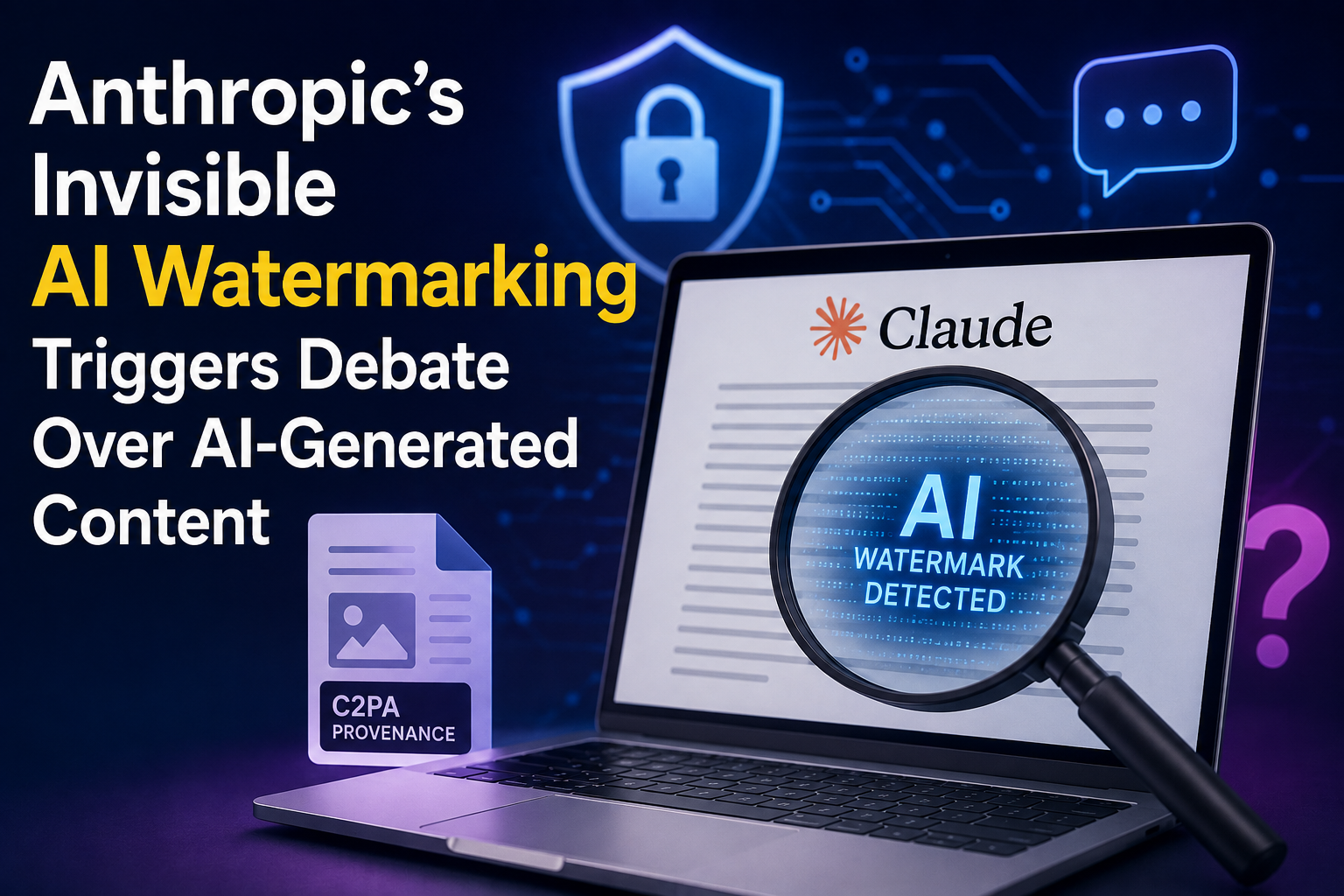
Anthropic’s Invisible AI Watermarking Triggers Debate Over AI-Generated Content
Anthropic is introducing a new way to identify content created by its Claude artificial intelligence models: invisible, machine-readable watermarks embedded into generated text, alongside provenance metadata for supported files.
The move is designed to make AI-generated material easier to identify without adding visible labels to every piece of content. But it is also raising difficult questions about authorship, privacy, AI detection, creative freedom and whether a watermark can remain reliable once AI-generated material is edited or passed through other tools.
The announcement arrives at a significant moment for the AI industry. The European Union’s AI Act transparency rules became applicable on August 2, 2026, requiring providers of generative AI systems to ensure synthetic content can be identified through machine-readable marking, subject to the law’s scope and exceptions.
What Anthropic Is Actually Watermarking
Anthropic’s approach involves two related mechanisms.
For text, the company says Claude outputs can contain an imperceptible watermark woven into the generated language itself. The watermark is intended to survive ordinary actions such as copying and pasting and some forms of editing.
For supported images and other files, Anthropic is using digitally signed provenance metadata based on the C2PA standard, which is designed to provide information about the origin and history of digital content.
The important distinction is that this is not simply a hidden file property that a user can see by opening a document’s information panel.
The text watermark is intended to be part of the generated output itself.
How the Two Systems Differ
| Content | Anthropic’s approach | Main purpose |
|---|---|---|
| Text | Imperceptible watermark | Identify Claude-generated text |
| Images/files | C2PA provenance metadata | Establish content origin |
| Human-visible label | Not necessarily present | Preserve normal user experience |
| Detection | Specialized detection tools | Verify provenance |
Anthropic says watermarking happens at the model level, meaning the signal can follow content regardless of whether Claude is accessed directly or through supported integrations such as APIs and cloud platforms.
Why Anthropic Is Doing This Now
The timing is closely connected to the growing push for AI transparency.
Under Article 50 of the EU AI Act, providers of AI systems that generate synthetic text, images, video or audio are required to mark outputs in a machine-readable format and make them detectable as artificially generated or manipulated, where the requirements apply. The EU says these measures are intended to address risks including deception and manipulation.
The European Commission’s transparency guidance specifically identifies text, images and video/audio as forms of synthetic content that can fall within the marking framework.
That means AI companies are increasingly being pushed toward a system in which content carries information about how it was produced.
Anthropic’s announcement is therefore not happening in isolation. Google has its own SynthID technology, which embeds imperceptible signals into AI-generated images, audio, video and text.
OpenAI has also expanded its approach to content provenance through technologies including C2PA Content Credentials and SynthID for certain generated media.
The broader industry appears to be moving toward a future where content provenance becomes part of the digital infrastructure rather than an optional disclosure added after publication.
What an Invisible Text Watermark Means
A traditional watermark is obvious.
A photographer might place a logo over an image. A publisher might stamp “COPY” across a document. A stock-photo company might visibly mark an image until it has been licensed.
An AI watermark works differently.
The goal is to make the signal imperceptible to the person reading the text while allowing an authorized system to detect it.
That creates an interesting separation between:
Human experience:
The text looks normal.
Machine verification:
A detector can potentially determine that the text contains a Claude-generated signal.
This is similar in principle to Google’s SynthID approach, which Google describes as embedding digital watermarks that humans cannot perceive but its technology can detect.
Can People Tell That Claude Text Has Been Watermarked?
Not simply by looking at it.
Anthropic’s system is specifically intended to avoid a visible marker that changes the appearance of ordinary text. The company says the watermark does not change the meaning, readability or visible presentation of the output.
That distinction matters because a visible label would make disclosure straightforward but could also make the technology much less useful for certain verification purposes.
An invisible marker allows a person to ask a different question:
Was this content generated by a particular AI system?
rather than relying on the subjective appearance of the writing.
Will the Watermark Survive Copying and Editing?
This is one of the most important unanswered questions.
Anthropic says its text watermark is designed to survive ordinary copy-and-paste behavior and some editing. However, reporting on the announcement also notes that more substantial transformations, including heavy paraphrasing or translation, can make the watermark harder or impossible to detect.
That creates an important limitation.
Imagine a user generates 1,000 words with Claude and then:
- Copies the text into a document.
- Changes a few sentences.
- Corrects spelling.
- Rearranges paragraphs.
The watermark may remain detectable.
But if the user substantially rewrites the article, translates it into another language and then rewrites it again, detection could become much more difficult.
This means watermarking should not be confused with a perfect AI detector.
A Watermark Does Not Prove That Something Is True
This may be the most important distinction for readers.
A watermark can potentially answer:
Did this content originate from an AI system?
It cannot answer:
Is this content accurate?
Those are completely different questions.
An AI-generated article could contain accurate information.
A human-written article could contain false information.
A Claude-generated research summary could be carefully fact-checked and accurate, while an entirely human-authored social-media post could spread misinformation.
Academic research has raised similar concerns about treating AI labeling as a proxy for truthfulness. A recent paper examining watermarking and AI-generated-content labels argues that provenance mechanisms identify model origin but do not themselves establish whether a piece of information is truthful or deceptive.
That distinction will become increasingly important as platforms experiment with automated AI labels.
Could AI Watermarks Affect Writers?
This is where the debate becomes more complicated.
AI tools are now used for far more than fully automated articles.
A writer might use Claude to:
- Brainstorm headlines
- Generate research questions
- Summarize notes
- Rewrite awkward sentences
- Translate material
- Create an outline
- Improve grammar
- Generate alternative wording
- Draft a first version
- Analyze large amounts of information
In many of these situations, the final product may involve substantial human work.
So what exactly does an AI watermark mean?
Does it mean:
“This article was written by AI”?
Or:
“AI was used somewhere during the creation process”?
Those statements are not equivalent.
A provenance system can establish that AI-generated material was involved, but it may not capture the full creative process behind the finished work.
That is one reason AI transparency is increasingly becoming a question of process transparency rather than simple authorship labels.
Why Publishers and Newsrooms Are Paying Attention
The implications are particularly significant for publishing.
News organizations, magazines, blogs and academic institutions increasingly use AI-assisted workflows. At the same time, audiences want greater confidence that published information has been properly researched and reviewed.
The EU AI Act specifically addresses AI-generated text published to inform the public about matters of public interest. The rules include an important exception where AI-generated material has undergone human review or editorial control and a natural or legal person retains editorial responsibility.
That distinction reinforces an important principle:
Human editorial accountability still matters.
A watermark can tell a platform that AI was involved.
It cannot replace:
- Fact-checking
- Source verification
- Editorial judgment
- Corrections
- Attribution
- Accountability
For professional publishers, those safeguards remain essential regardless of whether an article contains AI-generated material.
Could Watermarks Create False Accusations?
Potentially, and this is another issue that will require careful handling.
Suppose a detection system identifies a Claude watermark in an article.
That does not automatically establish:
- Who used Claude
- Why Claude was used
- How much of the article came from Claude
- Whether the author substantially rewrote the material
- Whether the published version still resembles the original output
- Whether the content is misleading
A provenance signal is therefore best understood as evidence about content origin, not a complete record of authorship.
Detection systems will need to communicate uncertainty carefully, particularly in high-stakes settings such as education, employment, journalism and academic publishing.
The AI Detector Arms Race Could Get More Complicated
Watermarking could lead to a new technological contest.
AI companies develop stronger provenance systems.
Researchers study their weaknesses.
Detection companies build verification tools.
Users discover ways that transformations affect detection.
AI companies improve their systems again.
This cycle is already familiar in image watermarking research. Recent academic work has demonstrated techniques that can weaken or remove certain invisible image watermarks while maintaining visual quality.
Text presents its own challenges.
Language can be:
- Paraphrased
- Translated
- Reordered
- Summarized
- Combined with human writing
- Rewritten by another AI system
Every transformation raises questions about whether provenance signals can remain detectable without compromising the quality or flexibility of the content.
Claude Is Not the Only AI System Using Watermarking
Anthropic’s announcement is part of a much broader movement.
Google’s SynthID can embed invisible watermarks into AI-generated images, audio, video and text. The company says the technology is designed to survive a range of common modifications.
OpenAI
OpenAI has been developing a multi-layered content-provenance approach involving C2PA Content Credentials and SynthID for images created with its tools.
C2PA
The Coalition for Content Provenance and Authenticity (C2PA) provides an open technical standard for recording information about digital media’s origin and editing history. It is increasingly being adopted across the technology and media ecosystem.
The direction is therefore bigger than Claude.
The emerging question is whether the internet can develop a common provenance layer that works across AI companies, publishers, cameras, editing software, social platforms and search engines.
What This Could Mean for the Future of Online Content
The long-term impact could extend well beyond AI writing.
Imagine a future in which a browser can show provenance information for almost any piece of digital media:
Photo: Captured by a camera
Image: Edited with Photoshop
Video: AI-generated
Text: Generated by Claude
Audio: AI-generated and modified
Article: AI-assisted, human-reviewed
That would give users more context about how something was produced.
It would not necessarily tell them whether the content is trustworthy, but it could make the production process more transparent.
Google is already expanding tools intended to help users understand how online content was created and edited, including through Search, Gemini, Chrome, Pixel and Cloud.
The Biggest Debate: Transparency or Surveillance?
Supporters of AI watermarking see it as a practical transparency tool.
If synthetic content becomes indistinguishable from human-created material, provenance signals could make it easier for:
- Journalists to verify media
- Platforms to label synthetic content
- Educators to understand AI use
- Researchers to study AI-generated material
- Consumers to assess digital media
- Regulators to enforce transparency rules
Critics, however, worry about what happens when provenance systems become ubiquitous.
Questions include:
- Who controls the detection technology?
- Who gets access to the detectors?
- Can watermarks be used to profile users?
- Can employers use them to police AI-assisted work?
- Could legitimate AI assistance be unfairly stigmatized?
- What happens when a watermark is detected incorrectly?
- How should mixed human-AI content be classified?
These questions become more important as AI moves from an optional productivity tool into everyday software.
What AI Watermarking Means for Everyday Users
For most people, the immediate experience may be surprisingly uneventful.
You may generate text in Claude and see no visible difference at all.
You can still copy and paste it.
You can still edit it.
You can still use AI as part of a broader workflow.
The difference is that the underlying content may carry a machine-detectable signal.
For users working in education, journalism, publishing or other fields with disclosure requirements, however, the issue deserves more attention.
AI assistance policies can differ significantly between organizations. A watermark does not tell you whether your particular use of AI is permitted.
That remains a question of institutional policy, professional standards and applicable law.
What Businesses Should Consider
Companies using Claude or other generative AI systems should begin thinking about provenance as part of their broader content-governance strategy.
Useful questions include:
Do we disclose AI use?
Establish clear internal rules about when AI assistance should be disclosed.
Do we retain human review?
For important public-facing content, human review can provide an additional layer of quality control.
Do we track content provenance?
Organizations may benefit from keeping records of how important documents were produced and edited.
Do we understand regulatory requirements?
Businesses operating across multiple jurisdictions should monitor applicable AI-transparency requirements.
Do we distinguish assistance from automation?
Using AI to brainstorm is fundamentally different from publishing an unreviewed AI-generated report.
The Bigger Shift Is From AI Detection to Content Provenance
For years, the AI-content debate focused heavily on one question:
Can we tell whether a human or an AI wrote this?
That question may now be evolving.
A more useful future question could be:
What happened to this content from creation to publication?
That is a much broader concept.
A document could begin as AI-generated text, receive human edits, undergo fact-checking, be translated, reviewed by an editor and finally published.
A simple “AI or human?” label cannot capture that history.
Provenance systems have the potential to provide more context by recording aspects of a content item’s origin and transformation.
But the technology will only be useful if those signals are reliable, interoperable, privacy-conscious and understandable to ordinary users.
What Happens Next for Claude and AI Watermarks?
Anthropic says it is developing detection tools for users and third parties and plans to provide additional technical information about its watermarking approach. [The Verge]
That next stage may be more consequential than the initial announcement.
A watermark is useful only if there is a reliable way to detect and interpret it.
The industry will therefore be watching several questions:
- How accurate will Claude’s detector be?
- How much editing can the watermark survive?
- Can it survive translation?
- What happens when Claude text is rewritten by another AI?
- Can independent researchers verify the system?
- Will publishers and universities adopt detection tools?
- Will competing AI companies agree on interoperable standards?
- How will mixed human-AI content be classified?
The answers will help determine whether invisible watermarking becomes a genuine foundation for digital trust—or simply another layer in the continuing battle between AI generation and AI detection.
AI Content May Soon Carry a Digital Paper Trail
Anthropic’s move marks an important change in how the AI industry thinks about generated content. Instead of relying entirely on visible labels or imperfect AI detectors, companies are increasingly trying to embed provenance directly into the content-creation process.
That could make the internet more transparent, but it will not solve the deeper problem of deciding what information deserves trust.
A watermark can potentially tell us where content came from. It cannot tell us whether the content is accurate, ethical, useful or worth believing.
As Claude, Gemini and other AI systems increasingly attach machine-readable signals to what they create, the real challenge will be building an ecosystem in which provenance information helps people make better decisions without turning every piece of AI-assisted work into a simplistic judgment about its author or credibility.




2 Comments
Micle harison
June 7, 2019Lorem ipsum dolor sit amet, usu ut perfecto postulant deterruisset, libris causae volutpat at est, ius id modus laoreet urbanitas. Mel ei delenit dolores.
John Doe
June 7, 2019Some consultants are employed indirectly by the client via a consultancy staffing company.