
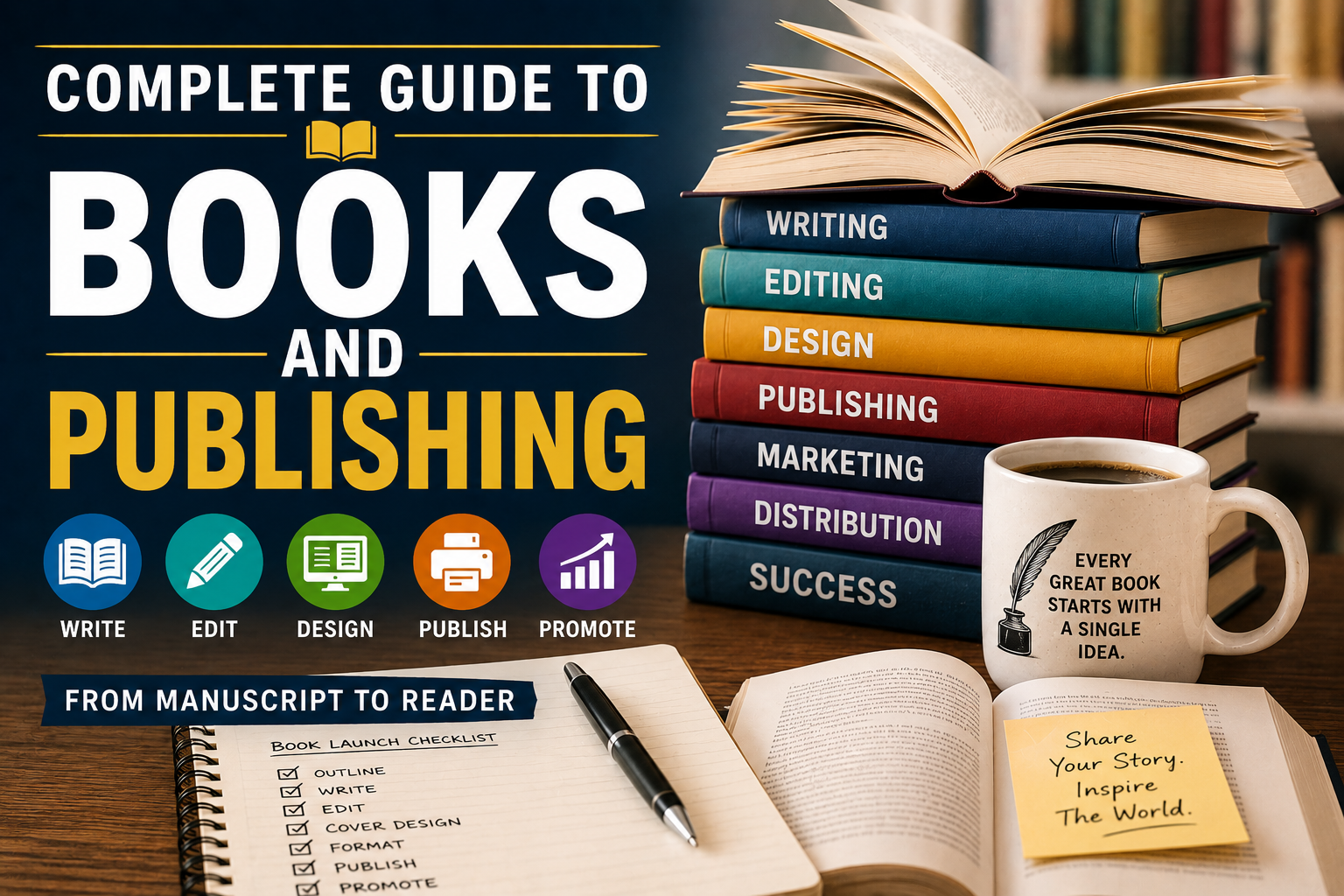
Complete Guide to Books and Publishing
Books have remained one of the most influential forms of entertainment, education and storytelling for centuries. From printed novels and biographies to audiobooks and digital editions, publishing has evolved dramatically while the basic purpose of a book remains remarkably consistent: connecting an author’s ideas with an audience.
For aspiring writers, understanding how publishing works can make the journey less confusing. For readers, knowing how books are created, edited, marketed and distributed provides a deeper appreciation of what happens before a title reaches a bookstore or digital platform.
This guide explains the different types of books, the publishing process, publishing options, editing, book marketing, distribution, royalties and the changing relationship between traditional publishing and independent authors.
What Is Publishing?
Publishing is the process of preparing, producing, distributing and promoting written or illustrated works for an audience.
A publishing process can involve:
- Writing and development
- Editing
- Fact-checking
- Design
- Formatting
- ISBN registration
- Printing
- Digital conversion
- Distribution
- Marketing
- Sales
- Rights management
The exact process depends on the type of book and the publishing route chosen by the author.
A traditionally published novel, for example, may pass through an agent, acquisitions editor, developmental editor, copy editor, designer and marketing team before reaching readers.
An independently published book may involve the author hiring individual professionals and coordinating the process themselves.
The Main Types of Books
Books come in many formats and genres, but they can broadly be divided into fiction and nonfiction.
Fiction
Fiction tells invented or imagined stories.
Common fiction categories include:
- Literary fiction
- Romance
- Mystery
- Thriller
- Science fiction
- Fantasy
- Historical fiction
- Horror
- Young adult fiction
- Children’s fiction
Fiction can range from short novels to enormous multi-volume series.
Nonfiction
Nonfiction is generally based on real people, events, information or ideas.
Examples include:
- Biographies
- Memoirs
- History
- Business books
- Self-help
- Travel books
- Cookbooks
- Academic books
- Essays
- Journalism
- Reference books
- Educational materials
Some nonfiction categories can overlap with narrative storytelling. A biography, for example, can use many techniques associated with fiction while remaining fact-based.
Print Books, Ebooks and Audiobooks
A single title can be published in several formats.
Hardcover
Hardcovers generally have rigid covers and are often positioned as premium editions.
They may appeal to collectors, gift buyers and readers who prefer physical books.
Paperback
Paperbacks are usually lighter and less expensive to produce than hardcovers.
They are widely used for novels, educational titles and general nonfiction.
Ebook
An ebook is a digital version designed for reading on devices such as:
- Smartphones
- Tablets
- E-readers
- Computers
Ebooks can be distributed globally without the physical printing and shipping required for paper copies.
Audiobook
Audiobooks turn written books into narrated audio.
They can be particularly useful for people who prefer listening while:
- Driving
- Exercising
- Commuting
- Cooking
- Traveling
A single book can therefore reach different audiences through multiple formats.
Traditional Publishing Explained
Traditional publishing involves a publishing company acquiring the rights to publish a book.
In many cases, an aspiring author first submits a manuscript or proposal to a literary agent.
The agent may then represent the author to publishers.
If a publisher decides to acquire the book, the author generally signs a publishing contract covering matters such as:
- Rights
- Royalties
- Advances
- Publication formats
- Territory
- Contract duration
- Delivery requirements
The publisher typically invests in production, distribution and some level of marketing.
The exact responsibilities vary significantly between publishers and contracts.
What Does a Literary Agent Do?
A literary agent acts as a professional representative for authors.
An agent may help with:
- Manuscript development
- Submission to publishers
- Contract negotiations
- Rights management
- Career strategy
- International rights
- Film and television opportunities
Agents can be particularly valuable in markets where major publishers generally do not accept unsolicited manuscripts.
However, not every book requires an agent.
Some publishing companies accept direct submissions, and independent publishing allows authors to bypass the traditional agent-publisher structure.
What Is an Acquisitions Editor?
An acquisitions editor or acquiring editor helps a publishing company decide which books to publish.
They may evaluate:
- Manuscript quality
- Market demand
- Author platform
- Competition
- Commercial potential
- Editorial fit
- Publishing costs
The decision is not based solely on whether the editor personally likes the book.
Publishers must consider whether they can successfully position, sell and distribute the title.
The Book Editing Process
Editing is one of the most important stages of publishing.
A strong manuscript may go through several levels of editing.
Developmental Editing
Developmental editing examines the book at a high level.
For fiction, this can involve:
- Plot
- Character development
- Pacing
- Structure
- Point of view
- Themes
For nonfiction, it may focus on:
- Organization
- Arguments
- Evidence
- Clarity
- Structure
- Audience needs
Line Editing
Line editing focuses on how the writing works sentence by sentence.
The editor may improve:
- Clarity
- Flow
- Tone
- Word choice
- Consistency
- Readability
Copy Editing
Copy editing addresses technical issues such as:
- Grammar
- Spelling
- Punctuation
- Usage
- Consistency
- Factual details
- Style requirements
Proofreading
Proofreading is generally performed after the book has been typeset or formatted.
The proofreader looks for remaining errors in the final version, including:
- Typographical mistakes
- Formatting problems
- Missing words
- Incorrect page elements
- Inconsistent headings
These stages can overlap depending on the publisher and project.
Why Book Design Matters
Readers often judge a book before reading the first page.
The cover communicates information about:
- Genre
- Tone
- Subject
- Audience
- Quality
- Positioning
A romance novel, business book and horror novel should not necessarily look the same.
The cover should therefore appeal to the intended audience while accurately representing the content.
Interior design matters too.
Typography, spacing, chapter headings, margins and illustrations all contribute to the reading experience.
How Book Formatting Works
Formatting prepares the manuscript for its intended publishing format.
A print book requires careful attention to:
- Page dimensions
- Margins
- Fonts
- Paragraph spacing
- Chapter openings
- Headers and footers
- Page numbers
- Images
- Bleed and trim requirements
Ebooks have different requirements because text may reflow depending on the reader’s device and font settings.
A book can therefore require separate preparation for print and digital editions.
What Is an ISBN?
An ISBN, or International Standard Book Number, is a unique identifier used for books and certain other publishing products.
It helps distinguish one publication from another.
Different editions and formats can have separate ISBNs.
For example, the hardcover, paperback and ebook editions of the same title may have different identifiers depending on the applicable ISBN rules.
ISBN systems are administered by national or regional agencies, so authors and publishers should obtain information from the appropriate ISBN agency for their country.
How Traditional Publishers Make Money
Publishers generally earn revenue by selling books through retailers, distributors, direct sales and other channels.
From that revenue, the publishing business must cover costs such as:
- Author royalties
- Printing
- Editing
- Design
- Distribution
- Warehousing
- Marketing
- Staff
- Returns
- Overhead
The economics can vary significantly between physical and digital books.
A book that sells thousands of copies may still have very different profitability depending on its format, pricing, production costs and distribution arrangements.
How Author Royalties Work
A royalty is compensation paid to an author based on sales or other defined uses of their work.
The calculation depends on the publishing contract.
A royalty may be calculated using:
- Retail price
- Net receipts
- Units sold
- Format
- Territory
Authors should carefully understand the definition used in their contracts.
A higher percentage does not automatically mean a better financial arrangement if the underlying calculation is different.
What Is a Publishing Advance?
Some traditional publishing contracts provide authors with an advance against royalties.
The publisher pays an amount upfront, subject to the contract.
Future royalties generally offset that advance before additional royalty payments become due.
For example, if an author receives a $10,000 advance and later earns $15,000 in royalties under the contract’s calculation, the first $10,000 is generally used to recoup the advance, with the remaining amount potentially payable to the author.
The precise mechanics depend on the contract.
An advance should therefore not simply be viewed as a bonus. It is generally an advance payment against future earnings.
What Is Self-Publishing?
Self-publishing allows an author to publish a book without transferring primary publishing control to a traditional publishing company.
The author may handle or outsource:
- Editing
- Cover design
- Formatting
- ISBN administration
- Printing
- Distribution
- Advertising
- Publicity
Self-publishing has become much more accessible because digital publishing and print-on-demand services can reduce the need for large upfront print runs.
However, accessibility does not eliminate the need for professional editing, design or marketing.
Traditional Publishing vs. Self-Publishing
| Factor | Traditional Publishing | Self-Publishing |
|---|---|---|
| Initial control | Publisher-led | Author-led |
| Editing | Usually publisher-supported | Author arranges it |
| Cover design | Usually publisher-managed | Author arranges it |
| Distribution | Publisher/distributors | Author or publishing platform |
| Upfront author cost | Usually lower | Can be significant |
| Publishing speed | Often slower | Potentially faster |
| Creative control | Shared/contractual | Usually greater |
| Marketing | Varies by publisher | Primarily author-led |
| Royalties | Contract-dependent | Platform-dependent |
| Business responsibility | Shared | Primarily author |
Neither route is automatically better.
The appropriate choice depends on the author’s goals, resources, genre and willingness to manage the publishing business.
What Is Hybrid Publishing?
The term hybrid publishing can describe arrangements that combine elements of traditional and independent publishing.
However, the term is used differently by different companies.
Some businesses operating under a “hybrid” label charge authors for publishing services.
That is fundamentally different from a traditional publisher investing its own resources in acquiring and publishing a book.
Authors should carefully examine:
- Fees
- Rights
- Royalties
- Distribution
- Contract terms
- Services included
- Ownership of intellectual property
Never assume that the word “publisher” automatically means the company operates under a traditional publishing model.
Print-on-Demand Publishing
Print on demand (POD) allows books to be printed when orders are placed rather than requiring large quantities to be printed in advance.
This can reduce:
- Inventory requirements
- Warehousing
- Upfront printing costs
- Risk of unsold stock
It can also allow independent authors to keep a book available even when sales volumes are relatively low.
The trade-off is that per-unit printing costs can be higher than those associated with very large print runs.
How Book Distribution Works
Publishing a book is only part of the process.
The book must also reach readers.
Distribution can involve:
- Bookstores
- Online retailers
- Libraries
- Schools
- Wholesalers
- Independent shops
- Direct author sales
- Subscription services
- Digital platforms
Traditional publishers often have established relationships with distributors and retailers.
Independent authors may use distribution platforms or work with specialized distributors.
What Is Book Marketing?
Book marketing is the process of making potential readers aware of a book and encouraging them to purchase or read it.
Marketing can include:
- Author websites
- Social media
- Email newsletters
- Book reviews
- Interviews
- Podcasts
- Events
- Advertising
- Public relations
- Search optimization
- Reader communities
- Promotional pricing
Marketing should begin before publication rather than waiting until the book is already available.
Building an Author Platform
An author platform is the audience, reputation and communication channels an author can use to reach readers.
It might include:
- Website
- Email list
- Social media following
- Podcast audience
- Professional network
- Speaking engagements
- Existing readership
A large platform can be particularly valuable for nonfiction authors because publishers may evaluate whether the author can help reach the target audience.
However, authors should not assume that having thousands of social-media followers automatically guarantees book sales.
The quality and relevance of the audience matter.
Book Reviews and Word of Mouth
Reader recommendations can be extremely influential.
People often discover books through:
- Friends
- Family
- Book clubs
- Review websites
- Social platforms
- Podcasts
- Libraries
- Booksellers
Authentic reviews can help potential readers decide whether a book is worth their time.
Authors should never manipulate reviews or misrepresent reader feedback.
Trust is particularly important in publishing because a reader who feels misled may avoid the author’s future work.
How Book Pricing Works
Book pricing involves balancing several considerations.
A publisher or author may consider:
- Production cost
- Distribution cost
- Comparable books
- Target audience
- Perceived value
- Format
- Author reputation
- Retailer economics
- Desired profit margin
A hardcover will generally have a different cost structure from an ebook.
Pricing can also vary by country because of currency, taxes, market conditions and distribution arrangements.
How Ebooks Changed Publishing
Ebooks dramatically changed how books could be produced and distributed.
They removed many physical constraints associated with publishing.
Digital books do not require:
- Physical warehouses
- Traditional print runs
- Shipping of individual copies
However, ebooks introduced new challenges, including:
- Digital piracy
- Platform dependence
- Pricing competition
- Discoverability
- Digital formatting
- Rapid growth in available titles
The result is a publishing environment where getting a book published can be easier than getting it discovered.
The Importance of Discoverability
One of the biggest challenges for modern authors is simply being found.
There are millions of books available across physical and digital markets.
A book therefore needs strong positioning.
Discoverability can be influenced by:
- Title
- Cover
- Description
- Category
- Keywords
- Reviews
- Author reputation
- Recommendations
- Retailer algorithms
- External marketing
The goal is not merely to make a book available.
It is to help the right readers discover it.
How to Write a Book
Writing a book starts with understanding its purpose and intended reader.
A practical process might look like this:
1. Define the Idea
What is the book about?
2. Identify the Audience
Who should read it?
3. Establish the Structure
Create an outline before writing the full manuscript.
4. Write the First Draft
Focus on getting the ideas down rather than perfecting every sentence.
5. Revise
Look at structure, pacing, logic and clarity.
6. Edit
Work through developmental, line and copy-level issues as appropriate.
7. Proofread
Check the final formatted version carefully.
8. Prepare for Publication
Complete design, formatting, metadata and distribution.
This process can take months or longer depending on the project.
How Long Should a Book Be?
There is no universal ideal length.
The appropriate length depends on genre, audience and purpose.
For example:
- Picture books may be very short.
- Novels can vary widely in length.
- Business books may be relatively concise.
- Academic works can be substantially longer.
- Reference books may contain hundreds of pages.
Writers should focus on delivering the necessary experience or information rather than artificially increasing word count.
A book should be as long as it needs to be and no longer than necessary.
Common Publishing Mistakes
Publishing Without Professional Editing
Authors sometimes believe that a few spelling checks are enough.
Structural and professional editing can identify problems the author is too close to notice.
Using an Amateur Cover
Readers often make judgments based on the cover before reading the description.
Choosing the Wrong Category
A book needs to reach readers who are actually interested in its subject or genre.
Ignoring Metadata
Book descriptions, categories, keywords and other metadata can affect discoverability.
Expecting the Publisher to Do Everything
Marketing responsibilities vary widely.
Even traditionally published authors may need to participate actively in promotion.
Spending Too Much Before Testing Demand
Independent authors should consider their financial risk before investing heavily in printing, advertising or services.
Signing a Contract Without Understanding It
Publishing contracts can contain complicated provisions concerning rights, royalties, territories, options and termination.
Professional legal advice can be worthwhile for significant agreements.
Understanding Book Rights
A publishing contract may grant a publisher certain rights to exploit the work.
These can include:
- Print rights
- Ebook rights
- Audiobook rights
- Translation rights
- International rights
- Film rights
- Television rights
- Adaptation rights
Authors should understand exactly which rights they are granting.
Not every publisher needs every possible right.
Rights management can become particularly valuable if a book succeeds internationally or attracts interest from other entertainment industries.
Translation and International Publishing
A successful book may eventually reach readers in other countries.
International publishing can involve:
- Translation rights
- Foreign publishers
- Licensing agreements
- Regional editions
- Local marketing
- Currency differences
- Territory-specific contracts
A book does not automatically become an international bestseller simply because it is available worldwide.
Language, culture, local competition and marketing all influence international performance.
Books and Film Adaptations
Some books eventually become:
- Films
- Television series
- Streaming productions
- Stage productions
- Video games
These adaptations involve separate rights and agreements.
A book’s author may retain or license adaptation rights depending on the publishing contract.
Authors should therefore pay close attention to rights clauses before signing publishing agreements.
The Future of Books and Publishing
Publishing will continue to evolve as technology changes how people create and consume content.
Digital distribution will remain important, while physical books continue to offer something digital formats cannot fully reproduce: a tangible reading experience.
Audiobooks are also expanding the ways readers consume written content.
Artificial intelligence is introducing additional questions around:
- Writing assistance
- Editing
- Translation
- Audiobook production
- Copyright
- Authorship
- Training data
- Disclosure
- Human creativity
The publishing industry will need to balance technological innovation with intellectual-property protection, reader trust and the value of human authorship.
How Readers Can Choose Better Books
Readers have more choices than ever, which makes selection increasingly important.
Consider:
- Genre or subject
- Author background
- Reviews from credible readers
- Sample chapters
- Recommendations from trusted sources
- Publisher reputation
- Publication date where relevant
For nonfiction, readers should also consider the author’s qualifications and the quality of the evidence presented.
A popular book is not automatically an authoritative one.
How Aspiring Authors Can Get Started
A first-time writer does not need to understand the entire publishing industry before writing the first chapter.
Start with:
- A clear idea.
- A defined audience.
- A realistic outline.
- A consistent writing schedule.
- A willingness to revise.
- Professional feedback.
- Research into suitable publishing options.
Once the manuscript is ready, compare traditional publishing, independent publishing and other legitimate routes before making a decision.
Avoid companies that make extravagant promises about guaranteed sales or bestseller status.
A Simple Publishing Roadmap
| Stage | Main Objective |
|---|---|
| Idea | Define the book |
| Research | Understand audience and subject |
| Outline | Build structure |
| Draft | Write the manuscript |
| Revision | Improve content |
| Editing | Refine the manuscript |
| Design | Create cover and interior |
| Formatting | Prepare print/digital files |
| Rights | Establish ownership and licensing |
| Distribution | Make the book available |
| Marketing | Reach potential readers |
| Launch | Coordinate publication |
| Evaluation | Analyze sales and reader response |
The Book Is Only the Beginning
Publishing is no longer a single path controlled entirely by a small number of publishing houses. Authors today can choose from traditional publishing, independent publishing, print-on-demand, digital distribution and combinations of these approaches.
But greater accessibility also brings greater responsibility.
Authors need to think beyond writing the manuscript. Editing, design, rights management, pricing, distribution, discoverability and audience development all influence whether a book succeeds.
For readers, the modern publishing landscape offers unprecedented choice. For writers, it offers unprecedented opportunity—but also a more competitive marketplace.
The most durable books are usually those that deliver something genuinely valuable: a compelling story, a new perspective, useful knowledge, an emotional experience or an idea worth remembering.
Technology may continue to change how books are created, distributed and consumed, but that fundamental relationship between an author and a reader is likely to remain at the heart of publishing.



2 Comments
Micle harison
June 7, 2019Lorem ipsum dolor sit amet, usu ut perfecto postulant deterruisset, libris causae volutpat at est, ius id modus laoreet urbanitas. Mel ei delenit dolores.
John Doe
June 7, 2019Some consultants are employed indirectly by the client via a consultancy staffing company.