
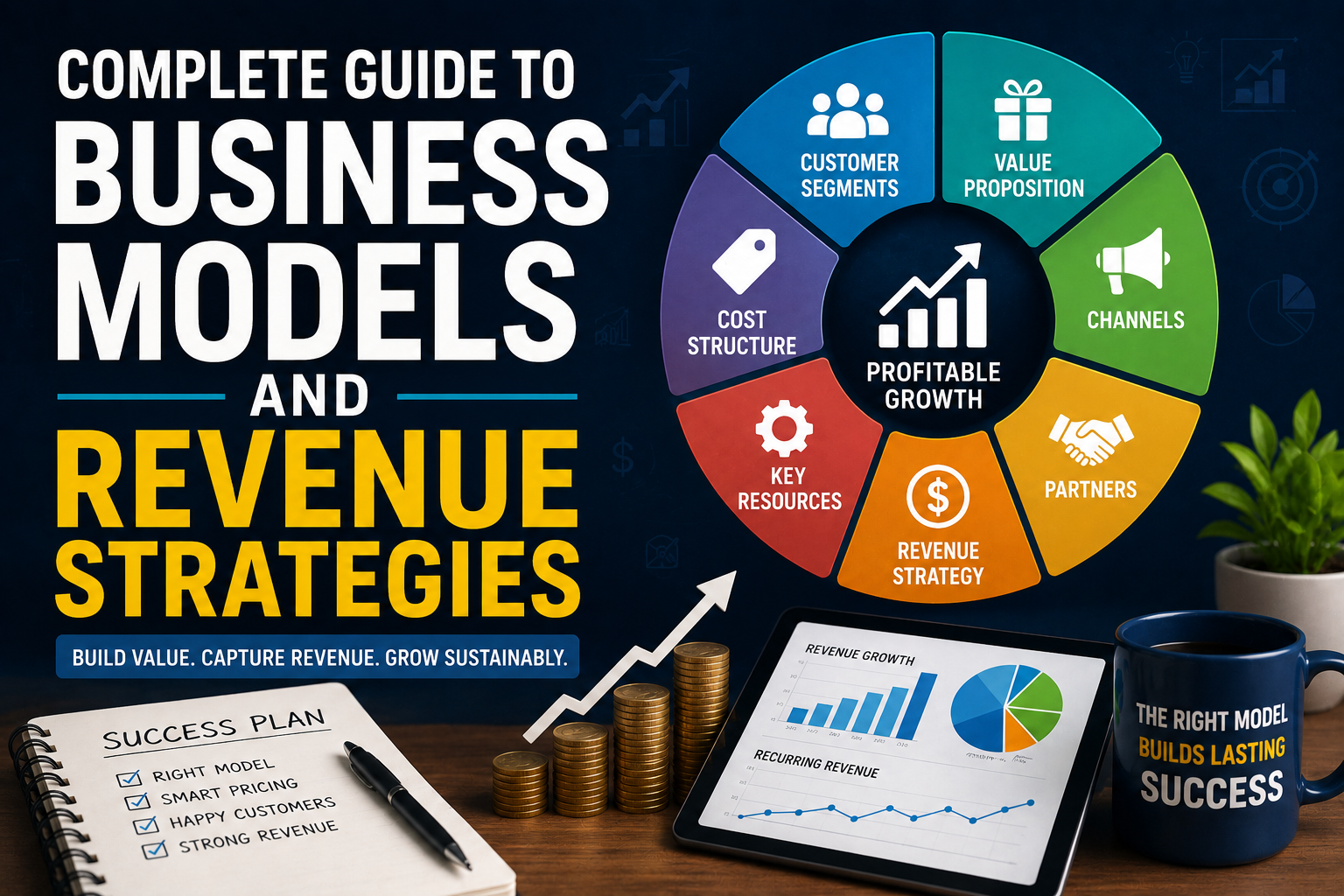
Complete Guide to Business Models and Revenue Strategies
A business can have a great product, a recognizable brand and thousands of customers—and still struggle to make money.
The difference often comes down to two related questions:
How does the business create and deliver value?
And:
How does it capture enough of that value as revenue to remain profitable?
These questions sit at the heart of a company’s business model and revenue strategy. While the terms are sometimes used interchangeably, they describe different parts of how a business works.
A business model explains the broader system through which a company creates, delivers and captures value. A revenue strategy focuses more specifically on how the company generates income from customers and other sources.
Understanding both is useful whether you’re starting a small business, launching a technology company, managing an established organization or evaluating a potential investment.
What Is a Business Model?
A business model is the overall structure a company uses to create, deliver and capture value.
It answers questions such as:
- Who are the customers?
- What problem does the business solve?
- What does it sell?
- How does it reach customers?
- What resources does it need?
- Who are its partners?
- What does it cost to operate?
- How does it make money?
A business model therefore goes beyond simply selling a product.
For example, two companies could sell similar products but have completely different business models.
One might manufacture products and sell them through physical stores. Another might manufacture through third parties and sell directly to consumers online.
The products may be similar, but their costs, distribution systems, customer relationships and revenue structures can be very different.
Business Model vs. Revenue Model
The distinction is important.
A business model describes the entire economic system of the company.
A revenue model describes how the company generates revenue within that system.
For example, a software company could have:
- A business model based on providing cloud-based software to businesses.
- A subscription revenue model in which customers pay monthly or annually.
The business model is broader than the revenue mechanism.
A company can also combine several revenue models. For example, a digital platform might generate money through subscriptions, advertising, transaction fees and premium services.
The Main Components of a Business Model
A useful business model typically addresses several interconnected areas.
1. Customer Segments
Businesses need to know exactly who they serve.
Potential customer segments might include:
- Individual consumers
- Small businesses
- Large corporations
- Government organizations
- Nonprofit organizations
- Students
- Professionals
- High-income customers
- Budget-conscious customers
Different customer groups can have very different needs and willingness to pay.
A company serving large corporations may prioritize customization, security and account management, while a consumer business may prioritize convenience, price and brand experience.
2. Value Proposition
The value proposition explains why customers should choose the business.
It could be based on:
- Lower prices
- Better quality
- Convenience
- Speed
- Reliability
- Customization
- Innovation
- Brand reputation
- Specialized expertise
- Customer service
A strong value proposition solves a meaningful customer problem rather than simply listing product features.
3. Distribution Channels
A business needs a way to get its product or service to customers.
Channels can include:
- Physical stores
- Websites
- Mobile applications
- Marketplaces
- Sales representatives
- Distributors
- Wholesalers
- Social media
- Partnerships
The right channel depends on the product, customer and economics of the business.
4. Customer Relationships
Businesses can interact with customers in different ways.
Some rely heavily on self-service, while others require personal assistance.
Common approaches include:
- Self-service
- Personal support
- Account management
- Automated support
- Online communities
- Membership programs
- Dedicated customer-success teams
Customer relationships can influence both retention and profitability.
5. Key Resources
Businesses require resources to deliver their value proposition.
These may include:
- Employees
- Intellectual property
- Technology
- Equipment
- Buildings
- Capital
- Data
- Brand assets
- Supplier relationships
The resources required vary significantly between business models.
6. Key Activities
These are the activities the company must perform particularly well.
For a manufacturer, production may be central.
For a software company, development and infrastructure may be critical.
For a consulting firm, recruiting and delivering professional expertise may represent the core activity.
7. Key Partners
Businesses rarely operate completely alone.
Partners can include:
- Suppliers
- Distributors
- Technology providers
- Contractors
- Logistics companies
- Financial institutions
- Strategic partners
- Licensing partners
Strong partnerships can reduce costs, improve distribution or provide capabilities that would otherwise be expensive to develop internally.
8. Cost Structure
Every business has costs.
These can include:
- Salaries
- Rent
- Technology
- Marketing
- Inventory
- Manufacturing
- Transportation
- Insurance
- Taxes
- Financing
- Customer support
Understanding the cost structure is essential because revenue alone does not determine whether a business is successful.
Common Types of Business Models
There is no single universal classification of business models, but several structures appear repeatedly across industries.
Retail Business Model
Retailers purchase or manufacture products and sell them to consumers.
Revenue generally comes from the difference between the selling price and the total cost of acquiring or producing the goods.
Retail businesses can operate through:
- Physical stores
- E-commerce
- Marketplaces
- Omnichannel systems
Their success often depends on inventory management, pricing, customer experience and distribution efficiency.
Wholesale Business Model
Wholesalers typically sell products in larger quantities to other businesses rather than directly to individual consumers.
Their customers may include:
- Retailers
- Restaurants
- Manufacturers
- Institutions
- Distributors
Wholesale businesses generally compete through pricing, availability, logistics and supplier relationships.
Manufacturing Business Model
Manufacturers transform raw materials or components into finished products.
Revenue is generated by selling those products to consumers, retailers, wholesalers or other businesses.
Manufacturing economics can depend heavily on:
- Production volume
- Labor costs
- Raw materials
- Equipment utilization
- Supply chains
- Quality control
- Distribution
Economies of scale can become particularly important as production increases.
Subscription Business Model
A subscription business charges customers repeatedly for continued access to a product or service.
Payments may occur:
- Monthly
- Quarterly
- Annually
Examples include software, streaming services, memberships and subscription boxes.
The major advantage is recurring revenue.
Instead of repeatedly convincing a customer to make an individual purchase, the company aims to retain the customer over an extended period.
Important metrics include:
- Customer retention
- Churn rate
- Monthly recurring revenue
- Annual recurring revenue
- Customer acquisition cost
- Customer lifetime value
Freemium Business Model
The freemium model provides a basic product or service for free while charging for advanced features.
The free version acts as an entry point.
Premium features might include:
- More storage
- Advanced functionality
- Higher usage limits
- Additional customization
- Business features
- Priority support
The challenge is finding the right balance between the free and paid versions.
If the free product is too limited, users may never become interested. If it is too generous, users may have little reason to upgrade.
Marketplace Business Model
A marketplace connects buyers and sellers rather than necessarily owning all of the products being sold.
Examples can include marketplaces for:
- Accommodation
- Freelancers
- Vehicles
- Retail products
- Professional services
The marketplace may generate revenue through:
- Transaction fees
- Listing fees
- Subscriptions
- Advertising
- Premium placement
One major challenge is achieving sufficient activity on both sides of the marketplace.
Buyers want plenty of sellers.
Sellers want plenty of buyers.
This creates what is commonly called a network effect.
Platform Business Model
A platform provides infrastructure that allows different groups to interact.
Technology companies frequently use platform models, but the concept applies more broadly.
A platform might connect:
- Buyers and sellers
- Developers and users
- Advertisers and audiences
- Employers and workers
- Service providers and customers
Platforms can become powerful when increasing participation makes the service more valuable to other participants.
Advertising-Supported Business Model
Some businesses provide content or services at little or no direct cost to users and generate revenue from advertisers.
Common examples include:
- Media websites
- Search engines
- Social platforms
- Free applications
- Online publications
The business essentially monetizes access to an audience.
Important considerations include:
- Audience size
- Engagement
- Demographics
- Advertising rates
- Brand safety
- User experience
The challenge is avoiding excessive advertising that damages the experience and drives users away.
Licensing Business Model
Under a licensing model, a company allows another organization to use intellectual property in exchange for payment.
The intellectual property could include:
- Software
- Patents
- Trademarks
- Designs
- Characters
- Content
- Technology
Licensing can allow companies to monetize intellectual property without manufacturing or distributing every product themselves.
Franchise Business Model
A franchise allows independent operators to use an established company’s brand, systems and business processes.
The franchisee generally pays some combination of:
- Initial franchise fees
- Royalties
- Marketing fees
- Other ongoing charges
The franchisor can expand more rapidly without directly owning and operating every location.
The franchisee benefits from an established brand and operating system but typically has to follow specific requirements.
Service-Based Business Model
Service businesses sell expertise, labor, access or outcomes rather than primarily selling physical products.
Examples include:
- Consulting
- Accounting
- Legal services
- Cleaning
- Marketing
- Design
- Repair services
- Professional training
Service businesses often have relatively low inventory requirements but can become constrained by employee capacity.
One important challenge is scalability.
A consultant who personally performs every service may have a natural limit on how many clients can be served.
The Most Common Revenue Strategies
Once the business model is understood, the next question is how the company actually collects money.
Direct Product Sales
The simplest revenue strategy is selling products directly to customers.
Revenue is typically calculated as:
Revenue = Selling Price × Units Sold
For example, selling 1,000 products at $50 each produces $50,000 in gross sales before refunds, discounts and other adjustments.
This model is straightforward but can require continuous customer acquisition.
Subscription Revenue
Subscription revenue creates recurring payments.
A simplified calculation is:
Recurring Revenue = Number of Paying Customers × Average Subscription Price
For example, 2,000 customers paying $20 per month would generate $40,000 in monthly recurring revenue before cancellations, discounts and other adjustments.
The major advantage is predictability.
The major challenge is retention.
Transaction Fees
A business can charge a percentage or fixed amount every time a transaction occurs.
For example, a marketplace might charge sellers a 5% fee on completed transactions.
If customers collectively generate $1 million in transactions, a 5% fee would produce $50,000 in revenue.
This strategy can scale alongside platform activity.
Commission Revenue
Commission models are similar to transaction fees but are particularly common when an intermediary helps facilitate a sale.
Examples include:
- Real estate
- Financial services
- Recruitment
- Travel
- Insurance
- Online marketplaces
The company receives compensation for facilitating the transaction.
Advertising Revenue
Advertising revenue comes from businesses paying to reach an audience.
Common forms include:
- Display advertising
- Search advertising
- Sponsored content
- Video advertising
- Native advertising
- Newsletter advertising
The value of an advertising audience depends not only on size but also on its relevance and engagement.
A smaller audience with a highly valuable demographic can sometimes be more commercially attractive than a much larger general audience.
Usage-Based Pricing
Under usage-based pricing, customers pay according to how much they consume.
Examples include:
- Cloud computing
- Data storage
- Telecommunications
- Utilities
- Payment processing
- API usage
This approach can align the customer’s bill with the value or resources consumed.
However, customers may find usage-based pricing less predictable than fixed subscriptions.
Tiered Pricing
Tiered pricing offers several packages at different price points.
For example:
| Plan | Target Customer | Features |
|---|---|---|
| Basic | Individuals | Essential features |
| Professional | Small businesses | Advanced features |
| Enterprise | Large organizations | Premium features and support |
Tiering allows a company to serve customers with different needs and willingness to pay.
It can also encourage customers to upgrade as their needs grow.
Freemium-to-Paid Revenue
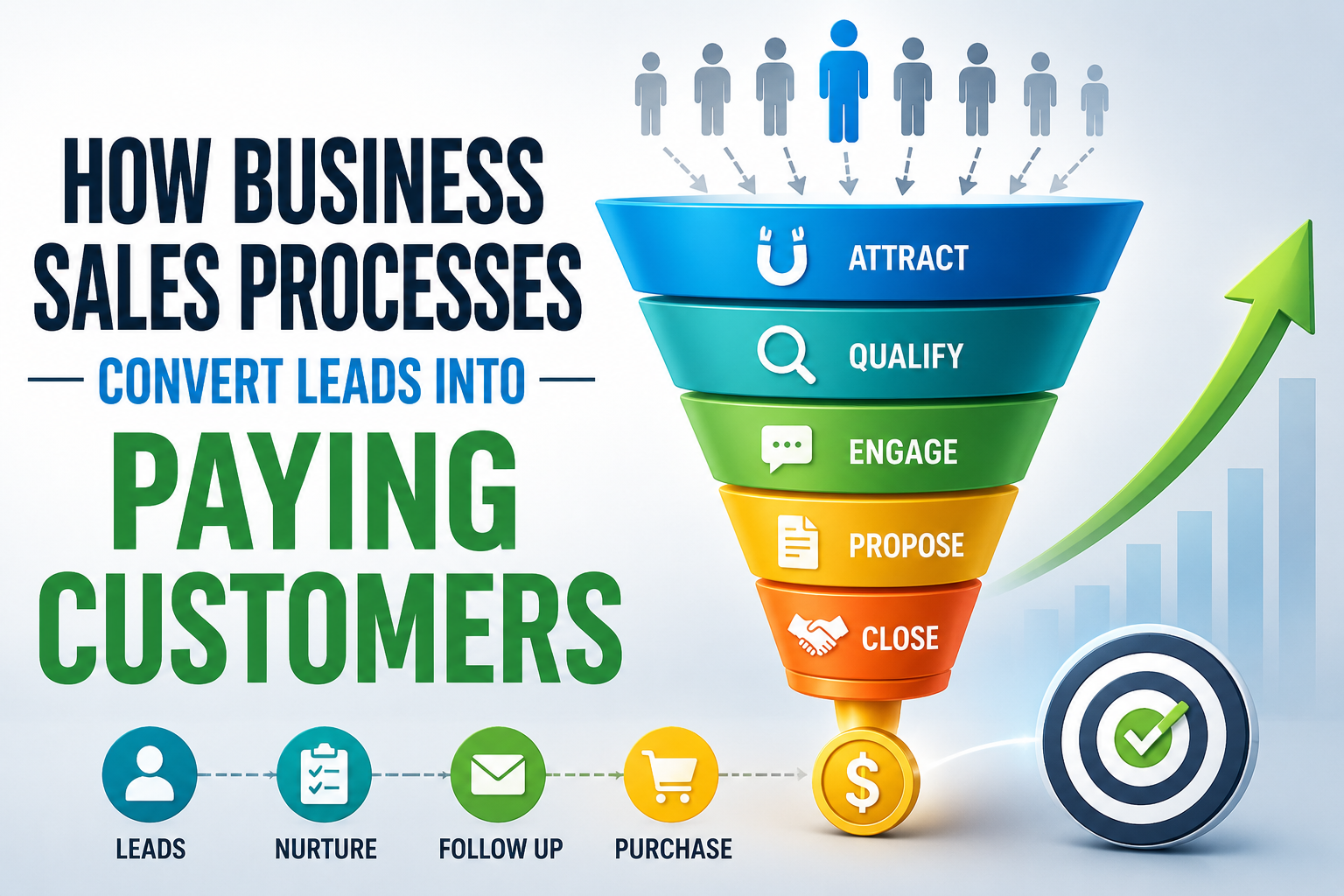
A free product can serve as the top of the customer funnel.
The company then converts a percentage of users into paying customers.
For example:
100,000 free users × 3% conversion × $10 monthly subscription = $30,000 monthly recurring revenue.
The important variables are:
- Number of free users
- Conversion rate
- Price
- Retention
- Cost of serving free users
A large free user base is not necessarily valuable if it produces little conversion or creates excessive infrastructure costs.
How to Choose the Right Revenue Strategy
There is no universally best revenue model.
The appropriate approach depends on the product, customer, industry and cost structure.
Ask several questions.
How frequently do customers need the product?
A product purchased once every five years may not be naturally suited to a monthly subscription.
Can customers clearly measure ongoing value?
Recurring pricing works particularly well when customers continuously receive value.
How predictable is usage?
If usage varies dramatically, usage-based pricing may be more appropriate than a fixed price.
How sensitive are customers to price?
Businesses should understand how demand changes when prices change.
What does it cost to serve each customer?
A revenue model must generate enough gross margin to support the cost of delivery.
Pricing Strategy Is Part of Revenue Strategy
Revenue strategy is not simply deciding whether to charge customers.
Pricing can dramatically influence revenue, profitability and customer perception.
Several pricing approaches are common.
Cost-Plus Pricing
The company calculates its cost and adds a markup.
For example:
Selling Price = Cost + Desired Markup
This approach is simple but may overlook customer willingness to pay.
Competitive Pricing
The company sets prices partly by considering what competitors charge.
This can be useful in markets where customers compare similar products.
Value-Based Pricing
Prices are based primarily on the value customers receive rather than simply the company’s costs.
This approach can be particularly powerful for specialized services and business-to-business products.
Penetration Pricing
A company initially sets a relatively low price to attract customers and gain market share.
The strategy can work when scale and customer acquisition are important, but businesses must consider whether customers will accept later price increases.
Premium Pricing
A company deliberately charges more to position the product as premium.
Success depends on delivering an experience or value proposition that justifies the price.
Revenue Is Not the Same as Profit
One of the most important financial distinctions for business owners is the difference between revenue and profit.
Revenue is the money generated from sales and other operating activities.
Profit is what remains after relevant expenses are deducted.
A simplified equation is:
Profit = Revenue − Expenses
Consider a company that generates $500,000 in annual revenue but spends $450,000 operating the business.
Its simplified operating profit would be $50,000.
A company generating $1 million in revenue is not necessarily healthier than one generating $500,000.
The important question is how efficiently each company converts revenue into sustainable profit and cash flow.
Gross Margin Matters
Gross margin measures how much revenue remains after the direct costs associated with producing goods or delivering services.
A simplified formula is:
Gross Margin = (Revenue − Cost of Goods Sold) ÷ Revenue × 100
For example, if a company generates $100,000 in revenue and has $60,000 in direct costs:
Gross Margin = 40%
Higher gross margins can give a business more room to cover marketing, salaries, administration, research and development and other operating expenses.
Customer Acquisition Cost
A business also needs to understand what it costs to acquire customers.
Customer Acquisition Cost (CAC) is commonly calculated as:
CAC = Total Customer Acquisition Costs ÷ Number of New Customers
Suppose a company spends $20,000 on sales and marketing and acquires 400 new customers.
Its simplified CAC is:
$20,000 ÷ 400 = $50
A revenue strategy becomes more attractive when the value generated by a customer comfortably exceeds the cost of acquiring that customer.
Customer Lifetime Value
Customer Lifetime Value (LTV) estimates how much revenue or gross profit a customer may generate over the relationship with the company.
A simplified subscription example might consider:
LTV ≈ Average Revenue Per Customer × Gross Margin × Expected Customer Lifetime
The precise calculation depends on the business model.
Comparing LTV with CAC can help businesses evaluate the economics of customer acquisition.
However, these metrics should not be treated as isolated numbers. Cash-flow timing, retention assumptions, refunds, expansion revenue and service costs can materially affect the real economics.
Recurring Revenue Can Improve Predictability
Recurring revenue is attractive because it can make future income easier to forecast.
A company with thousands of customers on annual contracts may have more predictable revenue than a company that starts every month with zero committed sales.
Recurring models can include:
- Subscriptions
- Memberships
- Retainers
- Maintenance contracts
- Licensing agreements
- Service contracts
But recurring revenue is not automatically profitable.
A business can have high recurring revenue while losing money if customer acquisition and service costs are excessive.
Business Model Scalability
Scalability describes how effectively a business can increase revenue without increasing costs at the same rate.
Technology companies can sometimes scale rapidly because adding another customer may require relatively little additional cost.
A labor-intensive service business may face greater capacity constraints.
Businesses can improve scalability through:
- Automation
- Standardized processes
- Software
- Outsourcing
- Training systems
- Self-service tools
- Digital distribution
Scalability should not mean sacrificing quality.
A business that doubles its customer base while its customer-service quality collapses may have increased revenue but weakened its long-term position.
Network Effects Can Strengthen Business Models
A network effect occurs when a product or platform becomes more valuable as more people use it.
A marketplace is a common example.
More sellers can attract more buyers.
More buyers can attract more sellers.
This creates a reinforcing cycle.
Network effects can become powerful competitive advantages because new competitors may struggle to attract enough participants to replicate the established network.
However, not every growing user base creates a genuine network effect. The additional users must increase value for other participants in a meaningful way.
Common Business Model Mistakes
Even promising companies can undermine themselves by choosing an unsuitable economic model.
Charging Before Understanding Value
Businesses sometimes set prices without understanding what customers actually value.
Competing Only on Price
Low prices can attract customers but can also produce weak margins and difficult economics.
Ignoring Retention
Acquiring customers is not enough if they leave quickly.
Offering Too Many Pricing Options
Complex pricing can make purchasing difficult and reduce conversion.
Underestimating Delivery Costs
A business may appear profitable until all customer-support, logistics and infrastructure costs are included.
Confusing Revenue With Success
Rapidly growing sales can hide deteriorating margins or cash flow.
Copying Competitors
A competitor’s pricing model may work because of its particular brand, cost structure or customer base. Copying it without understanding those factors can be dangerous.
How to Build a Strong Business Model
A practical process can make business-model development easier.
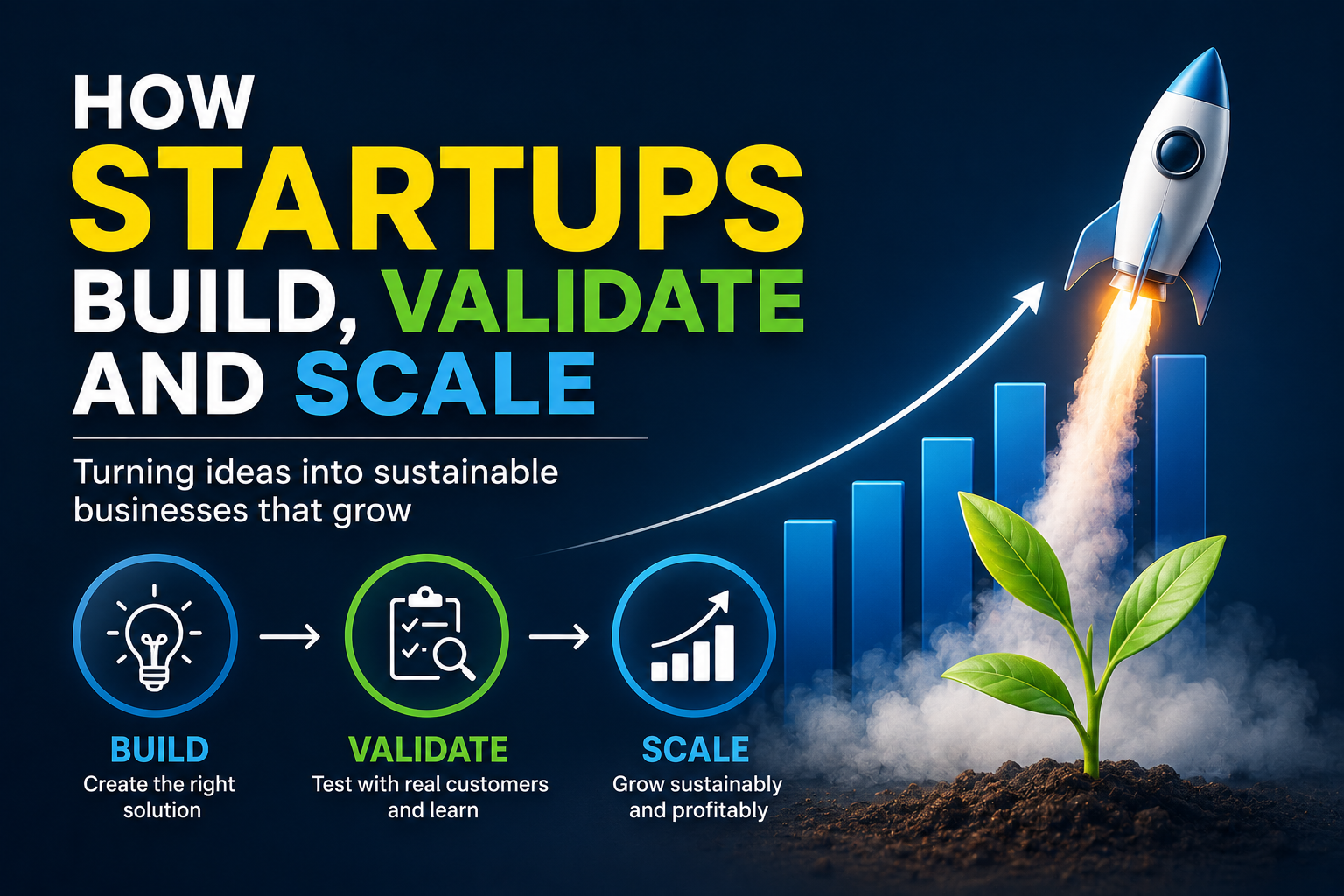
Step 1: Identify a Real Customer Problem
Start with the problem rather than the product.
Step 2: Define the Target Customer
Be specific about who experiences the problem and who is willing to pay to solve it.
Step 3: Develop the Value Proposition
Explain clearly why your solution is better, faster, cheaper, easier or more valuable.
Step 4: Determine How Customers Will Buy
Choose appropriate sales and distribution channels.
Step 5: Estimate the Cost Structure
Identify both fixed and variable costs.
Step 6: Select a Revenue Model
Consider subscriptions, direct sales, transaction fees, advertising, licensing or another suitable approach.
Step 7: Test Pricing
Use customer research and real-world experiments rather than relying entirely on assumptions.
Step 8: Measure Unit Economics
Track metrics such as CAC, LTV, gross margin, retention and contribution margin.
Step 9: Improve the Model
A business model is not necessarily permanent. Customer behavior, technology and competition can change.
Business Model Innovation
Sometimes the biggest opportunity is not creating an entirely new product but changing how the product is sold.
A traditional company might move from:
One-time purchase → Subscription
A manufacturer might move from:
Selling equipment → Equipment plus maintenance
A software company might move from:
Perpetual license → Cloud subscription
A service provider might move from:
Hourly billing → Fixed-fee packages
Business model innovation can create new revenue streams without requiring an entirely new product.
Multiple Revenue Streams
Businesses sometimes combine several revenue sources to reduce dependence on one income stream.
For example, a company might generate revenue from:
- Product sales
- Subscriptions
- Advertising
- Licensing
- Professional services
Diversification can improve resilience, but adding revenue streams also creates complexity.
Every new revenue stream should have a clear strategic purpose.
A company should avoid adding unrelated monetization methods simply because they are available.
How Technology Is Changing Business Models
Technology has made many business models easier to implement at scale.
Cloud computing allows businesses to deliver software without distributing physical media.
Digital payments make small transactions easier to process.
E-commerce allows businesses to reach customers across geographical boundaries.
Artificial intelligence can automate certain processes and reduce the cost of delivering some services.
Data analytics can help companies understand customer behavior and personalize offers.
At the same time, technology can reduce barriers to entry. Competitors can often replicate digital products faster than traditional physical infrastructure.
This makes differentiation, brand strength, customer relationships and proprietary capabilities increasingly important.
How to Know Whether a Business Model Is Working
A healthy business model should eventually demonstrate several characteristics.
Customers receive meaningful value
People should have a clear reason to purchase and remain customers.
Revenue is sufficient
The business needs enough income to support its operations and growth.
Margins are sustainable
Revenue should generate enough contribution to cover operating expenses and investment.
Customer acquisition is economically viable
The cost of acquiring customers should make sense relative to their expected value.
Cash flow is manageable
A profitable business can still fail if it runs out of cash.
The model can adapt
Markets change. A strong business model should be capable of evolving without destroying the company’s core economics.
A Simple Business Model Checklist
Before launching or expanding a business, ask:
| Question | What You Need to Know |
|---|---|
| Who is the customer? | Clearly defined target market |
| What problem is solved? | Specific customer need |
| What is the value proposition? | Why customers should choose you |
| How will customers find you? | Marketing and distribution channels |
| How will customers pay? | Revenue model |
| How much will they pay? | Pricing strategy |
| What does delivery cost? | Cost structure |
| Can customers be retained? | Retention strategy |
| Can the model scale? | Capacity and economics |
| Can it generate profit? | Sustainable unit economics |
| Can it generate cash? | Cash-flow sustainability |
| What could disrupt it? | Competitive and market risks |
Building a Business That Can Make Money Sustainably
A strong business model is ultimately about alignment.
The customer needs a meaningful problem solved. The company needs a practical way to deliver that solution. The pricing needs to reflect the value created while remaining attractive to the target market. And the resulting revenue must be sufficient to cover costs, support investment and produce sustainable returns.
The most successful businesses are rarely built around revenue alone. They develop an interconnected system in which customer value, pricing, distribution, costs, retention and profitability reinforce one another.
That is why entrepreneurs should treat a business model as something to understand and test—not simply something to write into a business plan.
A great product can attract attention, but a well-designed business model determines whether the company can turn that value into durable revenue, healthy margins and a sustainable organization over the long term.


2 Comments
Micle harison
June 7, 2019Lorem ipsum dolor sit amet, usu ut perfecto postulant deterruisset, libris causae volutpat at est, ius id modus laoreet urbanitas. Mel ei delenit dolores.
John Doe
June 7, 2019Some consultants are employed indirectly by the client via a consultancy staffing company.