
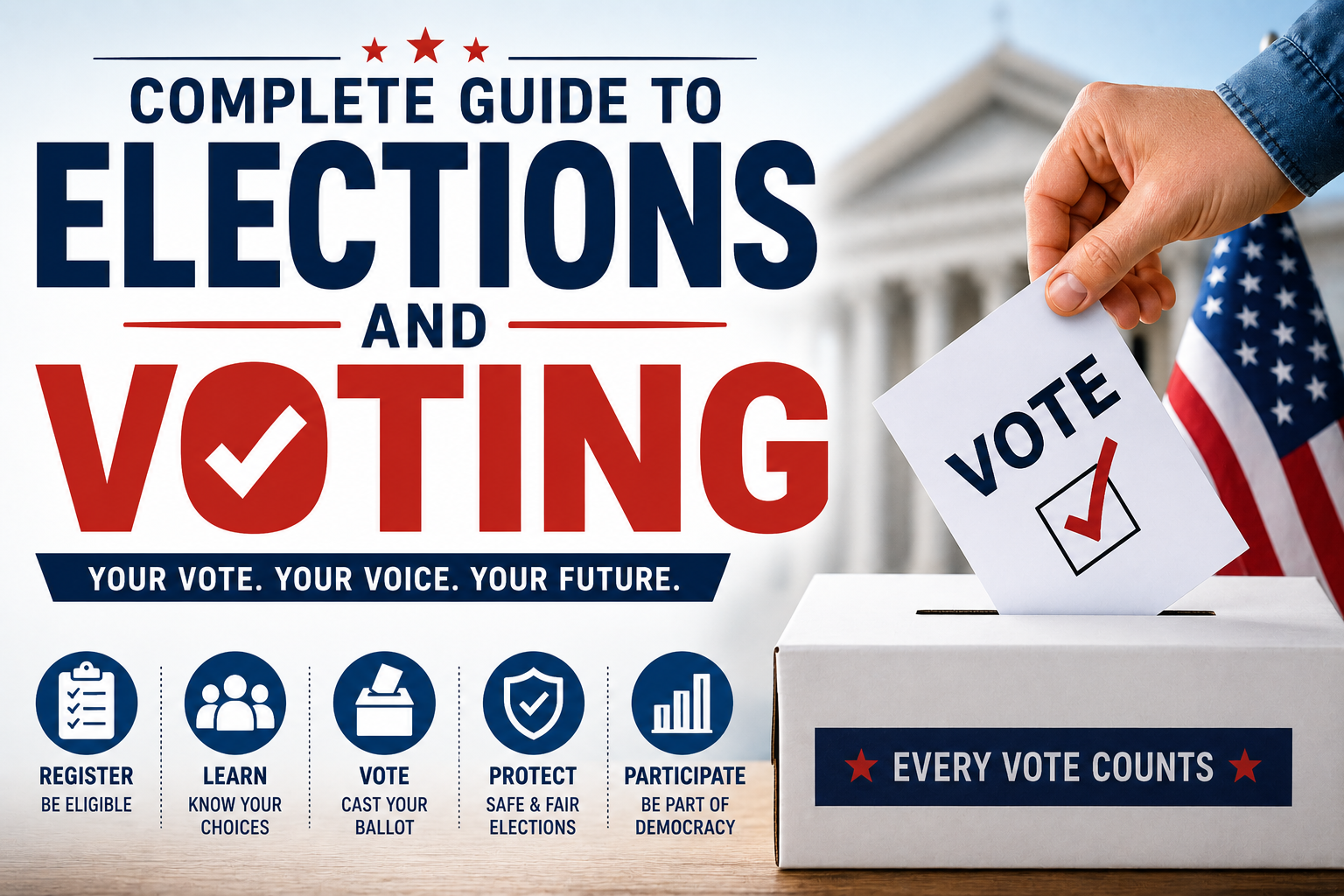
Complete Guide to Elections and Voting
Elections are one of the most important mechanisms through which citizens participate in government. They determine who holds public office, influence public policy and provide voters with an opportunity to reward, replace or challenge political leaders.
Yet elections can be complicated. Different countries use different electoral systems, voting procedures, registration rules and methods for counting ballots. Even within the same country, rules can vary between national, regional and local elections.
Understanding how elections work makes it easier to evaluate candidates, interpret election results and participate effectively in the democratic process.
This guide explains the fundamentals of elections and voting, including electoral systems, voter registration, ballots, political parties, campaigns, election administration, counting, results and common voting mistakes.
What Is an Election?
An election is a formal process through which eligible voters choose representatives or decide between competing political options.
Elections can be held to select:
- Presidents
- Prime ministers through parliamentary systems
- Members of parliament
- Governors
- Mayors
- Local council representatives
- Legislators
- Other public officials
Some elections also involve direct questions put to voters, such as constitutional amendments or referendums.
The purpose of an election depends on the political system, but competitive elections generally provide a mechanism for citizens to influence who exercises political authority.
What Is Voting?
Voting is the act of expressing a choice in an election or other democratic decision-making process.
A voter may select:
- A candidate
- A political party
- A list of candidates
- A referendum option
- A proposition or measure
The method used depends on the electoral system.
Voting can take place through:
- Paper ballots
- Electronic voting machines
- Postal or absentee ballots
- Early voting
- In-person voting
- Other legally authorized methods
The specific procedures vary considerably between jurisdictions.
Why Elections Matter
Elections perform several important functions in a political system.
Choosing Leaders
Elections give eligible citizens a mechanism for selecting representatives.
Accountability
Politicians who know they must eventually face voters have an incentive to explain their decisions and respond to public concerns.
Peaceful Transfers of Power
Competitive elections can provide a structured alternative to political leadership changing through force or instability.
Political Participation
Voting gives citizens an opportunity to participate directly in the selection of public officials.
Representation
Elections can help different communities, regions and political interests gain representation in government.
However, elections alone do not guarantee that every political system is democratic or that every voter is equally represented. Electoral rules, institutions, political freedoms and the protection of voting rights also matter.
Who Can Vote?
Eligibility requirements differ between countries and elections.
Common requirements may include:
- Citizenship
- Minimum voting age
- Voter registration
- Legal residency requirements
- Possession of acceptable identification
- Compliance with applicable election laws
Some jurisdictions automatically register eligible voters, while others require individuals to register themselves.
Certain elections may also have different eligibility rules from national elections.
For example, a local election can have residency requirements that differ from those for a national election.
What Is Voter Registration?
Voter registration is the process through which an eligible person is added to the official electoral register.
Depending on the jurisdiction, registration may involve providing information such as:
- Full name
- Date of birth
- Address
- Citizenship information
- Identification details
Registration systems help election authorities determine who is eligible to vote and where voters should cast their ballots.
Voters should check registration requirements well before election day because deadlines can apply.
Why Voter Registration Matters
Being eligible to vote does not necessarily mean that a person can simply appear at any polling location and cast a ballot.
A voter may need to:
- Register before a deadline.
- Confirm their registration details.
- Vote in the correct electoral district.
- Provide required identification.
- Follow the applicable voting procedure.
The rules vary by jurisdiction, so voters should rely on their election authority for the current requirements.
What Is an Electoral District?
An electoral district is a geographic area represented by an elected official or group of officials.
Different countries use different terms, including:
- Constituency
- District
- Riding
- Ward
- Electoral division
District boundaries determine which candidates appear on a particular ballot and which voters participate in a specific contest.
The boundaries can be redrawn over time through processes such as redistricting or boundary delimitation.
What Is an Electoral System?
An electoral system determines how votes are translated into election results.
This is one of the most important differences between elections around the world.
Two elections can produce very different political outcomes even if voters have similar preferences simply because their electoral systems operate differently.
Major systems include:
- First-past-the-post
- Two-round systems
- Proportional representation
- Ranked-choice voting
- Mixed electoral systems
First-Past-the-Post Explained
Under a first-past-the-post system, the candidate who receives the most votes in a district wins.
A candidate does not necessarily need more than 50% of the vote.
For example:
| Candidate | Votes |
|---|---|
| Candidate A | 42% |
| Candidate B | 35% |
| Candidate C | 23% |
Candidate A wins because they received more votes than either competitor.
This system is relatively straightforward and often produces clear district-level winners.
However, the percentage of seats won by a political party can differ significantly from its overall share of the national vote.
Two-Round Elections
Some elections use a two-round system, sometimes called a runoff system.
If no candidate reaches the required threshold in the first round, a second election is held between qualifying candidates.
For example:
Round 1:
Candidate A — 40%
Candidate B — 34%
Candidate C — 26%
If the rules require a majority, Candidate A and Candidate B might proceed to a second round.
Round 2:
Candidate A — 53%
Candidate B — 47%
Candidate A then wins.
The system is commonly used in presidential elections in various countries.
Proportional Representation
Proportional representation (PR) aims to allocate legislative seats more closely according to parties’ shares of the vote.
Suppose a parliament has 100 seats and a party receives approximately 30% of the relevant vote.
Under a proportional system, the party might receive approximately 30 seats, subject to the specific electoral rules.
Different forms of proportional representation include:
- Party-list systems
- Open-list systems
- Closed-list systems
- Single transferable vote
- Mixed-member proportional systems
Each has different methods for selecting candidates and allocating seats.
Ranked-Choice Voting
Under ranked-choice voting, voters rank candidates rather than selecting only one.
A ballot might allow a voter to indicate:
- First choice
- Second choice
- Third choice
If no candidate achieves the required threshold, lower-ranked candidates can be eliminated and their votes redistributed according to voters’ next preferences.
The exact counting method depends on the particular system.
Ranked voting can allow voters to express preferences beyond their first choice, but the counting process can be more complicated than a simple plurality election.
Mixed Electoral Systems
Some countries combine different electoral methods.
A mixed system may use:
- District representatives
- Party-list representatives
The goal can be to combine geographic representation with proportional representation.
The exact structure varies considerably between countries.
Presidential and Parliamentary Elections
Not all governments select political leaders in the same way.
Presidential Systems
In a presidential system, voters may directly elect a president who serves as head of state and often head of government.
The president’s powers depend on the country’s constitution.
Parliamentary Systems
In a parliamentary system, voters generally elect legislators, while the government is formed through the parliamentary process.
The prime minister is usually the head of government and may be the leader of the party or coalition able to command legislative support.
Some parliamentary systems also have a separate head of state.
What Are Political Parties?
A political party is an organized group that seeks to influence government by contesting elections and promoting particular policies, values or political objectives.
Political parties can:
- Recruit candidates
- Develop policy platforms
- Organize campaigns
- Mobilize voters
- Raise funds
- Coordinate legislators
- Communicate political positions
Party systems vary widely.
Some countries have two dominant parties, while others have multiple parties that regularly compete for power.
What Is an Independent Candidate?
An independent candidate runs for office without being officially nominated by a political party.
Independent candidates can offer voters an alternative to established party organizations.
Their challenges may include:
- Limited funding
- Lower name recognition
- Smaller campaign organizations
- Reduced access to party infrastructure
However, an independent candidate can sometimes attract voters who are dissatisfied with major parties.
What Is a Political Platform?
A political platform describes a party’s or candidate’s major positions, priorities and proposed policies.
A platform may address:
- Economy
- Employment
- Taxes
- Healthcare
- Education
- Housing
- Infrastructure
- Security
- Environment
- Foreign policy
- Government spending
Voters can use platforms to compare candidates beyond campaign slogans.
How Political Campaigns Work
A political campaign is an organized effort to persuade voters to support a candidate, party or political position.
Campaign activities can include:
- Public meetings
- Debates
- Television advertising
- Digital advertising
- Social media
- Door-to-door canvassing
- Telephone outreach
- Political rallies
- Interviews
- Policy announcements
Campaigns generally combine communication, organization, fundraising and voter mobilization.
Campaign Messages and Political Advertising
Political campaigns use different messages to appeal to voters.
Some focus on:
- Economic policy
- Leadership
- Personal background
- Public services
- National security
- Social issues
- Government reform
Political advertising can be persuasive, but voters should distinguish between:
A candidate’s claim
and
independently verifiable evidence supporting that claim.
Checking the original source of statistics, quotations and policy claims can help voters make better-informed decisions.
How to Evaluate Political Candidates
A useful evaluation process involves looking beyond campaign popularity.
Consider:
Policy Positions
What does the candidate actually propose?
Experience
Does their previous experience provide useful evidence about how they may perform in office?
Record
If they have previously held public office, what decisions and results can be independently verified?
Feasibility
Can the policies realistically be implemented within the government’s constitutional and financial constraints?
Transparency
Does the candidate provide credible information about funding, interests and major policy proposals?
Leadership
How have they responded to difficult situations and criticism?
Accountability
Do they accept responsibility for mistakes and provide evidence for important claims?
What Is a Ballot?
A ballot is the official mechanism through which voters record their choices.
A ballot can contain:
- Candidate names
- Party names
- Referendum questions
- Instructions
- Symbols
- Electoral contests
The format varies depending on the voting system.
A voter should follow the instructions carefully because marking a ballot incorrectly can sometimes result in it being rejected.
What Is a Spoiled or Invalid Ballot?
A ballot may be considered spoiled, rejected or invalid when it does not meet the requirements for counting.
Possible reasons include:
- Selecting too many candidates
- Failing to mark the ballot correctly
- Writing unauthorized information
- Damaging the ballot
- Making the voter’s intention unclear
The definition and treatment of invalid ballots depend on local election law.
Voters should therefore follow the official ballot instructions carefully.
What Is a Secret Ballot?
A secret ballot is designed to protect voters from having their individual choices publicly revealed.
Secret voting helps protect people from:
- Intimidation
- Coercion
- Retaliation
- Pressure from employers
- Political retaliation
- Family or community pressure
The exact procedures used to maintain ballot secrecy vary by electoral system.
What Happens at a Polling Station?
The process varies between countries, but a typical polling experience may involve:
- Arriving at the designated polling location.
- Confirming voter eligibility.
- Presenting required identification where applicable.
- Receiving a ballot.
- Entering a private voting area.
- Marking the ballot according to the instructions.
- Depositing the ballot into the designated ballot box or voting system.
Election workers help administer the process and maintain orderly voting.
Early Voting
Some jurisdictions allow people to vote before the official election day.
Early voting can provide greater flexibility for people who:
- Work on election day
- Travel
- Have family responsibilities
- Face mobility challenges
- Prefer to avoid election-day crowds
Availability and eligibility vary by jurisdiction.
Absentee and Postal Voting
Absentee voting generally allows eligible voters to vote without appearing at their normal polling location.
Postal voting is one method of absentee voting.
Depending on local rules, voters may need to:
- Request a ballot
- Complete an application
- Verify their identity
- Return the ballot by a deadline
- Follow specific envelope or signature requirements
Because postal ballots may have separate deadlines from in-person voting, voters should check official instructions carefully.
Electronic Voting
Some jurisdictions use electronic systems to record or count votes.
Electronic voting can include:
- Electronic voting machines
- Optical scanners
- Digital voter-registration systems
- Electronic ballot transmission in limited circumstances
Technology can improve efficiency in certain contexts, but election systems also require strong safeguards involving security, testing, auditing and transparency.
The technology used does not by itself determine whether an election is trustworthy. The broader system of procedures and oversight matters as well.
How Votes Are Counted
After polls close, election officials begin counting or processing ballots.
The process may involve:
- Securing ballots.
- Verifying ballot materials.
- Counting votes.
- Recording results.
- Conducting required checks or audits.
- Reporting preliminary results.
- Certifying the final result.
The timeline can vary considerably.
An election result reported on election night may be preliminary rather than final.
Why Election Results Can Change After Election Day
Early results do not necessarily include every vote.
Additional ballots may be counted later because of:
- Postal voting
- Absentee ballots
- Early voting procedures
- Geographical differences
- Ballot verification
- Administrative checks
- Close races requiring additional procedures
Therefore, a candidate who leads early in the count can later lose once additional votes are included.
This does not automatically indicate wrongdoing.
It may simply reflect how the election’s counting process works.
What Is Election Certification?
Election certification is the formal process through which the appropriate authority confirms the official results.
Certification generally occurs after required counting, verification and legal procedures have been completed.
The certified result is more authoritative than an early media projection or unofficial tally.
What Are Exit Polls?
An exit poll asks voters about how they voted after leaving a polling location.
Exit polls can provide information about voting patterns and demographics.
However, they are not the official election results.
Their accuracy can be affected by:
- Sampling
- Response rates
- Methodology
- Geographic coverage
- Voter behavior
They should therefore be treated as analytical information rather than a replacement for official vote counts.
What Is a Referendum?
A referendum allows voters to directly decide a specific political or legal question.
Instead of choosing between candidates, voters may be asked to select options such as:
- Yes / No
- Approve / Reject
- Remain / Leave
Referendums can address constitutional amendments, major policy questions or changes to political arrangements.
The legal effect of a referendum depends on the country’s constitution and election laws.
What Is Voter Turnout?
Voter turnout measures the proportion of eligible or registered voters who participate in an election, depending on the calculation used.
A basic turnout calculation can be expressed as:
Voter Turnout = Votes Cast ÷ Eligible Voting Population × 100
However, organizations may use different denominators.
For example, turnout may be calculated using registered voters rather than the entire voting-age population.
When comparing turnout statistics, check how the figure was calculated.
Why Voter Turnout Matters
Turnout can influence election outcomes and provide insight into political participation.
Low turnout may indicate:
- Disengagement
- Registration barriers
- Lack of competitive races
- Logistical difficulties
- Political dissatisfaction
- Election fatigue
High turnout can indicate strong political engagement, although turnout alone does not explain why people participate or which policies they support.
Election Security
Election security involves protecting the voting process against attempts to disrupt, manipulate or compromise elections.
It can include protections for:
- Voter registration systems
- Voting equipment
- Ballot storage
- Election-worker systems
- Results transmission
- Physical polling locations
- Cybersecurity
- Election infrastructure
Election security is broader than cybersecurity.
Physical procedures, chain-of-custody controls, audits and trained election workers can also be important safeguards.
What Is a Chain of Custody?
Chain of custody refers to documented procedures for controlling election materials as they move between different stages of the electoral process.
Depending on the system, this can include:
- Ballots
- Voting equipment
- Results records
- Secure containers
- Election documents
The purpose is to create accountability and make unauthorized handling easier to detect.
Election Audits
An election audit is a process used to examine election results or procedures after voting.
Different types of audits exist.
They can help verify that:
- Votes were counted accurately
- Procedures were followed
- Equipment functioned correctly
- Reported results correspond to underlying records
An audit is not necessarily the same as a recount.
A recount generally involves counting ballots again, while an audit may examine whether the reported outcome or election procedures are supported by appropriate evidence.
What Is a Recount?
A recount is a second count of votes in an election.
It may occur because:
- The margin is extremely narrow
- Election law requires one
- A candidate requests one under defined conditions
- A court orders one
- Election officials identify a reason for additional counting
The rules vary by jurisdiction.
A recount does not necessarily mean the original election was fraudulent. It can be a normal safeguard in a close contest.
Election Fraud vs. Election Errors
These concepts should not be confused.
Election fraud generally involves intentional deception or unlawful manipulation of an election.
Election errors can occur without intentional wrongdoing.
Examples might include:
- Data-entry mistakes
- Equipment problems
- Incorrect paperwork
- Misunderstood procedures
- Administrative errors
Election systems therefore use verification, audits, recounts and other controls to identify and correct problems where appropriate.
Misinformation During Elections
Elections often generate large amounts of information, including inaccurate or misleading claims.
Before sharing a dramatic election claim, consider:
- Who originally made the claim?
- Is there evidence?
- Does the evidence come from a primary source?
- Is the information current?
- Are credible election authorities reporting the same thing?
- Is a preliminary result being presented as final?
- Is a statistic being interpreted correctly?
Screenshots and social-media posts can be misleading when removed from their original context.
How to Verify Election Information
A reliable verification process starts with primary sources.
Look for:
- Official election authorities
- Election commission announcements
- Government records
- Court documents
- Official candidate statements
- Published legislation
- Credible reporting that identifies its sources
For numerical results, compare media reports with official election data where available.
For legal questions, examine the relevant law or official court decision rather than relying solely on social-media commentary.
The Role of Election Observers
Election observers may monitor voting and counting processes to assess whether procedures are being followed appropriately.
Observers can come from:
- Domestic organizations
- International organizations
- Civil society groups
- Political parties, where permitted
Observation frameworks differ, but observers can contribute to transparency by documenting how electoral processes operate.
Political Participation Beyond Voting
Voting is important, but it is not the only form of democratic participation.
People can also participate by:
- Attending public meetings
- Contacting elected representatives
- Joining civic organizations
- Participating in political parties
- Supporting community initiatives
- Submitting public comments where permitted
- Monitoring government performance
- Engaging in peaceful political advocacy
Democratic participation therefore continues between elections.
Common Voting Mistakes to Avoid
Waiting Until the Last Minute to Register
Registration deadlines can pass before voters realize they have a problem.
Failing to Check Your Polling Location
Polling places can change.
Ignoring Identification Requirements
Different jurisdictions have different rules concerning acceptable identification.
Voting for More Candidates Than Allowed
Over-voting can cause a ballot to be rejected in systems where this invalidates the relevant contest.
Assuming a Candidate’s Claims Are Facts
Campaign statements should be evaluated against evidence.
Treating Preliminary Results as Final
Election-night numbers can change as additional votes are counted.
Sharing Unverified Election Claims
False information can spread quickly during politically charged events.
A Practical Election-Day Checklist
Before voting, consider checking:
- Am I registered?
- Am I eligible for this election?
- Where is my polling location?
- What identification is required?
- What are the voting hours?
- Do I understand the ballot?
- Have I reviewed the candidates and issues?
- Do I know the rules for marking the ballot?
- If voting remotely, what is the submission deadline?
- Do I know where to obtain official election information?
The exact checklist will depend on the jurisdiction.
How to Become a More Informed Voter
Being an informed voter does not require agreeing with a particular political party.
It means developing a process for evaluating information.
A useful approach is to:
Read Beyond Headlines
Headlines are designed to attract attention. Read the underlying article or source.
Compare Sources
Different credible sources may emphasize different aspects of the same event.
Examine Primary Evidence
Whenever possible, look at original documents, official statistics and legislation.
Separate Facts From Predictions
A candidate’s promise is different from an established fact.
Check Context
Statistics can be misleading when important context is omitted.
Consider Multiple Candidates
Evaluating more than one option can produce a better understanding of the choices available.
Think About Implementation
Ask not only what a candidate promises, but also how the proposal could actually be implemented.
Elections and Democratic Accountability
Elections work best when voters can make meaningful choices and political institutions provide mechanisms for accountability.
That requires more than ballots.
It also depends on factors such as:
- Freedom to participate
- Access to reliable information
- Transparent election administration
- Independent institutions
- Peaceful political competition
- Legal protections
- Accessible voting procedures
- Accurate vote counting
- Respect for legitimate results
- Lawful mechanisms for resolving disputes
The strength of an electoral system therefore depends on the broader institutions surrounding the vote.
Making Your Vote Count as Part of a Bigger Process
Understanding elections is ultimately about more than knowing where to mark a ballot.
A meaningful electoral process connects voters, candidates, political parties, election administrators, laws, institutions and the counting process into one system.
For voters, the most practical approach is straightforward: verify your eligibility, understand the voting rules, research the choices available, evaluate political claims critically and use official sources for election information.
Once voting ends, the process continues through counting, verification, certification and—where necessary—lawful challenges and recounts.
Elections cannot solve every political problem, and no electoral system is perfect. But informed participation gives citizens a meaningful role in deciding who represents them and in holding those representatives accountable once they take office.



2 Comments
Micle harison
June 7, 2019Lorem ipsum dolor sit amet, usu ut perfecto postulant deterruisset, libris causae volutpat at est, ius id modus laoreet urbanitas. Mel ei delenit dolores.
John Doe
June 7, 2019Some consultants are employed indirectly by the client via a consultancy staffing company.