
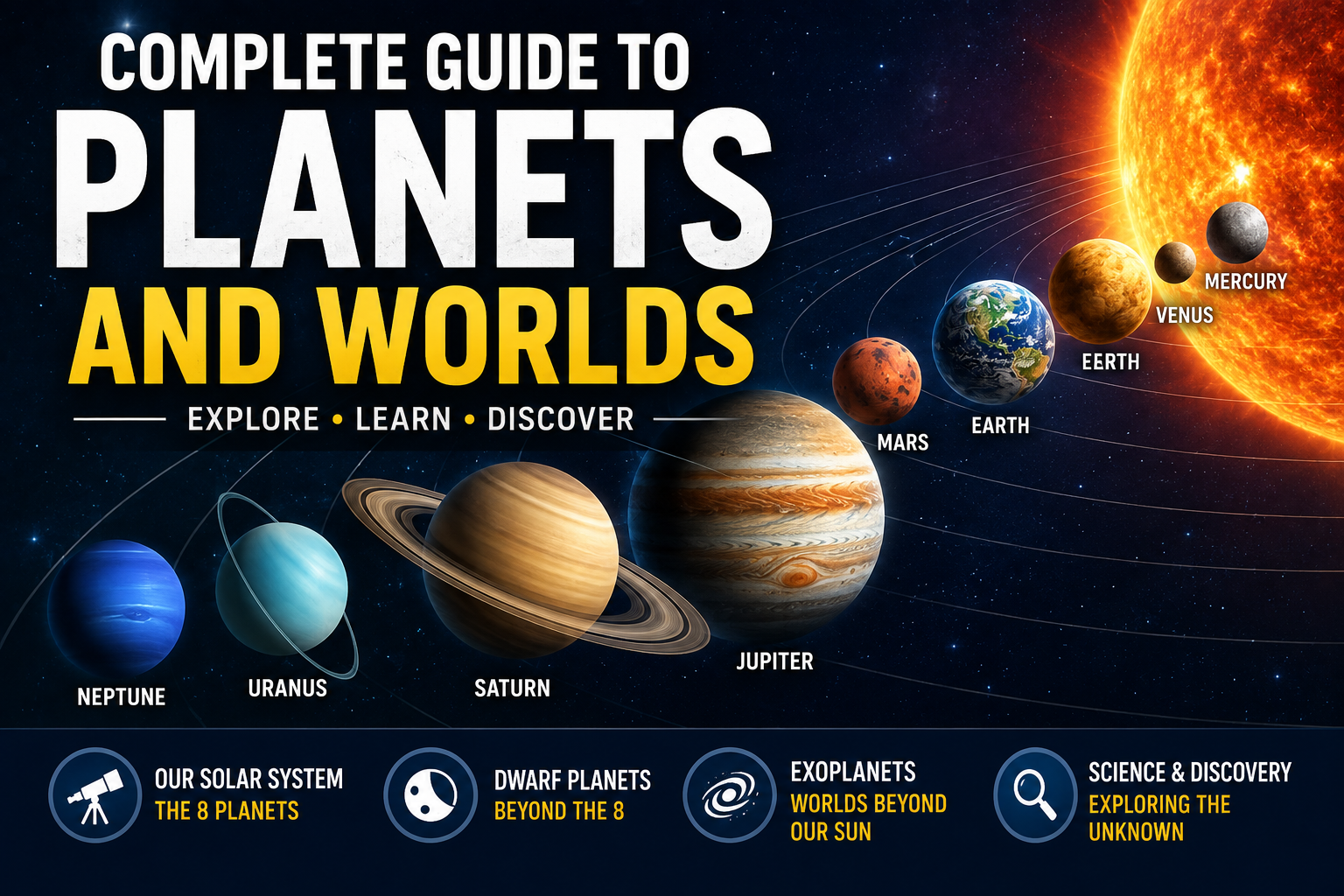
Complete Guide to Planets and Worlds
From the rocky surface of Mercury to the enormous storms of Jupiter and the frozen landscapes of distant dwarf planets, our cosmic neighborhood contains an extraordinary range of worlds.
And the Solar System is only a small part of the picture.
Astronomers have now confirmed thousands of exoplanets orbiting stars beyond the Sun, revealing planetary systems that can look dramatically different from our own. Some worlds are enormous gas giants orbiting their stars in just a few days, while others are small, rocky planets that may resemble Earth in size. NASA notes that there are likely to be trillions of planets across the Milky Way. [NASA Science]
This guide explains what makes a planet a planet, how worlds are classified, how the planets in our Solar System differ, what dwarf planets are, and what scientists have learned from planets beyond our Solar System.
What Is a Planet?
The word planet comes from an ancient Greek term meaning “wanderer,” reflecting the way these objects appeared to move across the night sky relative to distant stars.
Today, astronomers use a more specific definition.
The International Astronomical Union (IAU) established the current formal definition for planets in our Solar System in 2006. Under that definition, a planet must:
- Orbit the Sun.
- Have enough mass for its own gravity to make it approximately round.
- Have cleared the neighborhood around its orbit.
Using these criteria, our Solar System has eight planets: Mercury, Venus, Earth, Mars, Jupiter, Saturn, Uranus and Neptune. [IAU]
Pluto does not meet the third criterion and is therefore classified as a dwarf planet.
It is important to note that the IAU definition specifically concerns objects orbiting the Sun. Astronomers also use the broader concept of planets when discussing worlds orbiting other stars, known as exoplanets.
The Eight Planets of Our Solar System
The planets can broadly be divided into two groups:
- Terrestrial planets: Mercury, Venus, Earth and Mars
- Outer giant planets: Jupiter, Saturn, Uranus and Neptune
The first four are relatively small and rocky. Jupiter and Saturn are gas giants, while Uranus and Neptune are generally classified as ice giants.
Mercury
Mercury is the closest planet to the Sun and the smallest of the eight planets.
It has a rocky surface heavily marked by impact craters. Because it has only a very thin exosphere rather than a substantial atmosphere, Mercury experiences enormous temperature differences between its illuminated and dark sides.
Despite being closest to the Sun, Mercury is not the hottest planet. That distinction belongs to Venus.
Venus
Venus is similar to Earth in size and is sometimes described as Earth’s planetary sibling.
But the two worlds have radically different surface conditions.
Venus has a dense atmosphere dominated by carbon dioxide and clouds containing sulfuric acid. Its powerful greenhouse effect produces surface temperatures hot enough to melt lead.
The planet rotates unusually slowly and in the opposite direction from most planets in the Solar System.
Venus demonstrates how dramatically planetary environments can diverge even when two planets have similar sizes.
Earth
Earth is the third planet from the Sun and the only world currently known to support life.
It has abundant liquid water on its surface, a nitrogen-rich atmosphere, an active climate system and a magnetic field that helps shield the planet from charged particles from the Sun.
Earth also has a large natural satellite: the Moon.
Its combination of liquid water, suitable temperatures, chemical ingredients and long-term environmental stability makes Earth an important reference point in the search for potentially habitable worlds elsewhere.
Mars
Mars is the fourth planet from the Sun and is often called the Red Planet because iron minerals on its surface have oxidized, producing its characteristic reddish appearance.
Mars has enormous volcanoes, deep valleys, polar ice deposits and evidence that liquid water once flowed across parts of its surface.
Today, the planet is cold and dry at the surface, but scientists continue investigating whether underground environments could preserve conditions suitable for microbial life.
Mars is also one of the most extensively explored planets beyond Earth.
Jupiter
Jupiter is the largest planet in the Solar System.
It is a gas giant composed primarily of hydrogen and helium and does not have a solid surface like Earth.
Its atmosphere contains enormous bands of clouds and powerful storms, including the famous Great Red Spot, a long-lived storm system.
Jupiter is also surrounded by a complex system of moons, including Europa, Ganymede, Io and Callisto.
Some of these moons are scientifically fascinating in their own right. Europa, for example, is believed to have a subsurface ocean beneath its icy exterior.
Saturn
Saturn is the second-largest planet and is best known for its spectacular ring system.
Like Jupiter, Saturn is primarily composed of hydrogen and helium and is classified as a gas giant. [NASA Science]
Its rings are made primarily of countless particles of ice and rocky material.
Saturn also has a remarkable collection of moons. Titan, its largest moon, has a thick atmosphere and lakes and seas of liquid hydrocarbons on its surface.
Enceladus is another particularly important world because evidence indicates that a global ocean exists beneath its icy crust.
Uranus
Uranus is the seventh planet from the Sun and one of the Solar System’s two ice giants.
Its atmosphere contains hydrogen and helium, along with methane, which contributes to its blue-green appearance.
Uranus is particularly unusual because it rotates with an extreme axial tilt. Its orientation means that the planet experiences highly unusual seasonal patterns.
Like the other outer giant planets, Uranus also has rings and numerous moons.
Neptune
Neptune is the eighth and most distant recognized planet in the Solar System.
It is an ice giant with a blue appearance and an atmosphere characterized by powerful winds and storms.
Despite receiving little sunlight because of its distance from the Sun, Neptune has an active atmosphere.
The planet’s great distance also makes direct exploration challenging. Much of what scientists know about Neptune comes from telescopic observations and data obtained during spacecraft encounters.
Why Are the Inner Planets Rocky?
Mercury, Venus, Earth and Mars are known as terrestrial planets because they have solid, rocky surfaces.
NASA describes terrestrial planets as worlds dominated by rock or iron, generally with solid or liquid surfaces. [NASA Science]
Their location near the young Sun helps explain their composition.
When the Solar System formed approximately 4.6 billion years ago, temperatures were much higher near the Sun. Materials with relatively high melting points, such as silicates and metals, were more capable of remaining in the inner Solar System.
Farther away, colder conditions allowed more volatile materials to remain available.
This contributed to the contrasting compositions of the inner rocky planets and outer giant planets.
Gas Giants vs. Ice Giants
Jupiter and Saturn are gas giants.
Uranus and Neptune are ice giants.
The distinction is related to their composition and formation.
Gas giants are dominated by hydrogen and helium. NASA describes Jupiter and Saturn as examples of planets composed largely of these gases. [NASA Science]
Ice giants contain larger proportions of heavier materials commonly described in planetary science as “ices,” including water, ammonia and methane, alongside hydrogen and helium.
The word “ice” can be misleading because these substances may exist under enormous pressures and temperatures in forms very different from familiar ice on Earth.
What Is a Dwarf Planet?
A dwarf planet is a Solar System body that:
- Orbits the Sun.
- Is sufficiently massive to become approximately round.
- Has not cleared its orbital neighborhood.
- Is not a moon.
The IAU’s definition places dwarf planets in a separate category from the eight planets. [IAU]
NASA currently identifies five officially recognized dwarf planets in our Solar System:
- Ceres
- Pluto
- Haumea
- Makemake
- Eris [NASA Science]
Pluto remains the most famous example.
Its reclassification in 2006 generated considerable public debate, but the change reflected the discovery of other Pluto-sized bodies and the need for a consistent classification system.
Pluto: A World of Its Own
Pluto is located in the distant Kuiper Belt, a region beyond Neptune containing numerous icy bodies.
Although it is classified as a dwarf planet, Pluto is scientifically fascinating.
NASA’s New Horizons spacecraft flew past Pluto in 2015, revealing a surprisingly diverse landscape that included mountains, glaciers and broad plains.
The mission transformed Pluto from a distant point of light into a complex world.
Its discovery also helped demonstrate why classification matters: as astronomers find more distant objects, they need systems that distinguish between planets, dwarf planets and smaller Solar System bodies.
Planets Beyond the Solar System
The planets in our Solar System are not the only worlds in the universe.
A planet orbiting another star is called an exoplanet.
NASA says scientists have confirmed thousands of exoplanets, with many more candidates awaiting further investigation. [NASA Science]
These discoveries have dramatically expanded our understanding of what a planetary system can look like.
Exoplanets range from small rocky worlds to planets larger than Jupiter.
Some orbit extremely close to their stars. Others travel on much wider orbits.
Some even appear to orbit two stars.
The Main Types of Exoplanets
NASA broadly categorizes exoplanets into four major types:
- Gas giants
- Neptune-like planets
- Super-Earths
- Terrestrial planets [NASA Science]
These categories are useful for describing broad characteristics, but planetary systems can be much more complicated.
Gas Giants
Gas-giant exoplanets are large worlds dominated by hydrogen and helium.
Some orbit so close to their stars that their atmospheric temperatures reach extraordinary levels.
These worlds are often called hot Jupiters when they resemble Jupiter in size and composition but orbit extremely close to their stars.
Neptune-Like Planets
Neptune-like worlds are broadly similar in size to Neptune or Uranus.
They can have hydrogen- and helium-rich outer atmospheres surrounding denser interiors.
Scientists have also discovered mini-Neptunes, planets smaller than Neptune but larger than Earth. There is no equivalent planet in our Solar System. [NASA Science]
Super-Earths
A super-Earth is generally more massive than Earth but less massive than Neptune.
The term does not mean the planet is necessarily similar to Earth in habitability.
A super-Earth can have a very different composition, atmosphere or surface environment.
Terrestrial Exoplanets
Terrestrial exoplanets are rocky worlds comparable in size to Earth or smaller.
Finding terrestrial planets in the right orbital locations is particularly interesting because some may have conditions suitable for liquid water.
However, being in a potentially habitable region does not prove that a planet supports life.
What Is the Habitable Zone?
The habitable zone is the region around a star where conditions could allow liquid water to exist on a planet’s surface under suitable atmospheric conditions.
It is sometimes called the “Goldilocks zone” because it represents an orbital distance that may be neither too hot nor too cold.
But the concept has important limitations.
A planet’s actual environment also depends on:
- Atmospheric composition
- Atmospheric pressure
- Cloud cover
- Planetary size
- Internal heat
- Stellar activity
- Rotation
- Surface chemistry
- Presence of oceans
A planet in the habitable zone is therefore potentially interesting, not automatically habitable.
NASA emphasizes that finding an Earth-sized planet at an appropriate distance from its star does not by itself demonstrate the existence of oceans, an atmosphere or life. [NASA Science]
Could Other Planets Support Life?
Scientists have not confirmed life beyond Earth.
However, planetary science has identified several characteristics that make certain worlds interesting targets for astrobiological research.
Researchers look for evidence involving:
- Liquid water
- Organic molecules
- Suitable energy sources
- Stable environments
- Potentially favorable chemistry
Importantly, scientists are not only looking at planets.
Some moons may be equally compelling.
Europa and Enceladus, for example, are believed to contain subsurface oceans, making them important targets in the search for potentially habitable environments.
Mars is also a major focus because geological evidence indicates that ancient Mars once had environments involving liquid water.
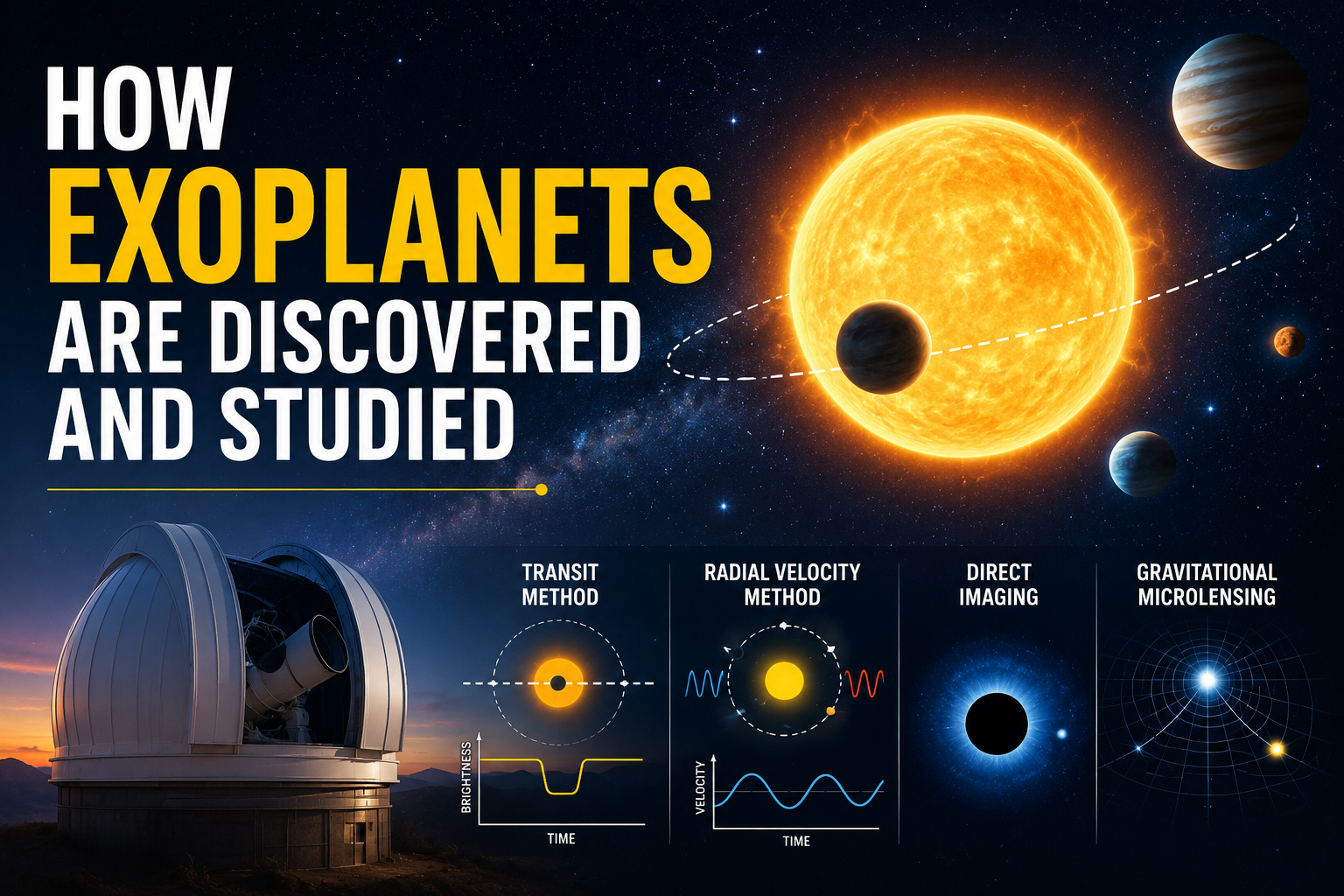
How Do Scientists Find Exoplanets?
Most exoplanets cannot simply be photographed directly.
Instead, astronomers frequently detect them through the effects they have on their host stars.
The Transit Method
When a planet passes between its star and Earth, it can block a tiny fraction of the star’s light.
Astronomers measure this repeated decrease in brightness.
The size of the dip can provide information about the planet’s approximate size.
The Radial Velocity Method
A planet’s gravity causes its star to move slightly.
Astronomers can detect this motion by measuring changes in the star’s spectrum.
The technique can provide information about a planet’s mass or minimum mass.
Direct Imaging
In some circumstances, astronomers can directly observe light associated with a planet.
This is particularly challenging because a star is vastly brighter than the planets orbiting it.
Gravitational Microlensing
A planet can sometimes be detected when its gravity affects the light from a more distant background star.
Each method reveals different information, and combining observations can provide a much clearer picture of a distant world.
Why Planetary Worlds Are So Different
Planetary diversity is largely a result of differences in formation, composition, size, orbit and environment.
A planet’s distance from its star can influence its temperature and the materials available during formation.
Its mass affects how strongly it can hold onto an atmosphere.
Its internal structure influences geological activity.
Its orbit affects seasons and climate.
Its host star can determine how much radiation reaches the planet.
Even two planets with similar sizes can develop dramatically different environments.
Venus and Earth are a powerful example within our own Solar System.
How Planetary Systems Form
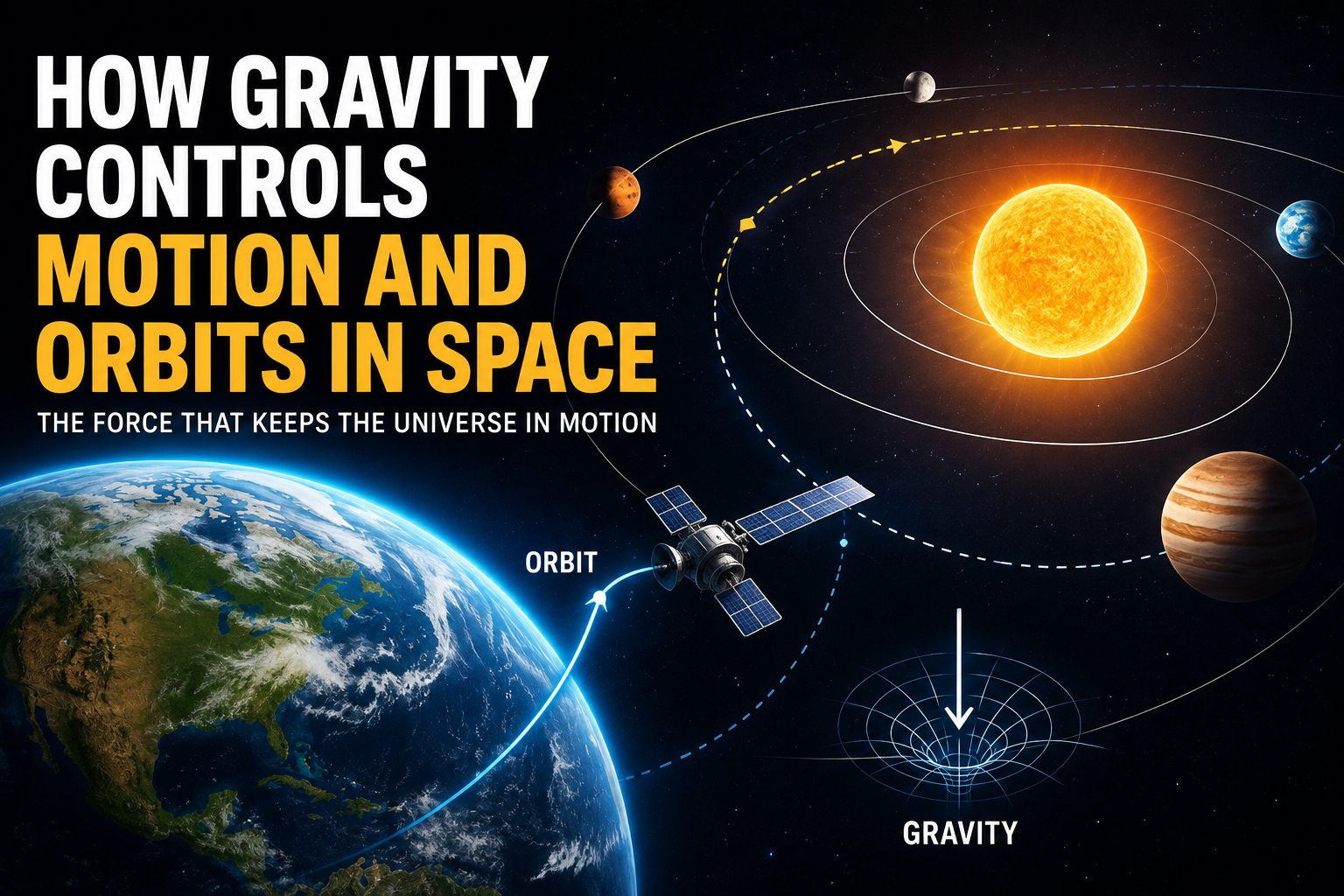
Our Solar System formed about 4.6 billion years ago from a dense cloud of gas and dust.
As the cloud collapsed under gravity, it formed a rotating disk around the young Sun.
Material within the disk gradually collided and accumulated.
Some objects became larger bodies called planetesimals. Continued collisions and gravitational interactions eventually produced planets, dwarf planets, moons and other Solar System objects.
NASA explains that the first four planets formed from material capable of withstanding the higher temperatures closer to the young Sun, while ice-rich materials were more common farther out. [NASA Science]
Astronomers have discovered that other planetary systems can develop very differently.
Some planets appear to have migrated significantly from where they originally formed.
Others occupy orbital arrangements unlike anything in our Solar System.
Worlds Without Stars
Not every planet necessarily remains permanently attached to a star.
Astronomers have identified evidence for rogue planets, worlds that travel through space without orbiting a star.
These objects may have been ejected from planetary systems through gravitational interactions.
Without a nearby star providing substantial light and heat, their surface environments could be extremely cold.
However, internal heat could potentially influence conditions beneath the surface.
Rogue planets are particularly interesting because they challenge the traditional image of a planet as something that must orbit a star.
What Makes Earth Special?
Earth is not the largest planet, the hottest planet or the planet with the strongest winds.
Its importance comes from its combination of characteristics.
It has:
- Abundant surface water
- A protective atmosphere
- A relatively stable climate over geological timescales
- Active geological processes
- A magnetic field
- A diverse chemical environment
- Life
The presence of life also changes the planet itself.
Earth’s atmosphere, oceans, soils and geological processes interact with biological activity in ways that make our planet an evolving system.
That makes Earth an essential reference point when scientists study distant worlds.
Why Scientists Study Other Worlds
Studying planets is not simply about finding another Earth.
Planetary science helps answer fundamental questions about:
- How planets form
- How atmospheres develop
- How climates change
- Why some planets remain geologically active
- How water is distributed
- How planetary magnetic fields work
- How common Earth-like environments might be
- Whether life could exist elsewhere
Every new planetary system provides another natural laboratory.
Comparing different worlds allows scientists to identify which characteristics are common and which may be unusual.
The Future of Planet Discovery
The study of planets is entering an increasingly detailed era.
Modern telescopes can examine distant planetary systems and, in some cases, analyze the atmospheres of exoplanets.
NASA’s James Webb Space Telescope has already contributed to the study of exoplanet atmospheres and planetary systems.
The upcoming Nancy Grace Roman Space Telescope is expected to expand exoplanet research further. NASA says the mission is scheduled to launch on August 30, 2026, and is expected to discover more than 100,000 exoplanets through its planned surveys. [NASA Science]
Future observations could help scientists determine how common particular planet types are and identify worlds worthy of deeper investigation.
A Universe Filled With Different Kinds of Worlds
The eight planets around our Sun represent only a small sample of planetary diversity.
Mercury is a cratered rocky world. Venus is wrapped in a dense, superheated atmosphere. Earth supports a biosphere. Mars preserves evidence of a wetter past. Jupiter and Saturn are immense gas giants surrounded by complicated moon systems. Uranus and Neptune are distant ice giants with unusual atmospheres and magnetic environments.
Beyond them are dwarf planets, asteroids, comets and countless smaller bodies.
Beyond our Solar System are thousands of confirmed exoplanets—and likely billions or trillions more waiting to be detected.
The Search for Worlds Is Really a Search for Understanding
Every planet tells part of the story of how matter transforms into worlds.
Studying these objects helps scientists reconstruct the history of our own Solar System while testing ideas about planetary formation across the galaxy. The discovery of super-Earths, mini-Neptunes, hot Jupiters, rogue planets and other unusual worlds has shown that our planetary system is only one possible outcome of a much larger cosmic process. [NASA Science]
The most important lesson may be that “planet” describes a surprisingly diverse family of worlds. Some are rocky, some gaseous, some icy, some potentially ocean-covered, and others exist in environments unlike anything found around the Sun.
As telescopes become more powerful and spacecraft explore more of our own cosmic neighborhood, the catalogue of known worlds will continue to grow—and with it, our understanding of how planets form, evolve and, perhaps, create environments capable of supporting life.


2 Comments
Micle harison
June 7, 2019Lorem ipsum dolor sit amet, usu ut perfecto postulant deterruisset, libris causae volutpat at est, ius id modus laoreet urbanitas. Mel ei delenit dolores.
John Doe
June 7, 2019Some consultants are employed indirectly by the client via a consultancy staffing company.