
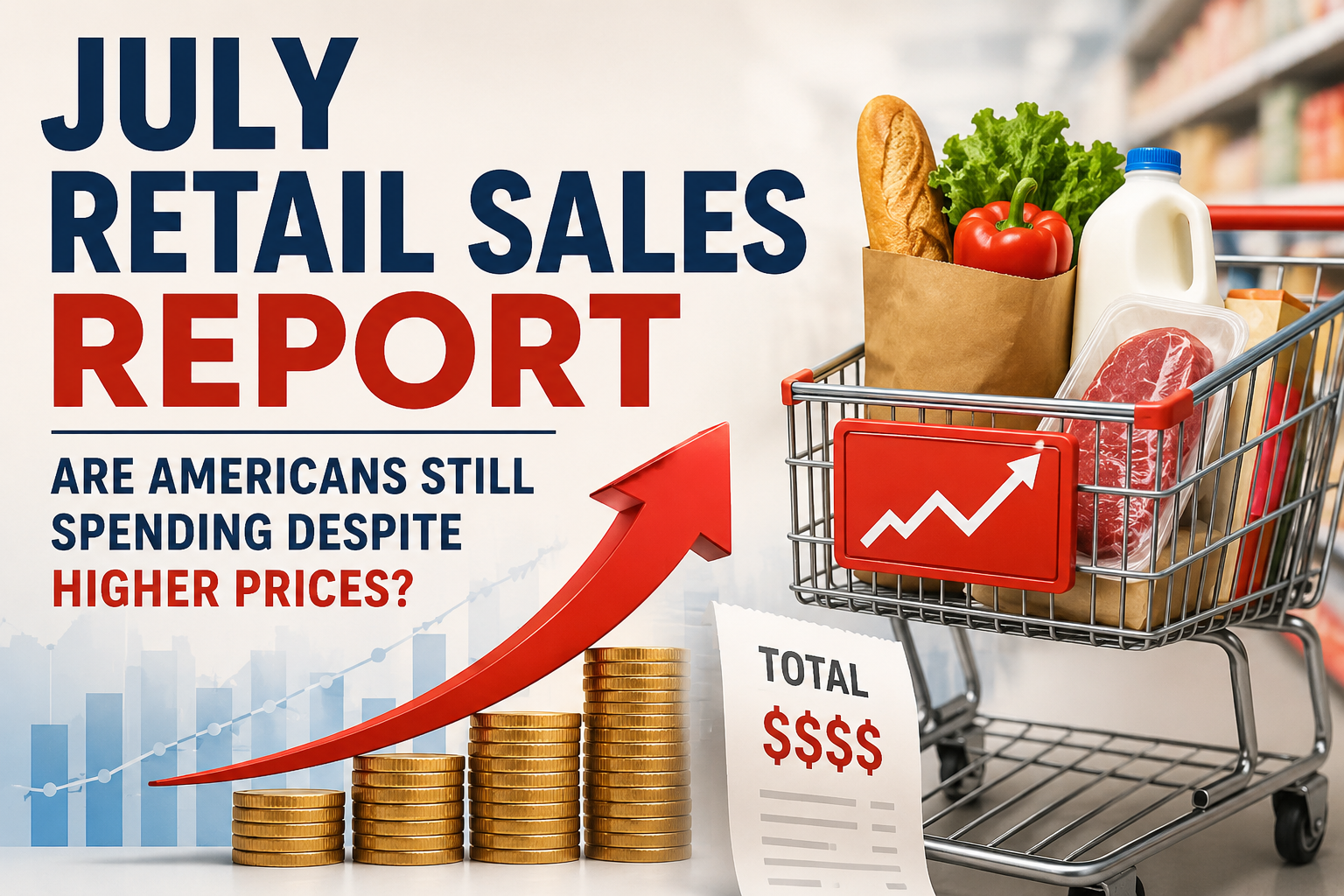
July Retail Sales Report: Are Americans Still Spending Despite Higher Prices?
American consumers are heading into the second half of summer with an increasingly complicated financial picture. Prices remain significantly higher than they were several years ago, borrowing costs continue to affect household budgets, and consumers are becoming more selective about where they spend.
The upcoming July retail sales report, scheduled for release on Friday, August 14, 2026, should provide an important snapshot of how Americans responded to those pressures during the month.
The big question is simple: Are Americans still spending because they feel financially confident, or because everyday purchases simply cost more?
When Is the July Retail Sales Report Coming Out?
The July retail sales report is scheduled for release at 8:30 a.m. Eastern Time on Friday, August 14.
The report will cover retail and food-service sales during July and provide an early look at consumer demand before more complete economic data become available.
For investors, economists and households, the timing is important because consumer spending remains one of the biggest drivers of economic activity in the United States.
Why July Consumer Spending Matters
Retail sales offer a useful window into how Americans are behaving financially.
When consumers continue purchasing cars, clothing, electronics, restaurant meals and other goods, businesses generally have more reason to maintain production, hiring and investment.
But the headline retail-sales figure needs to be interpreted carefully.
Retail sales are measured in dollar terms rather than inflation-adjusted purchasing volumes. If prices rise, consumers can spend more money without necessarily buying more products.
That distinction is particularly important in the current environment.
A family spending $500 on groceries instead of $450 is technically spending more. But if the family is bringing home roughly the same amount of food, the increase does not necessarily indicate stronger purchasing power.
Are Americans Actually Buying More?
That is one of the biggest questions economists will be asking when the July numbers arrive.
Recent consumer behavior has shown signs of resilience, but households are also dealing with elevated prices and higher costs across many categories.
Consumers may be responding in several ways:
- Looking for cheaper alternatives
- Waiting for sales and promotions
- Reducing restaurant visits
- Delaying major purchases
- Buying fewer nonessential items
- Using credit more frequently
- Prioritizing essential expenses
A strong retail-sales number therefore does not automatically mean Americans are feeling financially comfortable.
Higher Prices Can Distort the Headline
Imagine a household that spent $3,000 per month last year and now spends $3,200.
At first glance, that looks like stronger consumer spending.
But if the household is purchasing roughly the same amount of food, fuel, clothing and household necessities, the additional $200 may simply reflect higher prices.
This is why the July retail-sales report should be considered alongside inflation.
Recent inflation data showed that consumer prices continued to rise in July, with overall prices increasing 3.4% over the previous year.
That means Americans are still operating in an economy where the general price level is considerably higher than it was before the recent inflation surge.
The Categories Worth Watching
Not every part of the retail economy tells the same story.
Some categories are necessities, while others are much easier for households to cut when budgets become tight.
Grocery Spending
Grocery purchases can provide clues about how households are dealing with higher food costs.
Consumers may continue buying similar quantities while switching to cheaper brands, store brands or discounted products.
A strong grocery-sales number could therefore reflect higher prices rather than dramatically stronger demand.
Restaurant Spending
Restaurants are different.
Dining out is generally more discretionary than purchasing groceries, so weaker restaurant sales could indicate that consumers are becoming more cautious.
On the other hand, continued strength could suggest households still have room in their budgets for nonessential spending.
Motor Vehicles
Vehicle sales can have a significant influence on the overall retail picture.
Consumers making large purchases despite financing costs could signal continued confidence.
However, auto sales can also be volatile from month to month, so one report should not be treated as a definitive measure of consumer health.
Online Shopping
Online retail remains an important part of consumer behavior.
Strong e-commerce activity could indicate that consumers remain willing to spend while increasingly comparing prices and searching for discounts.
For retailers, this could also reveal whether consumers are shifting spending away from physical stores rather than reducing spending altogether.
Clothing and General Merchandise
These categories can provide a useful look at discretionary spending.
If households are feeling pressure, purchases such as clothing, home goods and other nonessential products may be among the first areas where spending slows.
What Retail Sales Could Mean for Inflation
Consumer spending and inflation are closely connected.
When demand remains strong while businesses face higher costs, companies may have more ability to pass those costs on to consumers.
But if spending starts weakening significantly, businesses may have less pricing power.
That makes the July retail-sales report another piece of the broader inflation puzzle.
The most important question isn’t simply whether sales increased.
It’s whether consumer demand is strong enough to keep supporting higher prices.
What the Report Could Mean for Interest Rates
Retail sales can also influence expectations surrounding Federal Reserve policy.
The Federal Reserve has to balance two competing risks:
- Inflation that remains too high
- Economic activity that slows too sharply
If July retail sales come in substantially stronger than expected, markets could interpret the result as evidence that consumers remain resilient.
That could reinforce expectations that policymakers need to remain cautious about easing financial conditions.
A surprisingly weak report could have the opposite effect.
If inflation is moderating while consumer demand is also weakening, markets may become more confident that economic conditions are cooling.
That could affect expectations for future interest-rate decisions.
Strong Spending Does Not Always Mean Healthy Finances
This is particularly important for personal-finance readers.
A household can maintain strong spending even while becoming financially more vulnerable.
For example, someone might continue eating out, traveling or purchasing expensive goods by relying more heavily on credit cards.
Retail sales would still show spending.
But the household’s financial position could actually be deteriorating.
That’s why consumers should look beyond national spending figures and examine their own financial indicators.
Ask Yourself:
- Are your monthly expenses rising?
- Is your income keeping pace with those increases?
- Are you carrying a larger credit-card balance?
- Are you saving less money?
- Are you postponing major purchases?
- Are essential expenses taking up more of your income?
- Are you relying more heavily on credit to maintain your lifestyle?
These questions can tell you far more about your financial health than a single economic report.
Three Possible Outcomes for July Retail Sales
1. Retail Sales Come in Strong
A strong report would suggest that Americans remain willing and able to spend.
That could be positive for retailers and other consumer-focused businesses.
However, investors and economists would still need to determine how much of the increase came from higher prices.
2. Retail Sales Disappoint
A weak number could indicate that consumers are finally becoming more cautious.
Households may be cutting discretionary spending, delaying major purchases or prioritizing necessities.
For the economy, that could signal a broader cooling in consumer demand.
3. Spending Rises but Remains Concentrated in Essentials
This may be the most revealing scenario.
Consumers could continue spending heavily on groceries, gasoline and other necessities while cutting back on restaurants, clothing, entertainment and household purchases.
That would suggest Americans are still spending—but their budgets are becoming more defensive.
What Higher Prices Mean for Household Budgets
One reason the retail-sales report matters to ordinary households is that inflation does not have to remain extremely high to create financial pressure.
Even when inflation slows, prices generally do not return to their previous levels.
If a product that once cost $100 now costs $115, a decline in the inflation rate does not necessarily bring it back to $100.
Households therefore need income growth to catch up with the higher price level.
This is particularly important for families trying to build emergency savings.
If more income is being absorbed by groceries, housing, transportation and utilities, there may be less available for savings and debt repayment.
What Savers Should Watch
For people focused on personal finance, the July retail-sales report can serve as a reminder to distinguish between economic growth and personal financial progress.
A strong economy does not guarantee that every household is financially secure.
Likewise, weaker consumer spending does not necessarily mean that every household is struggling.
Your own financial position depends on factors such as:
- Income
- Housing costs
- Debt
- Savings
- Interest rates
- Household size
- Transportation expenses
- Insurance costs
- Spending habits
The national retail-sales figure is useful context, but your personal budget remains the more important measure.
What Investors Should Watch
Investors will likely focus on both the headline retail-sales number and the details underneath it.
Important areas include:
- Overall monthly sales growth
- Previous-month revisions
- Motor-vehicle sales
- Restaurant spending
- Online retail
- General merchandise
- Gasoline sales
- Discretionary spending
The market reaction could also depend on how the report compares with expectations.
A number that looks strong on its own could still disappoint investors if analysts were expecting an even larger increase.
Why One Month Does Not Tell the Whole Story
Retail spending can fluctuate considerably from month to month.
Weather, promotions, vehicle purchases, gasoline prices, holidays and other temporary factors can influence the numbers.
That means July’s report should be viewed as part of a larger trend rather than as a definitive verdict on the American consumer.
The more useful question is whether spending has been strengthening, stabilizing or weakening over several months.
The Bigger Personal-Finance Question
The July retail-sales report is ultimately about more than shopping.
It provides a window into how households are adapting to a higher-cost economy.
If Americans continue spending strongly, businesses may remain confident about demand. If spending weakens, companies may have to adjust to more cautious consumers.
For households, however, the most important question is closer to home:
Can your income continue to cover your lifestyle as prices rise?
If the answer is becoming less certain, the appropriate response isn’t necessarily to stop spending altogether. It may mean reviewing recurring expenses, prioritizing essential purchases, reducing expensive debt and rebuilding emergency savings.
What to Watch When the Report Arrives
The July retail-sales report will be released Friday morning, August 14.
Rather than focusing only on whether the headline number rises or falls, look at the composition of spending and compare it with the latest inflation data.
A strong increase could mean consumers remain resilient. A weak figure could signal growing caution. And a mixed result could reveal that Americans are continuing to spend on necessities while cutting back elsewhere.
The most important takeaway for households may be this: higher spending does not necessarily mean greater financial strength. In an economy where prices remain elevated, the real measure of consumer resilience is whether incomes, savings and purchasing power are keeping pace with the cost of everyday life.


2 Comments
Micle harison
June 7, 2019Lorem ipsum dolor sit amet, usu ut perfecto postulant deterruisset, libris causae volutpat at est, ius id modus laoreet urbanitas. Mel ei delenit dolores.
John Doe
June 7, 2019Some consultants are employed indirectly by the client via a consultancy staffing company.