
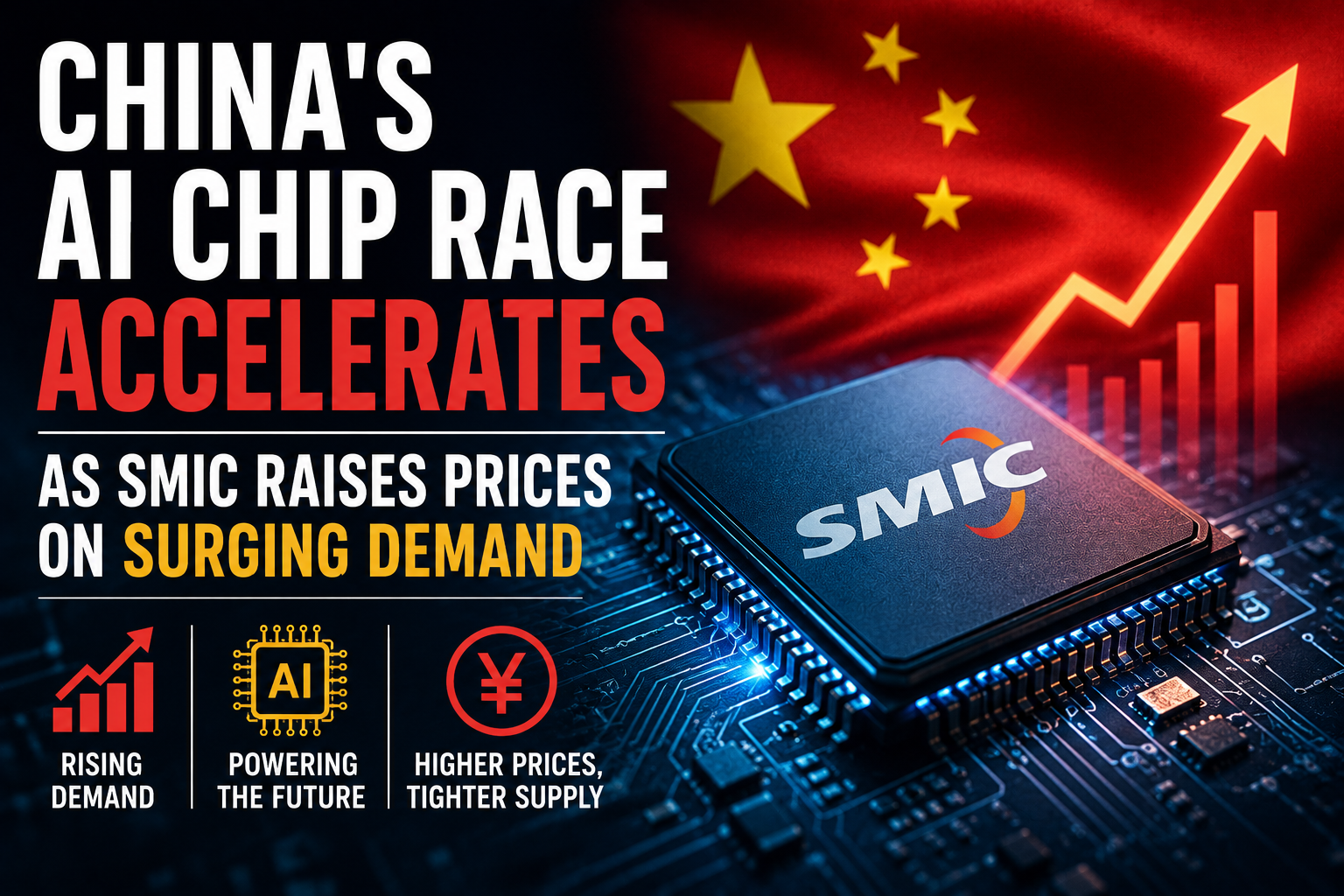
China’s AI Chip Race Accelerates as SMIC Raises Prices on Surging Demand
China’s artificial intelligence ambitions are increasingly showing up in an unexpected place: the pricing and availability of semiconductor manufacturing capacity.
Semiconductor Manufacturing International Corp. (SMIC), China’s largest contract chipmaker, has raised prices for some of its most sought-after production capacity as demand linked to artificial intelligence continues to strengthen. The move comes after SMIC reported record quarterly revenue above $3 billion and a sharp increase in profit, highlighting how the AI boom is reshaping China’s semiconductor industry—even beyond the most advanced processors. (Reuters)
The development is significant because China’s AI chip challenge isn’t simply about producing a direct competitor to Nvidia’s most powerful GPUs. It is increasingly about building an entire domestic semiconductor ecosystem capable of supplying the processors, power-management chips, controllers and other components needed to operate AI infrastructure at scale.
Why SMIC Is Raising Chip Prices
SMIC said AI-related demand is continuing to underpin orders, while shortages have allowed the company to increase prices for capacity where supply is particularly tight. The price increases followed negotiations in the first quarter and apply to wafers processed during the third quarter. (Reuters)
The company’s second-quarter results illustrate the strength of the underlying demand.
SMIC reported:
- More than $3 billion in quarterly revenue
- 36% year-over-year revenue growth
- $479.2 million in net profit
- 14% growth in wafer shipments
- 93.7% capacity utilization
- A 5.7% increase in average wafer prices
China accounted for about 90% of SMIC’s revenue during the quarter, underlining the importance of domestic semiconductor demand to the company’s growth. (Reuters)
SMIC also expects third-quarter revenue to increase by approximately 2% to 4% from the second quarter.
That combination—high utilization, rising prices and strong orders—suggests that semiconductor capacity has become an increasingly valuable resource in China’s technology sector.
The AI Chip Boom Is Bigger Than GPUs
When people talk about the AI chip race, the discussion often centers on advanced graphics processors and accelerators.
Those chips are crucial, but they aren’t the only components required to build an AI data center.
AI systems also require large quantities of supporting semiconductors, including:
- Power-management chips
- Controllers
- Connectivity chips
- Microcontrollers
- Memory-related components
- Display and interface chips
- Sensors
- Other specialty semiconductors
This is where the current SMIC story becomes particularly interesting.
According to Reuters, much of the new demand affecting SMIC involves chips beyond the most advanced AI processors. The AI infrastructure build-out is creating demand throughout the semiconductor supply chain, while production capacity at other major foundries is increasingly focused on high-value AI chips. (Reuters)
The result is an unusual spillover effect.
AI companies may not be buying every chip directly for AI computation, but their enormous infrastructure investments are consuming manufacturing capacity that could otherwise be used for other products.
How AI Is Creating a Semiconductor Capacity Squeeze
The global AI build-out requires enormous amounts of hardware.
Cloud providers and technology companies are investing heavily in data centers, servers and networking infrastructure. As manufacturers prioritize high-performance computing and AI-related products, capacity for other types of chips can become harder to secure.
SMIC has previously warned that AI demand was contributing to shortages in mature-node capacity, particularly for power-management chips and other components. Earlier in 2026, the company said AI demand was pushing customers toward Chinese foundries as global production capacity became increasingly constrained. (South China Morning Post)
That creates an important distinction:
A chip does not have to be the processor running an AI model to benefit from the AI boom.
It may be a supporting component inside the server, power system or networking equipment that makes the AI infrastructure possible.
China’s Semiconductor Strategy Is Changing
China has spent years trying to reduce its dependence on foreign semiconductor technology.
That effort became more urgent as U.S. restrictions limited Chinese companies’ access to some advanced AI processors and semiconductor manufacturing technologies.
The result has been a push toward greater domestic production.
Chinese technology companies and semiconductor manufacturers are increasingly being encouraged to develop local alternatives across the chip supply chain. SMIC is one of the most important pieces of that strategy because it provides domestic manufacturing capacity at a time when access to some foreign foundries and equipment remains complicated.
China’s broader AI strategy therefore isn’t simply about designing a faster processor.
It is about developing an ecosystem that includes:
Chip design → manufacturing → packaging → memory → networking → power management → servers → AI models → data centers
The stronger that ecosystem becomes, the less dependent Chinese technology companies are on external suppliers.
SMIC’s Results Show Why Domestic Demand Matters
SMIC’s latest numbers provide evidence that China’s domestic semiconductor market remains a major source of momentum.
Revenue increased to about $3.01 billion in the second quarter, while profit rose more than threefold year over year. The company’s utilization rate reached 93.7%, indicating that much of its available manufacturing capacity was being used. (Reuters)
The company also expanded monthly 12-inch production capacity by 8,000 wafers, while total output capacity increased to approximately 1.1 million wafers. (Reuters)
That expansion matters because semiconductor manufacturing is fundamentally a scale business.
Higher utilization can improve economics, but sustained demand also creates pressure to invest in additional factories and production equipment.
SMIC’s capital expenditure reached approximately $3.4 billion during the first half of 2026, according to Reuters. (Reuters)
Why Mature-Node Chips Matter to AI
One of the biggest misconceptions about the AI semiconductor race is that every important chip must use the latest manufacturing technology.
That’s not the case.
Advanced nodes are essential for high-performance processors, but many supporting components can be manufactured using older or mature processes.
Power-management chips are a good example.
An AI server can contain extremely advanced computing hardware while still requiring less cutting-edge chips to control power delivery, manage interfaces and perform other supporting functions.
As companies build more AI servers, the demand for these supporting components can increase substantially.
This helps explain why SMIC can benefit from the AI boom even though the company’s most important opportunity isn’t necessarily manufacturing the world’s most advanced AI accelerator.
China’s Domestic AI Demand Is Becoming a Major Force
Another important factor is the sheer size of China’s technology market.
Chinese cloud companies, AI startups, smartphone manufacturers, robotics companies, electric-vehicle manufacturers and other technology businesses are all potential consumers of semiconductor capacity.
SMIC has said AI-related demand is expected to remain an important driver of orders, while other Chinese foundries are seeing similar benefits. South China Morning Post reported that SMIC and Hua Hong Grace Semiconductor both experienced strong profit growth in the second quarter as demand for domestic AI chips increased. (South China Morning Post)
That suggests the effect isn’t isolated to a single company.
China’s semiconductor ecosystem is becoming increasingly interconnected with the country’s AI ambitions.
U.S. Chip Restrictions Add Another Layer
The semiconductor competition between China and the United States gives the SMIC story a geopolitical dimension.
U.S. export controls have restricted China’s access to some advanced AI chips and semiconductor manufacturing technologies.
That has created incentives for Chinese companies to develop domestic alternatives and increase local manufacturing capacity.
China still faces significant technological challenges, particularly in advanced semiconductor manufacturing and access to cutting-edge equipment.
But restrictions can also accelerate efforts to replace foreign technologies.
The resulting dynamic is complicated:
Restrictions make advanced technology harder to obtain, while simultaneously increasing the strategic value of domestic alternatives.
That is one reason China’s semiconductor industry has become such a major component of the country’s broader technology strategy.
China’s AI Chip Race Is Not Just About Catching Nvidia
It is tempting to measure China’s progress entirely by asking whether a domestic chip can match Nvidia’s latest accelerator.
That is an important question, but it is only one measure of semiconductor independence.
China can make progress by strengthening multiple layers of the supply chain:
AI Processor Design
Companies are developing domestic processors and accelerators for training and inference.
Semiconductor Manufacturing
Foundries such as SMIC provide the physical production capacity needed to manufacture chips.
Memory
Chinese memory manufacturers are expanding their capabilities as global memory demand rises.
Packaging
Advanced packaging allows manufacturers to combine and connect chips efficiently.
Networking
AI clusters require high-speed communication between processors and servers.
Power Management
Large data centers need sophisticated power-management components.
Software
AI chips also require compilers, libraries, drivers and development tools.
A stronger ecosystem across all these areas could reduce China’s dependence on foreign technology even if individual components don’t immediately match the world’s leading products.
The AI Boom Is Also Creating “Chipflation”
SMIC’s price increases are part of a broader semiconductor pricing story.
The rapid expansion of AI infrastructure has created enormous demand for chips and memory. Recent industry reports have described this phenomenon as “chipflation”, with rising semiconductor costs potentially feeding into the prices of computers, smartphones, servers and other electronics. (Axios)
The traditional semiconductor cycle was characterized by intense competition, periodic oversupply and falling prices.
AI is disrupting that pattern in some segments.
Technology companies are willing to spend enormous amounts to secure the hardware needed for AI infrastructure, potentially allowing chip manufacturers to command higher prices when capacity is constrained.
This creates a powerful feedback loop:
More AI investment → more servers → greater chip demand → tighter capacity → higher prices → greater semiconductor investment
The critical question is how long that cycle can continue.
What SMIC’s Price Increase Means for China’s AI Industry
Higher chip prices aren’t necessarily bad news for the semiconductor industry.
For manufacturers, they can provide additional revenue and improve the economics of expanding production.
For customers, however, higher component costs can increase the price of building AI infrastructure.
That could have several effects.
Higher AI Infrastructure Costs
Companies may have to spend more to build data centers and AI computing clusters.
Greater Incentive to Expand Capacity
Higher prices can encourage semiconductor manufacturers to build additional production lines.
More Competition
Strong margins can attract investment from competing chipmakers.
Potential Consumer Impact
If higher semiconductor costs persist across the supply chain, some electronics could eventually become more expensive.
Greater Strategic Importance
Domestic chip production becomes even more valuable when global supplies are constrained.
SMIC’s Next Challenge Is Capacity
Raising prices can improve profitability, but it doesn’t solve a capacity shortage by itself.
SMIC is therefore expanding production while trying to respond to demand.
The company said it would continue adjusting capacity allocation and accelerating production-line ramp-ups. Its high utilization rate shows that there is already considerable pressure on available manufacturing resources. (Reuters)
The challenge is balancing several priorities at once.
SMIC must:
- Expand capacity
- Maintain manufacturing yields
- Manage equipment constraints
- Meet customer demand
- Control costs
- Navigate export restrictions
- Invest in newer manufacturing technologies
- Maintain competitive pricing
That makes semiconductor manufacturing one of the most capital-intensive parts of China’s AI strategy.
What Comes Next for China’s AI Chip Industry?
The next phase of China’s AI chip race is likely to be measured less by individual announcements and more by manufacturing scale.
Key indicators to watch include:
- Domestic AI chip production volumes
- SMIC capacity expansion
- Semiconductor utilization rates
- Chinese AI server deployments
- Domestic accelerator performance
- Memory production
- Semiconductor equipment development
- Advanced packaging capabilities
- AI infrastructure investment
- U.S.-China technology restrictions
If demand remains strong, Chinese foundries could continue benefiting from the enormous amount of hardware required by the AI industry.
But sustained growth will depend on whether manufacturers can expand capacity quickly enough without creating new bottlenecks elsewhere in the supply chain.
Why SMIC Matters Beyond China
SMIC’s latest results are important because they illustrate how the AI boom is changing the semiconductor industry at a global level.
AI is no longer simply a story about software companies developing increasingly powerful models.
It is also a story about factories, electricity, networking equipment, memory, advanced packaging, manufacturing tools and thousands of supporting semiconductor components.
China’s ability to build more of that infrastructure domestically could influence the global balance of power in artificial intelligence.
At the same time, China’s semiconductor progress will continue to interact with U.S. export controls, Taiwan’s critical role in chip manufacturing and the investment decisions of companies across Asia, Europe and North America.
The Bigger AI Chip Race Is About Supply Chains
SMIC’s decision to raise prices on sought-after capacity is a sign that China’s AI expansion is creating real pressure throughout the semiconductor supply chain. Its record quarterly revenue, rising wafer prices and utilization above 90% show that demand is no longer confined to a handful of cutting-edge AI processors. (Reuters)
The bigger story is therefore not simply whether China can produce a chip capable of competing with Nvidia.
It is whether China can build enough of the entire semiconductor ecosystem needed to power its AI ambitions.
For Beijing, that means manufacturing capacity and technological independence. For Chinese technology companies, it means more reliable access to critical components. And for the global technology industry, it signals that the AI boom is increasingly becoming a competition over factories, supply chains and semiconductor capacity—not just algorithms.
As AI infrastructure spending continues to grow, SMIC’s latest price increases offer an early indication of how valuable that manufacturing capacity could become.



2 Comments
Micle harison
June 7, 2019Lorem ipsum dolor sit amet, usu ut perfecto postulant deterruisset, libris causae volutpat at est, ius id modus laoreet urbanitas. Mel ei delenit dolores.
John Doe
June 7, 2019Some consultants are employed indirectly by the client via a consultancy staffing company.