
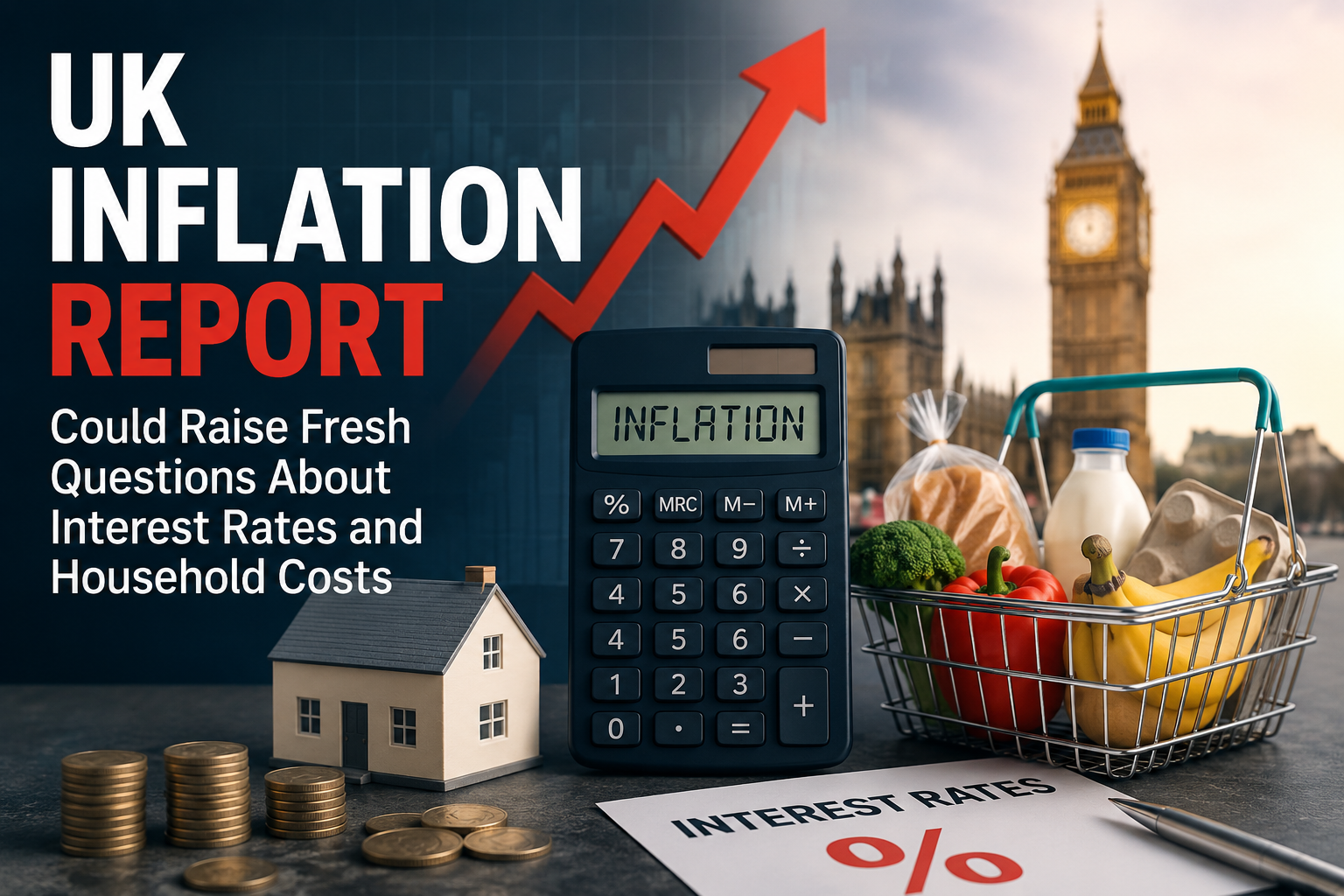
UK Inflation Report Could Raise Fresh Questions About Interest Rates and Household Costs
The latest UK inflation figures could put renewed attention on the direction of interest rates, household budgets and the outlook for borrowing costs.
For households already dealing with higher everyday expenses, even relatively small changes in inflation can have meaningful consequences. Mortgage payments, rents, food, energy, transport and other regular costs all influence how much money families have left after essential spending.
For savers and borrowers alike, the inflation picture also matters because it can influence the decisions made by the Bank of England on interest rates.
Why the UK Inflation Rate Matters
Inflation measures how quickly the prices of goods and services are rising over time. In the UK, the Consumer Prices Index (CPI) is the main measure used to track consumer price inflation.
When inflation remains above the Bank of England’s target, policymakers can face a difficult balancing act. Higher interest rates can help reduce inflationary pressure by making borrowing more expensive and encouraging households and businesses to spend less. However, higher rates can also increase financial pressure on borrowers.
When inflation falls, the opposite can happen. Lower inflation can give policymakers more room to consider reducing interest rates if other economic conditions support such a move.
That means an inflation report is important not only because of what it says about prices today, but also because of what it could imply for monetary policy in the months ahead.
What Could Happen to Interest Rates?
The Bank of England does not respond mechanically to a single inflation reading.
Policymakers consider a broad range of information, including inflation, wage growth, economic activity, employment and other measures of underlying price pressure.
This means that a higher-than-expected inflation figure would not automatically mean interest rates have to rise. Likewise, weaker inflation would not necessarily guarantee an immediate rate cut.
Instead, investors and households tend to look for signs about the direction of travel.
If inflation proves more persistent than expected, markets could begin to anticipate that interest rates will remain higher for longer. If price pressures continue easing, expectations for future rate reductions could strengthen.
Why Borrowers Are Watching Closely
Interest rates have a particularly direct effect on people with variable-rate borrowing.
For mortgage borrowers, the impact depends heavily on the type of mortgage they have. People on fixed-rate deals may be temporarily insulated from changes in the Bank of England’s policy rate, while those on variable or tracker rates can see borrowing costs change more quickly.
Households refinancing after a fixed-rate period can also face a significant change in monthly payments if available mortgage rates are higher than the rate on their previous deal.
Other forms of borrowing can be affected too.
Credit cards, personal loans and other forms of consumer credit may become more expensive when borrowing costs remain elevated. This can put additional pressure on households that are already relying on credit to manage higher living expenses.
Household Costs Remain More Complicated Than One Inflation Number
One of the most important points for consumers is that a falling inflation rate does not mean prices are falling.
If inflation declines from one month to another, it generally means prices are increasing more slowly than before.
For example, if the annual inflation rate falls from 4% to 3%, prices are still rising overall. They are simply rising at a slower pace.
This distinction can be easy to overlook.
A household may therefore continue to feel financial pressure even when headline inflation improves. Previous price increases can leave food, housing, transport and other essentials at substantially higher levels than they were several years earlier.
For families, the question is often not simply whether inflation is falling, but whether income is catching up with the cost of maintaining their normal standard of living.
Food and Energy Costs Can Shape Household Budgets
Essential spending tends to receive particular attention when households assess inflation.
Food is a major component of many family budgets, meaning persistent increases in grocery prices can have a noticeable effect even when other categories become more stable.
Energy costs can also influence household finances, although their contribution to inflation can change significantly depending on wholesale prices, government policies and regulatory adjustments.
Transport, housing and services can add further pressure.
This is why consumers can experience their own personal inflation rate that differs considerably from the national headline figure.
A household spending heavily on rent, food and transport may feel price increases more strongly than another household with different spending patterns.
Savers Face a Different Question
Interest rates do not only affect borrowers.
People with savings also pay close attention to inflation because it determines the purchasing power of their money.
A savings account paying 4% interest may appear attractive, but if inflation is also running at a relatively high level, the real increase in purchasing power can be much smaller than the headline interest rate suggests.
This is particularly important for people holding substantial cash savings over long periods.
Savers therefore need to consider both:
- The interest rate being earned
- The rate at which consumer prices are increasing
The difference between the two is often described in terms of the real return.
What Inflation Could Mean for Household Budgets
Regardless of what happens to interest rates, households can use the inflation environment as an opportunity to reassess their finances.
A practical review could include:
Review Fixed Expenses
Look at recurring costs such as insurance, subscriptions, utilities, broadband and other regular bills.
Even modest reductions in several monthly expenses can create additional room in a household budget.
Reassess Debt Costs
Borrowers should understand whether their loans have fixed or variable rates and when any introductory or fixed-rate period ends.
Knowing when a payment could change makes it easier to plan ahead.
Protect Emergency Savings
An emergency fund can provide a buffer against unexpected bills, temporary income disruption or sudden increases in essential expenses.
The appropriate amount varies from household to household, depending on income stability, existing commitments and financial circumstances.
Compare Savings Rates
As interest rates change, the most competitive savings options can change too.
People holding cash should periodically check whether their savings are earning a competitive rate while considering access requirements, account restrictions and tax implications.
Watch Spending Categories
Rather than focusing only on the headline inflation number, households can track the categories that account for most of their own spending.
This can provide a more useful picture of personal financial pressure.
Why Wage Growth Matters Too
Inflation cannot be considered in isolation from earnings.
If wages rise faster than consumer prices, households may experience an improvement in real purchasing power. If prices continue increasing faster than wages, households may find it harder to maintain their previous standard of living.
Wage growth is therefore closely watched by policymakers.
Strong wage growth can support household finances, but if wage pressures remain elevated, policymakers may also consider whether they could contribute to persistent inflation in some parts of the economy.
This creates another difficult balancing act for the Bank of England.
The Bigger Question for the UK Economy
The significance of an inflation report extends beyond mortgages and supermarket bills.
Interest rates influence business investment, housing activity, consumer spending, savings decisions and the wider economy.
If inflation remains stubbornly high, policymakers may have less flexibility to reduce borrowing costs.
If inflation continues to moderate while economic activity weakens, pressure for lower interest rates could become stronger.
The challenge is finding a level of monetary policy that keeps inflation under control without placing unnecessary strain on economic growth and household finances.
What Households Should Watch Next
The most useful approach is to avoid making major financial decisions based on a single economic release.
Instead, households can watch several indicators together:
- The latest CPI inflation reading
- Core inflation measures
- Services inflation
- Wage growth
- Bank of England interest-rate decisions
- Mortgage and savings rates
- Energy and food-price trends
- Employment conditions
- Household income growth
Together, these indicators provide a much clearer picture of the financial environment than any single headline figure.
What the Inflation Report Could Mean for Consumers
The next inflation figures could influence expectations around interest rates, but the effect on individual households will depend on their circumstances.
Borrowers may be particularly interested in whether rates could remain elevated or eventually move lower. Savers will want to know whether attractive deposit rates can continue. Meanwhile, families managing everyday expenses will remain focused on whether wages and household budgets are keeping pace with the cumulative increase in prices.
The most important takeaway is that slowing inflation is not the same as falling prices. Even if the rate of price growth continues to moderate, households may still need to manage a cost base that is considerably higher than it was several years ago.
For consumers, the best response is therefore not to try to predict the next interest-rate decision, but to understand how changes in inflation and borrowing costs affect their own budgets—and prepare for different economic scenarios.


2 Comments
Micle harison
June 7, 2019Lorem ipsum dolor sit amet, usu ut perfecto postulant deterruisset, libris causae volutpat at est, ius id modus laoreet urbanitas. Mel ei delenit dolores.
John Doe
June 7, 2019Some consultants are employed indirectly by the client via a consultancy staffing company.