
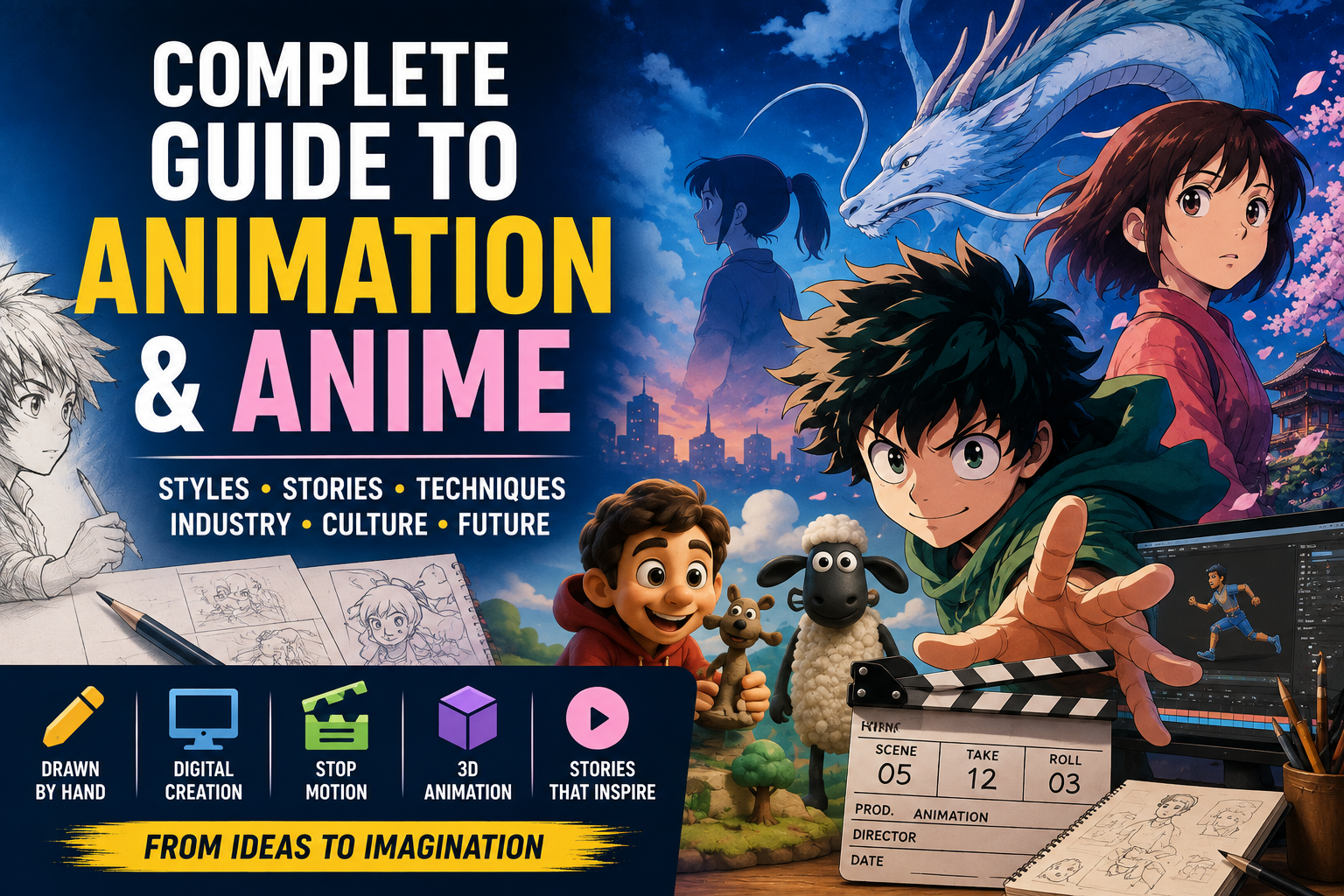
Complete Guide to Animation and Anime
Animation is one of the most versatile forms of storytelling ever created. It can bring imaginary worlds to life, visualize ideas that would be impossible to film conventionally, and tell stories across virtually every genre and age group.
Anime, meanwhile, has become one of the most recognizable branches of global animation culture. Although the word is commonly associated with Japanese animated productions, anime encompasses a remarkably diverse range of stories, artistic approaches and audiences.
From hand-drawn classics and stop-motion films to computer-generated characters and Japanese television series, animation has evolved dramatically while retaining its fundamental ability to turn still images into the perception of movement.
This complete guide explains what animation is, how it works, the major types of animation, what makes anime distinctive, how animated productions are created, and why animation continues to matter in modern entertainment.
What Is Animation?
Animation is the process of creating the appearance of movement by displaying a sequence of images, drawings, models or computer-generated frames.
Instead of recording movement continuously in the same way as live-action film, animators create individual visual states that, when presented sequentially, give viewers the impression that objects and characters are moving.
Animation can be created using many different techniques, including:
- Hand-drawn animation
- Computer-generated animation
- Stop-motion animation
- Cutout animation
- Motion graphics
- Clay animation
- Puppet animation
- Experimental techniques
- Hybrid animation
The fundamental principle remains similar: a sequence of visual changes is presented rapidly enough for the viewer to perceive continuous movement.
What Is Anime?
Anime is the Japanese term commonly used to describe animation.
Outside Japan, however, the term is generally used specifically for Japanese animation and animation strongly associated with Japanese production and artistic traditions.
Anime can include:
- Television series
- Feature films
- Short films
- Web productions
- Direct-to-video productions
- Music videos
- Commercial animation
Anime is not a single genre.
It can be:
- Action
- Comedy
- Romance
- Science fiction
- Fantasy
- Horror
- Mystery
- Drama
- Sports
- Historical
- Psychological
- Slice of life
- Adventure
This is one of the most important things for newcomers to understand.
Anime describes a form and cultural tradition of animation, not one particular type of story.
Animation vs. Anime
The terms are related, but they are not interchangeable.
| Animation | Anime |
|---|---|
| Broad medium | A specific animation tradition and industry |
| Produced worldwide | Strongly associated with Japan |
| Includes many techniques | Often associated with distinctive Japanese visual and storytelling conventions |
| Covers children’s and adult entertainment | Covers audiences ranging from children to adults |
| Includes films, television, games and advertising | Includes films, television, web series and other formats |
A Japanese animated film is animation, but animation produced in France, the United States, South Korea or elsewhere is not necessarily anime.
The distinction can become more complicated with international co-productions and modern global production pipelines.
How Does Animation Work?
At its simplest, animation works by presenting a series of images in rapid succession.
Each frame represents a slightly different state.
For example:
Frame 1: A character’s arm is down.
Frame 2: The arm moves upward.
Frame 3: The arm moves farther upward.
Frame 4: The arm reaches the desired position.
When these frames are displayed sequentially, the viewer perceives movement.
Animators don’t necessarily need to create every frame from scratch. Depending on the technique, software and production style, some movement can be interpolated, reused or generated through digital tools.
What Is Frame Rate?
Frame rate refers to the number of individual frames displayed per second.
It is usually expressed as frames per second (fps).
Different productions can use different frame rates.
Higher frame rates can provide smoother apparent movement, but smoothness isn’t the only factor that determines animation quality.
Animators can deliberately vary the number of drawings used for a movement to create a particular artistic effect.
Anime, for example, has historically made extensive use of limited animation techniques, allowing productions to create compelling storytelling without animating every element continuously at a high frame rate.
What Is Limited Animation?
Limited animation reduces the number of unique drawings or moving elements required for a sequence.
Instead of moving everything in every frame, animators might:
- Keep backgrounds static
- Move only a character’s mouth
- Pan across a still illustration
- Animate a character’s eyes
- Reuse certain movements
- Move only one body part
- Hold a pose for several frames
This approach can reduce production requirements while creating distinctive visual rhythms.
Limited animation should not automatically be interpreted as poor animation.
It can be an intentional artistic and production technique.
The Major Types of Animation
Animation has developed into numerous techniques.
The most important categories include traditional animation, 2D digital animation, 3D computer animation and stop motion.
Traditional Animation
Traditional animation typically involves creating individual drawings that are photographed or digitally captured in sequence.
Historically, many productions used transparent sheets called cels, which allowed characters and foreground elements to be placed over separately prepared backgrounds.
Traditional animation can produce highly expressive movement and remains an important part of animation history.
Hand-Drawn Animation
Hand-drawn animation involves creating visual frames by drawing characters, environments and objects.
It can be extremely labor-intensive because movement must be planned across many drawings.
However, hand-drawn animation offers artists a high degree of control over:
- Shape
- Expression
- Timing
- Movement
- Composition
- Artistic style
Many influential animated films and television productions were built around hand-drawn techniques.
2D Digital Animation
Digital tools transformed traditional 2D workflows.
Artists can now create drawings using:
- Graphics tablets
- Digital illustration software
- Animation software
- Vector graphics
- Digital compositing systems
Digital animation retains many principles of traditional animation while making editing, coloring, compositing and revisions easier.
3D Computer Animation
3D animation uses computer-generated models and environments.
A typical 3D production may involve:
- Modeling
- Texturing
- Rigging
- Animation
- Lighting
- Rendering
- Compositing
Unlike a hand-drawn character, a 3D character can be constructed as a digital model and manipulated repeatedly.
This makes 3D animation particularly useful for complex environments, camera movements and reusable characters.
What Is Stop-Motion Animation?
Stop motion creates movement by physically manipulating objects and photographing them one frame at a time.
A typical process might look like:
Position object → Take photograph → Move object slightly → Take another photograph → Repeat
When the photographs are played sequentially, the object appears to move.
Stop-motion productions can use:
- Clay figures
- Puppets
- Models
- Paper
- Household objects
- Miniature sets
The physical nature of the technique gives stop-motion a distinctive visual character.
Clay Animation
Clay animation, often called claymation, uses moldable materials to create characters and objects.
The animator changes the character’s position slightly between photographs.
Clay animation can create highly expressive characters because the material itself can be reshaped between frames.
Cutout Animation
Cutout animation uses flat shapes or pieces of material that are moved between frames.
Modern digital software can simulate the same technique electronically.
Cutout animation can produce distinctive graphic styles while simplifying certain aspects of production.
Motion Graphics
Motion graphics focuses on animating:
- Text
- Logos
- Shapes
- Charts
- Icons
- Diagrams
- Graphic elements
Motion graphics are widely used in:
- Advertising
- Television
- Presentations
- Educational content
- Film titles
- News programming
- Social media
Unlike character animation, motion graphics often prioritize information and visual communication.
The Principles of Animation
Animators rely on a collection of foundational principles to create convincing movement.
These principles help determine how characters and objects behave on screen.
Some of the best-known principles include:
- Squash and stretch
- Anticipation
- Staging
- Straight-ahead action
- Pose-to-pose animation
- Follow-through
- Overlapping action
- Slow in and slow out
- Arcs
- Secondary action
- Timing
- Exaggeration
- Solid drawing
- Appeal
These concepts remain relevant even when animation is created entirely with modern software.
Squash and Stretch
Squash and stretch communicate weight, flexibility and impact.
For example, a bouncing ball might become slightly wider when it hits the ground and slightly elongated as it accelerates upward.
The object changes shape without appearing to lose its identity.
This principle helps animation feel more dynamic.
Anticipation
Anticipation prepares the viewer for an action.
Before jumping, for example, a character may crouch.
Before throwing a ball, the character may move the arm backward.
These preparatory movements make the main action easier to understand.
Timing and Spacing
Timing refers broadly to how long an action takes.
Spacing refers to the distance between positions across successive frames.
Together, they influence how movement feels.
Fast movement can suggest:
- Energy
- Urgency
- Lightness
Slower movement can communicate:
- Weight
- Hesitation
- Sadness
- Tension
- Deliberation
Changing timing can completely alter the emotional meaning of the same action.
Character Animation
Character animation is the process of bringing fictional or stylized characters to life.
A successful animated character needs more than an appealing design.
Animators need to consider:
- Personality
- Body language
- Facial expressions
- Movement patterns
- Timing
- Emotional reactions
- Character relationships
A character’s movement should often reflect who they are.
A confident character might move differently from a nervous character even when both perform the same action.
Facial Animation
Facial expressions communicate information that dialogue cannot always convey.
Animators work with:
- Eyes
- Eyebrows
- Mouth
- Head position
- Subtle facial movements
A small change in expression can communicate:
- Surprise
- Fear
- Anger
- Happiness
- Confusion
- Suspicion
- Sadness
Strong facial animation helps audiences connect emotionally with characters.
What Makes Anime Distinctive?
Anime encompasses many visual styles, so there is no single formula.
However, anime is often associated with characteristics such as:
- Stylized character designs
- Strong facial expressions
- Detailed environments
- Dramatic composition
- Distinctive color palettes
- Emphasis on atmosphere
- Carefully timed action
- Extensive use of visual symbolism
Some anime productions are highly detailed, while others use relatively simple designs.
The medium is diverse enough that generalizations should be treated carefully.
Common Anime Character Design Features
Many anime styles use recognizable visual conventions.
These can include:
- Large or expressive eyes
- Simplified facial structures
- Stylized hair
- Exaggerated expressions
- Distinctive silhouettes
- Strong costume designs
However, anime character design varies enormously.
Different studios, artists, periods and genres can produce radically different approaches.
Why Are Anime Eyes Often Large?
Large eyes became associated with some forms of Japanese animation and manga partly because they provide a large area for expressing emotion.
The eyes can communicate subtle changes in:
- Attention
- Mood
- Surprise
- Fear
- Excitement
But not all anime characters have large eyes.
Character design varies according to artistic style and intended effect.
Anime and Manga
Anime and manga are closely connected but are not the same medium.
Manga generally refers to Japanese comics and graphic storytelling.
Anime refers to animation.
Many anime series are adaptations of manga, but anime can also be based on:
- Original screenplays
- Light novels
- Video games
- Visual novels
- Other forms of media
Likewise, manga can exist independently without receiving an animated adaptation.
What Are Anime Genres?
Anime covers a wide range of genres.
Action Anime
Focuses heavily on physical conflict, adventure and high-energy sequences.
Romance Anime
Centers on relationships, emotional development and romantic experiences.
Comedy Anime
Uses humor as a major storytelling element.
Horror Anime
Explores fear, suspense and unsettling themes.
Science Fiction Anime
Explores concepts involving technology, space, artificial intelligence and speculative societies.
Fantasy Anime
Uses magical, mythical or supernatural settings.
Sports Anime
Focuses on athletic competition, training and personal development.
Slice-of-Life Anime
Often focuses on ordinary experiences, relationships and everyday life.
Mystery Anime
Builds stories around secrets, investigations and unanswered questions.
Psychological Anime
Explores internal conflict, perception, identity and complex emotional themes.
Many series combine several of these categories.
Demographics and Anime
Anime is sometimes categorized using demographic labels associated with the manga industry.
Common terms include:
- Shonen
- Shojo
- Seinen
- Josei
- Kodomo
These terms broadly indicate intended demographic audiences rather than strict genres.
For example, a shonen work may contain action, comedy, fantasy or sports elements.
Likewise, josei works can encompass romance, drama, comedy and other themes.
Understanding this distinction helps newcomers avoid treating demographic categories as genres.
How Anime Is Made
Anime production can involve hundreds of artists, technicians and other professionals.
A simplified production pipeline may include:
- Planning
- Script development
- Storyboarding
- Character design
- Background design
- Layout
- Key animation
- In-between animation
- Coloring
- Background art
- Compositing
- Sound
- Voice recording
- Editing
- Final delivery
The exact workflow varies between productions.
What Is Storyboarding?
Storyboarding converts a script or concept into a sequence of visual shots.
A storyboard can communicate:
- Camera angles
- Character positions
- Movement
- Timing
- Dialogue
- Scene transitions
- Visual composition
It acts as a bridge between the written story and the final animation.
What Is Key Animation?
Key animation establishes the most important poses or positions within a movement.
For example, if a character jumps, key animators may establish:
- Preparation pose
- Takeoff
- Peak of jump
- Landing
Other animation work can then fill in the movement between those important poses.
What Is In-Between Animation?
In-between animation fills the frames between major key poses.
Its purpose is to create smooth and controlled transitions.
The relationship between key animation and in-between work is fundamental to many traditional animation pipelines.
Background Art in Animation
Characters don’t exist in empty space.
Background artists create:
- Buildings
- Landscapes
- Rooms
- Streets
- Natural environments
- Fantasy worlds
Detailed environments can establish atmosphere and communicate information about the world in which a story takes place.
Sound and Voice Acting
Animation isn’t purely visual.
Sound can dramatically change how an animated scene feels.
Important components include:
- Voice acting
- Music
- Sound effects
- Ambient sound
- Silence
Voice actors help establish character identity and emotion.
Sound designers create effects that make actions feel believable.
Music can reinforce tension, excitement, sadness or wonder.
The Importance of Voice Acting in Anime
Japanese anime traditionally features voice actors known as seiyu.
Voice performances can become strongly associated with characters.
The same anime may later receive a dubbed version in another language, requiring a new cast of voice performers.
Both original-language performances and dubbed versions can develop dedicated audiences.
Subtitles vs. Dubbing
Viewers commonly encounter two major localization options.
Subtitles
The original spoken dialogue remains while translated text appears on screen.
Advantages can include:
- Preserving original performances
- Hearing the original language
- Faster localization in some cases
Dubbing
The dialogue is re-recorded in another language.
Advantages can include:
- Easier viewing without reading subtitles
- Accessibility for some viewers
- Greater localization of dialogue
Neither approach is universally superior.
Personal preference plays a major role.
What Is Anime Localization?
Localization adapts a production for audiences in another market.
This can involve:
- Translation
- Dubbing
- Subtitles
- Cultural references
- Marketing
- Promotional materials
- Product descriptions
Good localization aims to preserve the original meaning while making the work understandable and natural for the target audience.
Why Animation Works Across Cultures
Animation has a major advantage: it isn’t restricted by physical reality.
Creators can construct:
- Entire fictional worlds
- Impossible creatures
- Imaginary technologies
- Alternative histories
- Abstract environments
- Exaggerated physical movement
This flexibility allows animation to communicate ideas that might be expensive, dangerous or impossible to reproduce through live action.
Animation for Children and Adults
One of the biggest misconceptions about animation is that it is exclusively children’s entertainment.
Animation can target virtually any age group.
Animated works can explore:
- Family relationships
- Politics
- Philosophy
- War
- Identity
- Grief
- Romance
- Social issues
- Science
- History
- Psychological themes
The appropriate audience depends on the content, not simply the fact that something is animated.
Animation in Education
Animation isn’t limited to entertainment.
It is also used for education because moving visuals can demonstrate concepts that are difficult to communicate through static images.
Examples include:
- Scientific processes
- Medical concepts
- Engineering systems
- Historical events
- Mathematical ideas
- Technical procedures
Animated diagrams can show processes step by step and make abstract systems easier to visualize.
Animation in Advertising
Brands use animation to communicate ideas through:
- Commercials
- Explainer videos
- Product demonstrations
- Motion graphics
- Social media content
- Brand identities
Animation allows advertisers to control virtually every visual element.
This can be particularly useful when the product or concept is abstract.
Animation in Video Games
Modern video games depend heavily on animation.
Game animation can include:
- Character movement
- Facial expressions
- Combat
- Environmental movement
- Physics
- Interface animations
- Cinematic sequences
Unlike film animation, game animation must often respond dynamically to player input.
This creates additional technical and creative challenges.
Animation and Visual Effects
Animation and visual effects overlap but are not identical.
Animation typically involves creating movement through drawn, modeled or digitally generated imagery.
Visual effects often combine filmed footage with computer-generated elements.
Modern productions can combine both extensively.
For example, a live-action film might include a completely computer-generated creature interacting with human actors.
How Computer Animation Changed the Industry
Computer technology dramatically expanded what animators can do.
Digital systems allow artists to:
- Edit scenes quickly
- Reuse assets
- Create complex camera movements
- Simulate physical effects
- Adjust lighting
- Modify colors
- Generate large environments
- Render complex characters
At the same time, technology has not eliminated the need for artistic judgment.
Software provides tools.
Artists still decide what those tools should create.
Artificial Intelligence and Animation
AI is increasingly being explored for animation-related tasks.
Potential applications include:
- Concept development
- Image generation
- Motion assistance
- Lip synchronization
- Background generation
- In-betweening
- Asset creation
- Production assistance
However, AI-assisted animation also raises questions about:
- Copyright
- Training data
- Artist compensation
- Attribution
- Creative ownership
- Quality control
- Human oversight
The long-term impact of AI on animation will depend not only on technical capability but also on how studios, artists, audiences and regulators address these issues.
Why Animation Remains Relevant
Animation continues to evolve because it can adapt to new technology without losing its fundamental storytelling strengths.
Today, animation appears across:
- Cinema
- Television
- Streaming
- Social media
- Video games
- Advertising
- Education
- Virtual reality
- Augmented reality
- Digital experiences
Its flexibility makes it useful far beyond traditional animated films.
How to Start Watching Anime
For someone new to anime, the sheer number of available series can be overwhelming.
A better approach is to start with your interests.
If you enjoy:
Fantasy: Look for fantasy-focused stories.
Sports: Try sports-centered anime.
Mystery: Explore investigative or psychological series.
Romance: Look for relationship-driven stories.
Science fiction: Explore futuristic or technology-focused works.
Comedy: Begin with lighter productions.
Don’t assume that the most popular series is automatically the best starting point for you.
How to Choose Anime for Different Audiences
Before recommending an anime, consider:
- Age suitability
- Genre preferences
- Violence
- Sexual content
- Horror elements
- Runtime
- Episode count
- Story complexity
- Language preferences
Some anime are appropriate for broad audiences, while others are specifically intended for mature viewers.
Checking content information before watching can prevent unpleasant surprises.
How Long Does It Take to Make Animation?
Production time varies dramatically.
A short animation may take days or months.
A television series can require many months of planning and production.
A major feature film can take several years.
The timeline depends on:
- Length
- Animation style
- Number of characters
- Complexity
- Production budget
- Number of animators
- Revisions
- Rendering requirements
- Distribution schedule
High-quality animation is often far more labor-intensive than audiences realize.
Common Animation Misconceptions
“Animation Is Only for Children”
False.
Animation encompasses content for children, teenagers and adults.
“Anime Is a Genre”
Not exactly.
Anime is a broad animation category and cultural tradition containing many genres.
“All Anime Looks the Same”
It doesn’t.
Styles vary enormously across creators, studios and eras.
“Computer Animation Requires No Artistic Skill”
Computer software still requires artists to understand movement, composition, design, storytelling and visual communication.
“Higher Frame Rates Always Mean Better Animation”
Not necessarily.
Timing, spacing, posing and artistic intent can matter more than simply increasing frame count.
“Hand-Drawn Animation Is Completely Obsolete”
Traditional techniques remain influential, and many modern digital workflows continue to use principles derived from hand-drawn animation.
The Future of Animation and Anime
The animation industry is likely to continue evolving alongside advances in computing, distribution and interactive entertainment.
Several developments could shape the future:
Real-Time Rendering
More animation may be produced using technologies capable of rendering scenes rapidly.
AI-Assisted Production
AI tools may increasingly assist with repetitive production tasks while human artists retain creative control.
Virtual Production
Animation techniques may become more closely integrated with real-time 3D environments and virtual filmmaking.
Interactive Animation
Stories may increasingly allow audiences to influence characters, environments or narrative outcomes.
Global Collaboration
International production teams are already common, and cross-border collaboration is likely to expand further.
New Distribution Platforms
Animation can reach audiences through streaming services, social platforms, games and immersive technologies rather than traditional television and cinema alone.
How to Appreciate Animation More Deeply
Once you understand the fundamentals, watching animation can become a different experience.
Pay attention to:
- Character movement
- Timing
- Background detail
- Camera movement
- Lighting
- Color
- Sound design
- Facial expressions
- Composition
- Transitions
- Visual symbolism
Instead of simply asking whether something “looks good,” consider why the animator made a particular choice.
A character standing completely still can sometimes communicate more tension than an elaborate action sequence.
A change in color can indicate a shift in mood.
A carefully timed pause can make a joke work.
Animation is often most effective when visual decisions support the story.
Animation Is More Than Moving Pictures
Animation has grown from hand-drawn sequences and physical models into a vast creative industry encompassing digital filmmaking, television, games, advertising, education and interactive experiences.
Anime represents one of the world’s most influential animation traditions, but its diversity demonstrates why it should not be reduced to a single visual style or genre.
Whether created with pencil and paper, clay, 3D software or a combination of technologies, animation ultimately depends on the same fundamental principle: using controlled visual change to communicate movement, emotion and ideas.
For audiences, that means there is almost no limit to what animation can explore.
For creators, it offers a storytelling language in which the rules of the physical world can be rewritten.
And for the entertainment industry, that flexibility ensures that animation—and the many cultures and creative traditions surrounding it—will remain an important part of storytelling for generations to come.



2 Comments
Micle harison
June 7, 2019Lorem ipsum dolor sit amet, usu ut perfecto postulant deterruisset, libris causae volutpat at est, ius id modus laoreet urbanitas. Mel ei delenit dolores.
John Doe
June 7, 2019Some consultants are employed indirectly by the client via a consultancy staffing company.