
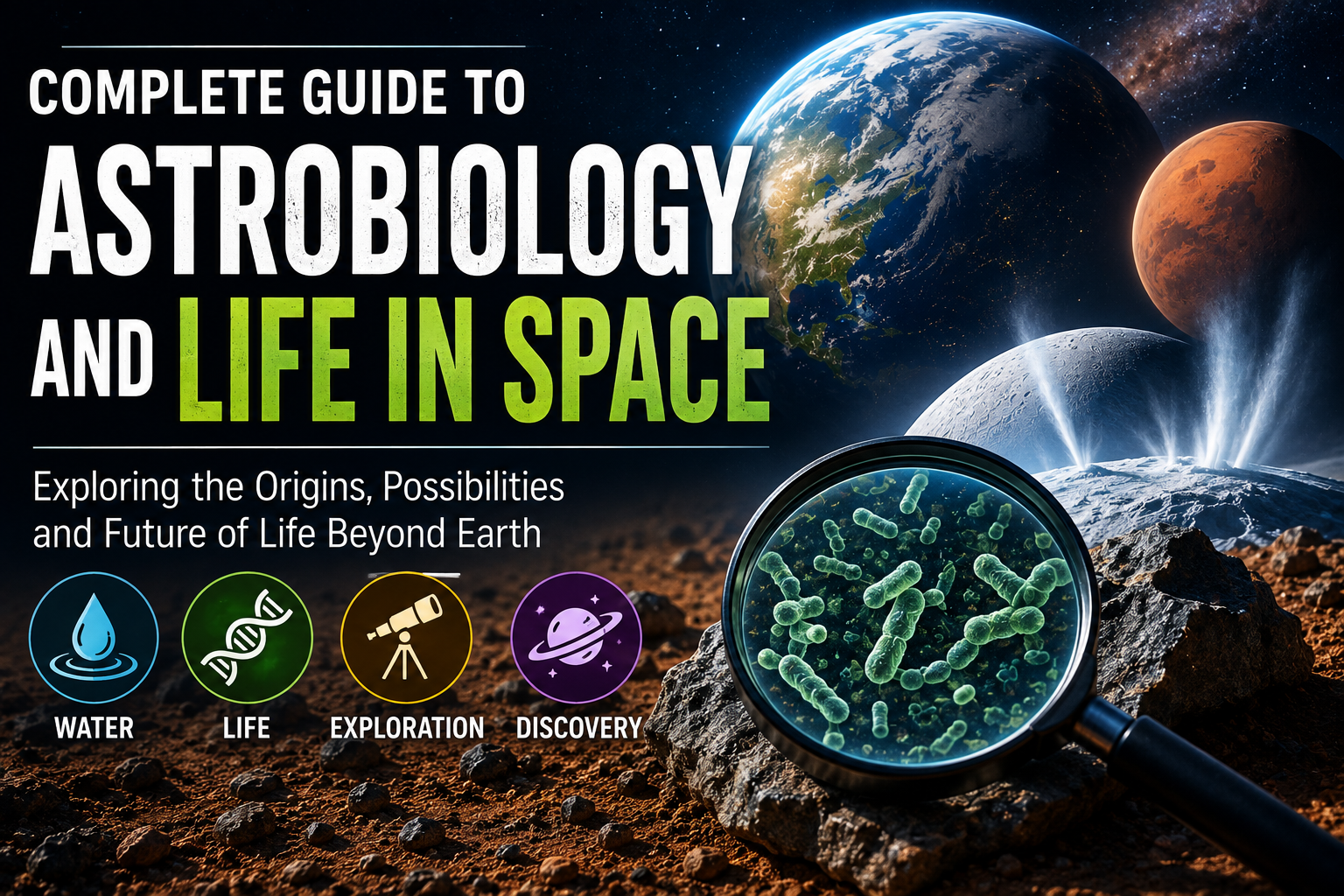
Complete Guide to Astrobiology and Life in Space
Are we alone in the universe?
It is one of humanity’s oldest questions, but today it is also a serious scientific problem. Researchers are studying planets, moons, meteorites, ancient rocks, atmospheric chemistry and extreme environments on Earth to understand whether life could exist beyond our planet.
This field is known as astrobiology.
Astrobiology brings together astronomy, biology, chemistry, geology, planetary science, physics and other disciplines to investigate the origin, evolution, distribution and future of life in the universe. NASA describes the field around several fundamental questions: how life begins and evolves, whether life exists beyond Earth and how we could detect it, and what the future of life might look like. (NASA Science)
The search is not simply about finding intelligent extraterrestrials. Scientists are also looking for microscopic organisms, ancient traces of biological activity and chemical environments that could support life.
This complete guide explains what astrobiology is, what life needs, where scientists are looking, how extraterrestrial life could be detected and why finding even the simplest organism beyond Earth would transform our understanding of life.
What Is Astrobiology?
Astrobiology is the scientific study of life in the universe, including its origins, evolution, distribution and potential future.
It asks questions such as:
- How did life begin on Earth?
- Could life have originated elsewhere?
- What environments can support life?
- Could life survive on other planets or moons?
- What evidence would prove that extraterrestrial life exists?
- How can scientists distinguish biological activity from non-biological chemistry?
- Could intelligent civilizations exist elsewhere?
- How common might life be throughout the universe?
Astrobiology starts with the only example of life currently known: Earth.
By studying Earth’s organisms, ancient environments and extreme habitats, scientists can establish realistic hypotheses about what life might require elsewhere.
NASA emphasizes that studying life in extreme environments on Earth is particularly useful because organisms have demonstrated remarkable adaptability in places such as polar regions, deserts and the deep ocean. (NASA)
Why Is the Search for Life Important?
Finding extraterrestrial life would answer one of the most profound scientific questions humans have ever asked.
But the significance would extend far beyond simply proving that aliens exist.
A discovery of life elsewhere could help scientists understand:
The Origin of Life
If life independently emerged on another world, scientists could compare its biology with Earth’s.
The Limits of Biology
Life elsewhere might survive under conditions previously considered extremely challenging.
Planetary Evolution
Life can change its environment, while planetary conditions can influence biological evolution.
The Uniqueness of Earth
Discovering that life is widespread would suggest Earth may be one example of a much broader cosmic phenomenon.
The Probability of Life
A second independent origin of life would provide an enormously important data point for estimating how frequently life develops.
What Does Life Need?
Scientists don’t have a universal definition of extraterrestrial life because Earth is the only planet known to contain life.
Instead, researchers study the characteristics shared by terrestrial organisms.
Life on Earth generally requires some combination of:
- A source of energy
- Chemical building blocks
- A suitable environment
- A medium in which chemical reactions can occur
- Mechanisms for maintaining and reproducing biological systems
Liquid water is particularly important in the search because all known terrestrial life depends on it.
However, scientists are careful not to assume that extraterrestrial life must be identical to organisms on Earth.
An alien ecosystem could potentially operate under conditions significantly different from those familiar to humans.
Why Water Matters So Much
Water is one of the most important substances in astrobiology.
It is an excellent solvent and participates in many chemical reactions required by terrestrial biology.
Scientists therefore pay close attention to worlds where liquid water could exist or may exist beneath a surface.
This doesn’t mean that finding water automatically means finding life.
Water is a habitability clue, not proof of biology.
A world can contain water and still be completely lifeless.
What Is a Habitable World?
A habitable world is generally one that has environmental conditions that could potentially support life.
Habitability can involve several factors:
- Temperature
- Availability of liquid water
- Energy sources
- Chemical ingredients
- Atmospheric conditions
- Long-term environmental stability
- Protection from harmful radiation
Importantly, habitable does not mean inhabited.
Scientists may identify an environment as potentially habitable without having evidence that life actually exists there.
NASA’s astrobiology program studies both potentially habitable environments within our Solar System and planets orbiting other stars. (NASA Science)
The Habitable Zone Explained
One of the most widely discussed concepts in astrobiology is the habitable zone, sometimes called the circumstellar habitable zone.
It is the region around a star where conditions could potentially allow liquid water to exist on the surface of a suitable planet.
The concept is useful, but it has limitations.
A planet’s habitability depends on much more than its distance from its star.
Atmospheric composition, pressure, cloud cover, geological activity and other factors can dramatically change a planet’s surface environment.
For that reason, being inside a star’s habitable zone does not prove that a planet is habitable.
Can Life Exist Without Sunlight?
Yes.
Earth provides an important example.
Deep beneath the ocean, ecosystems exist around hydrothermal vents where sunlight does not directly power biological communities.
Some organisms obtain energy through chemical reactions rather than photosynthesis.
This process, known as chemosynthesis, has expanded scientists’ understanding of where life might survive.
It means that a planet or moon doesn’t necessarily need an Earth-like surface illuminated by sunlight to be interesting from an astrobiological perspective.
An underground ocean with chemical energy could potentially be more important than a barren surface.
Extremophiles and the Search for Life
Extremophiles are organisms capable of living in environmental conditions that are extreme by human standards.
Examples of extreme environments on Earth include:
- Very high temperatures
- Extreme cold
- High pressure
- Highly acidic environments
- Highly salty environments
- Low-oxygen environments
- Deep underground habitats
Studying these organisms helps astrobiologists understand the possible limits of life.
If organisms can survive extreme environments on Earth, researchers can investigate whether comparable conditions might exist elsewhere.
This is one reason Earth’s deep oceans, polar regions and subsurface environments are valuable analogues for planetary exploration.
Where Could Life Exist in Our Solar System?
Scientists are investigating several locations within the Solar System.
The most prominent targets include:
- Mars
- Europa
- Enceladus
- Titan
- Other icy moons
- Ancient environments on Venus
- Potential subsurface environments elsewhere
Each world presents a different scientific question.
Mars and the Search for Ancient Life
Mars is one of the most important targets in astrobiology.
Evidence shows that ancient Mars was substantially different from the cold, dry surface environment observed today.
Scientists have found geological evidence indicating that liquid water existed on Mars in the past.
That makes ancient Martian environments important places to investigate for possible evidence of past microbial life.
NASA’s Perseverance rover is examining Martian rocks and collecting samples specifically relevant to understanding ancient environments and potential biosignatures. (NASA Science)
The key question is not simply whether Mars once had water.
It is whether some of those ancient environments also contained conditions suitable for life—and whether traces of that life remain preserved in rocks.
What Is Perseverance Looking For?
NASA’s Perseverance rover is investigating rocks and geological environments in Jezero Crater.
One major objective is to search for potential biosignatures.
A potential biosignature is evidence that could have a biological origin but requires additional investigation before scientists can conclude that life was responsible.
This distinction is extremely important.
Finding an interesting organic molecule or unusual mineral does not automatically mean scientists have discovered life.
Researchers must investigate alternative explanations.
Europa: An Ocean Beneath the Ice
Europa, one of Jupiter’s largest moons, is among the Solar System’s most intriguing astrobiological targets.
Its surface is dominated by an icy shell, while evidence indicates the moon has a global ocean beneath that ice.
That makes Europa particularly interesting because it could contain a substantial amount of liquid water hidden from direct view.
NASA’s Europa Clipper mission is designed to investigate whether Europa has conditions that could support life rather than directly searching for organisms. (NASA Science)
The distinction matters.
Scientists first need to determine whether the moon has the right combination of water, chemistry and energy to create a potentially habitable environment.
Enceladus and Its Hidden Ocean
Saturn’s moon Enceladus is another major astrobiological target.
The small icy moon has a subsurface ocean and has been observed producing plumes of material into space.
Those plumes are scientifically valuable because material from beneath the surface can potentially be studied without drilling through kilometers of ice.
This makes Enceladus an especially compelling example of how planetary geology and astrobiology overlap.
Scientists want to understand whether its underground environment contains the chemical ingredients and energy sources necessary for life.
Titan: A Very Different Kind of World
Titan, Saturn’s largest moon, is unlike Earth in many ways.
It has a thick atmosphere and lakes and seas of liquid hydrocarbons on its surface.
Titan also contains complex organic chemistry.
Although its surface environment is far too cold for Earth-like liquid water, scientists are interested in its chemistry and the possibility of subsurface water.
Titan demonstrates an important principle of astrobiology:
A world does not need to look like Earth to be scientifically fascinating.
Could Venus Have Had Life?
Venus is extremely hostile today.
Its surface has crushing atmospheric pressure and temperatures hot enough to melt some metals.
Yet scientists are interested in whether Venus may have been significantly more temperate in its distant past.
If Venus once possessed more favorable conditions, it raises questions about whether potentially habitable environments could have existed before the planet underwent dramatic climatic changes.
Studying Venus can therefore help researchers understand how planetary environments evolve and how long habitable conditions can persist.
What Is a Biosignature?
A biosignature is a characteristic, substance, structure or pattern that could provide evidence of past or present life.
Potential biosignatures can include:
- Fossil-like structures
- Organic molecules
- Chemical patterns
- Mineral structures
- Isotopic ratios
- Atmospheric gases
- Biological structures
- Environmental changes caused by organisms
NASA notes that biosignatures can be preserved in rocks, water or atmospheres and that scientists must carefully distinguish biological signals from processes that can occur without life. (NASA Science)
Why Finding a Biosignature Is Difficult
The biggest challenge is that nature can imitate biology.
Some chemical reactions can produce molecules that look interesting from a biological perspective.
Volcanic activity can alter atmospheric chemistry.
Geological processes can create unusual mineral structures.
Radiation can modify organic molecules.
Therefore, scientists cannot reasonably conclude that life exists simply because they detect one potentially interesting chemical.
A convincing discovery would ideally involve multiple independent lines of evidence.
Types of Biosignatures
Morphological Biosignatures
These involve physical structures that could have been produced by organisms.
Examples could include:
- Fossils
- Microbial structures
- Distinctive mineral patterns
- Biological textures
Chemical Biosignatures
These involve molecules or chemical distributions associated with biological processes.
Potential examples include:
- Organic compounds
- Unusual molecular distributions
- Isotopic patterns
- Atmospheric gases
Atmospheric Biosignatures
Scientists can analyze the atmospheres of distant planets for combinations of gases that might indicate biological activity.
This is particularly important for exoplanet research.
Oxygen Is Not Automatically Evidence of Life
Oxygen is produced abundantly by life on modern Earth, making it an obvious candidate biosignature.
But oxygen can also be produced through non-biological processes.
That means detecting oxygen in an exoplanet atmosphere would not automatically prove the existence of life.
Scientists instead need to consider:
- What other gases are present?
- How stable is the atmosphere?
- What is the planet’s temperature?
- How much ultraviolet radiation reaches it?
- Could geological processes produce the observed chemistry?
- Are multiple potential biosignatures present?
The context is as important as the individual measurement.
What Are Organic Molecules?
Organic molecules are carbon-containing compounds associated with the chemistry of life, although organic compounds can also form through non-biological processes.
Finding organic molecules elsewhere is therefore exciting but not definitive evidence of life.
Scientists have detected organic compounds in various extraterrestrial environments, including meteorites and planetary materials.
The key scientific question is always:
How were those molecules produced?
Could Alien Life Use DNA?
We don’t know.
All known life on Earth uses genetic information systems involving DNA and RNA, but scientists have only one example of life.
It would therefore be risky to assume extraterrestrial organisms must use exactly the same biological machinery.
Astrobiologists investigate broader chemical principles that could potentially support life rather than limiting the search to Earth-specific biology.
What Is a Technosignature?
A technosignature is a detectable sign of technology produced by an intelligent civilization.
It is related to the broader search for extraterrestrial life but focuses specifically on technological activity.
Potential technosignatures could include:
- Artificial radio signals
- Laser emissions
- Artificial atmospheric chemicals
- Unusual energy signatures
- Large technological structures
- Other detectable effects of advanced technology
NASA describes technosignatures as potential evidence of technological life and notes that researchers have investigated multiple possible forms, including radio signals and artificial atmospheric signatures. (NASA Science)
What Is SETI?
SETI, or the Search for Extraterrestrial Intelligence, is the broader effort to search for evidence of intelligent life beyond Earth.
Traditional SETI research has included searching the sky for unusual radio signals.
Modern approaches can be broader, potentially incorporating:
- Radio astronomy
- Optical observations
- Infrared observations
- Atmospheric spectroscopy
- Unusual stellar behavior
- Other possible technological signatures
So far, there is no confirmed evidence of an extraterrestrial technological civilization.
How Scientists Search for Life on Exoplanets
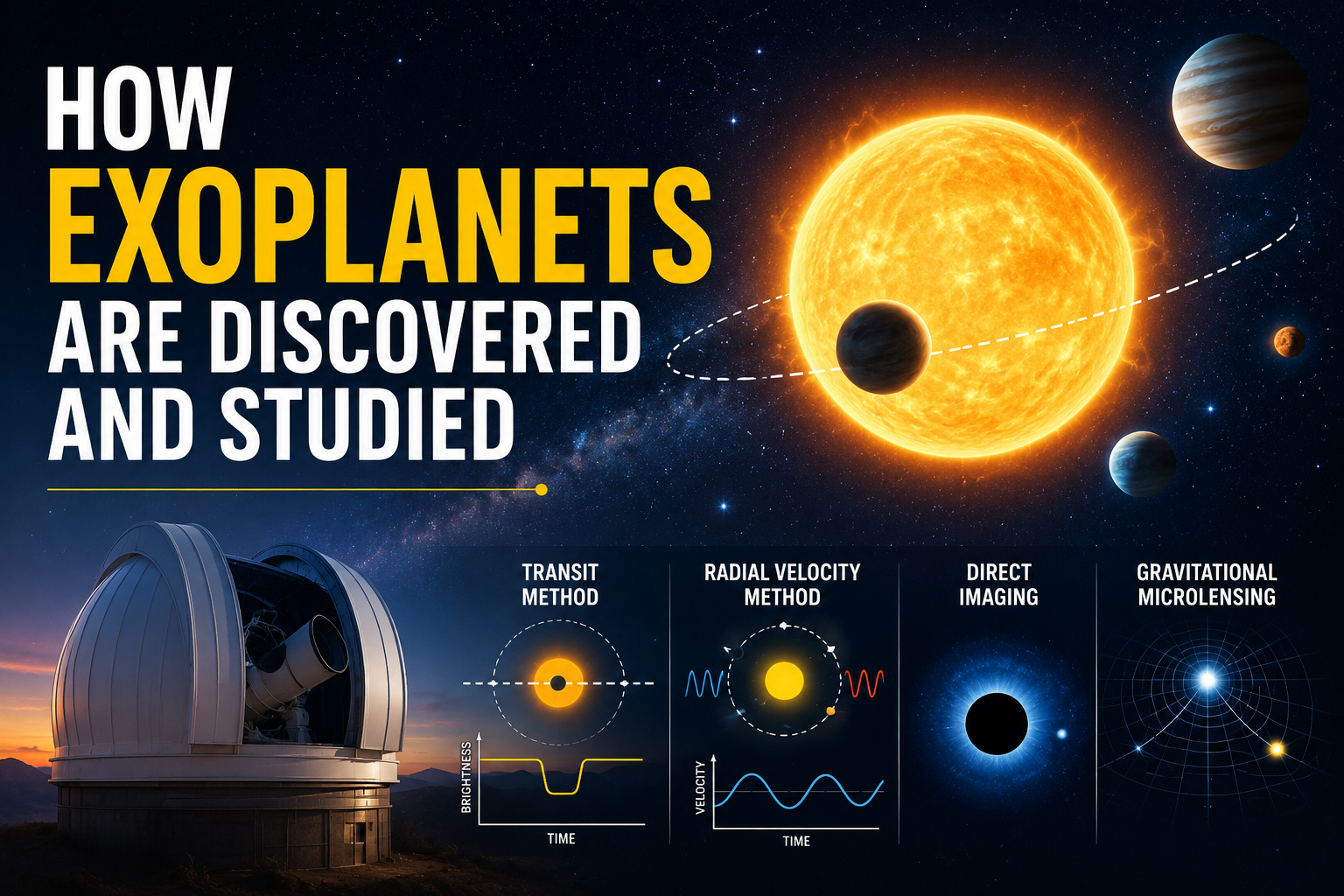
An exoplanet is a planet orbiting a star other than our Sun.
Thousands of exoplanets have been discovered, including worlds with a wide range of sizes and orbital characteristics.
Astrobiologists are particularly interested in planets that may have conditions suitable for life.
One powerful technique involves studying an exoplanet’s atmosphere.
When a planet passes in front of its star from our perspective, some starlight can pass through the planet’s atmosphere.
Molecules in the atmosphere can absorb specific wavelengths of light.
By analyzing those patterns, scientists can infer aspects of atmospheric composition.
NASA notes that increasingly powerful telescopes are opening new opportunities to study exoplanet atmospheres and investigate potential biosignatures. (NASA Science)
The James Webb Space Telescope and Astrobiology
The James Webb Space Telescope (JWST) has expanded scientists’ ability to study distant planetary systems.
Its infrared capabilities allow researchers to investigate exoplanet atmospheres and characterize planetary environments.
This doesn’t mean Webb can simply point at a planet and photograph an alien ecosystem.
Instead, scientists analyze extremely subtle changes in light and spectra.
The ultimate objective is to determine what distant worlds are made of and whether some possess combinations of conditions that could be compatible with life.
Why Spectroscopy Is Important
Spectroscopy is one of the fundamental tools of modern astronomy.
Different atoms and molecules interact with light in characteristic ways.
By splitting light into a spectrum, scientists can look for patterns associated with particular substances.
For exoplanets, spectroscopy can potentially reveal atmospheric components such as:
- Water vapor
- Carbon dioxide
- Methane
- Oxygen-related compounds
- Other gases
Interpreting these signals requires detailed planetary models because the same molecule can have different implications in different environments.
The Drake Equation
The Drake Equation is a framework developed by astronomer Frank Drake to organize thinking about the potential number of detectable technological civilizations in the Milky Way.
It incorporates factors related to:
- Star formation
- Planetary systems
- Potentially habitable planets
- The emergence of life
- Intelligent life
- Technological civilizations
- The longevity of detectable civilizations
The equation does not provide a simple answer to how many civilizations actually exist.
Its greater value is conceptual: it shows how many unknown factors influence the question.
The Fermi Paradox
The Fermi paradox refers to the apparent contradiction between the enormous number of potentially suitable stars and planets in the universe and the absence of confirmed evidence for extraterrestrial civilizations.
If intelligent life is common, why haven’t we detected it?
Possible explanations include:
- Intelligent life is extremely rare
- Technological civilizations don’t last long
- Civilizations are difficult to detect
- Interstellar distances are too large
- Civilizations communicate in ways we don’t recognize
- We haven’t searched enough
- Advanced civilizations deliberately remain quiet
- Life may be common while technological intelligence is rare
None of these explanations has been proven.
Could Microbial Life Be More Common Than Intelligent Life?
It is entirely possible.
On Earth, life existed for billions of years before technologically advanced humans appeared.
For most of Earth’s biological history, life consisted primarily of microorganisms.
This is one reason astrobiologists generally don’t limit their search to intelligent aliens.
A microscopic organism on Mars or evidence of ancient microbial life elsewhere could be an extraordinary scientific discovery.
NASA similarly emphasizes that microbial life may be a more realistic initial target than advanced extraterrestrial civilizations. (NASA)
What Would Count as Proof of Alien Life?
There is no single universal test that would apply to every possible discovery.
Instead, scientists would look for evidence that survives rigorous testing and eliminates plausible non-biological explanations.
A compelling discovery might involve:
- A potentially biological structure or chemical signal
- Independent confirmation
- Repeated observations
- Multiple lines of evidence
- Elimination of known abiotic explanations
- Reproducible measurements
- Agreement among independent research teams
The more extraordinary the claim, the more carefully scientists need to establish the evidence.
Why Scientists Use the Term “Potential Biosignature”
Scientific language matters.
Calling something a potential biosignature means that it could be associated with life but has not yet been demonstrated to have a biological origin.
This distinction protects scientific research from premature conclusions.
NASA specifically describes a potential biosignature as something that might have a biological origin but requires additional data or study before scientists can establish whether life is responsible. (NASA Science)
Could Life Exist Underground?
The subsurface is one of the most interesting possibilities in astrobiology.
On Earth, microorganisms have been found deep underground.
Subsurface environments can offer protection from:
- Radiation
- Extreme surface temperatures
- Atmospheric changes
- Harsh ultraviolet light
This makes underground habitats especially relevant to Mars.
Even if the Martian surface is currently hostile to life, protected subsurface environments could theoretically preserve or support microbial ecosystems under suitable conditions.
The Search for Life Is Also a Search for Chemistry
At its deepest level, astrobiology is not simply the search for organisms.
It is the search for complex chemistry capable of producing and sustaining biological systems.
Scientists study:
- Carbon chemistry
- Organic molecules
- Water
- Energy sources
- Minerals
- Atmospheric chemistry
- Ocean chemistry
- Chemical gradients
This allows researchers to investigate the boundary between non-living chemistry and biological systems.
How Life Might Begin
The origin of life remains one of science’s major unanswered questions.
Researchers have proposed numerous hypotheses involving:
- Early oceans
- Hydrothermal environments
- Mineral surfaces
- Organic molecules delivered by meteorites
- Atmospheric chemistry
- Energy-rich chemical gradients
There is currently no universally accepted explanation that completely describes how life first emerged on Earth.
Studying other planetary environments could provide additional clues.
Could Life Have Arrived From Space?
One hypothesis known as panspermia proposes that life or its precursors could potentially be transported between worlds.
Possible mechanisms include:
- Meteorite impacts
- Asteroids
- Comets
- Ejected planetary rocks
Panspermia does not necessarily explain the ultimate origin of life.
Instead, it addresses the possibility that biological material could move from one environment to another.
Whether natural interplanetary transfer of life has actually occurred remains an open scientific question.
Why Earth Remains the Most Important Laboratory
Despite the fascination with alien worlds, Earth is still the foundation of astrobiology.
Scientists can directly study:
- Microorganisms
- Fossils
- Ecosystems
- Extreme environments
- Atmospheric chemistry
- Ocean chemistry
- Geological processes
- The evolution of life
The better scientists understand Earth’s biology, the better they can recognize unusual signatures elsewhere.
This is particularly important because extraterrestrial life might not look like the fictional aliens portrayed in movies.
The Biggest Challenge: Knowing What to Look For
Imagine discovering a completely unfamiliar biological system.
How would you recognize it?
This is one of astrobiology’s central challenges.
Scientists could accidentally overlook life if it doesn’t produce the expected chemical or physical signatures.
For that reason, researchers try to develop methods that are not excessively dependent on assumptions about Earth biology.
The search is therefore both a hunt for life and an attempt to understand what life itself fundamentally is.
What Would Happen If We Found Life?
The scientific consequences would be enormous.
If researchers confirmed microbial life elsewhere in the Solar System, one of the first questions would be whether it shares a common origin with life on Earth.
Scientists would investigate:
- Genetic or biochemical similarities
- Molecular structures
- Metabolic pathways
- Cellular organization
- Evolutionary relationships
If extraterrestrial life were clearly independent from Earth life, the implications would be even greater.
It would demonstrate that life can emerge independently under more than one set of planetary circumstances.
That would fundamentally change estimates of how common life might be throughout the universe.
What If We Find Intelligent Life?
A confirmed technological civilization would represent an even more dramatic discovery.
Scientists would first need to establish that an observed signal or structure could not reasonably be explained by a natural phenomenon or human activity.
If confirmed, researchers would then face questions extending far beyond astronomy:
- How old is the civilization?
- How far away is it?
- Is the signal intentional?
- What information does it contain?
- Can communication occur?
- How long has the civilization existed?
- Are technological civilizations common?
The discovery would affect science, philosophy, history and humanity’s understanding of its place in the universe.
Common Questions About Astrobiology
Is There Life Beyond Earth?
There is currently no confirmed evidence of life beyond Earth. Scientists are actively searching for evidence using spacecraft, telescopes, laboratory research and observations of potentially habitable environments. (NASA)
What Planet Is Most Likely to Have Life?
There is no confirmed answer. Mars is an important target for ancient microbial life, while moons such as Europa and Enceladus are compelling because of their subsurface oceans and potentially habitable environments. (NASA Science)
Is Mars Habitable?
Mars has evidence of ancient environments that may once have been habitable. Whether life actually developed there remains unknown.
Can Life Exist Without Oxygen?
Yes. Many organisms on Earth do not require molecular oxygen and use other metabolic pathways.
Does Water Prove Life Exists?
No. Water is an important ingredient for life as we know it, but finding water alone is not evidence that life exists.
What Is the Difference Between a Biosignature and a Technosignature?
A biosignature is evidence that could indicate biological activity, while a technosignature is evidence associated specifically with technological activity by an intelligent civilization.
Have Scientists Found Alien Life?
No confirmed extraterrestrial life has been discovered so far. NASA continues to search for evidence of past or present life beyond Earth. (NASA)
The Future of Astrobiology
Astrobiology is entering an increasingly sophisticated phase.
Future research will combine:
- More powerful telescopes
- Advanced planetary spacecraft
- Robotic exploration
- Sample analysis
- Artificial intelligence
- Laboratory simulations
- Atmospheric spectroscopy
- Subsurface exploration
- Improved biosignature models
The goal isn’t simply to collect more data.
Scientists need to develop increasingly reliable ways to distinguish life from non-life.
That may ultimately be more difficult than finding an interesting molecule or unusual geological structure.
Why Life in Space Would Change Everything
The search for life beyond Earth is no longer purely a philosophical question or a subject for science fiction.
It is an active scientific investigation involving planetary missions, telescopes, laboratories and researchers across multiple disciplines.
Yet the most important lesson of astrobiology may be that finding life requires extraordinary scientific discipline.
A strange molecule is not automatically life. A potentially habitable planet is not necessarily inhabited. Water is not proof of biology. And an unexplained signal is not automatically an alien transmission.
Scientists must build evidence carefully.
Whether the first major discovery turns out to be ancient microbial life on Mars, evidence from an icy ocean moon, a compelling atmospheric biosignature on a distant exoplanet or something entirely unexpected, the result would reshape our understanding of life’s place in the cosmos.
The Search for Life Is Really a Search for Our Place in the Universe
Astrobiology ultimately connects two enormous questions: How did life begin, and how common is it?
Earth has provided scientists with one remarkable example, but one example cannot tell us how typical life is across the universe.
That is why researchers continue looking outward—to Mars, to the icy moons of the Solar System and to planets orbiting distant stars.
The discovery of extraterrestrial life would not simply mean that humans had found aliens. It would tell us something much deeper: that the transition from chemistry to biology happened somewhere beyond Earth, too.
And if that happens, one of humanity’s oldest questions—Are we alone?—would finally have a scientific answer.


2 Comments
Micle harison
June 7, 2019Lorem ipsum dolor sit amet, usu ut perfecto postulant deterruisset, libris causae volutpat at est, ius id modus laoreet urbanitas. Mel ei delenit dolores.
John Doe
June 7, 2019Some consultants are employed indirectly by the client via a consultancy staffing company.