
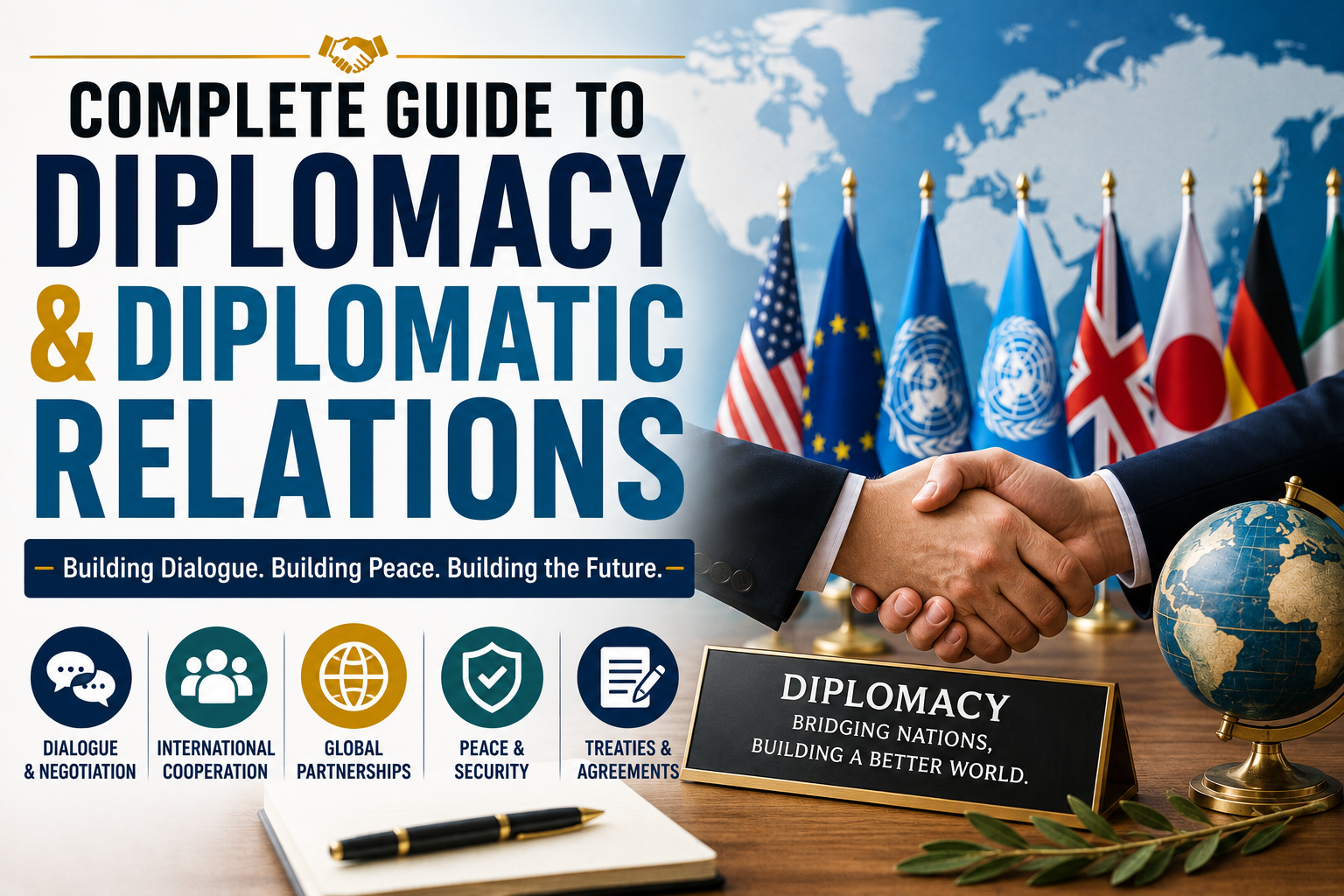
Complete Guide to Diplomacy and Diplomatic Relations
Diplomacy is one of the oldest tools societies have used to manage relationships, resolve disagreements and pursue shared interests without relying solely on force.
From negotiations over trade and security to international cooperation on climate, health and humanitarian issues, diplomacy shapes many of the decisions that affect countries and people around the world.
Although diplomacy is often associated with ambassadors, embassies and formal negotiations, the practice is much broader. Governments communicate through diplomatic channels, negotiate agreements, manage crises, build alliances and represent their national interests in international organizations.
Understanding diplomacy also requires understanding the institutions behind it, the different types of diplomatic relations, how negotiations work, and why diplomatic relationships sometimes succeed or break down.
This complete guide explains what diplomacy is, how diplomatic relations work, the role of diplomats and embassies, major forms of diplomacy, diplomatic negotiations, international agreements, and the challenges facing diplomacy in the modern world.
What Is Diplomacy?
Diplomacy is the practice of managing relationships between states and other international actors through communication, negotiation, representation and peaceful engagement.
In its traditional form, diplomacy involves governments communicating with one another to:
- Protect national interests
- Prevent or resolve conflicts
- Negotiate agreements
- Promote trade
- Coordinate security
- Build partnerships
- Exchange information
- Provide assistance to citizens abroad
- Address international problems
Diplomacy does not mean that countries always agree.
In fact, diplomacy is often most important when countries disagree strongly.
A diplomatic relationship provides channels through which governments can communicate even when their interests conflict.
What Are Diplomatic Relations?
Diplomatic relations are formal interactions between governments that allow them to communicate and conduct official business.
When two countries establish diplomatic relations, they generally recognize the importance of maintaining an official channel for communication.
Diplomatic relations can involve:
- Embassies
- Ambassadors
- Foreign ministries
- Consulates
- Bilateral negotiations
- International organizations
- Diplomatic agreements
- Official visits
- Crisis communication
Diplomatic relations do not necessarily mean that two governments are close allies.
Countries can maintain diplomatic relations while disagreeing about trade, security, borders, ideology or foreign policy.
Why Is Diplomacy Important?
Diplomacy provides alternatives to confrontation.
Without diplomatic communication, misunderstandings between governments can become more difficult to manage.
Diplomacy can help countries:
Prevent Conflicts
Regular communication can help governments clarify intentions and reduce misunderstandings.
Resolve Disputes
Negotiations can provide a pathway for addressing disagreements without immediately resorting to force.
Promote Trade
Governments use diplomacy to establish commercial relationships and negotiate trade arrangements.
Protect Citizens Abroad
Diplomatic missions assist citizens who encounter certain problems while traveling or living overseas.
Coordinate International Action
Global problems often require governments to work together.
Build Long-Term Relationships
Diplomatic engagement can create institutional relationships that survive changes in individual governments.
How Did Diplomacy Develop?
Diplomacy has existed in various forms for thousands of years.
Ancient societies exchanged envoys, negotiated agreements and established temporary or permanent relationships with neighboring powers.
Over time, diplomatic practices became more formalized.
Permanent diplomatic missions became increasingly important in European statecraft, while other civilizations developed their own sophisticated systems of interstate communication and negotiation.
Modern diplomacy eventually became closely connected with the development of the sovereign state system and international law.
Today, diplomacy operates through a complex network involving governments, international organizations and other actors.
What Is an Ambassador?
An ambassador is a senior diplomatic representative of one government to another state.
An ambassador typically represents their government in the host country and communicates with officials there.
Responsibilities can include:
- Representing the sending government
- Reporting political and economic developments
- Supporting bilateral relations
- Participating in negotiations
- Promoting cooperation
- Supporting citizens and diplomatic personnel
- Communicating official positions
Ambassadors are not simply ceremonial figures.
They can play an important role in interpreting political developments and maintaining communication between governments.
What Is an Embassy?
An embassy is the primary diplomatic mission of one country in another country.
It generally serves as an official channel between the two governments.
An embassy may handle:
- Political affairs
- Economic relations
- Cultural relations
- Public diplomacy
- Consular matters
- Security coordination
- Official communication
The ambassador typically leads the embassy.
Embassies are usually located in the host country’s capital because national governments and foreign ministries are generally concentrated there.
What Is a Consulate?
A consulate is a diplomatic or consular office that primarily provides services to citizens and supports certain economic and community-related functions.
Consulates may be located outside the capital, particularly in major cities.
Depending on the country and mission, consular services can include assistance related to:
- Passports
- Travel documents
- Emergency assistance
- Visas
- Certain legal or administrative matters
- Support for citizens in distress
An embassy and consulate are related but are not identical institutions.
Embassy vs. Consulate
| Embassy | Consulate |
|---|---|
| Usually located in the capital | Often located in major cities |
| Primarily handles government-to-government relations | Focuses heavily on consular and citizen services |
| Usually headed by an ambassador | Usually headed by a consul or senior consular official |
| Represents the sending government at the national level | Provides services and engagement at the regional level |
The exact structure varies between countries.
What Is a Diplomat?
A diplomat is an official who represents a government in international relations.
Diplomats can work in:
- Embassies
- Consulates
- Foreign ministries
- International organizations
- Special diplomatic missions
Their work can involve negotiation, research, reporting, communication, policy development and relationship management.
Diplomacy requires more than formal communication.
Diplomats often need to understand:
- Political systems
- History
- Economics
- International law
- Culture
- Security
- Negotiation
- Languages
- Public communication
What Does a Foreign Ministry Do?
A foreign ministry, also called a ministry of foreign affairs in many countries, is generally responsible for managing a country’s external relations.
Its responsibilities may include:
- Developing foreign policy
- Managing diplomatic missions
- Advising government leaders
- Negotiating international agreements
- Coordinating international relations
- Responding to international crises
- Supporting citizens abroad
- Participating in international organizations
The exact name and structure differ between governments.
Bilateral Diplomacy Explained
Bilateral diplomacy involves relations between two countries.
Examples of bilateral issues can include:
- Trade
- Border management
- Security cooperation
- Migration
- Infrastructure
- Education
- Investment
- Cultural exchange
Bilateral diplomacy can involve direct meetings between government officials, ambassadors, ministers and heads of government.
Because only two governments are directly negotiating a particular issue, bilateral diplomacy can sometimes provide a relatively focused environment for discussion.
Multilateral Diplomacy Explained
Multilateral diplomacy involves three or more international actors, often through international organizations or conferences.
Examples include negotiations involving:
- Multiple national governments
- Regional organizations
- International organizations
- International institutions
Multilateral diplomacy is particularly important when an issue crosses national borders.
Examples include:
- Climate change
- International security
- Public health
- Refugees
- Trade
- Maritime issues
- Global development
Multilateral negotiations can be more complicated because many participants have different priorities.
Public Diplomacy Explained
Public diplomacy involves communicating with foreign publics rather than communicating exclusively with foreign governments.
Governments may use public diplomacy to:
- Explain national policies
- Build international understanding
- Promote cultural exchange
- Support educational programs
- Improve perceptions of a country
- Communicate directly with international audiences
Public diplomacy can involve:
- Cultural programs
- Scholarships
- International broadcasting
- Educational exchanges
- Public events
- Digital communication
It differs from traditional diplomacy because the broader public becomes an important audience.
Cultural Diplomacy
Cultural diplomacy uses cultural exchange and shared cultural activities to strengthen international relationships.
It can involve:
- Art exhibitions
- Music
- Literature
- Film
- Sports
- Academic exchanges
- Museums
- Language programs
Cultural diplomacy can build relationships that extend beyond government institutions.
Economic Diplomacy
Economic diplomacy focuses on economic relationships between countries.
It can involve:
- Trade
- Investment
- Development assistance
- Economic agreements
- Infrastructure
- Business relationships
- Financial cooperation
Diplomats and government officials may work with businesses and economic institutions to promote national economic interests.
Digital Diplomacy
Digital diplomacy refers to the use of digital technologies and online communication in international relations.
Governments increasingly communicate through:
- Websites
- Social media
- Online statements
- Digital campaigns
- Virtual meetings
- Online diplomatic engagement
Digital diplomacy can allow governments to communicate with international audiences quickly.
It also creates challenges because statements can spread rapidly and can be interpreted by audiences far beyond their original target.
Summit Diplomacy
Summit diplomacy occurs when senior political leaders meet directly.
These meetings may involve:
- Heads of state
- Heads of government
- Foreign ministers
- Senior officials
High-level meetings can provide opportunities to resolve difficult issues or establish political direction.
However, successful summits usually depend on extensive preparation by diplomats and officials beforehand.
The visible meeting is often only the final stage of a much longer negotiation.
Shuttle Diplomacy
Shuttle diplomacy involves a mediator traveling between parties to facilitate negotiations.
Instead of bringing all sides into the same room immediately, the mediator communicates separately with each side.
This approach can be useful when direct communication is politically difficult or when trust between parties is limited.
The mediator attempts to identify areas of potential agreement and gradually narrow differences.
Track One and Track Two Diplomacy
Track One Diplomacy
Track One diplomacy involves official government representatives.
Track Two Diplomacy
Track Two diplomacy involves unofficial participants such as:
- Researchers
- Former officials
- Civil society representatives
- Academics
- Policy experts
- Community leaders
Track Two diplomacy can create space for discussions that may be difficult to conduct through formal government channels.
It does not replace official diplomacy but can complement it.
What Is Diplomatic Negotiation?
Diplomatic negotiation is the process through which parties attempt to reach an agreement despite having different interests.
Negotiations may address:
- Trade
- Borders
- Security
- Environmental issues
- Economic cooperation
- Humanitarian arrangements
- Peace agreements
Negotiation does not necessarily mean one side wins and the other loses.
Successful diplomacy often involves finding an arrangement in which each side considers the outcome preferable to the alternatives.
The Basic Stages of Diplomatic Negotiation
Although negotiations differ considerably, a simplified process might include:
1. Preparation
Each side identifies:
- Objectives
- Priorities
- Constraints
- Risks
- Possible compromises
2. Establishing Communication
Participants determine how discussions will take place.
3. Presenting Positions
Each side explains its priorities and concerns.
4. Identifying Interests
Negotiators explore what each party actually needs.
5. Exploring Options
Potential solutions are developed.
6. Bargaining
The parties negotiate specific terms.
7. Agreement
The participants document what they have accepted.
8. Implementation
The agreement is put into practice.
9. Monitoring
The parties evaluate whether commitments are being fulfilled.
Diplomacy and International Law
Diplomacy operates within a broader system of international law.
International law provides rules and principles governing relationships between states and other international actors.
It covers areas such as:
- Treaties
- Diplomatic relations
- Human rights
- International humanitarian law
- Maritime affairs
- International trade
- Use of force
- International organizations
Diplomatic practice and international law are closely connected, although they are not the same thing.
Diplomats negotiate and communicate, while international legal frameworks establish rights, obligations and procedures.
What Are Treaties?
A treaty is a formal international agreement between states or other parties that is governed by international law.
Treaties can address:
- Security
- Trade
- Environmental protection
- Human rights
- Borders
- Maritime issues
- Scientific cooperation
- Transportation
Treaties can range from highly technical agreements to major international instruments.
The legal procedures for signing, ratifying and implementing treaties vary according to national constitutional systems and the terms of the agreement.
Signing vs. Ratifying a Treaty
Signing and ratification are not necessarily the same thing.
A signature may indicate that a state has agreed to the text or intends to proceed with the treaty process.
Ratification is generally the formal process through which a state confirms its consent to be legally bound, subject to the treaty’s terms and the state’s constitutional procedures.
The precise legal effect of signature and ratification depends on the relevant international law and the treaty itself.
What Is Diplomatic Immunity?
Diplomatic immunity is a set of legal protections granted to certain diplomatic agents under international law.
The purpose is to allow diplomats to perform their functions without undue interference by the host state.
Diplomatic immunity is commonly associated with the Vienna Convention on Diplomatic Relations.
Importantly, diplomatic immunity does not mean diplomats are completely beyond legal or political consequences.
The sending state can take action against its diplomat, and the receiving state may have certain remedies available under international law, including declaring a diplomat persona non grata.
What Does Persona Non Grata Mean?
Persona non grata is a diplomatic term meaning that a host state considers a diplomat unacceptable.
A receiving state can declare a diplomat persona non grata without necessarily having to publicly provide a detailed explanation.
The sending state may then recall the diplomat or terminate their diplomatic functions.
This mechanism allows states to address serious diplomatic disagreements without necessarily severing all relations.
What Happens When Countries Break Diplomatic Relations?
A government can decide to sever or suspend diplomatic relations with another country.
This can happen because of serious disagreements involving:
- Security
- Foreign policy
- Military conflict
- Political disputes
- Diplomatic incidents
- Recognition of governments
- International law
Breaking diplomatic relations does not necessarily mean that all communication ends.
In some circumstances, communication can continue through:
- Third countries
- International organizations
- Special representatives
- Protecting powers
- Informal channels
What Is a Diplomatic Crisis?
A diplomatic crisis occurs when relations between governments deteriorate significantly.
Possible causes include:
- Military incidents
- Espionage allegations
- Territorial disputes
- Political interference accusations
- Arrests of officials
- Trade disputes
- Human rights disagreements
- Diplomatic expulsions
Diplomacy becomes particularly important during crises because governments need channels for communication even when relations are tense.
Crisis Diplomacy
Crisis diplomacy focuses on preventing dangerous situations from escalating.
It can involve:
- Emergency communication
- High-level meetings
- Third-party mediation
- Confidence-building measures
- Temporary agreements
- Public statements
- Back-channel discussions
The objective is often not to solve every underlying disagreement immediately.
Instead, the first priority may be preventing the situation from becoming worse.
What Is Mediation?
Mediation involves a third party helping disputing parties communicate and negotiate.
A mediator may:
- Facilitate meetings
- Carry messages
- Clarify positions
- Suggest options
- Help identify compromises
- Build confidence
The mediator’s influence depends heavily on whether the parties trust the process and believe the mediator can contribute something useful.
What Is a Peace Agreement?
A peace agreement is an arrangement designed to end or reduce armed conflict.
It may address:
- Ceasefires
- Security arrangements
- Political participation
- Territory
- Disarmament
- Prisoner arrangements
- Reconstruction
- Humanitarian access
Peace agreements can be extremely complex because ending violence does not automatically resolve the political, economic and social issues that caused or sustained a conflict.
Confidence-Building Measures
Confidence-building measures are steps designed to reduce suspicion between parties.
They may include:
- Information sharing
- Military communication channels
- Joint monitoring
- Advance notification of certain activities
- Verification mechanisms
- Limited reciprocal actions
These measures can make it easier for parties to negotiate broader agreements.
Diplomacy and Soft Power
Soft power is the ability to influence others through attraction and persuasion rather than coercion or payment.
Sources of soft power can include:
- Culture
- Values
- Institutions
- International reputation
- Education
- Economic attractiveness
- Diplomatic credibility
Diplomacy can help convert these sources of influence into relationships and cooperation.
Diplomacy and Hard Power
Hard power refers broadly to the ability to influence others through coercive or material capabilities.
These can include:
- Military capabilities
- Economic pressure
- Sanctions
- Financial resources
Diplomacy and hard power are not necessarily opposites.
Governments may use diplomatic negotiations while simultaneously relying on economic or security capabilities to influence the choices of other states.
What Is Foreign Policy?
Foreign policy is the broader strategy a government uses to manage its relationships with other countries and international actors.
Diplomacy is one of the primary instruments through which foreign policy is implemented.
Other foreign-policy instruments can include:
- Economic policy
- Development assistance
- Military policy
- Trade policy
- Sanctions
- International legal action
- Intelligence
- Cultural engagement
A useful distinction is:
Foreign policy determines objectives; diplomacy is one major way governments pursue them.
Diplomacy and International Organizations
Diplomacy is not limited to country-to-country relationships.
Governments also engage through international organizations and institutions.
These organizations can provide forums for:
- Negotiation
- Rule-making
- Conflict management
- Humanitarian coordination
- Economic cooperation
- Scientific collaboration
Multilateral diplomacy can be especially important when problems cannot realistically be solved by one country acting alone.
The Role of the United Nations in Diplomacy
The United Nations provides a major international forum where governments discuss global issues.
Diplomatic activity can take place through:
- The General Assembly
- The Security Council
- Specialized agencies
- Conferences
- Committees
- Negotiating processes
The UN does not eliminate disagreement between governments.
Instead, it provides institutions and procedures through which countries can communicate and negotiate.
Regional Diplomacy
Countries also conduct diplomacy through regional organizations.
Regional diplomacy can focus on:
- Security
- Trade
- Infrastructure
- Migration
- Economic integration
- Political cooperation
- Environmental issues
Regional organizations can provide additional mechanisms for addressing problems that affect neighboring countries.
Economic Interests in Diplomacy
Economic interests are frequently part of international relations.
Governments may negotiate over:
- Market access
- Investment
- Tariffs
- Energy
- Infrastructure
- Natural resources
- Financial cooperation
- Technology
Economic diplomacy often involves close interaction between governments and private-sector organizations.
Trade Diplomacy
Trade diplomacy involves negotiations and relationships concerning international commerce.
Governments may discuss:
- Tariffs
- Quotas
- Standards
- Customs procedures
- Market access
- Intellectual property
- Services
- Agricultural products
Trade negotiations can be difficult because governments must balance international commitments with domestic economic and political interests.
Science and Technology Diplomacy
Science and technology increasingly influence international relationships.
Diplomatic cooperation can involve:
- Research
- Space exploration
- Telecommunications
- Cybersecurity
- Artificial intelligence
- Biotechnology
- Energy
- Climate science
Scientific collaboration can create relationships even between countries that disagree on other issues.
Environmental Diplomacy
Environmental challenges frequently cross national borders.
Diplomatic negotiations can address:
- Climate change
- Biodiversity
- Oceans
- Water resources
- Pollution
- Deforestation
- Conservation
Environmental diplomacy often requires long-term cooperation because environmental problems can persist for decades.
Humanitarian Diplomacy
Humanitarian diplomacy focuses on securing assistance and protection for people affected by crises.
It can involve negotiations concerning:
- Humanitarian access
- Refugees
- Displaced populations
- Food assistance
- Medical aid
- Civilian protection
Humanitarian organizations may engage with governments, armed groups and international institutions to facilitate assistance.
Diplomatic Communication
Communication is one of the most important skills in diplomacy.
Diplomatic language often needs to achieve several goals simultaneously:
- Clearly communicate a position
- Avoid unnecessary escalation
- Preserve room for negotiation
- Signal priorities
- Maintain relationships
A diplomatic statement may therefore be deliberately more measured than ordinary political rhetoric.
Why Diplomatic Language Can Sound Indirect
Diplomatic communication sometimes appears vague because governments may want to avoid closing off future options.
For example, language such as:
“The government is deeply concerned by the development.”
can communicate serious disagreement without necessarily threatening immediate action.
Diplomatic wording can therefore function as a tool for signaling without unnecessarily escalating tensions.
Back-Channel Diplomacy
Back-channel diplomacy refers to confidential or unofficial communication between parties.
It can be useful when:
- Public negotiations are politically sensitive
- Leaders need to test proposals privately
- Trust is limited
- Public statements could make compromise difficult
Back channels can complement formal negotiations, although secrecy can also create accountability concerns.
Why Diplomatic Negotiations Fail
Diplomacy does not always produce agreement.
Negotiations can fail because:
- Parties have incompatible interests
- Domestic political pressure limits flexibility
- Leaders distrust one another
- One side expects greater concessions
- The costs of compromise are considered too high
- Communication breaks down
- External events change the situation
- Parties believe they can gain more through other means
Failure does not necessarily mean diplomacy was useless.
Even unsuccessful negotiations can clarify positions and establish communication channels for future efforts.
Common Challenges in Modern Diplomacy
Diplomacy today faces several major challenges.
Rapid Information
Social media can spread diplomatic statements worldwide within seconds.
Domestic Politics
Foreign-policy decisions are often affected by domestic political pressures.
Economic Interdependence
Countries can be simultaneously partners and competitors.
Non-State Actors
Governments increasingly interact with businesses, NGOs, international institutions and other organizations.
Cybersecurity
Digital systems create new opportunities for communication as well as new security risks.
Global Crises
Problems such as pandemics, environmental degradation and financial instability can cross borders quickly.
The Rise of Non-State Actors
Modern international relations involve more than governments.
Other influential actors can include:
- International corporations
- NGOs
- Universities
- Research institutions
- Humanitarian organizations
- Financial institutions
- Technology companies
- Civil society groups
These organizations can influence international discussions even though they are not sovereign states.
What Skills Do Diplomats Need?
Successful diplomats generally need a broad combination of skills.
Important abilities include:
- Negotiation
- Writing
- Public speaking
- Listening
- Research
- Cultural awareness
- Strategic thinking
- Language skills
- Analytical reasoning
- Emotional intelligence
- Crisis management
Diplomacy often requires balancing competing priorities rather than simply winning an argument.
How to Become a Diplomat
The pathway varies considerably between countries.
In many countries, diplomats enter government through a competitive foreign-service or civil-service recruitment system.
Relevant areas of study can include:
- International relations
- Political science
- Law
- Economics
- History
- Languages
- Public policy
However, there is no single academic degree that universally guarantees a diplomatic career.
Professional experience, language skills, analytical ability and knowledge of international affairs can all be valuable.
Diplomacy vs. International Relations
These concepts overlap but are not identical.
International relations is the broader field concerned with interactions between countries and international actors.
Diplomacy is a practical instrument used to manage those relationships.
International relations includes subjects such as:
- International security
- Global economics
- International law
- Political theory
- Foreign policy
- International organizations
Diplomacy is one mechanism through which these relationships are conducted.
Diplomacy vs. Negotiation
Negotiation is an important part of diplomacy, but diplomacy is broader.
Diplomacy can include:
- Representation
- Communication
- Relationship building
- Reporting
- Cultural exchange
- Crisis management
- Negotiation
Negotiation focuses specifically on reaching an agreement between parties with different interests.
Common Misconceptions About Diplomacy
Diplomacy Means Being Friendly
Not necessarily.
Diplomacy can involve serious disagreement while maintaining communication.
Diplomats Always Avoid Conflict
Diplomats may openly communicate disagreement.
Their role is often to manage conflict rather than pretend it does not exist.
Diplomacy Always Produces Compromise
Sometimes negotiations result in compromise.
Other times they produce limited agreements, stalemate or no agreement at all.
Diplomacy Is Only About Politics
Diplomatic work can involve economics, culture, science, trade, security and humanitarian affairs.
Diplomacy Is Only Between Governments
Modern diplomacy increasingly involves international organizations and other non-state actors.
Why Diplomatic Relationships Matter to Ordinary People
International diplomacy can seem distant from everyday life, but diplomatic decisions can affect ordinary people in many ways.
Diplomatic relationships can influence:
- International travel
- Visas
- Trade
- Employment
- Education
- Investment
- Security
- Migration
- International aid
- Access to foreign markets
- Consular assistance
When governments establish cooperative relationships, citizens and businesses may benefit from easier communication and greater opportunities.
When relationships deteriorate, travel restrictions, economic measures and other consequences can affect people far beyond government institutions.
The Future of Diplomacy
Diplomacy is unlikely to disappear as international politics becomes more technologically connected.
Instead, the tools and environments of diplomacy will continue changing.
Future diplomats may increasingly need to understand:
- Artificial intelligence
- Cybersecurity
- Digital communication
- Climate policy
- Emerging technologies
- Global supply chains
- Space policy
- Data governance
At the same time, many traditional diplomatic skills will remain important.
Trust, communication, negotiation, cultural understanding and the ability to manage disagreements cannot be replaced simply by new technology.
Diplomacy in an Increasingly Connected World
Diplomacy remains one of the most important mechanisms for managing relationships between countries.
It provides governments with channels for negotiation when interests overlap and mechanisms for communication when interests collide.
From embassies and ambassadors to international organizations, peace negotiations and economic agreements, diplomacy operates at almost every level of international affairs.
Its purpose is not necessarily to eliminate disagreement. Countries will continue to have competing interests, different political systems and conflicting priorities.
The enduring value of diplomacy lies in creating ways to manage those differences without allowing every disagreement to become a crisis.
As international relationships become more interconnected and challenges increasingly cross national borders, effective diplomacy will remain essential—not because countries will always agree, but because they will always need ways to communicate when they do not.



2 Comments
Micle harison
June 7, 2019Lorem ipsum dolor sit amet, usu ut perfecto postulant deterruisset, libris causae volutpat at est, ius id modus laoreet urbanitas. Mel ei delenit dolores.
John Doe
June 7, 2019Some consultants are employed indirectly by the client via a consultancy staffing company.