
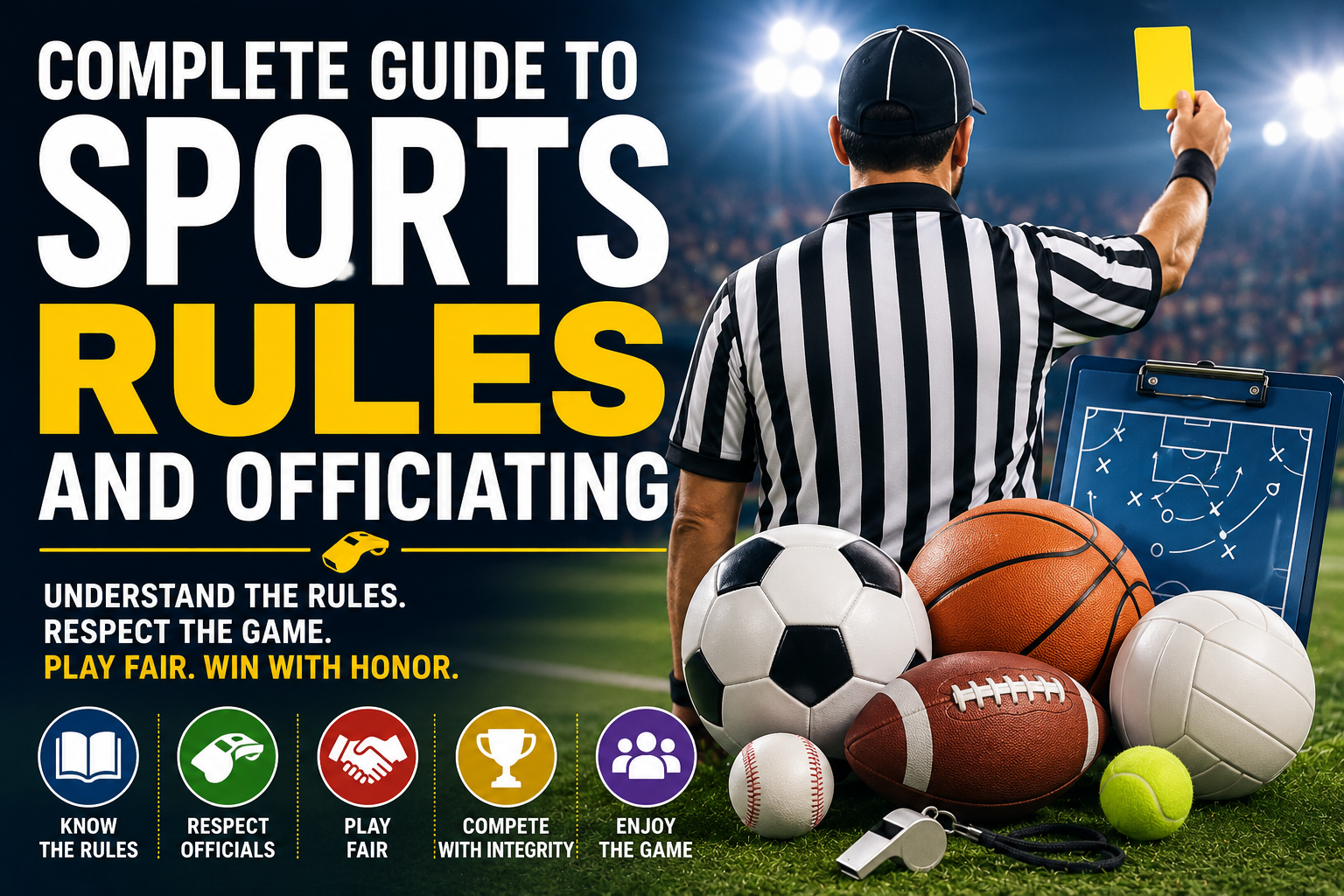
Complete Guide to Sports Rules and Officiating
Sports are built around rules. Whether it is football, basketball, tennis, athletics, cricket, volleyball, baseball, or another competitive discipline, rules create the structure that allows athletes to compete fairly and spectators to understand what is happening.
Officiating is equally important. Referees, umpires, judges, officials, and other match administrators are responsible for applying those rules, managing competition, resolving disputes, and helping maintain the integrity of the sport.
But sports rules can sometimes seem complicated, particularly for beginners. Different sports have different playing areas, scoring systems, penalties, equipment requirements, and officiating procedures. Even experienced fans can occasionally be confused by a technical decision.
This complete guide explains how sports rules work, what officials do, how penalties are applied, and why effective officiating matters.
What Are Sports Rules?
Sports rules are established guidelines that define how a game or competition is played.
They determine things such as:
- How participants can legally play
- How points or goals are scored
- How winners are determined
- What constitutes a foul or violation
- Which equipment can be used
- How long competitions last
- Where athletes can compete
- How officials make decisions
- What penalties apply to rule violations
- How disputes and protests are handled
Rules can be simple in some sports and highly detailed in others.
For example, a basic recreational game may require only a small number of rules, while professional competitions can have extensive regulations covering everything from player eligibility to equipment specifications and officiating procedures.
Why Do Sports Need Rules?
Without rules, competitive sports would quickly become difficult to organize and unfair to participants.
Rules provide several important functions.
1. They Create Fair Competition
Rules establish a common standard for everyone. Players and teams know what actions are permitted and what behavior can result in a penalty.
2. They Protect Participants
Many rules exist to reduce unnecessary physical danger. Restrictions on dangerous tackles, illegal contact, unsafe equipment, or reckless behavior can help protect athletes.
3. They Make Results Meaningful
A competition needs a consistent method for determining who wins. Scoring rules, timing requirements, tie-break procedures, and eligibility standards help produce legitimate results.
4. They Make Sports Easier to Understand
Clear rules give spectators a framework for following the action. Once fans understand scoring, fouls, penalties, and basic tactics, watching a sport becomes more engaging.
5. They Protect the Integrity of Competition
Rules can also address issues such as cheating, deliberate manipulation, prohibited equipment, unsporting behavior, and other conduct that could undermine fair competition.
The Main Types of Sports Rules
Although every sport has its own rulebook, most regulations fall into several broad categories.
Playing Rules
Playing rules describe what athletes can and cannot do during competition.
They may cover:
- Movement
- Passing
- Shooting
- Serving
- Tackling
- Contact
- Positioning
- Possession
- Boundaries
- Legal techniques
These rules form the core of the actual game.
Scoring Rules
Scoring rules explain how athletes or teams earn points.
Depending on the sport, scoring might involve:
- Goals
- Runs
- Baskets
- Points
- Touchdowns
- Sets
- Laps
- Distance
- Time
- Successful attempts
Understanding the scoring system is usually one of the easiest ways for a new fan to learn a sport.
Time Rules
Many sports have strict timing regulations.
These can determine:
- Match duration
- Period or quarter length
- Breaks
- Overtime
- Timeouts
- Stoppage time
- Shot or possession clocks
- Delays
Timekeeping can become particularly important when a competition is closely contested.
Equipment Rules
Sports organizations often establish requirements for equipment.
These may specify:
- Dimensions
- Weight
- Materials
- Protective equipment
- Clothing
- Footwear
- Ball specifications
- Racket or bat specifications
- Competition surfaces
Equipment rules help ensure that competitors operate under comparable conditions.
Eligibility Rules
Eligibility regulations determine who can participate.
Depending on the competition, they may address:
- Age
- Gender categories
- Nationality
- Registration
- Team membership
- Amateur or professional status
- Qualification standards
- Medical or safety requirements
Eligibility rules are particularly important in organized competitions.
Conduct Rules
Athletes are generally expected to follow standards of sportsmanship.
Conduct rules can cover:
- Verbal abuse
- Aggressive behavior
- Disrespect toward officials
- Deliberate cheating
- Unsporting conduct
- Dangerous actions
- Interference with opponents
- Improper celebrations
Violations can result in warnings, penalties, removal from competition, or other disciplinary action depending on the sport.
How Sports Officiating Works
Officiating is the process of supervising competition and applying the rules.
The exact structure differs from one sport to another.
A football match, for example, may involve a referee, assistant referees, a fourth official, and video officials. Other sports may use umpires, judges, line judges, timekeepers, scorers, or technical officials.
The central responsibility remains the same: apply the competition rules consistently and fairly.
What Does a Sports Official Do?
An official may be responsible for several tasks.
Enforcing the Rules
Officials observe the competition and identify violations.
They must determine whether an action was legal and, when necessary, apply the appropriate penalty.
Managing the Competition
Officials can also control the flow of a contest.
Depending on the sport, this may involve:
- Starting and stopping play
- Managing substitutions
- Monitoring time
- Authorizing restarts
- Controlling equipment
- Recording scores
- Managing protests
- Communicating decisions
Protecting Participants
Officials may intervene when play becomes dangerous or when athletes violate safety-related rules.
Recording Important Events
Officials or supporting personnel may document:
- Scores
- Fouls
- Penalties
- Disqualifications
- Substitutions
- Time
- Warnings
- Results
Accurate records are essential for official results.
Referees, Umpires, Judges, and Other Officials
Different sports use different titles for their officials.
Referees
Referees commonly oversee sports where active play involves frequent rule decisions.
They may determine whether contact is legal, whether a goal or score is valid, or whether a player has committed a violation.
Umpires
Umpires are used in several sports, including baseball and cricket.
Their responsibilities vary considerably depending on the sport, but generally involve observing play and making decisions according to the rules.
Judges
Judges are especially important in sports where performance must be evaluated rather than determined solely by points or goals.
Examples can include:
- Gymnastics
- Diving
- Figure skating
- Combat sports
- Certain judged competitions
Judges may assess technical execution, difficulty, accuracy, style, or other established criteria.
Timekeepers and Scorers
Some competitions use specialized officials to track:
- Match time
- Scores
- Penalties
- Possession clocks
- Official statistics
These roles help reduce the administrative burden on the primary officials.
What Is a Foul or Violation?
A foul or violation occurs when a participant breaks a rule.
The consequences depend on the nature and severity of the offense.
A minor violation might result in a simple restart or loss of possession. A more serious offense could produce a penalty, warning, temporary removal, disqualification, or other sanction.
Not every mistake is necessarily a foul.
This distinction is important because officials must determine whether the rules actually prohibit the action.
Understanding Sports Penalties
Penalties are consequences imposed after certain rule violations.
Common forms include:
- Free attempts or free kicks
- Loss of possession
- Yardage penalties
- Warnings
- Yellow or similar disciplinary cards
- Temporary suspension
- Player removal
- Disqualification
- Penalty points
- Time penalties
- Restart advantages
The appropriate penalty is determined by the rules of the particular sport.
Why Penalties Matter
Penalties serve several purposes.
First, they discourage athletes from deliberately breaking rules. Second, they can restore some of the competitive balance affected by an illegal action. Third, they communicate that rules have consequences.
However, penalties must be applied consistently. Inconsistent enforcement can create controversy and undermine confidence in officiating.
What Is Advantage in Sports Officiating?
Some sports allow officials to avoid stopping play when a team or athlete that was affected by an infraction would benefit more from continuing.
This concept is commonly known as advantage.
For example, if stopping play would unnecessarily take away a favorable attacking opportunity, an official may allow competition to continue when the applicable rules permit it.
Advantage requires judgment because the official must consider what is likely to happen if play continues.
It is one reason officiating is more complicated than simply memorizing a rulebook.
How Officials Make Difficult Decisions
Officials often have to make decisions in real time.
They may have only a fraction of a second to determine:
- Who committed an infraction
- Whether contact occurred
- Whether the ball was in or out
- Whether a player gained an unfair advantage
- Whether an action was deliberate
- Whether a scoring opportunity was legal
This requires observation, positioning, concentration, experience, and a detailed understanding of the rules.
Positioning Matters
Good officials attempt to position themselves where they have the best possible view of an incident.
Positioning can affect their ability to judge:
- Contact
- Ball movement
- Player positioning
- Boundary decisions
- Fouls
- Offside or similar positional violations
Professional officiating therefore involves much more than simply reacting to what happens.
The Role of Technology in Officiating
Technology has become increasingly important in modern sports.
Depending on the sport, officials may have access to systems such as:
- Video review
- Goal-line technology
- Electronic timing
- Hawk-Eye-style tracking
- Instant replay
- Photo finishes
- Electronic scoring systems
- Athlete tracking
- Automated measurement systems
These technologies can help officials make more accurate decisions.
However, technology does not necessarily eliminate controversy.
A video system still operates within rules that determine:
- When review is allowed
- Which decisions can be reviewed
- Who can initiate a review
- What evidence is sufficient
- Whether the original decision can be overturned
Technology is therefore a tool within the officiating system rather than a replacement for rules and human judgment.
What Is Video Review?
Video review allows officials to examine recorded footage of an incident when the rules permit it.
It is commonly used for situations where a decision can have a major effect on the competition.
The exact process varies between sports.
A review system may allow officials to:
- Identify a reviewable incident.
- Examine available footage.
- Compare the evidence with the applicable rule.
- Confirm, change, or uphold the original decision.
The goal is generally to improve accuracy while preserving the flow and authority of the competition.
Why Sports Officials Need Training
High-level officiating requires substantial preparation.
Officials must understand the rulebook and develop the ability to apply it under pressure.
Training can include:
- Rule examinations
- Fitness testing
- Practical sessions
- Video analysis
- Positioning exercises
- Match simulations
- Communication training
- Decision-making exercises
- Performance reviews
Physical fitness can also be important.
In fast-paced sports, officials may need to move continuously while maintaining concentration and keeping up with athletes.
Common Challenges Officials Face
Officiating can be difficult even when officials are highly experienced.
Split-Second Decisions
Some decisions must be made almost instantly.
Obstructed Views
Players, equipment, or other officials can sometimes block an official’s view.
Crowd Pressure
Large crowds can create an intense environment. Officials must make decisions based on the rules rather than the reaction of spectators.
Player Pressure
Athletes and coaches may strongly disagree with decisions.
Officials must remain composed and communicate appropriately.
Complex Rules
Some rules contain exceptions, conditions, and technical details that can make decisions difficult.
Human Error
Officials are human and can make mistakes. Strong officiating systems therefore focus not only on individual performance but also on procedures that reduce avoidable errors.
How Rule Changes Affect Sports
Sports rules are not necessarily permanent.
Governing organizations may modify regulations to address:
- Safety concerns
- Competitive balance
- Technology
- Game speed
- Equipment developments
- Confusing rules
- Unintended strategic advantages
- Changes in participation
- Spectator experience
A rule change can sometimes have significant consequences for tactics and player behavior.
For that reason, athletes, coaches, officials, and fans often need time to understand new regulations.
Why Rulebooks Are So Detailed
A professional sport needs rules that can address unusual situations.
A simple statement such as “score more points than your opponent” is not enough to organize a professional competition.
A comprehensive rulebook may need to explain:
- What counts as a legal score
- What happens when play is interrupted
- How ties are resolved
- How substitutions work
- What happens when equipment fails
- How officials communicate decisions
- What penalties apply
- How protests are handled
- What happens during unusual circumstances
The goal is not to make sports unnecessarily complicated. Detailed rules provide consistency when unusual situations arise.
How to Learn the Rules of a New Sport
You do not need to memorize an entire rulebook before watching or playing a sport.
A better approach is to learn progressively.
Start With Scoring
Learn how points are earned and how a winner is determined.
Learn the Basic Objective
Understand what each team or athlete is trying to accomplish.
Learn the Main Violations
Focus on the most common fouls and mistakes first.
Understand the Playing Area
Learn boundaries, zones, positions, and important markings.
Watch Experienced Players
Observing real competition can help connect rules with actual situations.
Learn Advanced Rules Later
Once the basics are familiar, move on to specialized rules, tactical situations, and unusual scenarios.
Common Misunderstandings About Sports Officiating
“Officials Should Never Make Mistakes”
Perfect officiating is unrealistic because officials must interpret events occurring at high speed and sometimes from imperfect viewing angles.
The objective is accurate, consistent decision-making supported by appropriate systems.
“Every Physical Contact Is a Foul”
Not necessarily. Many sports permit certain forms of contact. Whether contact is illegal depends on the specific rules and circumstances.
“Technology Makes Officials Unnecessary”
Technology can assist decision-making, but humans are still needed to interpret rules, manage competition, communicate decisions, and handle situations technology cannot resolve.
“The Loudest Protest Should Change the Decision”
Officials should make decisions based on the rules and available evidence rather than pressure from athletes, coaches, or spectators.
How Coaches and Athletes Can Avoid Penalties
Understanding rules can provide a competitive advantage without violating them.
Athletes should:
- Learn the official rules
- Understand common penalties
- Practice legal techniques
- Listen to officials
- Avoid unnecessary confrontation
- Understand equipment requirements
- Know substitution procedures
- Ask coaches about complicated rules
- Review mistakes after competition
Coaches also have an important role in educating athletes about regulations.
A team that understands the rules can often avoid preventable penalties.
Sportsmanship and the Spirit of Competition
Rules establish the minimum standards of legal behavior, but sportsmanship goes beyond simply avoiding penalties.
Good sportsmanship involves:
- Respecting opponents
- Respecting officials
- Accepting legitimate decisions
- Avoiding deliberate cheating
- Competing honestly
- Helping maintain a safe environment
- Handling victory and defeat responsibly
A player can technically avoid a penalty while still behaving in a way that damages the spirit of competition.
Strong sporting cultures therefore combine rule compliance with respect and integrity.
How Fans Can Better Understand Officiating
Fans do not need to agree with every decision to understand why it was made.
When an incident occurs, ask:
- What happened?
- Which rule applies?
- Was the action prohibited?
- What evidence did the official have?
- Was technology available?
- What penalty does the rule prescribe?
- Was the decision within the official’s authority?
This approach is more useful than judging an incident solely by whether the decision benefited a favorite team.
The Difference Between Rules and Laws
Sports rules are sometimes described as “laws of the game,” but they are not the same as laws created by governments.
A sports rule applies within a particular competition or sporting organization. A government law generally applies to people within a specific legal jurisdiction.
Sports organizations establish and enforce their own competition regulations, although their activities still operate within broader legal frameworks.
This distinction becomes especially important when discussions involve athlete safety, contracts, eligibility, discrimination, or other issues outside the playing rules.
Building Better Sports Knowledge
Understanding rules and officiating makes sports more than something to watch casually. It allows fans to recognize tactics, understand strategic decisions, evaluate controversial moments, and appreciate the difficulty of high-level competition.
The most useful approach is to start with the fundamentals: the objective of the sport, scoring system, playing area, common violations, and basic penalties. From there, advanced rules and officiating procedures become much easier to understand.
Whether you are a new fan, recreational athlete, coach, parent, or experienced supporter, learning how the rules work can make every competition more interesting. Behind every score, penalty, restart, or disputed decision is a framework designed to keep competition organized, fair, and meaningful.




2 Comments
Micle harison
June 7, 2019Lorem ipsum dolor sit amet, usu ut perfecto postulant deterruisset, libris causae volutpat at est, ius id modus laoreet urbanitas. Mel ei delenit dolores.
John Doe
June 7, 2019Some consultants are employed indirectly by the client via a consultancy staffing company.