
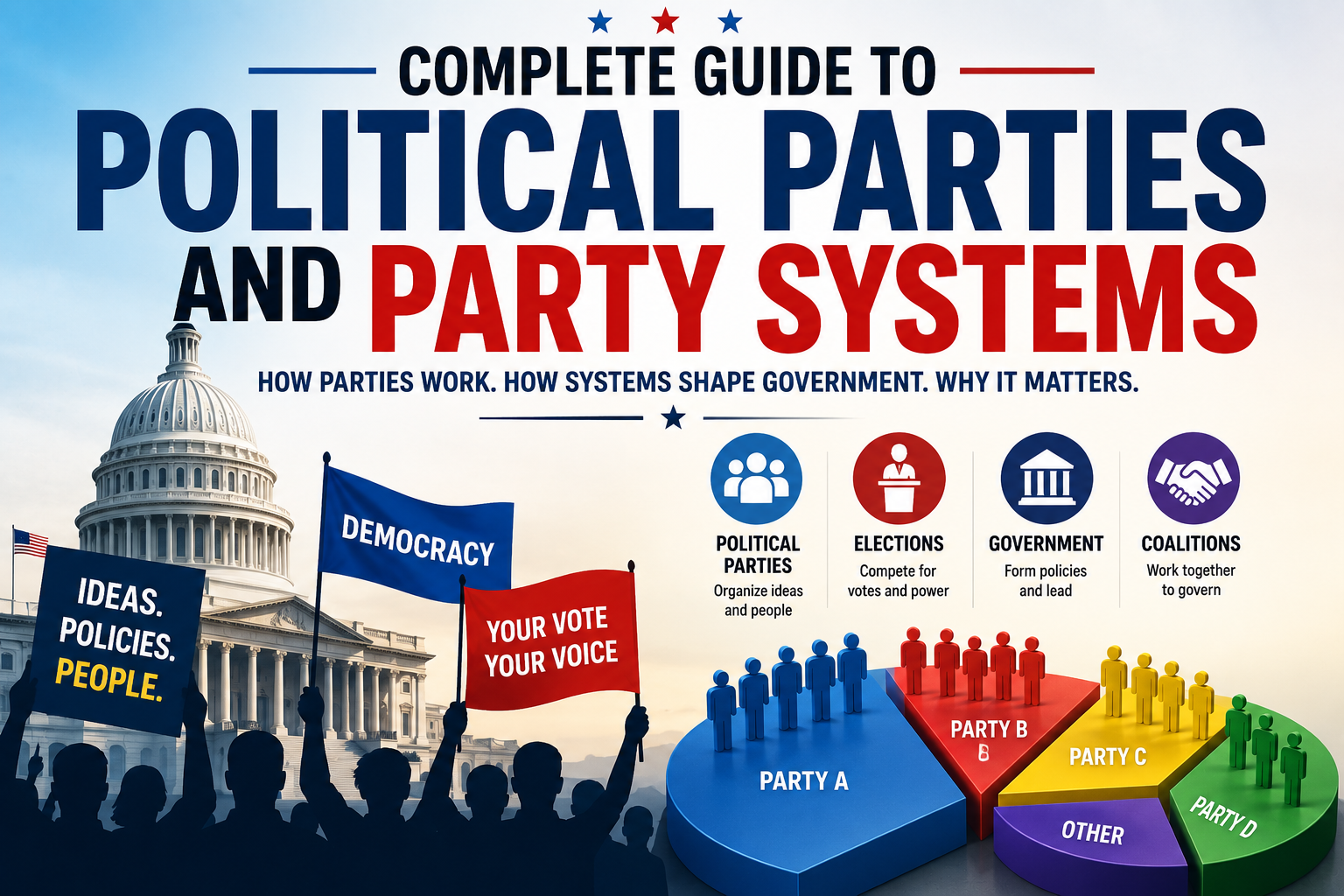
Complete Guide to Political Parties and Party Systems
Political parties are among the most important institutions in modern politics. They organize political ideas, recruit candidates, compete in elections, develop policy platforms, and connect citizens with governments. In many countries, political parties also shape how legislatures operate and how governments are formed.
Yet parties can look very different from one political system to another. Some countries have two dominant parties, while others have several parties that must cooperate to form governments. Some parties are organized around ideology, while others are built around regional interests, personalities, religion, social groups, or particular policy goals.
Understanding political parties and party systems makes it easier to understand elections, government formation, political competition, coalition building, and public policy.
This guide explains what political parties are, how they operate, the major types of party systems, and why they matter in democratic societies.
What Is a Political Party?
A political party is an organized group of people who share political goals and seek to influence government, usually by participating in elections and attempting to win political power.
A party may bring together people who agree on broad principles such as:
- Economic policy
- Government spending
- Taxation
- Individual rights
- Social policy
- Environmental policy
- National security
- Foreign affairs
- The role of government
- Regional or local interests
Political parties can range from highly organized national institutions to relatively loose electoral movements.
The exact structure depends on a country’s political system, electoral laws, history, and political culture.
What Do Political Parties Do?
Political parties perform several functions that help organize political life.
1. Recruit Political Candidates
Parties identify, support, and nominate candidates for public office.
This can include candidates for:
- National legislatures
- Local councils
- Mayoral positions
- Presidential offices
- Regional governments
- Other elected positions
Candidate recruitment gives voters recognizable choices during elections.
2. Develop Political Platforms
A party platform outlines the policies and priorities the party intends to pursue.
A platform may address:
- Healthcare
- Education
- Employment
- Taxes
- Infrastructure
- Housing
- Energy
- Agriculture
- Public safety
- Foreign policy
Platforms help voters understand what parties say they would do if given political power.
3. Mobilize Voters
Parties encourage people to participate in elections.
They may organize:
- Campaign events
- Public meetings
- Door-to-door outreach
- Advertising
- Digital campaigns
- Voter education
- Volunteer networks
- Fundraising activities
Political parties therefore act as important channels between citizens and political institutions.
4. Organize Legislatures
After elections, parties often organize legislative activity.
Members of the same party may coordinate around:
- Bills
- Budgets
- Parliamentary procedures
- Committee work
- Government programs
- Votes of confidence
Party organization can make legislative decision-making more structured.
5. Form Governments
In parliamentary systems, the party or coalition capable of commanding legislative support generally forms the government.
This means elections can determine not only which politicians enter parliament but also which parties control executive government.
6. Represent Political Interests
Parties aggregate different interests within society.
For example, a party might emphasize the concerns of:
- Workers
- Businesses
- Farmers
- Young people
- Urban communities
- Rural communities
- Environmental groups
- Religious communities
- Regional populations
Representation is rarely perfect, but parties provide organized mechanisms through which groups can seek political influence.
What Is a Party System?
A party system describes the pattern of political parties competing for power within a country.
It is not simply the number of parties that exist.
A party system also considers:
- How many parties are politically significant
- How competitive elections are
- How parties interact
- Whether parties regularly form coalitions
- How ideological differences are structured
- How easily new parties can gain influence
- Whether one party consistently dominates government
Two countries might both have several registered political parties but have very different party systems if only a few parties are electorally important in one country while many regularly win seats in another.
The Major Types of Party Systems
Political scientists commonly distinguish between several broad party-system types.
One-Party Systems
A one-party system is one in which a single political party dominates political power and other parties may be prohibited, severely restricted, or unable to compete meaningfully.
It is important to distinguish a genuine competitive multiparty system from a system in which other parties technically exist but cannot realistically challenge the dominant party.
One-party systems can differ substantially in how political participation and internal competition operate.
Two-Party Systems
A two-party system is characterized by two major parties dominating electoral competition.
Smaller parties may exist, but the two largest parties typically receive most of the votes and control most elected offices.
A two-party system can provide relatively straightforward choices for voters and can make government formation easier.
However, it can also limit the range of parties with a realistic chance of governing.
Multiparty Systems
A multiparty system contains several politically significant parties capable of winning substantial electoral support and legislative representation.
In these systems, no single party may regularly win enough seats to govern alone.
As a result, parties may negotiate coalitions or agreements to form governments.
Multiparty systems can provide voters with a broader range of political choices, but coalition negotiations can sometimes make government formation more complicated.
Dominant-Party Systems
A dominant-party system occurs when one party repeatedly wins elections and maintains political control over extended periods, even though other parties may legally compete.
The existence of opposition parties does not necessarily mean that competition is equally balanced.
A dominant party may maintain its position because of:
- Strong voter loyalty
- Historical reputation
- Organizational advantages
- Electoral rules
- Opposition fragmentation
- Political institutions
- Regional support
Dominance can change if political conditions shift or opposition forces become more competitive.
Political Parties and Political Ideology
Ideology is one way parties distinguish themselves from competitors.
Common ideological traditions include:
Liberalism
Liberal political traditions generally emphasize individual rights, political freedoms, constitutional government, and limits on arbitrary state power, although the meaning of liberalism varies significantly between countries.
Conservatism
Conservative traditions generally place greater emphasis on continuity, established institutions, social order, and gradual rather than radical political change.
Socialism
Socialist traditions generally emphasize economic equality, collective interests, and stronger social or economic intervention to address inequalities.
Social Democracy
Social democratic parties generally support democratic institutions alongside substantial social protections and regulated market economies.
Green Politics
Green parties typically place strong emphasis on environmental protection, sustainability, climate policy, and ecological concerns.
Nationalism
Nationalist parties emphasize the interests, identity, sovereignty, or political independence of a particular nation or national community.
These categories are not universal boxes. Political parties frequently combine ideas from multiple traditions.
Left, Right, and Center in Politics
The terms left, right, and center are commonly used to describe political positions.
However, these labels are broad and can mean different things in different countries.
In simplified terms:
- Left-wing politics is often associated with greater emphasis on economic equality and social reform.
- Right-wing politics is often associated with tradition, social order, national identity, or more market-oriented economic policies.
- Center politics generally seeks positions between competing ideological extremes.
Political beliefs cannot always be accurately represented on a single left-right scale.
A party may be economically conservative but socially liberal, for example. Another may support substantial government spending while taking socially conservative positions.
For this reason, understanding a party requires examining its actual policies rather than relying exclusively on labels.
How Political Parties Differ From Political Movements
A political party and a political movement are related but not identical.
A political movement is generally a broader effort to promote political or social change.
A movement may:
- Campaign for a specific cause
- Organize protests
- Influence public debate
- Lobby government
- Mobilize communities
- Encourage political participation
A movement may eventually create a political party, but it does not have to.
Political parties are generally more directly focused on gaining or exercising political power through formal political institutions.
How Parties Choose Their Candidates
Candidate selection varies significantly.
Possible methods include:
- Party leadership selection
- Internal party elections
- Primary elections
- Local party meetings
- Delegates or conventions
- Membership ballots
- Candidate nomination committees
The method matters because it affects who has influence within a party.
A system that allows ordinary party members to select candidates may distribute power more broadly than one in which party leadership makes most nomination decisions.
What Is a Party Platform?
A party platform is a formal statement of political principles, priorities, and policy proposals.
It can serve several purposes.
For Voters
It helps voters compare competing parties.
For Candidates
It provides a framework for campaign messages.
For Party Members
It establishes shared objectives.
For Governments
It can provide a reference point for policy priorities after an election.
However, a platform is not necessarily a guarantee that every proposed policy will be implemented. Governments face budget constraints, legislative opposition, court decisions, changing circumstances, and coalition negotiations.
How Elections Shape Party Systems
Electoral systems have a major influence on how parties compete.
The two broad approaches most often discussed are majoritarian and proportional systems, although many countries use variations or combinations.
Majoritarian Systems
Majoritarian systems generally emphasize winning individual electoral districts.
Depending on the rules, a candidate may need to receive the most votes or a specified majority to win.
Such systems can encourage parties to build broad electoral coalitions because winning representation may require concentrated support across particular districts.
Proportional Representation
Proportional representation systems generally aim to distribute legislative seats more closely according to the share of votes parties receive.
For example, a party that receives a substantial percentage of the vote may obtain a broadly corresponding share of legislative seats, subject to the specific electoral formula.
Proportional systems can make it easier for smaller parties to gain representation.
What Is a Coalition Government?
A coalition government is formed when two or more political parties cooperate to govern.
Coalitions are common in multiparty parliamentary systems.
Parties may negotiate agreements covering:
- Government leadership
- Cabinet positions
- Budget priorities
- Legislative programs
- Economic policy
- Social policy
- Foreign affairs
Coalition governments can provide representation for several political groups.
However, coalition partners may disagree, and serious disagreements can sometimes lead to the collapse or restructuring of a government.
What Is a Minority Government?
A minority government occurs when the governing party or coalition does not hold an outright majority of legislative seats but is nevertheless able to govern.
It may rely on:
- Support from another party
- Issue-by-issue agreements
- Independent legislators
- Confidence-and-supply arrangements
- Temporary parliamentary alliances
Minority governments can function effectively when parties cooperate, although maintaining legislative support can require continuous negotiation.
Government Parties and Opposition Parties
In parliamentary politics, parties are often divided into government and opposition.
Government Parties
These parties participate in governing and generally support the executive’s legislative agenda.
Opposition Parties
Opposition parties do not form the government and instead scrutinize government decisions, propose alternatives, and challenge policies.
A strong opposition can play an important role in democratic accountability.
What Makes a Political Party Successful?
Winning elections depends on many factors.
Important factors can include:
- Candidate quality
- Party organization
- Policy positions
- Public trust
- Economic conditions
- Leadership
- Campaign strategy
- Voter turnout
- Media coverage
- Political history
- Electoral geography
- Opposition strength
There is no single formula that guarantees electoral success.
A party can have strong national support but struggle to win seats if its votes are distributed inefficiently under a particular electoral system.
Party Membership and Political Participation
People can participate in party politics in many ways.
They may:
- Become members
- Volunteer
- Attend meetings
- Donate money
- Campaign for candidates
- Help with voter outreach
- Participate in candidate selection
- Develop policy proposals
- Serve as candidates
Participation does not necessarily require holding public office.
Political parties can therefore provide a pathway for citizens to become involved in public life.
How Political Parties Are Funded
Political parties require resources to operate.
Funding can come from different sources depending on a country’s laws.
Potential sources include:
- Membership fees
- Individual donations
- Fundraising
- Public financing
- Political committees
- Party-owned activities
- Other legally permitted contributions
Because money can influence political competition, many countries establish rules governing political donations, campaign spending, financial disclosures, and reporting.
The details differ substantially between jurisdictions.
Why Campaign Finance Matters
Campaign finance can affect the competitiveness and transparency of elections.
Strong financial resources can help parties:
- Reach more voters
- Hire campaign staff
- Conduct research
- Purchase advertising
- Organize events
- Develop digital campaigns
At the same time, political systems generally seek safeguards against corruption, undisclosed influence, and excessive financial advantages.
Campaign finance regulations therefore form an important part of many political systems.
Political Parties and Voter Representation
One of the most important questions surrounding political parties is whether they accurately represent citizens.
Parties can aggregate interests that would otherwise remain politically fragmented.
However, parties also have to make strategic choices.
They may need to balance competing interests among:
- Different age groups
- Economic classes
- Regions
- Urban and rural populations
- Different professions
- Cultural communities
- Social groups
As a result, a party’s platform is often a compromise among different constituencies.
Why Smaller Parties Matter
A smaller party may not control government but can still have significant political influence.
It may:
- Win enough legislative seats to affect coalition formation
- Push larger parties toward particular policies
- Introduce issues that larger parties previously ignored
- Represent specific geographic or ideological constituencies
- Influence parliamentary debates
- Change the political agenda
In proportional systems especially, smaller parties can sometimes play an important role in government formation.
What Causes Party Systems to Change?
Party systems can evolve over time.
Changes may result from:
- Demographic shifts
- Economic transformations
- New social issues
- Electoral reforms
- Changes in voter preferences
- Leadership changes
- New political movements
- Institutional reforms
- Regional conflicts
- Changes in political alliances
A party system that appears stable for decades can change rapidly when major political coalitions break apart.
Common Problems Political Parties Face
Political parties can strengthen democracy, but they can also create challenges.
Polarization
Strong partisan competition can make compromise more difficult.
Internal Factionalism
Parties may contain competing factions with different priorities.
Personality-Based Politics
Some parties become heavily dependent on individual leaders rather than durable institutions.
Lack of Internal Democracy
Party leadership may sometimes hold disproportionate power over nominations and policy decisions.
Corruption and Undue Influence
Weak oversight can create opportunities for money or private interests to influence political decisions improperly.
Voter Disillusionment
Citizens may become less engaged when they believe parties do not represent their interests.
These challenges vary significantly across countries and political systems.
Political Parties in Presidential and Parliamentary Systems
Political parties operate differently depending on the structure of government.
Presidential Systems
In presidential systems, voters typically elect a president separately from the legislature.
This can produce situations where:
- The president’s party controls the legislature
- The president’s party lacks a legislative majority
- Different parties control different branches or institutions
Parties therefore have to operate across separately elected institutions.
Parliamentary Systems
In parliamentary systems, the executive is generally connected more directly to the legislature.
The government normally depends on maintaining legislative support.
This makes party relationships, coalitions, and parliamentary majorities particularly important.
How Party Systems Affect Voters
The structure of a party system influences the choices available to voters.
A two-party environment may present a relatively simple choice between two major governing alternatives.
A multiparty system may provide more ideological and policy choices but require voters to understand more parties and potential coalition arrangements.
The electoral system can also influence whether voters feel their preferred party has a realistic chance of winning representation.
How to Evaluate a Political Party
Rather than judging a party solely by its name or political label, voters and researchers can examine several areas.
Examine Its Policies
What does the party actually propose?
Study Its Record
What did it do when it previously held political power?
Evaluate Its Leadership
Who makes important decisions, and how accountable are they?
Examine Its Funding
How does the party raise and spend money?
Consider Its Organization
Does the party have functioning institutions beyond individual personalities?
Compare Its Claims With Evidence
Campaign promises should be evaluated against available evidence and practical constraints.
Understand Its Political Alliances
A party’s likely partners can influence what policies it can realistically implement.
Why Political Parties Matter
Political parties provide an organizational structure for political competition. They help transform individual opinions and social interests into collective political programs.
They recruit candidates, organize elections, develop policy proposals, form governments, organize legislatures, and provide mechanisms for political participation.
At the same time, parties are not identical across countries. Their organization, ideology, funding, electoral prospects, and influence depend heavily on political institutions and history.
Understanding the difference between a political party and a party system is particularly important. A political party is an individual organization competing for political influence, while a party system describes the broader pattern of competition and interaction among politically significant parties.
Understanding the Political Choices on the Ballot
A healthy understanding of political parties goes beyond memorizing party names. It means examining how parties are organized, what they believe, whom they represent, how they compete, and how the electoral system converts votes into political power.
For voters, this knowledge provides a stronger foundation for evaluating candidates and policies. For students and anyone trying to understand government, it also explains why elections can produce very different outcomes under different political systems.
Ultimately, political parties are one of the main mechanisms through which organized political preferences become government action. Their influence extends from local elections to national institutions, making party systems a fundamental part of understanding how modern politics works.



2 Comments
Micle harison
June 7, 2019Lorem ipsum dolor sit amet, usu ut perfecto postulant deterruisset, libris causae volutpat at est, ius id modus laoreet urbanitas. Mel ei delenit dolores.
John Doe
June 7, 2019Some consultants are employed indirectly by the client via a consultancy staffing company.